Stated income alternative financing provides a vital lifeline for self-employed Calgary homeowners by verifying business cash flow and property equity rather than relying strictly on the net taxable income reported to the government. In 2026, this asset-based lending approach allows entrepreneurs to bypass rigid federal stress tests, accessing up to 75% of their home’s appraised value to fund business growth, consolidate high-interest debt, or clear tax arrears without sacrificing their legal tax deduction strategies.
Key Takeaways:
- Asset-Based Approval: Access up to 75% of your home’s Loan-to-Value (LTV) without traditional T1 General income verification.
- Cash Flow Verification: Lenders utilize the Reasonability Test to verify gross business revenue through 6 to 12 months of operating account statements.
- Rapid Funding: Capital can typically be secured in 3 to 7 business days, compared to the 3 to 6 weeks required by traditional A-lenders.
- Strategic Utility: Funds are ideal for resolving government tax arrears, purchasing heavy equipment, or injecting seasonal working capital.
- Mandatory Exit Strategy: These are bridge loans requiring a clear 12-to-24-month exit plan, such as traditional refinancing or property sale.
The Entrepreneur’s Dilemma: Tax Efficiency vs. Borrowing Power
For Calgary’s entrepreneurs, the path to commercial success requires highly strategic financial management. Business owners pour their energy into building their enterprises, often prioritizing aggressive reinvestment and tax efficiency over showing a massive personal income on their Notice of Assessment (NOA). While this strategy is brilliant for your bottom line during tax season, it creates a significant roadblock when you walk into a traditional bank branch.
According to 2026 labor data from Statistics Canada, over 15.4% of Alberta’s workforce is self-employed. Many of these business owners aggressively write off legitimate expenses: vehicle leases, home office costs, travel, and equipment depreciation. A business owner grossing $250,000 annually might legally reduce their taxable net income to just $45,000. However, to a traditional bank adhering to the strict federal B-20 stress test guidelines, that borrower only earns $45,000.
As Sarah Jenkins, Senior Economist at the Canadian Federation of Independent Business (CFIB), notes: “The current federal mortgage stress test disproportionately penalizes successful business owners who utilize legal tax deductions. It creates a false narrative of high risk for individuals who actually possess immense financial liquidity.”
This disconnect between actual financial strength and paper income leaves many thriving business owners struggling to secure capital. Fortunately, securing financing with low taxable income is entirely possible through the alternative lending market.
How Alternative Lenders Assess Risk in 2026
The alternative lending market operates on a fundamentally different risk assessment model. Private and alternative lenders recognize that self-employed individuals control significant cash flow that simply does not appear on a standard tax return. Instead of proving income strictly with a T4 slip or NOA, you declare your reasonable annual income based on gross revenue.
The lender validates this claim using the Reasonability Test. They analyze your specific industry standards, your tenure in the business (typically requiring a minimum of two years of operation), and your business bank statements to confirm consistent revenue deposits. If your stated income aligns with your cash flow and industry averages, the lender accepts your declaration.
Marcus Thorne, Director of Underwriting at Prairie Alternative Capital, explains the 2026 landscape: “A business owner’s true purchasing power is found in their operating accounts, not their Notice of Assessment. We lend on reality, not paper deductions. If the equity is there, and the cash flow makes sense, we can fund the deal.”
This pragmatic approach to verifying self-employed income ensures your borrowing power reflects your true economic reality.

Traditional Banks vs. Alternative Lenders
To understand why alternative financing is often the superior choice for entrepreneurs needing rapid capital deployment, consider this direct comparison of lending criteria in 2026:
| Feature | Traditional Bank (A-Lender) | Alternative Lender |
|---|---|---|
| Income Verification | 2 years NOA, T1 Generals, strict net income focus | Bank statements, business licenses, stated gross revenue |
| Approval Speed | 3 to 6 weeks | 3 to 7 business days |
| Credit Score Focus | Strict (Typically 680+ required) | Flexible (Asset and equity-focused) |
| Primary Security | Borrower’s personal debt-to-income ratio | Property’s Loan-to-Value (LTV) ratio |
| Maximum LTV | Up to 80% (with stringent stress testing) | Up to 75% (based on appraised value) |
Asset-Based Lending: Leveraging Your Home Equity
For many alternative financing deals, the primary security is not your personal credit score—it is your real estate. Private lenders focus heavily on the Loan-to-Value (LTV) ratio. If you have significant equity in your home, lenders are willing to take on the perceived risk of your self-employment.
Typically, lenders will lend up to 75% of your home’s appraised value. This means you need at least 25% equity remaining after the new loan is added to the property title. Because the lender is secured by a tangible asset, they can bypass the bureaucratic hurdles that stop traditional bank loans. For many business owners, this makes equity extraction a far superior option to a traditional cash-out refinance, which would require breaking a favorable first mortgage rate.
Strategic Uses for Alternative Funds in Your Business
Smart entrepreneurs view their home equity as a powerful business tool. While the interest rate might be higher than a prime residential mortgage, it is often significantly lower than an unsecured business loan or a credit card. Here is why this strategy often beats an unsecured line of credit:
1. Injecting Working Capital
Timing is everything in business. You can inject cash into your operations to buy bulk inventory at a seasonal discount, hire specialized staff for a massive new contract, or cover overhead during a predictable slow season. Having liquid capital allows you to seize opportunities that competitors might miss.
2. Purchasing Heavy Equipment
Use the funds to buy a new commercial truck, manufacturing machinery, or specialized software. Financing via home equity can be cheaper than high-interest equipment leasing, and you own the asset outright from day one, instantly improving your company’s balance sheet.
3. Resolving CRA Tax Arrears
If you owe back taxes, the Canada Revenue Agency (CRA) charges compounding daily interest and severe penalties. Alternative financing can pay off the CRA immediately. This stops the financial bleeding, removes the stress of government collection actions, and protects your business assets from being frozen.
4. Consolidating High-Interest Debt
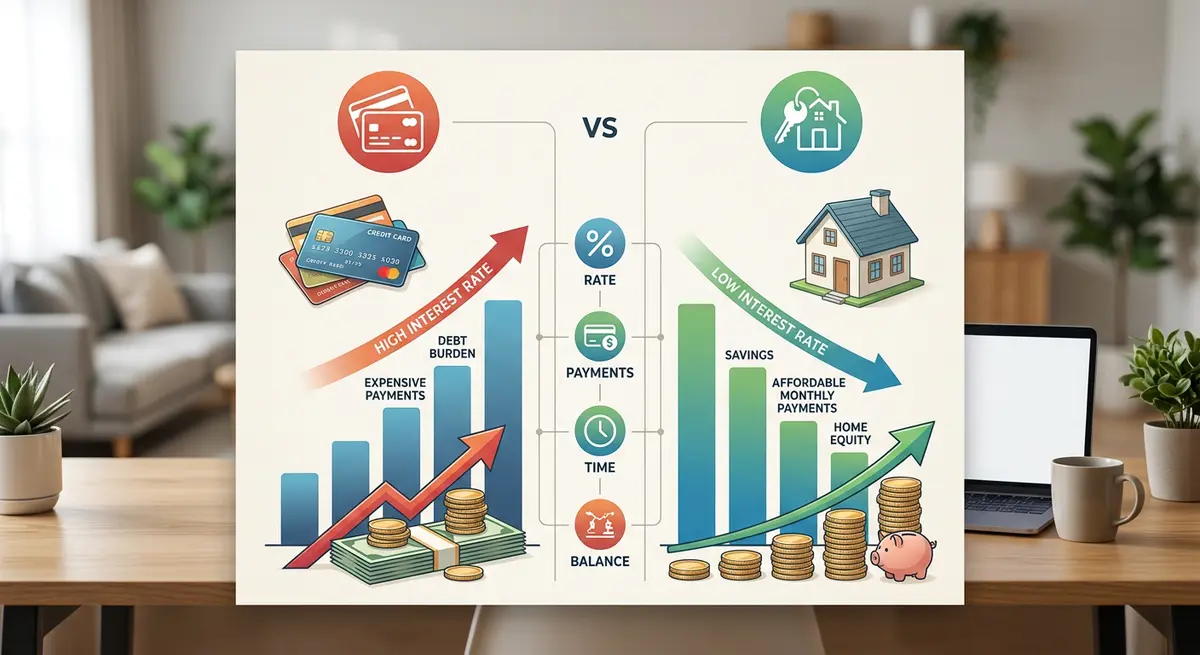
Many founders fund their startups using personal credit cards carrying 19% to 29% interest rates. Consolidating that revolving debt into a loan at 10% to 12% can save thousands of dollars in monthly cash flow, instantly extending your business’s operational runway.
Step-by-Step: The 2026 Application Process
To speed up the approval process with alternative lenders, you must present a professional, well-organized application package. Follow these specific steps to ensure a smooth funding process:
- Calculate Your Available Equity: Determine your home’s current 2026 market value and subtract your existing first mortgage balance. Lenders will typically fund up to 75% of the total value.
- Gather Business Documentation: You do not need audited financials, but you must prove your business exists. Collect your Articles of Incorporation, Trade Name Declaration, or GST registration number.
- Prepare Your Bank Statements: Provide 6 to 12 months of operating account statements showing consistent gross revenue deposits.
- Organize Property Details: Have a recent mortgage statement, a current property tax bill, and your home insurance policy ready. Reviewing a comprehensive document checklist beforehand prevents delays.
- Draft a Letter of Explanation: Write a brief, professional summary of your business model, your target clientele, and exactly how the loan proceeds will generate a return on investment (ROI) for your company.
Navigating Costs and Planning Your Exit Strategy
It is crucial to approach alternative financing with your eyes wide open. These products come with a premium. You are paying for the flexibility, the speed of funding, and the lack of standard income verification. Expect interest rates to range from 8% to 12% depending on your LTV and credit profile, alongside lender and brokerage setup fees.
However, sophisticated business owners calculate the Opportunity Cost. If borrowing $80,000 costs you $8,000 in interest and fees over a year, but allows you to execute a commercial contract yielding $60,000 in net profit, the financing is a highly profitable business investment.
Elena Rostova, an Alternative Lending Specialist, advises: “These loans are designed to be a bridge, not a permanent foundation. We structure them for 12 to 24 months. The most important part of the application is the exit strategy—how the borrower plans to transition back to prime lending.”
Common exit strategies include adjusting your tax strategy over the next two years to show higher net income for a prime refinance, using direct business profits to pay down the principal, or selling an investment property.
Edge Cases: Bruised Credit and Co-Borrowers
Even with asset-based lending, your credit score plays a role in the underwriting process. According to data from Equifax Canada, a strong credit score (680+) validates your financial responsibility, making lenders more comfortable with stated income claims. A lower score does not automatically disqualify you, but it may reduce the maximum LTV the lender offers (e.g., capping at 65% instead of 75%) or slightly increase the interest rate.
If your credit is severely bruised, or if you lack sufficient equity on your own, you might consider adding a co-signer. However, be aware of the legal implications and ensure all parties understand their liability. Furthermore, borrowers should know their rights; under provincial law, you have specific windows to legally rescind a high-interest private mortgage if the final terms differ from your initial agreement.
David Chen, a Calgary Real Estate Lawyer, emphasizes: “Always have independent legal counsel review alternative lending contracts. While these tools are incredibly useful for entrepreneurs, the default clauses and renewal fees require careful scrutiny before signing.”

Frequently Asked Questions (FAQ)
Are stated income loans legal in Alberta in 2026?
Yes. Stated income loans are entirely legitimate financial products offered by alternative and private lenders. They use different risk assessment models than federally regulated banks and are fully compliant with provincial real estate and lending regulations.
How much home equity do I need to qualify?
Typically, alternative lenders will lend up to 75% of your home’s appraised value. This means you must have at least 25% equity remaining in the property after the new loan is registered on the title.
Do I need to be an incorporated business?
No, incorporation is not strictly required. Sole proprietors and partnerships can also qualify, provided they have a valid municipal business license, proof of registration, and consistent bank statements showing business revenue.
Will the lender contact my clients to verify my income?
No. Alternative lenders respect your privacy and your professional relationships. They verify your business operations through public registries, your online presence, and your bank statements, never by directly contacting your customers.
Can I pay off the loan early if my business booms?
Most private mortgages have specific terms regarding prepayment privileges. Some are fully open after an initial three-to-six-month closed period, while others may charge a small penalty (typically three months of interest) for early payout. Always review the term sheet carefully.
Does this financing affect my current first mortgage?
No. Your first mortgage remains completely untouched, maintaining its current interest rate and amortization schedule. The new loan sits in second position on your property title, meaning you will simply make two separate payments each month.
What if I currently have tax arrears with the CRA?
You can still be approved. In fact, paying off CRA arrears is one of the most common uses for alternative home equity financing. The lender will simply require that the tax arrears be paid directly from the loan proceeds at closing to ensure any potential CRA liens are cleared.
Conclusion
For self-employed professionals in 2026, traditional banking metrics often fail to capture true financial health. Alternative financing bridges this gap, allowing entrepreneurs to leverage their hard-earned home equity to fuel business growth, manage cash flow, and optimize their tax strategies without the burden of rigid federal stress tests. By understanding the Reasonability Test, preparing meticulous documentation, and planning a clear exit strategy, you can transform your property into a powerful engine for commercial success. If you are a business owner looking to unlock your property’s potential, contact our team today to explore your financing options.