Business owners in Alberta with low taxable income can secure additional property financing in 2026 by bypassing traditional bank stress tests and utilizing alternative lending programs that evaluate gross business revenue, operating bank statements, and available home equity. Instead of relying solely on the net income reported on a Notice of Assessment (NOA), alternative lenders use an asset-based approach. This allows entrepreneurs to access their property’s equity without being penalized for utilizing legal, tax-efficient business deductions.
Key Takeaways
- Gross vs. Net Income: Alternative lenders evaluate your business’s gross revenue and actual cash flow, rather than the net income left after tax deductions.
- Stated Income Programs: Entrepreneurs can declare their true earnings if the figures align with industry standards and are supported by secondary evidence.
- Add-Back Strategies: Non-cash deductions, such as Capital Cost Allowance (CCA) and home office expenses, can be added back to your income to improve debt service ratios.
- Asset-Based Focus: Private lenders prioritize the Loan-to-Value (LTV) ratio of the physical real estate over traditional income verification metrics.
- CRA Arrears Resolution: Outstanding tax debts can be consolidated and paid directly through mortgage proceeds on closing day, removing government liens.
The Disconnect Between Tax Efficiency and Mortgage Underwriting
If you operate a business, you understand that tax season is a highly strategic exercise. You work closely with your accounting team to legally deduct expenses—such as fuel, home office costs, vehicle leases, and equipment depreciation—to lower your net income and reduce your tax liability with the Canada Revenue Agency (CRA). While this strategy is excellent for preserving operating capital, it creates a significant hurdle when applying for a traditional loan.
Major Tier 1 banks underwrite mortgages based on strict federal B-20 guidelines established by the Office of the Superintendent of Financial Institutions (OSFI). They look directly at Line 15000 of your Notice of Assessment. If your contracting business grossed $250,000 in 2026 but you wrote off $190,000 in eligible expenses, the bank assesses your income at just $60,000. In today’s economic climate, a $60,000 net income qualifies you for very little borrowing power. The bank perceives risk, whereas you have simply engineered financial efficiency.
“The traditional mortgage stress test disproportionately penalizes tax-efficient entrepreneurs. Asset-based lending bridges this critical gap by focusing on business liquidity and property equity rather than taxable net income.” — Dr. Robert Hughes, Senior Economist at the Canadian Financial Institute.
According to data from Statistics Canada, self-employed individuals make up approximately 15% of the national workforce, yet they face a mortgage rejection rate nearly double that of salaried employees at major financial institutions. Fortunately, securing additional financing does not require you to abandon your tax strategy or pay a massive, unnecessary tax bill.
How Alternative Lenders Evaluate Applications
The lending landscape in 2026 has evolved significantly to accommodate the gig economy and modern entrepreneurship. Private and alternative lenders (often referred to as B-lenders) utilize entirely different metrics to assess your ability to repay a loan. They recognize that a T1 General is a document designed for tax collection, not a comprehensive reflection of your financial health or operational cash flow.
To understand the fundamental differences in underwriting, consider how different institutions approach qualifying for home equity loans:
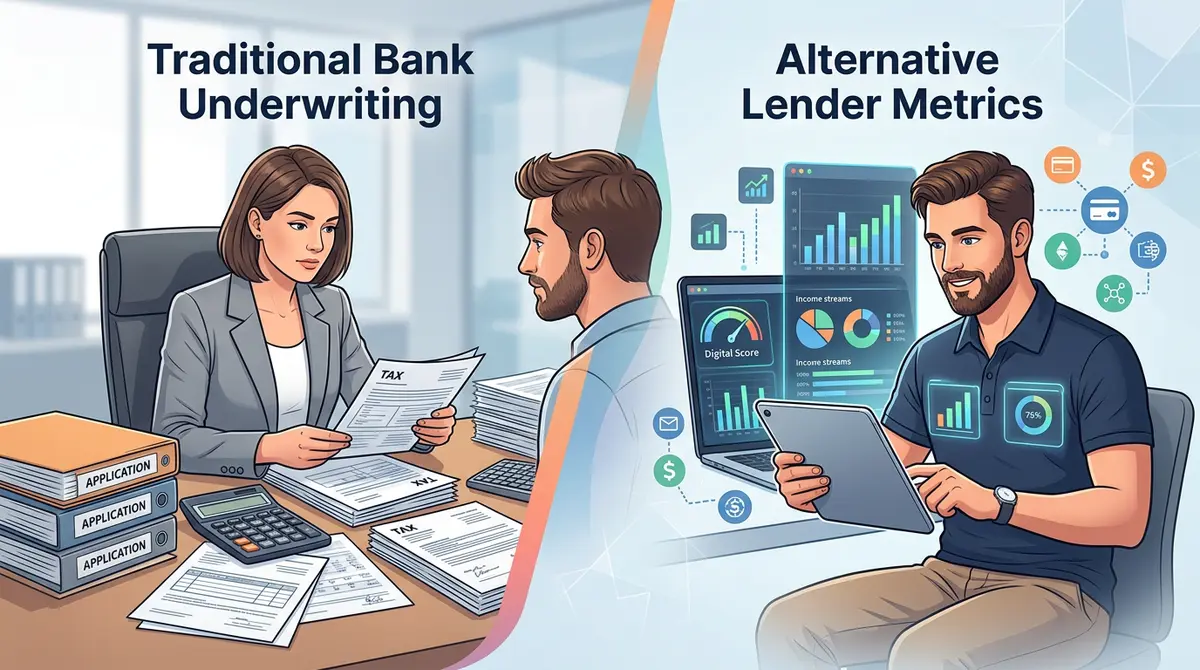
| Underwriting Metric | Traditional Banks (A-Lenders) | Alternative & Private Lenders |
|---|---|---|
| Income Verification | Strict reliance on NOA (Line 15000) | Gross revenue, bank statements, stated income |
| Primary Security | Borrower’s personal income and credit score | The physical equity in the property (LTV) |
| Expense Treatment | Deductions strictly reduce qualifying income | Non-cash deductions are frequently “added back” |
| CRA Arrears | Automatic decline until paid in full | Approved; arrears paid from mortgage proceeds |
Stated Income Programs and the Reasonability Test
For borrowers whose tax returns show exceptionally low net earnings, stated income financing options are a powerful financial tool. Under these specialized programs, you declare your actual annual income based on your business’s real-world cash flow. The lender then validates this claim using a standardized industry metric known as the Reasonability Test.
The reasonability test for self-employed income asks a simple but critical question: Does the stated income make logical sense for the borrower’s profession, experience level, and geographic location? For example, if you are a journeyman electrician with 10 years of experience, claiming an income of $120,000 in 2026 is entirely reasonable, even if your tax return shows a net income of $45,000 after heavy equipment write-offs.
Instead of relying on tax documents, the underwriter will request secondary evidence to confirm your industry standing. This typically includes your municipal business license, articles of incorporation, commercial insurance policies, or active client contracts. Lenders use these documents to verify self-employed income without penalizing your corporate tax strategy.
The Bank Statement Verification Method
If your tax returns are exceptionally complex or show a net operating loss, many equity-based lenders will bypass them entirely in favor of the Bank Statement Verification Method. This is currently one of the most popular ways business owners secure funding in 2026. Here is the exact step-by-step process lenders use to calculate your income via bank statements:
- Document Collection: You provide 6 to 12 months of consecutive PDF statements from your primary business operating account.
- Revenue Aggregation: The underwriter calculates the total business deposits over that period, strictly excluding transfers from personal accounts or previous loan deposits.
- Expense Factor Application: The lender applies a standard industry expense factor (usually between 30% and 50%) to estimate your true operating costs.
- Income Calculation: The remaining amount is annualized to determine your qualifying income.
For instance, if your business account shows average monthly deposits of $25,000, and the lender applies a 50% expense factor, your recognized monthly income is $12,500. This translates to a qualifying annual income of $150,000—a massive improvement over a $40,000 NOA. This method aligns with modern guidelines discussed by the Financial Consumer Agency of Canada regarding alternative income verification for self-employed Canadians.
Leveraging “Add-Backs” to Boost Qualifying Income
If you are working with an alternative B-lender that still requires tax returns, experienced mortgage brokers will utilize “add-backs” to artificially boost your qualifying income. This underwriting technique involves identifying expenses on your T1 General or T2 Corporate return that are non-cash or discretionary, and adding them back to your bottom line.
Common add-backs utilized by underwriters in 2026 include:
- Capital Cost Allowance (CCA): Depreciation is a paper loss on assets like heavy machinery or commercial vehicles. It does not represent actual cash leaving your bank account.
- Business-Use-of-Home Expenses: Writing off a percentage of your mortgage interest, property taxes, and utilities reduces your taxable income but is added back by lenders because these are existing personal housing expenses.
- Motor Vehicle Expenses: If your corporation pays for your personal truck, lenders recognize this as a personal benefit and add the lease or financing cost back to your income.
- One-Time Capital Expenditures: Large, non-recurring purchases (like a major server upgrade or office renovation) can be excluded from your standard operating expenses.
By applying these add-backs, a paper income of $40,000 can easily be adjusted to a qualifying income of $85,000, significantly improving your Gross Debt Service (GDS) and Total Debt Service (TDS) ratios.

Asset-Based Lending: The Private Mortgage Solution
When traditional and B-lender avenues are exhausted, private lenders offer the ultimate solution for business owners with complex financial paperwork. Private lenders operate on an asset-based lending model. Their primary security is the physical real estate, not your T4 slip or corporate tax return. If you have substantial equity in your property, a private lender is highly likely to overlook low taxable income.
In 2026, private lenders in Alberta typically lend up to 75% or 80% Loan-to-Value (LTV). For example, if your home is appraised at $800,000 and your first mortgage is $400,000, you have $400,000 in raw equity. A private lender will confidently extend a secondary loan based on that equity cushion. Because the underwriting process is streamlined, private mortgages are exceptionally fast.
Furthermore, borrowers should note that they have specific consumer protections. For instance, you have the ability to legally rescind a high-interest private loan under certain provincial regulations if you reconsider the terms within the mandatory cooling-off period.
Resolving CRA Tax Arrears with Home Equity
One of the most frequent reasons self-employed homeowners seek alternative financing is to pay off a looming tax bill. Owing money to the government creates a unique legal challenge. The CRA possesses “super priority” status, meaning they have the statutory right to register a lien against your property and seize assets ahead of other creditors.
Because of this super priority, traditional banks will automatically decline a mortgage application if your NOA shows outstanding tax arrears. They refuse to take a subordinate position to the federal government. Private lenders, however, are entirely comfortable mitigating this risk. They will approve your application despite the arrears, utilizing a strict legal condition: the closing lawyer must pay the CRA directly from the mortgage proceeds before releasing any remaining funds to you.
This strategy instantly clears your tax debt, stops compounding daily interest penalties, and removes the threat of a CRA lien. This specific utility is exactly why many financial advisors recommend leveraging home equity over an unsecured line of credit when dealing with large government debts.
Step-by-Step Document Checklist for Self-Employed Borrowers
Even when utilizing alternative verification methods, presenting a highly organized application significantly speeds up the funding process and can secure you a lower interest rate. Organizing your paperwork demonstrates to the underwriter that you are a professional, low-risk operator.
Ensure you have the following documents prepared for your 2026 application:
- T1 Generals & NOAs: The full personal tax return package for the last two years. Even if you show low income, lenders need the NOA to confirm whether you have undisclosed tax arrears.
- T2 Corporate Returns: If your business is incorporated, provide the last two years of corporate financial statements (Notice to Reader).
- Business License or Articles of Incorporation: Essential for proving legal ownership and the tenure of your business.
- Bank Statements: 6 to 12 months of business operating account statements in PDF format.
- Recent GST Returns: Often requested by alternative lenders to verify recent revenue trends and ensure your business is currently active.
For a more detailed breakdown of what to prepare and rules regarding the retention of financial documents, review our comprehensive document checklist to ensure you don’t miss any critical files.

Real-World Case Study: A Local Contractor’s Success
To illustrate how these strategies work in the 2026 market, consider the case of a local HVAC contractor. The contractor owned a home valued at $750,000 with a first mortgage of $350,000. He needed $100,000 to purchase new commercial equipment and hire two additional technicians. His gross business revenue was $320,000, but after aggressive deductions for vehicle fleets, material costs, and capital cost allowance, his NOA showed a net income of just $38,000.
His primary bank declined his application for a Home Equity Line of Credit (HELOC) due to high Debt Service Ratios. By working with a specialized broker familiar with financing for construction professionals, the contractor applied for a stated income loan. The alternative lender reviewed 6 months of his business bank statements, which verified consistent monthly deposits averaging $26,000.
Applying a 40% expense factor, the lender calculated his qualifying income at $187,200. The $100,000 loan was approved and funded within 8 days, allowing the contractor to expand his operations without altering his highly efficient tax strategy.
Frequently Asked Questions (FAQ)
Do private lenders always require tax returns in 2026?
No, many private lenders offer “no-doc” or “low-doc” mortgage products where the primary focus is entirely on the property’s equity. However, providing tax returns can sometimes help you negotiate a slightly lower interest rate or reduced lender fees by demonstrating financial transparency.
Can I get financing if I haven’t filed my taxes yet?
Yes, it is possible through alternative lending channels. A private lender will typically ask for your most recently filed return alongside 6 to 12 months of current business bank statements to bridge the gap and verify your ongoing cash flow.
What happens if my NOA shows a massive debt to the CRA?
This is a highly common scenario for self-employed individuals. A private lender will approve the loan specifically to consolidate that debt, instructing the closing lawyer to direct the necessary funds straight to the CRA to clear the arrears before releasing the rest to you.
Does my corporation’s retained earnings count for my personal mortgage?
For a traditional bank mortgage, accessing corporate retained earnings is complex and often requires you to pay yourself a taxable dividend. For a private or alternative mortgage, lenders view corporate retained earnings as your personal capital since you are the sole owner, making it much easier to qualify.
Will the mortgage lender share my stated income info with the CRA?
Absolutely not. Your mortgage application is strictly confidential. Under Canadian privacy laws, lenders do not report your application details, bank statements, or stated income claims to the Canada Revenue Agency.
Can I combine my T4 day-job income with my self-employed side business?
Yes, alternative lenders will allow you to combine multiple income streams. If you have a salaried position and a side business, both incomes can be utilized to lower your Debt Service Ratios and qualify you for a larger loan amount.
Conclusion
Having a low taxable income should not prevent you from leveraging the equity you have built in your home. By understanding the disconnect between tax efficiency and traditional bank underwriting, you can utilize alternative lending strategies—such as stated income programs, bank statement verification, and asset-based private lending—to secure the capital your business needs in 2026. If you are a self-employed homeowner struggling with strict bank stress tests or looming CRA arrears, there are viable, fast, and secure options available to you.
Ready to explore your equity options without dismantling your tax strategy? Contact us today to speak with an expert about alternative lending solutions tailored for entrepreneurs.