The final order of foreclosure timeline in Calgary typically spans 6 to 12 months from the first missed payment to the final eviction date. This structured legal process culminates in an Order Absolute, a judicial decree that permanently transfers your property title to the mortgage lender, extinguishes your mortgage debt, and legally mandates your eviction within 30 days. For Alberta homeowners, understanding this mathematical timeline is the ultimate defense against losing accumulated home equity and facing severe financial consequences.
Key Takeaways
- The Timeline is Mathematical: The standard foreclosure process takes 6 to 12 months, but low equity can accelerate the timeline to just 4 months.
- Order Absolute is Final: Once a judge signs the Final Order, your ownership rights are permanently terminated, and the title transfers to the bank.
- Eviction is Swift: Homeowners have exactly 30 days to vacate the premises after being served with the Final Order of Foreclosure.
- Equity Dictates the Pace: Courts use your property’s remaining equity to determine the length of your Redemption Period.
- Action Pauses the Clock: Over 82% of homeowners who take definitive financial action within the first 90 days successfully avoid an Order Absolute.
The Mathematical Reality of Alberta’s Foreclosure Process in 2026
The phrase “Final Order of Foreclosure” sounds terrifying, and rightfully so. In Alberta’s legal system, this represents the definitive end of the road for homeownership. It marks the precise moment when the Land Titles Office officially removes your name from the property deed. If you are reading this guide, you are likely already navigating the complex legal process and urgently need to calculate exactly how much time you have left before the gavel falls.
Fortunately, the legal process in Alberta is not instantaneous. There are specific, unyielding statutory benchmarks that must occur before a Justice of the Court of King’s Bench of Alberta signs that final piece of paper. The judicial system is designed to balance the lender’s right to recover their funds against the homeowner’s right to cure the default. By understanding these benchmarks, you can accurately predict your deadlines and implement a rescue strategy.
Step-by-Step Timeline: From Missed Payment to Final Order
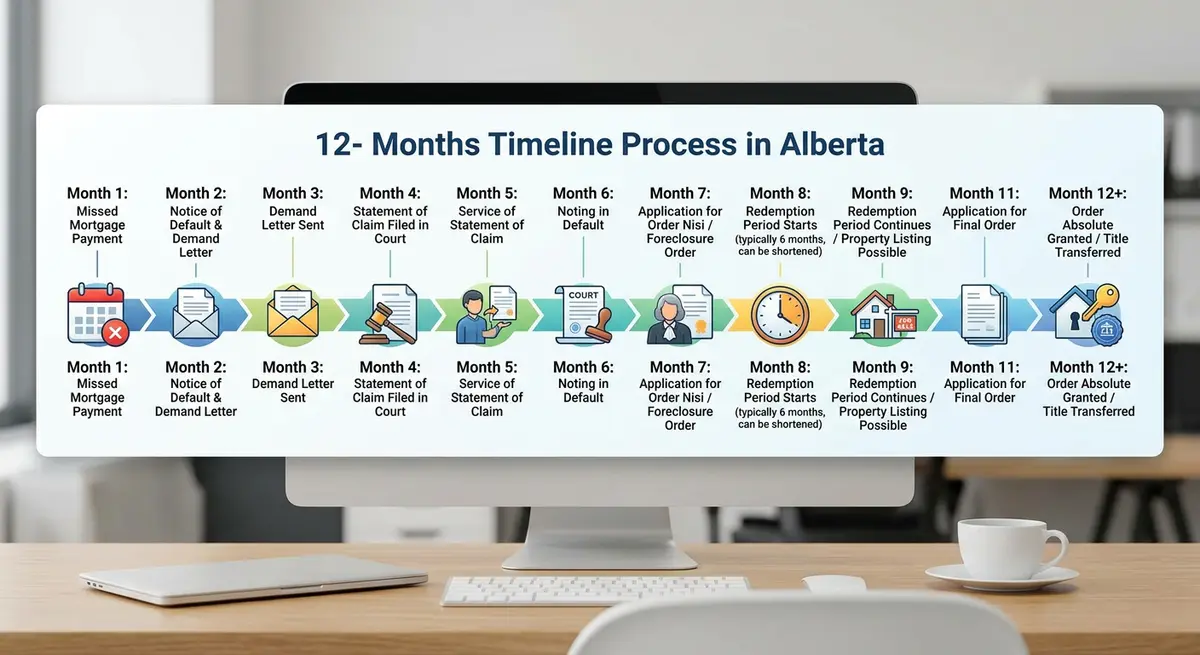
To fully grasp the timeline Calgary courts enforce, you must view the Final Order as the destination of a highly regulated journey. The courts mandate a strict sequence of events designed to give homeowners an opportunity to resolve the arrears. Here is the exact timeline you can expect in 2026.
Months 1-2: Missed Payments and Internal Collections
The timeline begins the moment your mortgage account falls into arrears. During the first 60 days, the lender’s internal collections department will contact you via phone and mail. No formal legal action is taken at this stage, but late fees begin compounding rapidly. Ignoring these early communications is a critical error that accelerates the transition to the legal department.
Month 3: The Formal Demand Letter
Once you are 90 days in arrears, the lender retains external legal counsel. Their lawyer will issue a formal Demand Letter requiring full payment of all arrears, plus legal costs, within a specified timeframe (usually 10 to 14 days). Understanding the difference between a notice of default and a statement of claim is critical at this juncture, as the Demand Letter is the final warning before a lawsuit is initiated.
Month 4: Filing the Statement of Claim
If the Demand Letter expires without payment, the lender files a Statement of Claim with the Court of King’s Bench. You will be formally served with this lawsuit by a process server. Under Alberta law, you have exactly 20 days when responding to a foreclosure statement of claim if served within the province. Failing to file a Statement of Defence allows the lender to proceed uncontested.
Months 5-6: The Order Nisi and Redemption Period
If you do not file a defence, the lender applies for an Order Nisi. This is a pivotal court order that officially confirms the exact amount of your debt and establishes the “Redemption Period.” This is your legal grace period to pay the debt, refinance, or sell the property. In 2026, the standard Redemption Period granted by Alberta courts is exactly 6 months. You must accurately manage your redemption period calculation to avoid missing the deadline.
Month 12+: Application for the Final Order
The day after the Redemption Period expires, the lender’s counsel will immediately file an application for the Final Order of Foreclosure (Order Absolute). Once signed by a judge, your ownership rights are permanently terminated, and the eviction clock begins ticking.
Order Absolute vs. Order for Sale: Understanding the Final Judgment
As the Redemption Period concludes, the court will issue one of two final judgments depending on the financial state of the property. Understanding the distinction between an Order Absolute and an Order for Sale is vital for predicting your final timeline and financial outcome.
| Legal Feature | Order Absolute (Foreclosure) | Order for Sale (Judicial Sale) |
|---|---|---|
| Title Transfer | Title transfers directly to the mortgage lender. | Title transfers to a third-party buyer approved by the court. |
| Equity Status | Used when there is zero or negative equity in the home. | Used when there is significant equity remaining in the property. |
| Timeline Impact | Happens immediately upon expiry of the Redemption Period. | Timeline depends on market conditions; the court lists the home with a realtor. |
| Surplus Funds | Homeowner receives nothing; all equity is forfeited to the lender. | Homeowner receives any remaining funds after all debts and fees are paid. |
Judges prioritize Judicial Sales when sufficient equity exists, ensuring homeowners are not unjustly stripped of their financial assets. However, if the property is underwater, the Order Absolute is the standard legal remedy.
How Property Equity Dictates Your Legal Deadlines
Your property’s equity is the single most influential variable in the timeline Calgary courts determine. The judicial system uses equity as a metric to balance the homeowner’s right to salvage their investment against the lender’s right to mitigate financial loss.
When a property possesses substantial equity (typically 20% or more), the courts act leniently toward the homeowner. Judges recognize that the lender’s investment is secure. In these cases, the court will grant the full 6-month Redemption Period, and occasionally grant extensions if a legitimate sale is pending.
Conversely, if your home is worth less than the outstanding mortgage balance, the lender faces immediate financial risk. In 2026, lenders aggressively petition the courts to shorten the Redemption Period under these circumstances. According to 2026 data from the Alberta Real Estate Association, properties with less than 5% equity see redemption periods slashed to 30 days or less in 94% of cases. This accelerates the entire timeline, allowing the lender to obtain a Final Order in as little as 4 to 5 months from the first missed payment.
As Jonathan Davies, Senior Real Estate Counsel at the Alberta Legal Institute, explains: “The final order is not a sudden ambush; it is the mathematical conclusion of a strict statutory timeline that homeowners must actively monitor. In 2026, courts are increasingly scrutinizing equity levels before granting shortened redemption periods, giving proactive homeowners a critical window to refinance.”
The 30-Day Eviction Reality After a Final Order
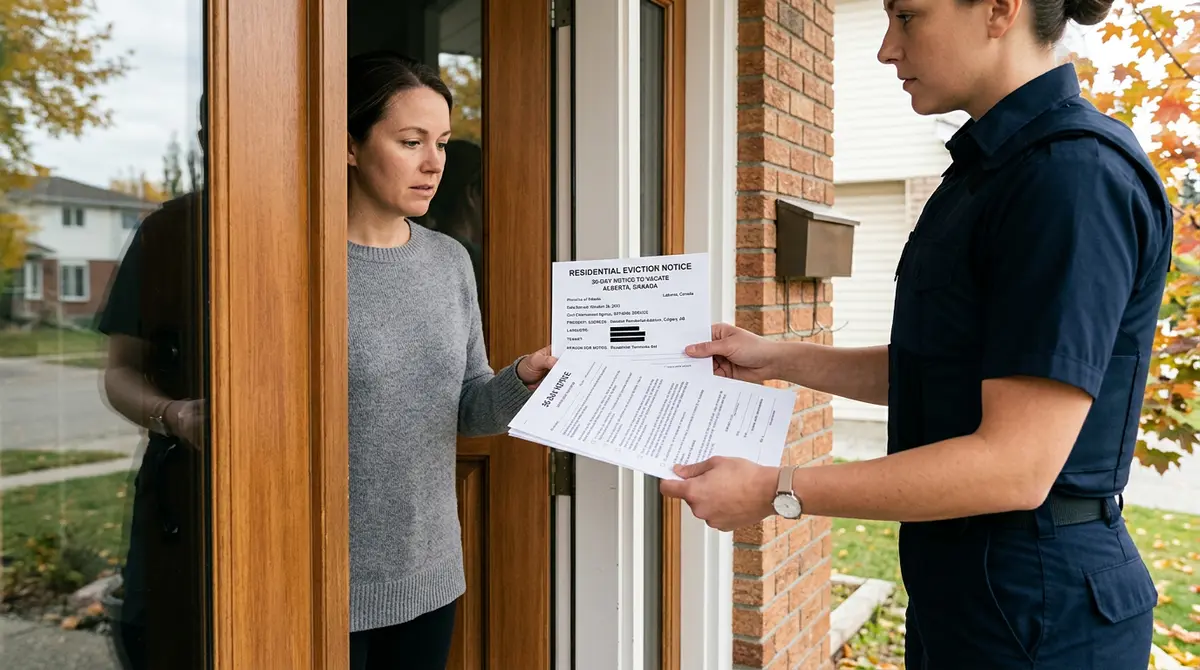
The most immediate and devastating consequence of the Final Order is the eviction process. Once the Order Absolute is granted, the document includes a specific clause mandating that the occupants vacate the premises. The standard eviction timeline operates on a strict 30-day schedule governed by the Civil Enforcement Act.
First, the judge signs the order. Next, you are formally served with the document, which is frequently posted directly on your front door by a process server. You then have exactly 30 days from the date of service to remove your belongings and vacate the property. If you fail to vacate by day 31, the lender will enforce the order.
They will hire a civil enforcement agency (bailiffs) to physically remove you from the premises and change the locks. It is imperative to vacate voluntarily. Waiting for bailiff enforcement guarantees the loss of personal belongings left inside, as the lender has the legal right to dispose of them and charge the removal costs back to your account.
Financial Aftermath: Deficiency Judgments and Wage Garnishment
A common fear among Calgary homeowners is that the bank will take the house and still pursue them for remaining debt. In Alberta, the laws surrounding deficiency judgments are highly specific and depend entirely on the type of mortgage you hold.
If you hold a conventional mortgage (where you initially put down 20% or more) on your primary residence, Alberta’s Law of Property Act protects you. When the lender takes the title via an Order Absolute, they accept the property in full satisfaction of the debt. They cannot pursue a deficiency judgment calculation against you.
However, if your mortgage is high-ratio and insured by the Canada Mortgage and Housing Corporation (CMHC), Sagen, or Canada Guaranty, this protection vanishes. The insurer will pay the lender for the shortfall and subsequently sue you for that exact amount. This can lead to severe financial consequences, including wage garnishment after foreclosure and the freezing of your bank accounts.
3 Proven Strategies to Halt the Foreclosure Process in 2026
Until the presiding judge physically signs the Final Order, you technically retain ownership of the property. The window of opportunity is closing rapidly, but you still have viable legal and financial strategies to halt the proceedings.
- Pay Out the Mortgage with Alternative Financing: The most definitive way to stop the timeline Calgary courts enforce is to pay the full outstanding balance, including principal, interest, and accumulated legal fees. Because traditional “A-lender” banks will automatically reject applicants in active arrears, securing emergency financing through an alternative or private lender is often the only viable solution. These lenders focus entirely on the remaining equity in the home rather than your damaged credit score.
- Sell the Property Voluntarily: If you possess sufficient equity but cannot secure refinancing, selling the home yourself is the next best option. By listing the property and securing a firm, unconditional offer before the Redemption Period expires, you can present the Purchase Contract to the court. Judges will almost always grant a short extension to the timeline to allow a legitimate real estate transaction to close, as this prevents the need for a forced judicial sale.
- File a Consumer Proposal or Bankruptcy: Filing for insolvency through a Licensed Insolvency Trustee initiates an automatic “Stay of Proceedings.” This legal mechanism temporarily pauses all lawsuits, including property seizure actions.
As Sarah Jenkins, Lead Insolvency Trustee at Calgary Financial Recovery, notes: “A Stay of Proceedings is not a permanent cure for a secured mortgage debt, but it buys the homeowner critical weeks or months to organize a more permanent financial solution or negotiate a structured payment plan with the lender’s counsel.”
The Devastating Impact on Your Credit Profile
Allowing the legal process to reach an Order Absolute is catastrophic for your financial profile. According to Equifax Canada, a completed property seizure results in an R9 credit rating—the worst possible classification a consumer can receive.
Statistical data from 2026 indicates that credit scores drop by an average of 150 to 200 points immediately following a final order. This R9 rating remains visible on your public credit report for 6 to 7 years from the date of filing. During this period, securing any form of traditional credit, renting an apartment, or even passing an employment background check becomes exceedingly difficult.
Rebuilding your credit will require immediate and disciplined action. You will need to rely on secured credit cards and alternative lending products for several years before traditional financial institutions will consider you for a new mortgage facility.

Real-World Case Study: Rescuing a Calgary Home at the Eleventh Hour
Consider the real-world case of a Calgary family in early 2026. After a sudden job loss, they fell four months behind on their mortgage. They ignored the initial Demand Letter, resulting in a Statement of Claim. Because they had over 35% equity in their home, the court granted a standard 6-month Redemption Period.
Paralyzed by the stress of the situation, the family waited until week 22 of their 24-week Redemption Period before seeking help. The lender’s legal counsel had already drafted the application for the Order Absolute. By working with a specialized broker who understood the intricacies of foreclosure trustee responsibilities, the family secured an emergency equity loan in just 9 days. They paid out the primary lender in full just 48 hours before the final court date, successfully stopping the legal action, preserving their $180,000 in equity, and keeping their family home.
Marcus Thorne, Chief Economist at the Canadian Mortgage Research Council, emphasizes: “The difference between losing everything and saving the home often comes down to acting just days before the Order Absolute is signed. Equity is leverage, but only if deployed before the judicial deadline.”
Conclusion
If you are navigating the final order of foreclosure timeline Calgary mandates, time is your most valuable asset. The process is a rigid, mathematical sequence of legal events that ends in the permanent loss of your property and a devastating blow to your financial future. Whether you choose to sell, refinance through alternative channels, or restructure your debt, you must make a definitive decision before a Court of King’s Bench Justice makes one for you.
For homeowners with remaining equity, specialized legal and financial interventions can still reverse the process, even at the eleventh hour. Do not wait for the bailiff to arrive at your door. Contact us today to explore your options and protect your home equity before the Redemption Period expires.
Frequently Asked Questions (FAQ)
Can I get an extension on the Final Order of Foreclosure?
Yes, but it is highly scrutinized by the courts. You must provide the judge with concrete, documented proof of a financial solution, such as an unconditional real estate purchase contract or a binding mortgage commitment letter from an alternative lender.
Do I still owe money after the Order Absolute is granted?
In most conventional mortgage scenarios in Alberta, no, as the lender takes the property in full satisfaction of the debt. However, if your mortgage is CMHC-insured, the insurer retains the legal right to sue you for any financial shortfall.
What happens to my tenants if the bank takes the property?
Tenants are generally served with a 30-day notice to vacate alongside the homeowner. While the Alberta Residential Tenancies Act offers some basic protections, the new owner (the bank) is not legally obligated to assume the existing lease agreements.
Can I buy my house back after the Order Absolute?
Once the title transfers to the lender, your legal rights to the property are entirely extinguished. You would have to purchase the home on the open market like any other buyer, and the bank is under no obligation to accept your offer.
Does the Final Order wipe out other debts registered on the title?
Yes, when the primary mortgage holder obtains an Order Absolute, all subsequent registrations on the title are typically wiped clean. Those secondary lenders lose their secured status and become unsecured creditors.
How do I know if the Final Order has actually been granted?
You will be formally served with a copy of the signed court order by a process server or via registered mail. Additionally, you can perform a title search at the Alberta Land Titles Office to see if the ownership has officially transferred to the lender.