A mortgage gift letter is a legally binding document required by Canadian lenders to verify that down payment funds provided by a family member are a genuine gift with no expectation of repayment. This critical piece of paperwork ensures the borrower’s debt service ratios remain accurate and complies with federal anti-money laundering regulations. In 2026, as property values continue to shift, over 42% of first-time homebuyers in Alberta rely on family assistance to bridge the gap between their savings and the minimum required down payment. Whether these funds come from a parent’s cash savings or are extracted via a home equity line of credit (HELOC), underwriters demand strict documentation before approving the file.
Key Takeaways
- Zero Repayment Obligation: The letter must explicitly state that the funds are a gift and no repayment is expected, protecting your debt-to-income ratios.
- Immediate Family Restriction: Lenders typically only accept down payment gifts from parents, grandparents, or siblings to prevent straw-buyer fraud schemes.
- Strict Paper Trail: You must provide corresponding bank statements showing the exact dollar amount leaving the donor’s account and entering yours.
- Equity Sourcing is Permitted: Parents can use borrowed funds (like a HELOC) to provide the gift, provided they qualify for that debt independently.
- Property Type Limits: Gifted down payments are generally restricted to primary residences and second homes, excluding investment properties.
The Anatomy of a Compliant Mortgage Gift Letter in 2026
A gift letter is not merely a polite note from your parents; it is a legal declaration scrutinized by underwriters and mortgage insurers like the Canada Mortgage and Housing Corporation (CMHC). If a single required field is missing, the lender will reject the document, potentially delaying your closing date.
To pass underwriting standards, the document must contain several non-negotiable data points. First, it requires the donor’s full legal name, current address, phone number, and their exact relationship to the borrower. Second, it must list the recipient’s name and the specific address of the property being purchased. Third, the exact dollar figure of the gift must be stated, and this number must match the accompanying bank deposits to the penny. Finally, the document must contain the “magic words” declaring that no repayment is required, followed by the signatures and dates of all parties involved.
“Precision is the most critical factor in mortgage documentation,” explains Sarah Jenkins, Chief Underwriter at the Canadian Mortgage Professionals Association. “If a gift letter states $50,000, but the bank statement shows a transfer of $49,985 due to wire fees, the file will be flagged for manual review until the discrepancy is resolved.”

Why Lenders Scrutinize “No Repayment” Clauses
The core reason lenders are pedantic about gift letters comes down to mathematical risk assessment. When you apply for a mortgage, the bank calculates your Total Debt Service (TDS) and Gross Debt Service (GDS) ratios. In Canada, the standard maximum limits are 39% for GDS and 44% for TDS. These ratios compare your gross household income against your monthly debt obligations.
If your parents provide you with $65,000 (the average family down payment gift in 2026) but secretly expect you to pay them back $400 a month, that transaction is legally a loan. That $400 monthly obligation must be factored into your TDS ratio. By signing a gift letter, your parents are legally confirming to the financial institution that there is no monthly payment. If they secretly expect repayment, you are misrepresenting your liabilities, which constitutes mortgage fraud.
Understanding how these ratios work is vital when verifying mortgage income and ensuring you qualify for the requested loan amount without breaching federal lending guidelines.
Acceptable Donors: Who Can Gift You a Down Payment?
Canadian anti-money laundering laws and mortgage underwriting guidelines strictly regulate who can provide a down payment gift. The acceptable donor list is intentionally short to mitigate the risk of “straw buyer” schemes, where a third party funds a purchase to hide the true owner’s identity.
Acceptable donors typically include:
- Parents or step-parents
- Grandparents
- Siblings
- Legal guardians
Friends, distant cousins, uncles, and employers are generally prohibited from providing gifted down payments for prime A-lender mortgages. If an unapproved individual wishes to help, they may need to gift the funds to your parent first, who then gifts them to you. However, this “re-gifting” creates a complex paper trail that underwriters will scrutinize heavily.
Sourcing the Funds: Using a Second Mortgage or HELOC
With the rising cost of living and shifting interest rates managed by the Bank of Canada, many parents do not have $100,000 in liquid cash sitting in a checking account. Instead, they leverage the equity in their own homes. It is incredibly common for parents to take out a HELOC or a secondary loan on their property to provide a lump sum to their children.
From the lender’s perspective, this is perfectly acceptable. The debt belongs entirely to the parents, and they are responsible for the monthly payments on that equity withdrawal. Once the funds are transferred to the child via a properly executed gift letter, the money becomes the child’s unencumbered equity. If you are exploring this route, understanding the mechanics of using a second mortgage for your down payment is essential for structuring the transaction correctly.
The Anti-Money Laundering (AML) Paper Trail
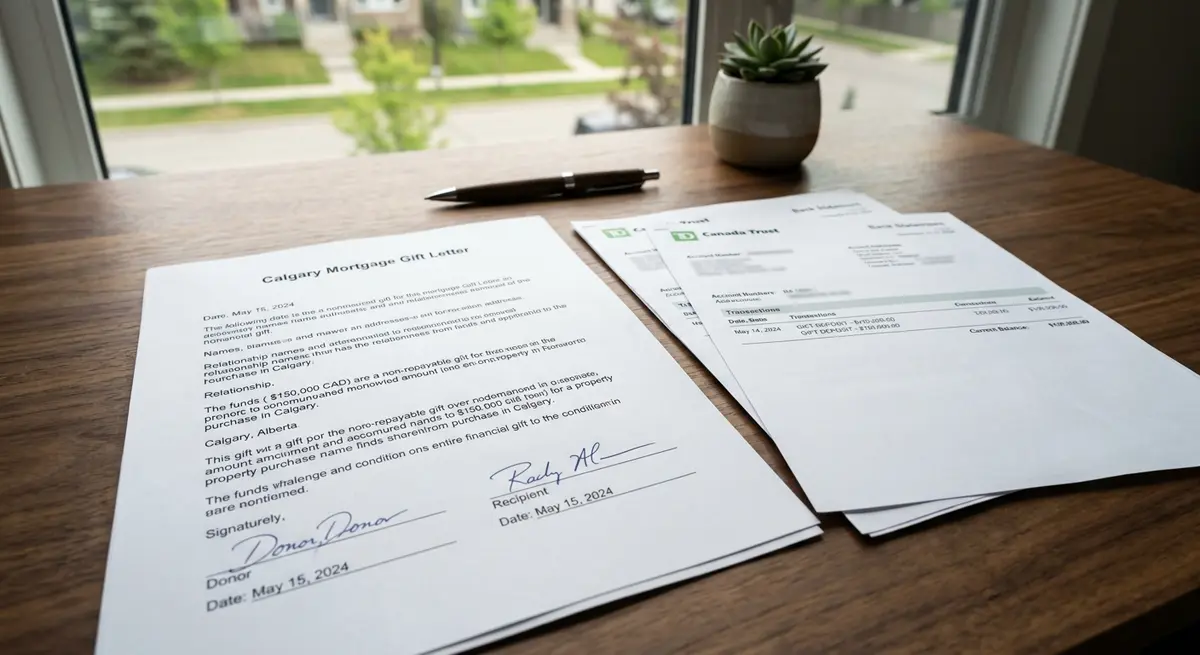
A signed letter is only the first half of the compliance equation. The Financial Transactions and Reports Analysis Centre of Canada (FINTRAC) requires lenders to verify the exact source of all large deposits to prevent money laundering. You must provide a flawless paper trail proving the money moved legally.
- Donor’s Proof of Withdrawal: You must supply a bank statement from your parents showing the exact gift amount leaving their account. If the funds came from a HELOC, a statement showing the draw from the credit line is required.
- The Transfer Mechanism: The funds should be moved via a traceable method, such as a wire transfer, bank draft, or certified cheque. Cash transfers are strictly prohibited.
- Recipient’s Proof of Deposit: You must provide a statement from your own bank account showing the exact matching amount arriving.
- Seasoning of Funds: If the money was transferred more than 90 days ago, it is generally considered “seasoned” and becomes part of your regular savings, though underwriters may still ask for a historical letter if the deposit was unusually large.
Gathering these documents early is a crucial part of organizing your mortgage paperwork to ensure a smooth underwriting process.
Property Type Restrictions
The rules governing gifted down payments change depending on the intended use of the property. Lenders view different property types through different risk lenses.
| Property Type | Gift Permitted? | Typical Down Payment Required | Lender Risk Assessment |
|---|---|---|---|
| Primary Residence | Yes | 5% to 20% | Low Risk. Family assistance is standard and widely accepted. |
| Second Home (Cottage) | Yes | 5% to 20% | Moderate Risk. Gifts are allowed but scrutinized more closely. |
| Investment Property | No (Generally) | 20% Minimum | High Risk. Investors are expected to use their own capital. |
If you are purchasing a rental property, you cannot typically rely on a gift letter. Lenders require investors to have their own “skin in the game.” If you are co-buying with family members instead of receiving a gift, you might consider using a parent to secure your mortgage as a co-signer or guarantor, which carries entirely different legal obligations.
The Legal Risks of Mortgage Fraud
It can be tempting to sign a gift letter to secure mortgage approval with the secret intention of paying your parents back later. Financial and legal experts strongly advise against this. According to David Chen, a real estate lawyer, “Falsifying a gift letter is a direct violation of the Criminal Code of Canada under mortgage fraud statutes. If discovered, the lender has the right to call the mortgage due immediately, forcing a rapid sale or foreclosure.”
Furthermore, in the event of a marital breakdown or personal bankruptcy, the courts will treat those funds exactly as the letter states: as a gift. Your parents would have no legal standing as creditors to reclaim their money, meaning their retirement savings could be lost in your divorce settlement or seized by a bankruptcy trustee. The distinction between a gift and borrowing from family must be legally clear from day one.

Standard Calgary Gift Letter Template
While many major banks have their own proprietary forms, the following template covers all standard requirements mandated by Alberta brokers and federal insurers. You can use this to draft your documentation for initial review.
GIFT LETTER
Date: [DD/MM/YYYY]
To: [Name of Lending Institution]
Re: [Address of Property Being Purchased]I/We, [Name of Donor(s)], hereby certify that I/we have given a gift of $[Exact Amount] to [Name of Recipient(s)], who is/are my [Relationship, e.g., Son/Daughter].
This gift is to be applied toward the purchase of the property located at: [Full Address of Calgary Property].
I/We certify that this is a bona fide gift and that there is no repayment expected or implied, either in the form of cash or future services. No part of this gift is being provided by any third party having an interest in the sale of the property (such as the seller, real estate agent, or builder).
Donor Information:
Name: [Donor Name]
Address: [Donor Address]
Phone: [Donor Phone Number]
Source of Funds: [e.g., Savings / Sale of Property / HELOC]Signatures:
___________________________ [Signature of Donor] Date: [Date]
___________________________ [Signature of Recipient] Date: [Date]
Always cross-reference this template with your specific mortgage document checklist provided by your broker to ensure no lender-specific addendums are missed.
Processing Times and Underwriting Verification
Once you submit the signed letter alongside the required 90-day banking history, the lender’s underwriting department will review the file. In 2026, standard processing times for gift verification range from 24 to 48 hours, assuming all documentation is legible and mathematically perfect.
Financial analyst Marcus Thorne notes, “The most common delay in mortgage funding isn’t credit scores; it’s mismatched AML documentation. If a parent transfers $50,000 from a joint account, but only one parent signs the gift letter, the underwriter will halt the file until an amended letter is provided.” To avoid these delays, ensure that if the donor funds originate from a joint account, all account holders are listed as donors on the letter.
If you are navigating complex family dynamics, such as adding a spouse to your loan while receiving a gift from only one side of the family, consult with your broker to ensure the letter is structured to protect the donor’s intent under Alberta’s family law regulations.
Frequently Asked Questions (FAQ)
Do I need a lawyer to notarize a mortgage gift letter in Alberta?
Generally, no. A standard witness signature is usually sufficient for most prime lenders. However, some alternative lenders or private institutions may request notarization to prevent fraud, though this remains rare in standard residential transactions.
Are down payment gifts taxable in Canada?
No, there is no “gift tax” in Canada. Your immediate family can give you any amount of cash tax-free. The Financial Consumer Agency of Canada confirms that genuine gifts do not trigger income tax liabilities for the recipient.
Can I use a gift letter for closing costs instead of the down payment?
Yes. Gifted funds can be applied toward the down payment, closing costs (such as legal fees and land transfer taxes), or even held as required cash reserves, provided the letter clearly states the total amount being gifted.
What happens if the gifted money is coming from an overseas account?
Funds can be gifted from foreign accounts, but the AML paper trail requirements are significantly stricter. You will need international wire transfer receipts and at least 90 days of translated bank statements from the foreign institution to prove the funds are legitimate.
Can I legally repay the gift to my parents years later?
You can choose to give money to your parents in the future as a separate, unrelated gift of your own free will. However, you cannot be legally obligated to do so at the time the mortgage is signed, nor can there be any written side agreements enforcing repayment.
Can I use cash received from a wedding as a down payment gift?
Yes, but you cannot use a standard gift letter for dozens of random wedding guests. You must deposit the cash into your bank account and wait 90 days for the funds to “season” into standard savings, or provide your marriage certificate and a detailed deposit log if the purchase is immediate.
Conclusion
A properly drafted gift letter is the key that unlocks homeownership for thousands of Albertans every year. It bridges the critical gap between family financial support and strict lender compliance. By ensuring your documentation explicitly states that no repayment is required, and by backing that claim with a crystal-clear banking paper trail, you can navigate the underwriting process with confidence. Remember that precision is paramount—matching exact dollar amounts and adhering to AML guidelines will prevent stressful delays as your closing date approaches. If you need assistance structuring your family’s equity transfer or verifying your documentation, contact our team today for expert guidance.