In the 2026 Calgary real estate market, having a parent back your second mortgage typically means they must become a registered co-borrower on your property title, rather than just signing as a traditional guarantor. This legal structure makes them 100% liable for the debt, exposes their personal assets to recovery actions, and directly impacts their credit score. Because of these severe financial implications, Alberta law and private lenders strictly require parents to obtain Independent Legal Advice (ILA) before any funds are released. Navigating this process requires a clear understanding of joint liability, estate planning, and a documented exit strategy to protect your family’s financial future.
Key Takeaways for 2026 Borrowers
- Title Registration is Mandatory: Over 85% of private lenders in Alberta require parents to be registered on the property title (usually as 1% owners) rather than acting as off-title guarantors.
- Total Asset Exposure: Parents are subject to joint and several liability, meaning the lender can pursue 100% of the debt from the parent’s assets if the primary borrower defaults.
- Credit Score Impact: The new mortgage will appear on the parent’s credit bureau, directly increasing their Total Debt Service (TDS) ratio and potentially hindering their own borrowing power.
- Independent Legal Advice (ILA): Lenders mandate that parents consult a separate, independent lawyer to sign an ILA certificate, costing between $350 and $600.
- Mandatory Exit Strategy: Families must establish a clear 12-to-24-month plan to refinance or sell the property to remove the parent from the financial obligation.
The 2026 Reality: Guarantor vs. Co-Borrower in Private Lending
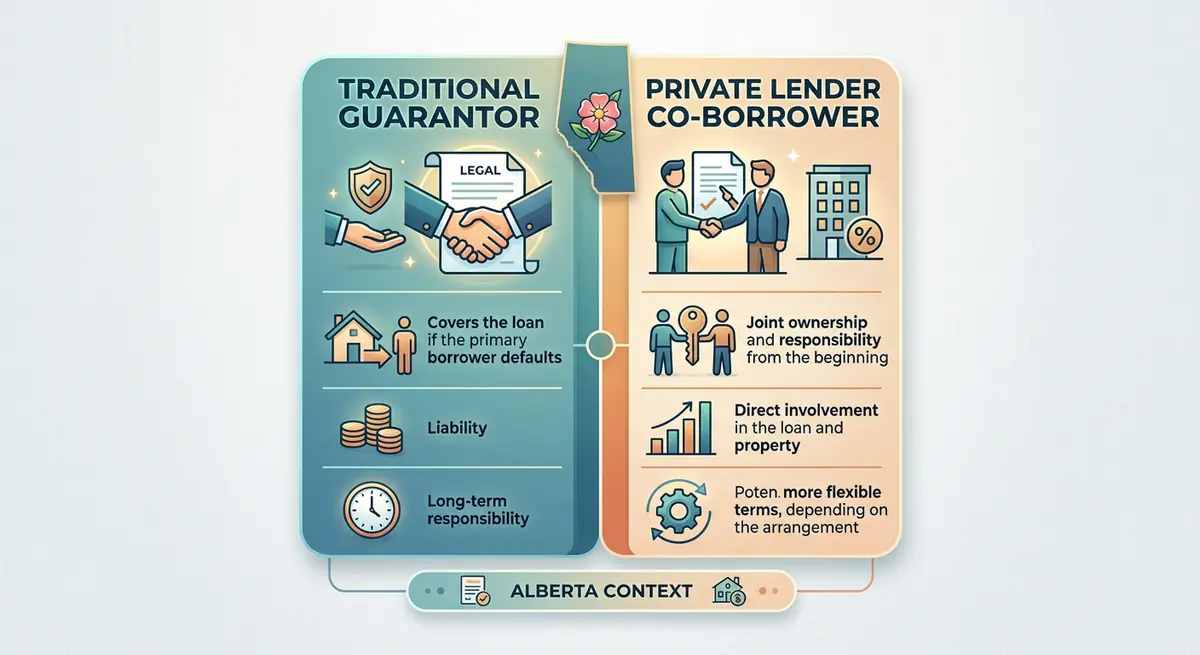
To understand the mechanics of family-assisted financing, you must first distinguish between the legal roles involved. In the traditional banking sector, a guarantor is an individual who signs a loan agreement promising to cover the payments if the primary borrower defaults. They support the application with their income and credit history but do not hold ownership rights to the property.
However, the landscape of alternative financing has shifted dramatically. In the 2026 private lending space—where the vast majority of secondary financing originates—true off-title guarantor arrangements are practically non-existent. Private equity lenders prioritize hard security and streamlined asset recovery over signature-based promises.
Consequently, lenders almost universally require the parent to be added to the property title as a co-borrower. This means the parent becomes a legal owner of the home and is jointly and severally liable for the entire encumbrance. For a deeper understanding of how these roles differ legally, the Financial Consumer Agency of Canada (FCAC) provides extensive guidelines on the responsibilities of joint debt.
| Feature | Traditional Guarantor | Private Lender Co-Borrower |
|---|---|---|
| Title Ownership | Not registered on title | Must be registered (e.g., 1% ownership) |
| Liability Level | Secondary (pursued after borrower) | Primary (Joint and Several Liability) |
| Credit Reporting | May not appear until default occurs | Appears immediately on credit bureau |
| Lender Preference | Prime Banks (A-Lenders) | Private Equity Lenders (B/C-Lenders) |
Why Calgary Private Lenders Demand Title Registration
Private lenders focus heavily on risk mitigation and collateral recovery. If a loan falls into arrears and legal action becomes necessary, it is significantly cleaner for the lender if all parties responsible for the debt are also registered owners of the collateral. This structure simplifies foreclosure proceedings and expedites the recovery of capital.
As Sarah Jenkins, Senior Underwriter at Alberta Private Lending, explains: “Private lenders prioritize hard equity over signature guarantees. If we have to initiate foreclosure proceedings, dealing with an off-title guarantor creates legal friction. By requiring the parent to be a co-borrower on title, we ensure all liable parties are directly tied to the collateral.”
Before asking a family member to sign any documents, it is vital to understand what happens to a guarantor when a mortgage defaults, as the consequences extend far beyond a simple credit downgrade.
The True Financial Risks for Parents
Parents often view signing a loan document as a temporary formality to help their child secure a property or consolidate debt. However, the legal and financial risks are substantial, tangible, and immediate. When a parent agrees to back a mortgage, they are legally stating that they will pay the full principal, interest, and legal fees if the primary borrower cannot.
According to 2026 data from the Canada Mortgage and Housing Corporation (CMHC), nearly 31% of alternative mortgages involve family co-signers, yet a significant portion of these families fail to grasp the long-term credit implications. This is not a partial responsibility based on ownership percentage; it is total liability.
If the child misses a payment, the lender will immediately contact the parent for restitution. If the loan goes into default, the parent’s credit score will suffer the exact same derogatory marks as the child’s. In a worst-case scenario where the property is sold under power of sale and there is a deficiency, the lender can sue the parent for the shortfall, putting their own home, investments, and retirement savings in jeopardy.
Impact on Retirement and Borrowing Power
Many parents in Calgary are either nearing retirement or actively living on fixed incomes. Taking on a new contingent liability can severely disrupt their financial planning. If they intend to downsize, purchase a vacation property, or co-sign for another child, this new debt will show up on their credit bureau as an active obligation.
Prime lenders and the Bank of Canada strictly cap Total Debt Service (TDS) ratios at 44% for conventional financing. Adding a $100,000 secondary loan to a parent’s credit profile can instantly push their TDS ratio over this regulatory limit, disqualifying them from securing their own future financing.
Estate Planning and Title Structuring in Alberta
If a parent must be added to the property title to secure the financing, the family must carefully decide how to structure that ownership. This decision has profound implications for estate planning and taxation.
- Joint Tenancy: Under this structure, if one owner passes away, their share automatically transfers to the surviving owner(s) through the right of survivorship. This is highly risky for parents who have multiple children, as it means their equity in the home would bypass their estate entirely and go directly to the child on the title.
- Tenants in Common: Owners hold specific, undivided percentages of the property (for example, the child owns 99%, and the parent owns 1%). If the parent passes away, their 1% share—and the associated debt liability—transfers to their estate to be distributed according to their will. This is the preferred structure for intergenerational financing to keep estate planning clean.
Furthermore, borrowers must consider provincial legislation. Depending on the living situation, you must determine if a spouse must consent to your mortgage under the Alberta Dower Act, which protects the rights of a legally married spouse to the matrimonial home.

Mandatory Independent Legal Advice (ILA)
In Alberta, the judicial system is fiercely protective of individuals taking on debt for the benefit of others, particularly elderly parents. There is a valid legal concern that a parent might be pressured, coerced, or “unduly influenced” by their child to sign binding financial documents they do not fully comprehend.
To mitigate this risk and ensure the contract is legally binding, lenders and title insurance companies strictly require Independent Legal Advice (ILA). According to David Chen, a Calgary-based real estate attorney: “Independent Legal Advice is not just a formality; it is a critical shield. It ensures the parent understands that they are risking their own financial security. Without a signed ILA certificate, the mortgage is essentially unenforceable in Alberta courts.”
This mandate dictates that the parents must meet with a different lawyer than the one representing the child or the lender. This independent counsel will review the commitment letter and standard charge terms in private, explaining the worst-case scenarios and confirming that the parents are signing voluntarily. In 2026, ILA consultations in Calgary average between $350 and $600. For more information on legal standards and public protection, the Law Society of Alberta offers extensive resources.
Step-by-Step: How to Apply with a Parent Co-Borrower in 2026
If you and your family have weighed the risks and decided to proceed, the application process requires meticulous organization. Private lenders focus heavily on the equity in the property and the financial strength of the co-borrower.
- Gather Comprehensive Documentation: Compile your parent’s government-issued IDs, proof of home ownership (such as a recent property tax bill or land title), and their most recent mortgage statements. You will also need your own income verification and property appraisal. Review a comprehensive second mortgage document checklist to ensure your submission is complete.
- Draft a Letter of Explanation (LOE): Provide the underwriter with a written explanation of why the funds are needed, how the parent is assisting, and exactly how the loan will be serviced and eventually repaid.
- Structure the Title: Work with your real estate lawyer to register the parent as a 1% Tenant in Common to protect their estate.
- Obtain the ILA Certificate: Schedule a private meeting for your parents with an independent solicitor to review the liability terms.
- Finalize the Exit Strategy: Document the exact timeline and financial milestones required to remove the parent from the loan within the term limit.
Structuring a Bulletproof Exit Strategy
Using family support to secure alternative financing should never be viewed as a permanent solution. It is a temporary financial bridge designed to overcome a specific hurdle, such as a low credit score, a recent consumer proposal, or a sudden need for capital. Before signing any documents, all parties must agree upon a documented exit strategy.
This strategy defines exactly when and how the parent will be absolved of their financial liability. Common exit strategies in the 2026 market include:
- Aggressive Refinancing: Once the primary borrower’s credit score improves or their verifiable income increases, they apply for a new conventional mortgage solely in their name to pay out the joint debt. This is the standard process for removing a co-borrower from the title.
- Selling the Property: The family agrees upfront to list and sell the property within a set timeframe (e.g., 24 months) to liquidate the equity and pay off the debt entirely.
- Strict Renewal Terms: Drafting a family agreement stating that if the primary borrower cannot qualify to refinance by the maturity date, the property will automatically be listed for sale. Having this written down prevents emotional family friction later.

Safer Alternatives to Co-Signing a Mortgage
If the total asset exposure and credit risks are deemed too high for your family’s comfort level, there are safer, legally cleaner alternatives to explore in the 2026 lending market.
1. The Gifted Down Payment
If parents have liquid cash available in savings or a TFSA, providing a direct financial gift is the cleanest option. They transfer the funds, sign a standardized document, and assume zero ongoing liability. To satisfy federal anti-money laundering (AML) regulations, you must ensure you follow the correct procedures for drafting a formal gift letter.
2. Personal Inter-Family Loans
Instead of involving a third-party private lender, parents can act as the bank. They can lend the money directly to the child and register a private mortgage in their own favor against the child’s property. This approach turns the parents into secured creditors rather than exposed co-borrowers. While borrowing directly from family carries relational risks, it protects the parents’ assets from external corporate lenders.
3. Co-Investment Partnerships
Parents can purchase a percentage of the home as a true investment partner. In this scenario, they share in the property’s market appreciation, contribute to the monthly payments, and treat the arrangement as a formal real estate joint venture rather than a favor.
Conclusion
Leveraging a parent’s financial strength to secure alternative financing is a powerful strategy to overcome strict banking regulations, but it permanently binds your financial fates together until the loan is discharged. It requires absolute transparency, strict legal safeguards like Independent Legal Advice, and a rock-solid exit strategy to ensure the parent’s retirement and credit remain protected.
By understanding the specific rules of the 2026 Calgary private lending market, you can utilize this strategy responsibly to achieve your real estate goals without fracturing your family’s financial foundation. If you are considering this route and need expert guidance on structuring the loan safely, get in touch with our team today to discuss your options.
Frequently Asked Questions (FAQ)
Can my parent guarantee my mortgage without going on title in Calgary?
In the prime banking world (A-lenders), this is sometimes possible for strong applicants. However, in the 2026 private lending market, it is exceptionally rare. Over 85% of private lenders require the supporting family member to be added to the property title as a co-borrower to ensure streamlined asset recovery in the event of default.
Will being a co-borrower affect my parent’s Old Age Security (OAS) or CPP?
No, acting as a co-borrower is a contingent debt liability, not a source of taxable income. It does not affect government pension benefits unless the parent is forced to pay the debt and must withdraw large sums from their RRSPs to do so, which would then trigger taxable income and potential OAS clawbacks.
Does my parent need to live in Alberta to support my application?
Not necessarily, but they must be a legal Canadian resident. Lenders prefer co-borrowers who hold verifiable, liquid assets within Canada. Out-of-province parents will still need to obtain Independent Legal Advice from a lawyer licensed in their respective home jurisdiction.
Can I remove my parent from the mortgage if I lose my job?
No. You can only remove a co-borrower by fully refinancing the loan or selling the property. To refinance, you must qualify entirely on your own financial merits. If you have lost your job, you will not pass the lender’s income stress test, meaning your parent must remain legally bound to the loan.
What exactly is a “Collateral Guarantee” or Inter-Alia Mortgage?
A collateral or inter-alia mortgage occurs when a parent uses their own home’s equity to secure your loan. The lender registers a legal encumbrance on both your house and your parent’s house. While this allows for higher borrowing amounts, it puts the parent’s primary residence at direct risk of foreclosure if you miss payments.
What happens if my parent passes away while on the mortgage?
This depends entirely on how the property title is structured. If held as Joint Tenants, the property ownership transfers to you, but the debt remains active. If held as Tenants in Common, their percentage of the property—and the associated debt liability—transfers to their estate, which must be settled during the probate process.