When property values decline while you carry multiple mortgages, you immediately face the risk of negative equity, a scenario where your combined loan balances exceed your home’s current market worth. This financial imbalance restricts your ability to refinance, freezes access to revolving credit lines, and triggers strict reassessments from subordinate lenders. Because secondary lienholders face heightened financial exposure during market downturns, they often impose demanding renewal terms or demand principal reductions to mitigate their risk. Addressing this situation requires proactive lender negotiation, aggressive principal repayment strategies, and a clear understanding of provincial foreclosure laws.
Key Takeaways
- Negative Equity Risks: Dropping property values can quickly push homeowners with multiple loans underwater, eliminating equity buffers.
- Refinancing Limitations: Lenders typically cap total borrowing at 80% of current appraised value, making refinancing impossible during severe downturns.
- Subordinate Lender Scrutiny: Secondary lienholders bear the highest risk and will aggressively monitor property valuations and payment histories.
- Legal Vulnerabilities: Alberta’s full recourse mortgage laws mean lenders can pursue your personal assets if a property sale doesn’t cover the outstanding debt.
- Proactive Solutions: Accelerating principal payments and restructuring debt hierarchies are proven methods to rebuild ownership stakes.
The Reality of Declining Property Values and Secondary Financing
Shifting economic winds continually reshape the real estate landscape across Canada. In early 2026, data from the Calgary Real Estate Board (CREB) highlighted a stabilization phase following a period of significant market correction. For homeowners carrying a single primary mortgage, a dip in property value is often a minor paper loss. However, for those managing multiple loans, this volatility creates immediate and tangible financial risks.
Subordinate loans rely entirely on the equity buffer established after the primary lender’s claim. When that buffer shrinks, your financial flexibility vanishes. High-ratio financing during market peaks leaves minimal room for error. If you purchased or borrowed heavily against your home when prices were at their zenith, even a 5% to 10% market correction can erase your ownership stake.
As Dr. Sarah Jenkins, Senior Economist at the Canadian Real Estate Research Institute, explains: “When secondary financing overlaps with a market correction, homeowners lose the equity buffer that traditionally protects against foreclosure. Subordinate lenders panic first, leading to frozen credit lines and aggressive collection postures.”
Understanding these market dynamics is the first step toward protecting your assets. You must evaluate whether current conditions reflect temporary local corrections or lasting macroeconomic adjustments. This assessment dictates whether you should wait out the storm or take immediate restructuring action.
Understanding Negative Equity and Underwater Mortgages
Negative equity, commonly referred to as an “underwater mortgage,” occurs when your outstanding debt surpasses the fair market value of your collateral. This mathematical reality fundamentally alters your relationship with your financial institutions.
Consider a practical example. Suppose your property was appraised at $600,000. You hold a primary mortgage of $400,000 and secured an additional loan of $100,000, bringing your total debt to $500,000. You previously held $100,000 in equity. If local market conditions drive your property’s value down to $480,000, your combined debt now exceeds your home’s worth by $20,000. You are officially underwater.
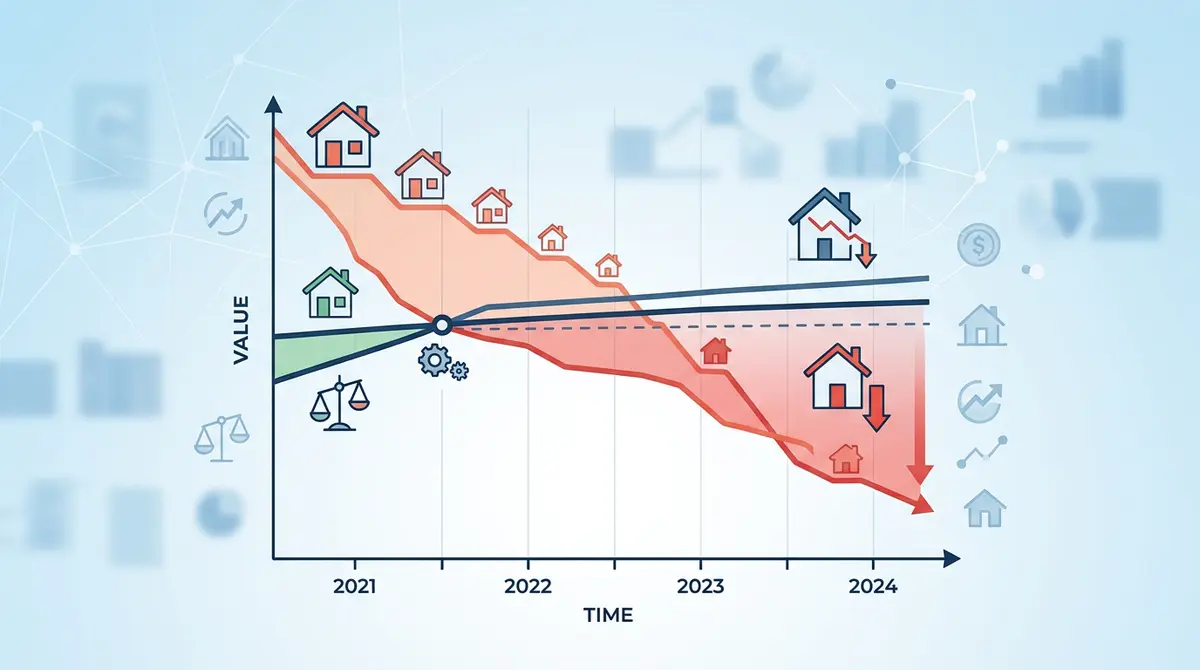
This imbalance creates severe operational constraints. Traditional financial institutions view negative equity as a critical default indicator. Consequently, your access to new credit lines becomes non-existent. Furthermore, if your loan term expires while you are underwater, you may face exorbitant renewal rates or outright refusal from your current lender.
To combat this, homeowners must explore aggressive principal reduction strategies. By directing surplus cash flow toward the loan principal, you manually rebuild the equity that the market erased. It requires disciplined budgeting but remains the most effective method for regaining financial control.
How Interest Rate Fluctuations Impact Your Mortgage Strategy
Property values do not exist in a vacuum; they are intrinsically linked to the cost of borrowing. The Bank of Canada utilizes interest rate adjustments to manage inflation, which directly impacts consumer purchasing power and, subsequently, housing demand.
When rates rise, higher interest costs create immediate challenges for variable-rate products. Your monthly obligations can jump significantly, squeezing household budgets. Conversely, fixed-rate loans offer temporary protection, but borrowers face severe payment shocks when their terms expire amid elevated rate environments.
It is crucial to understand how compounding frequency impacts your debt. Many alternative lending products compound interest monthly or even semi-monthly, accelerating debt accumulation during high-rate periods. When combined with dropping property values, high compounding frequencies can trap borrowers in an inescapable debt spiral.
HELOCs vs. Fixed Home Equity Loans During a Downturn
Accessing your home’s value typically involves one of two structures: a Home Equity Line of Credit (HELOC) or a fixed-term equity loan. Market declines affect these products differently, and understanding the distinction is vital for risk management.
HELOCs function as revolving credit secured by your property. Lenders typically allow borrowing up to 65% of the home’s appraised value. However, HELOC agreements contain clauses allowing the institution to reduce your credit limit or freeze the account entirely if the underlying asset depreciates. Fixed loans, on the other hand, provide a lump sum upfront with scheduled installment payments, offering more stability against sudden lender actions.
| Feature | HELOC (Revolving Credit) | Fixed Equity Loan |
|---|---|---|
| Interest Rate | Variable (fluctuates with prime rate) | Fixed for the duration of the term |
| Lender Response to Value Drop | May freeze or reduce available credit limit | Cannot alter the disbursed loan amount |
| Payment Structure | Interest-only options available | Fixed principal and interest installments |
| Risk Level in Downturn | High (vulnerable to immediate limit cuts) | Moderate (stable payments, but renewal risks) |
If you currently rely on a HELOC for operational cash flow, a sudden drop in property value could sever your financial lifeline. Transitioning to a fixed-term structure before valuations drop further can lock in your available capital and provide predictable repayment schedules.
Step-by-Step: What to Do When Your Home Value Drops
Financial crossroads require decisive, calculated action. If you suspect your property value has dipped below your combined loan balances, follow this systematic approach to protect your interests.
- Determine Your True Loan-to-Value (LTV) Ratio: Commission a professional appraisal or consult a local real estate agent for a comparative market analysis (CMA). Compare this precise valuation against your exact outstanding loan balances.
- Halt Discretionary Borrowing: Immediately stop drawing funds from any open credit lines secured by your home. Increasing your debt load while collateral value drops accelerates your path to insolvency.
- Initiate Proactive Lender Communication: Do not wait for a missed payment to speak with your financial institution. Lenders prefer borrowers who communicate early. Request a meeting to discuss term extensions or temporary payment modifications.
- Restructure Your Debt Hierarchy: Prioritize paying down the highest-interest subordinate loans first. Freeing up cash flow from expensive alternative debt provides breathing room to manage your primary obligations.

According to Marcus Thorne, a financial restructuring specialist: “Proactive communication with your subordinate lender is the single most effective strategy to prevent default proceedings during a valuation slump. Silence breeds suspicion, while transparency invites negotiation.”
Legal Risks: Foreclosure and Full Recourse Mortgages in Alberta
Navigating equity challenges requires a firm grasp of provincial legal frameworks. In Alberta, the distinction between recourse and non-recourse lending dictates your personal financial exposure during a market crash.
Most secondary financing agreements in the province are full recourse mortgages. This means that if you default and the lender forecloses, they can seize and sell the property. If the sale proceeds do not cover the outstanding loan balance—a certainty in negative equity scenarios—the lender can sue you personally for the difference, known as a deficiency judgment.
The legal timeline is strict. Upon missing payments, you will eventually face receiving a statement of claim. This formal legal document initiates the foreclosure process. The courts will determine specific foreclosure redemption periods, granting you a limited window to pay the arrears and halt the proceedings.
If you fail to redeem the mortgage, the court will issue a final order. Understanding the final order of foreclosure timeline is critical for planning your transition and protecting your remaining assets. During this phase, the foreclosure trustee responsibilities include managing the property sale and distributing the proceeds according to lien priority.
Alternative Solutions: Short Sales and Deed-in-Lieu
When traditional paths narrow and retaining the property becomes mathematically impossible, alternative exit strategies can mitigate long-term credit damage. Two primary options exist for underwater borrowers: short sales and deed-in-lieu of foreclosure.
A short sale occurs when you sell the property for less than the outstanding mortgage balance, with the explicit approval of all lienholders. The lenders agree to accept the proceeds as partial or full satisfaction of the debt. This process requires extensive documentation proving financial hardship, as outlined by the Financial Consumer Agency of Canada. While a short sale impacts your credit score, it is generally viewed more favorably than a formal foreclosure.
Alternatively, a deed-in-lieu involves voluntarily transferring the property title directly to the lender to satisfy the debt. This avoids the public spectacle and legal costs of a prolonged court battle. However, subordinate lenders rarely accept a deed-in-lieu if a primary mortgage still exists, as they would have to assume the primary debt to take title.

As Elena Rostova, Director of Risk Management at Alberta Lending Corp, notes: “Subordinate lienholders face the highest exposure during a downturn, which inevitably leads to stricter renewal terms. Borrowers must present comprehensive financial recovery plans to secure short sale approvals.”
Rebuilding Your Home Equity
If you choose to weather the market correction and retain your home, your primary focus must shift to aggressive equity rebuilding. Waiting for the market to naturally appreciate is a passive strategy fraught with risk. Instead, you must actively force equity growth through principal reduction.
Start by transitioning to an accelerated bi-weekly payment schedule. By making 26 half-payments a year, you effectively make one extra full monthly payment annually, applied directly to the principal. Additionally, utilize any annual prepayment privileges—often up to 15% or 20% of the original loan amount—using tax refunds, bonuses, or liquidated investments.
You should also explore cash-out refinancing alternatives once the market begins to recover. Consolidating high-interest subordinate debt into a single, lower-rate primary mortgage can drastically reduce your monthly carrying costs, accelerating your journey back to positive equity.
Frequently Asked Questions (FAQ)
What happens if my home value drops below my total mortgage balance?
You enter a state of negative equity, meaning you owe more than the property is worth. This restricts your ability to sell without bringing cash to closing and prevents you from refinancing or accessing new credit lines.
Can my lender demand immediate payment if my property value drops?
Generally, lenders cannot demand immediate full repayment solely due to a drop in property value as long as you continue making your scheduled payments. However, they can freeze revolving credit lines like HELOCs to prevent further borrowing.
Will a drop in home value affect my mortgage renewal?
Yes. If you have negative equity at the time of renewal, you are essentially trapped with your current lender. They may offer less favorable interest rates because you represent a higher risk, and you cannot shop the mortgage to other institutions.
What is a deficiency judgment in Alberta?
Because many secondary loans in Alberta are full recourse, a deficiency judgment allows a lender to sue you personally for the remaining loan balance if the foreclosure sale of your home does not generate enough money to cover the debt.
Should I continue paying my second mortgage if I am underwater?
Yes. Defaulting on any mortgage triggers severe credit damage and initiates foreclosure proceedings. Maintaining payments preserves your legal standing and keeps negotiation channels open with your lenders.
How long does it take for property values to recover?
Recovery timelines vary heavily based on macroeconomic factors, interest rates, and local employment data. According to historical data from the Canada Mortgage and Housing Corporation (CMHC), localized market corrections can take anywhere from 18 months to 5 years to fully rebound.
Conclusion
Experiencing a drop in property value while managing multiple loans is a stressful financial event, but it is not insurmountable. By understanding the mechanics of negative equity, recognizing the legal realities of full recourse lending, and implementing aggressive principal reduction strategies, you can protect your assets and navigate the 2026 market correction successfully. Proactive communication with your lenders and a disciplined approach to debt management are your strongest defenses against foreclosure. If you are struggling to manage your subordinate loans amid declining valuations, do not wait for the situation to escalate. Contact our team today to explore personalized debt restructuring and equity preservation strategies.