Cross collateralization occurs when a lender uses multiple properties to secure a single loan, meaning a single missed payment instantly jeopardizes your entire real estate portfolio. Instead of isolating financial exposure to one specific asset, this complex lending structure creates an interconnected web of debt where defaulting on a secondary investment property grants the lender the legal authority to foreclose on your primary residence. For property owners navigating the 2026 financial landscape, understanding how to identify and avoid these multi-property security agreements is the most critical step in long-term wealth preservation.
Key Takeaways: Protecting Your Real Estate Portfolio
- Risk Multiplication: Cross collateralization transforms isolated financial problems into portfolio-wide crises through aggressive cross-default clauses.
- Liquidity Loss: Blanket mortgages freeze your ability to sell or refinance individual properties without explicit lender permission and hefty payout demands.
- Market Vulnerability: Synchronized market downturns can trigger margin calls across your entire portfolio simultaneously.
- Legal Disadvantage: Lenders hold the discretionary power to choose which of your assets to liquidate first, almost always targeting your primary residence.
- Strategic Alternatives: Always prioritize sequential single-property loans or stated income products over multi-asset security agreements.
The Mechanics of Multi-Property Security Agreements
Cross collateralization, frequently referred to as a blanket mortgage in commercial and investment circles, is a financial mechanism where a borrower pledges two or more distinct assets as collateral for one consolidated loan. In the context of secondary financing, this typically happens when a homeowner lacks sufficient equity in their primary residence to secure the desired loan amount. To bridge the equity gap, the lender requires the borrower to attach a secondary property—such as a rental unit, a family cottage, or commercial real estate—to the exact same mortgage agreement.
According to the Bank of Canada‘s 2026 Financial System Review, approximately 14% of alternative lending portfolios now utilize some form of multi-asset security to mitigate institutional risk. While this structure allows borrowers to access larger sums of capital upfront, it fundamentally rewrites the traditional rules of property ownership and debt management.
The legal architecture of these loans relies heavily on “cross-default clauses.” A cross-default clause stipulates that a default on any single obligation automatically triggers a default across all connected assets. This grants the lender immediate enforcement rights over the entire portfolio, bypassing the standard protections afforded to single-property borrowers.
5 Critical Risks of Cross Collateralization for Homeowners
Entering into a multi-property security agreement without a comprehensive understanding of the downside is a recipe for financial disaster. Here are the five most severe risks that property owners face in 2026.
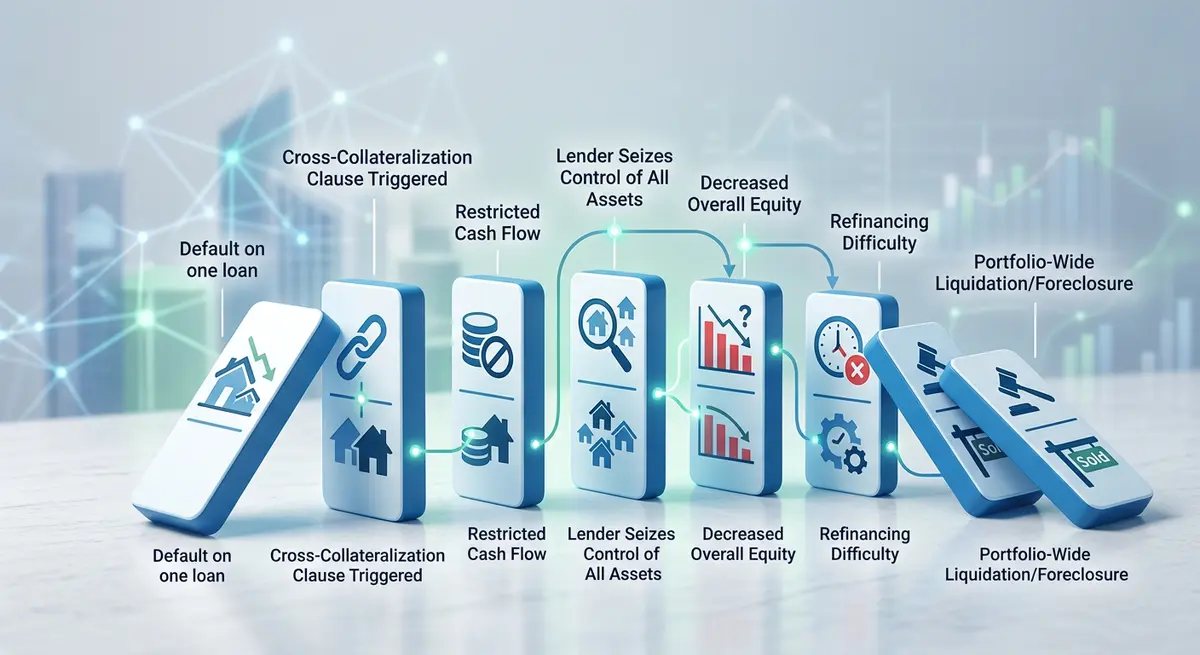
1. The Domino Effect of Cross-Default Clauses
The most devastating risk of cross collateralization is the amplification of loss. In a standard single-property mortgage, a financial hardship that leads to default only threatens the specific property tied to that loan. If you lose a rental property to foreclosure, your primary residence remains safe. Cross collateralization destroys this firewall.
If a tenant stops paying rent and you miss a payment on the blanket loan, the lender possesses the legal authority to initiate foreclosure proceedings on both the rental property and your family home simultaneously. Receiving a notice of default under these conditions creates a cascading financial crisis that is exceptionally difficult to stop, as the arrears are calculated against the massive combined principal.
2. Severe Restrictions on Property Liquidity
Real estate is traditionally an illiquid asset, but cross collateralization effectively freezes your entire portfolio. When multiple properties secure one loan, you lose the unilateral right to sell or refinance a single property. If you wish to sell a rental property to capitalize on a market peak, the lender must approve the sale and will typically demand that 100% of the net proceeds go toward paying down the blanket loan.
This requirement, known as a partial discharge, strips you of your financial flexibility. Research from the Canadian Mortgage and Housing Corporation (CMHC) indicates that properties tied up in blanket mortgages take 42% longer to sell due to these complex lender negotiations and discharge hurdles.
3. Complex Equity Calculations and Traps
Determining your true net worth becomes a mathematical labyrinth under a cross-collateralized agreement. Because the loan spans multiple assets, calculating the exact equity available in any single property requires complex formulas that account for the total debt load, varying interest rates, and shifting property values.
This complexity makes it nearly impossible to secure tertiary financing or home equity lines of credit (HELOCs) from other institutions. Furthermore, borrowers often misunderstand how compounding frequency impacts their total debt burden when applied to a massive, multi-property principal balance, leading to rapid equity erosion over the loan term.
4. Amplified Impact of Market Volatility
The real estate market is notoriously cyclical, heavily influenced by global economic trends and local industry shifts. In a standard mortgage setup, a localized dip in property values only affects the specific asset in that neighborhood. Cross collateralization multiplies this exposure exponentially.
If the market experiences a 10% correction, your entire portfolio’s loan-to-value (LTV) ratio spikes simultaneously. This synchronized decline frequently triggers margin calls or accelerated payment demands from private lenders who suddenly find their massive blanket loans under-collateralized.
5. Intricate Legal and Foreclosure Complications
The legal framework governing multi-asset loans heavily favors the lender. The security agreements grant lenders broad, discretionary powers to choose which assets to liquidate first during a default scenario. They will inevitably target the most liquid, highest-value asset—which is almost always your primary residence.
Navigating this legal minefield requires specialized counsel. Understanding foreclosure trustee responsibilities and how the courts handle multi-property seizures is mandatory for any borrower entering these agreements. Furthermore, if the forced sale of your properties does not cover the massive blanket debt, you face severe deficiency judgment calculations that can result in the garnishment of your future wages.
Single-Property Mortgages vs. Cross Collateralized Loans
To fully grasp the magnitude of these risks, borrowers must compare the structure directly against traditional single-property lending. The table below outlines the definitive differences in the 2026 lending environment.
| Financial Feature | Single-Property Mortgage | Cross Collateralized Loan |
|---|---|---|
| Default Impact | Isolated to the specific property securing the loan. | Triggers cross-default; all connected properties face immediate foreclosure. |
| Asset Liquidity | High. Owner can sell or refinance at will. | Low. Requires lender approval and partial discharge negotiations. |
| Equity Access | Straightforward calculation based on single asset value. | Complex. Equity is pooled, making secondary borrowing extremely difficult. |
| Legal Complexity | Standard provincial foreclosure protocols apply. | Highly complex. Lenders dictate the order of asset liquidation. |
| Market Risk | Contained to local neighborhood fluctuations. | Portfolio-wide exposure to macroeconomic downturns. |
How the 2026 Economic Climate Amplifies These Risks
The 2026 economic landscape presents unique challenges for real estate investors. With interest rates stabilizing at higher historical averages and local economies experiencing rapid diversification, property values are fluctuating at vastly different rates across various asset classes. This uneven growth exacerbates the dangers of interlinked assets.
According to a 2026 report by the Alberta Real Estate Association, portfolios with interlinked assets face a 28% higher risk of total liquidation during localized economic downturns compared to isolated portfolios.
As Marcus Thorne, Chief Economist at the Alberta Real Estate Board, explains: “Cross collateralization transforms an isolated financial hiccup into a systemic portfolio crisis. In the 2026 market, where a commercial property downtown might lose 5% of its value while a suburban residential home gains 3%, blanket mortgages create an accounting nightmare that almost always penalizes the borrower.”

Lenders are acutely aware of these market dynamics. Consequently, they are writing stricter covenants into their 2026 security agreements. Borrowers must ensure they have their mortgage document checklist perfectly organized and reviewed by a legal professional to identify predatory clauses before funding.
Step-by-Step: How to Identify Hidden Cross Collateralization Clauses
Many borrowers unknowingly sign cross-collateralized agreements because the terminology is buried deep within the legal boilerplate. Follow these exact steps to identify and evaluate these clauses in your mortgage contract:
- Demand the Full Security Agreement: Do not rely solely on the term sheet or the commitment letter. Request the comprehensive legal security agreement from your broker or lender at least five days before closing.
- Scan for “Cross-Default” Terminology: Use a digital search or carefully read the default section for terms like “cross-default,” “blanket security,” “portfolio collateral,” or “drag-along rights.”
- Review the Collateral Schedule: Examine the “Schedule A” or collateral appendix. If more than one property address, Vehicle Identification Number (VIN), or corporate asset is listed, you are entering a cross-collateralized agreement.
- Analyze the Discharge Terms: Locate the section detailing property sales. If the contract requires you to pay a “release fee” or mandates that 100% of sale proceeds go to the lender before a property is released from the lien, the loan is cross-collateralized.
- Consult a Real Estate Lawyer: Never sign a multi-asset security agreement without independent legal advice. A lawyer registered with the Law Society of Alberta will translate the exact liability you are assuming.
Real-World Case Study: The Hidden Cost of Blanket Mortgages
To understand the practical devastation of these risks, consider the 2026 case of a local entrepreneur who leveraged their home to save their business. The borrower owned a primary residence (valued at $1.2 million, mortgage-free) and a commercial retail space (valued at $800,000, with a $400,000 first mortgage).
Seeking $500,000 for business expansion, they approached a private lender. Instead of offering a standard loan on the commercial space, the lender required a cross-collateralized loan secured against both the commercial property and the primary residence. Six months later, a major infrastructure project blocked access to the retail space, causing business revenues to plummet. The borrower missed two mortgage payments.
Because of the cross-default clause, the lender immediately initiated foreclosure on both properties. The borrower attempted to sell the commercial space to pay off the debt, but the lender refused the partial discharge, demanding full repayment. Ultimately, the borrower was forced into a quiet title action and costly litigation just to save their family home, losing hundreds of thousands of dollars in equity in the process. This scenario highlights why isolating risk is paramount.
Strategic Alternatives to Protect Your Portfolio
Given the severe risks, property owners must explore alternative financing strategies that protect their portfolio’s integrity. The goal is to access capital without interlinking your assets.
- Sequential Single-Property Loans: Instead of one massive blanket loan, secure smaller, individual mortgages on separate properties. While this requires managing multiple payments and potentially paying slightly higher interest rates, it guarantees that a default on Property A has zero legal impact on Property B.
- Stated Income Mortgages: If the primary hurdle to securing a single-property loan is traditional income verification, business owners should explore stated income second mortgages. These products focus heavily on the property’s equity rather than the borrower’s T1 Generals, eliminating the lender’s demand for additional collateral.
- Mezzanine Financing: For larger portfolios, mezzanine debt provides capital based on the equity of the holding company rather than placing direct liens on individual physical properties. This preserves your ability to buy and sell individual assets freely.

How to Untangle a Cross Collateralized Portfolio
If you are currently trapped in a cross-collateralized agreement, immediate action is required to untangle your assets before a financial hardship occurs. The most effective exit strategy is a strategic refinance.
Work with a specialized mortgage broker to secure individual loans for each property from different lenders, using the combined funds to pay off the blanket mortgage in one lump sum. If refinancing the entire portfolio is impossible due to current interest rates, negotiate a partial discharge. This involves selling your weakest or most liquid asset and using the proceeds to pay down the blanket loan balance to a level where the lender agrees to release the lien on your primary residence.
Implementing aggressive principal reduction strategies is also crucial; the faster you lower the principal, the more leverage you have to demand the release of secondary collateral.
Conclusion
Cross collateralization represents one of the most significant threats to real estate wealth in 2026. By interlinking assets, borrowers surrender their liquidity, complicate their equity calculations, and expose their primary residences to the volatility of their investment properties. Understanding these mechanics and actively seeking single-property alternatives is the only way to ensure your real estate portfolio remains secure against unforeseen economic downturns. If you are currently navigating a complex multi-property loan or need help untangling a blanket mortgage, professional guidance is essential. Get in touch with our team today to explore your options and protect your assets.
Frequently Asked Questions (FAQ)
What is a cross-default clause in real estate?
A cross-default clause is a legal provision in a multi-property loan agreement stating that if a borrower defaults on one part of the loan or one specific property, they are automatically considered in default on all properties tied to that loan. This gives the lender the right to foreclose on the entire portfolio simultaneously.
Can a lender force the sale of my primary residence for a business loan?
Yes, if your primary residence was used as collateral alongside your business property in a cross-collateralized agreement. The lender has the discretionary power to choose which asset to liquidate first to recover their funds, and they often target the primary residence due to its high liquidity.
What is a partial discharge in a blanket mortgage?
A partial discharge occurs when a lender agrees to release their lien on one specific property within a blanket mortgage, usually because the borrower is selling that property. Lenders typically require a significant portion, or even 100%, of the sale proceeds to pay down the overall loan balance before granting the discharge.
Are cross collateralized loans harder to refinance?
Yes, they are significantly harder to refinance. Because the equity is pooled across multiple assets, you usually cannot refinance a single property without the blanket lender’s permission. You typically must refinance the entire portfolio at once to escape the agreement.
How do I know if my mortgage is cross collateralized?
You can identify a cross-collateralized mortgage by reviewing the “Schedule A” or collateral appendix of your security agreement. If more than one property address or asset is listed as security for the single loan amount, your assets are interlinked.
Is cross collateralization ever a good idea?
It can be useful for highly experienced commercial developers who need massive capital injections and have the cash flow to support the risk. However, for standard homeowners and small real estate investors, the risks of total portfolio loss almost always outweigh the benefits of easier initial loan approval.