To legally operate as a private mortgage lender in Alberta in 2026, applicants must register with either the Alberta Securities Commission (ASC) or the Real Estate Council of Alberta (RECA), demonstrate a minimum liquid capital of $50,000, secure at least $1 million in professional liability insurance, and pass comprehensive RCMP background checks. Furthermore, key personnel are required to complete approved educational programs and maintain strict ongoing compliance with provincial securities and consumer protection legislation. This comprehensive framework ensures that only well-capitalized, ethical entities can participate in the province’s secondary financing market.
Key Takeaways
- Registration with the ASC or RECA is mandatory for all private lending operations in Alberta.
- Minimum liquid capital requirements range from $50,000 to over $100,000, depending on the specific corporate structure.
- Lenders must maintain a minimum of $1 million in Errors and Omissions (E&O) insurance per occurrence.
- The standard application processing timeline spans 60 to 90 days through the National Registration Database.
- Licensees must complete 20 to 30 hours of continuing education annually to maintain active status.
- Strict adherence to the Consumer Protection Act regarding APR and compounding disclosures is heavily enforced.
The 2026 Regulatory Landscape for Alberta Private Lenders
The alternative lending market has experienced a 15% year-over-year growth in Western Canada, prompting provincial regulators to tighten oversight and modernize compliance frameworks. In Alberta, the regulatory environment for secondary financing is overseen by multiple governing bodies, primarily the Alberta Securities Commission (ASC) and the Real Estate Council of Alberta (RECA). These organizations operate with specific mandates to protect both investors and borrowers while ensuring broader market stability.
Under the current 2026 regulatory structure, private lenders typically fall under the category of Mortgage Investment Entities (MIEs) or Exempt Market Dealers (EMDs), depending on their specific business model and funding sources. This classification dictates the specific licensing prerequisites, ongoing obligations, and regulatory oversight that applies to each lending institution. Operating outside of these defined parameters carries severe legal and financial consequences.
“The landscape of alternative lending has matured significantly. Compliance is no longer a one-time hurdle but a continuous operational standard. The 2026 updates to provincial guidelines ensure that only well-capitalized, highly ethical entities can participate in the secondary mortgage market.” — Sarah Jenkins, Director of Compliance at the Alberta Financial Regulatory Board
Core Licensing Prerequisites: Education and Character
Navigating the regulatory framework requires meticulous preparation. The foundation of a successful application rests on educational qualifications and rigorous character assessments. Regulators recognize that effective mortgage lending requires comprehensive knowledge of financial principles, legal requirements, and consumer protection standards.
Minimum educational requirements typically include the completion of approved mortgage lending courses offered by recognized industry organizations such as Mortgage Professionals Canada. Key personnel must demonstrate relevant experience in financial services, risk assessment, and real estate law. For professionals looking to finance these mandatory qualifications, exploring options like leveraging home equity for professional licensing can provide the necessary upfront capital to launch their practice.
Beyond education, all individuals in significant roles—including directors, officers, and compliance managers—must undergo rigorous background checks. This includes criminal record searches via the RCMP, comprehensive credit bureau reports, and regulatory history verification across all Canadian jurisdictions. Any history of financial fraud, bankruptcy, or regulatory sanctions can result in immediate application denial.

Financial Thresholds: Capital and Insurance Mandates
Financial qualification standards are designed to ensure that licensed entities maintain sufficient capital reserves, operational funding, and risk management capabilities. These requirements reflect the significant financial responsibilities associated with alternative lending activities.
Liquid Capital: Applicants must demonstrate liquid capital ranging from $50,000 to $100,000. The exact figure depends heavily on whether the entity plans to lend personal funds, pool investor capital, or operate as an intermediary. This capital must be unencumbered and readily available for operational deployment.
Liability Insurance: Professional Errors and Omissions (E&O) insurance requirements mandate coverage levels sufficient to protect against potential claims of negligence or breach of fiduciary duty. Minimum coverage strictly requires $1 million per occurrence, with aggregate annual limits extending up to $5 million based on the firm’s projected business volume.
Surety Bonds: Bonding requirements may apply to specific license types, particularly those involving the management of investor funds or syndicated mortgages. These bonds act as a financial guarantee that the lender will comply with all provincial statutes.
“Meeting minimum capital thresholds is just the baseline. Regulators want to see robust financial health and a clear separation of operational funds from investor capital to prevent misappropriation.” — David Chen, Senior Partner at Chen & Associates Financial Law
Step-by-Step Application Process
The application process for prospective lenders involves multiple stages, extensive documentation requirements, and significant financial commitments. The entire process typically requires 60 to 90 days for completion, assuming all documentation is properly submitted without errors.
- Determine License Category: Assess your business model to determine if you require registration as an EMD, an MIE, or a restricted portfolio manager.
- Complete Educational Prerequisites: Ensure all key personnel have completed their mandatory licensing courses, passed the provincial exams, and obtained their certificates.
- Prepare the Business Plan: Draft a comprehensive business plan detailing proposed lending activities, target markets, maximum Loan-to-Value (LTV) limits, and internal risk management procedures.
- Compile Financial Documentation: Gather audited financial statements, proof of minimum liquid capital, and E&O insurance certificates from an approved provider.
- Submit Application and Fees: File the formal application through the National Registration Database (NRD). Application fees range from $2,500 to $15,000 depending on the corporate structure and the number of registered individuals.
- Undergo Regulatory Review: Respond promptly to any requests for additional information, clarification of business practices, or interviews from regulatory authorities.
Comparing Lending License Categories
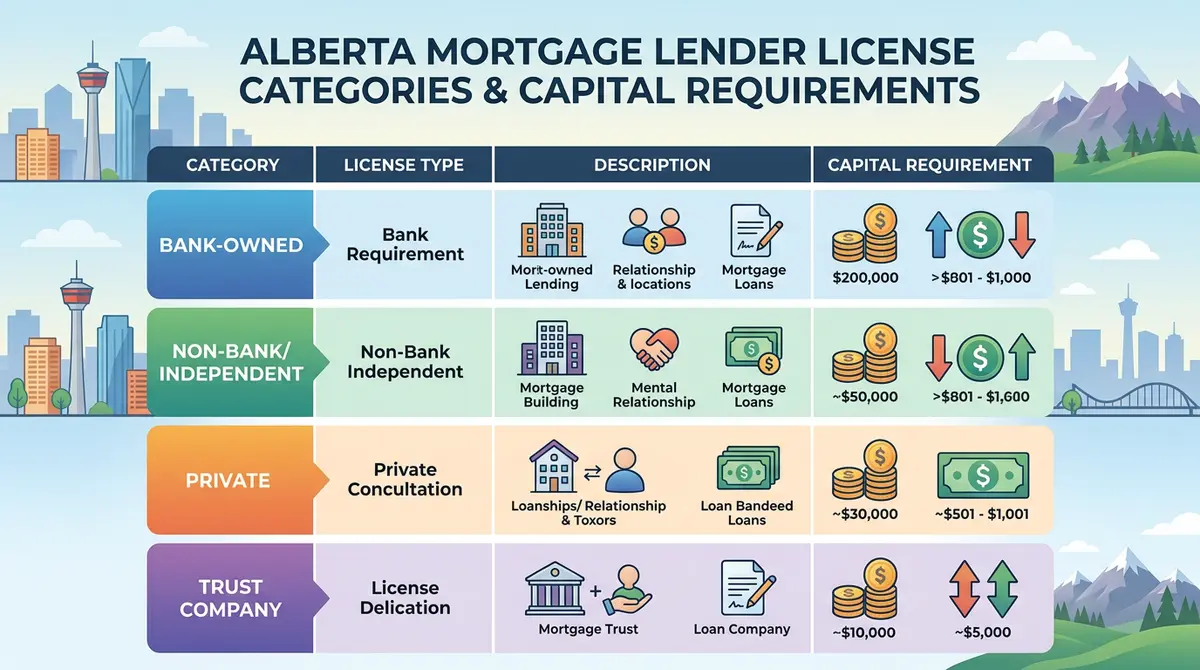
Understanding the distinctions between different lending structures is crucial for compliance. The regulatory burden scales with the complexity of the funding model. Below is a comparison of the primary operational models in Alberta for 2026.
| Requirement | Individual Private Lender | Mortgage Investment Corp (MIC) | Exempt Market Dealer (EMD) |
|---|---|---|---|
| Primary Oversight | RECA | ASC / CRA | ASC |
| Minimum Capital | $50,000 | $100,000+ | $50,000 (Working Capital) |
| Funding Source | Personal Funds | Pooled Investor Funds | Syndicated Investors |
| Audit Frequency | Random / Complaint-based | Annual Audited Statements | Annual Audited Statements |
| Complexity Level | Low to Moderate | High | Very High |
Ongoing Compliance and Regulatory Obligations
Licensed lenders face comprehensive ongoing compliance obligations that extend far beyond the initial approval. These obligations ensure continued adherence to regulatory standards and the protection of consumer interests. Failure to maintain these standards can result in immediate license suspension.
Record-Keeping and Reporting
Record-keeping obligations require the maintenance of detailed documentation for all lending transactions, client communications, and compliance activities. According to provincial standards, these records must be retained for a minimum of 7 years and must be readily available for regulatory inspection. Lenders must establish secure, encrypted protocols for document retention, aligning with the strict guidelines regarding how long to keep second mortgage documents to ensure audit readiness.
Regular reporting requirements include quarterly business activity reports, annual audited financial statements, and immediate notification of material changes to business operations, ownership structure, or key personnel.
Underwriting and Income Verification
Regulators expect private lenders to employ sound underwriting practices, even when dealing with alternative income sources or borrowers with bruised credit. When assessing borrowers, particularly entrepreneurs and gig-economy workers, lenders must apply rigorous standards to verify the capacity to repay. This involves utilizing the reasonability test for verifying self-employed income, ensuring that stated income aligns with industry norms, business bank statements, and tax assessments.
Consumer Protection and Disclosure Obligations
The Financial Consumer Agency of Canada (FCAC) and provincial bodies place heavy emphasis on transparency. Lenders must comply with strict disclosure requirements, fair lending practices, and standardized dispute resolution procedures.
“Consumer protection remains our highest priority. Lenders who fail to provide transparent cost-of-borrowing disclosures or who engage in predatory equity-stripping practices will face immediate license suspension and severe financial penalties.” — Marcus Thorne, Chief Investigator for Provincial Mortgage Standards
One critical area of compliance is the accurate disclosure of interest calculations. Lenders must clearly explain the Annual Percentage Rate (APR) and the specific compounding periods, as these drastically affect the total cost of the loan. Failing to disclose how compounding frequency silently increases debt is a direct violation of the Consumer Protection Act.
Additionally, lenders must strictly adhere to statutory cooling-off periods. In specific high-interest lending scenarios, borrowers have legal rights to cancel the agreement without penalty. Lenders must be intimately familiar with regulations such as the 4-day exception for rescinding high-interest private mortgages to avoid legal disputes and regulatory fines.
Enforcement Protocols and Legal Proceedings
A comprehensive understanding of licensing requirements also necessitates deep knowledge of enforcement procedures when a loan defaults. Licensed lenders must follow strict legal protocols when initiating recovery actions. Lenders cannot simply seize property; they must navigate the judicial foreclosure process mandated by the Alberta Law of Property Act.
This begins with understanding the critical legal distinction between a Notice of Default and a Statement of Claim. A Notice of Default serves as a formal warning, whereas a Statement of Claim initiates formal litigation. Furthermore, lenders often work with specialized legal professionals to manage the recovery process, requiring a deep understanding of foreclosure trustee responsibilities in Alberta to ensure all actions comply with provincial mandates and respect borrower rights.

Frequently Asked Questions
What is the minimum capital required to become a licensed private lender in Alberta?
In 2026, the minimum liquid capital requirement typically ranges from $50,000 to $100,000. This depends heavily on your specific business model, such as whether you are lending personal funds or operating as an Exempt Market Dealer managing syndicated investments.
How long does the mortgage lender licensing process take?
The standard processing time for a new licensing application through the National Registration Database is between 60 and 90 days. This timeline assumes that all financial documentation, business plans, and background checks are submitted accurately without requiring major revisions.
Do I need specific insurance to operate as a private lender?
Yes, all licensed lenders must carry professional Errors and Omissions (E&O) liability insurance. The regulatory minimum is $1 million per occurrence, though many corporate entities are required to carry up to $5 million based on their lending volume.
What are the continuing education requirements for Alberta lenders?
Licensed mortgage professionals must complete 20 to 30 hours of approved continuing education annually. These courses focus on updates to provincial regulations, ethical lending practices, and advanced risk management strategies.
Can a license be revoked for failing to disclose compounding interest?
Absolutely. Failing to provide transparent cost-of-borrowing disclosures, including accurate Annual Percentage Rates and compounding frequencies, violates the Consumer Protection Act. This can lead to immediate regulatory audits, hefty fines, and potential license revocation.
How often are licensed mortgage entities audited in Alberta?
Mortgage Investment Corporations (MICs) and Exempt Market Dealers (EMDs) must submit audited financial statements annually. Additionally, the Alberta Securities Commission conducts random and complaint-based compliance reviews throughout the year.
Are Alberta’s licensing requirements different from Ontario’s?
Yes, while there are similarities, Alberta’s framework is uniquely governed by the ASC and RECA, whereas Ontario relies on the Financial Services Regulatory Authority (FSRA). Alberta has specific exemptions and capital adequacy rules tailored to its distinct real estate and energy-driven economic landscape.
Conclusion
Entering the alternative lending market in Alberta requires a significant commitment to regulatory compliance, financial stability, and ethical business practices. The 2026 framework established by the ASC and RECA ensures that the market remains robust and that consumers are protected from predatory practices. From securing the initial $50,000 in liquid capital to maintaining rigorous 7-year record-keeping protocols, successful lenders must integrate compliance into every facet of their operations.
If you are navigating the complexities of secondary financing, whether as a prospective lender or a borrower seeking alternative solutions, professional guidance is essential. Contact us today to speak with our experts and ensure your financial strategies align with Alberta’s current regulatory standards.