To successfully sell your house before foreclosure in Calgary, you must list the property immediately during the court-ordered redemption period, price it 5% to 10% below current market value, and work with a specialized distressed-property real estate team. By executing a rapid sale before the court issues a Final Order of Foreclosure, you can pay off your mortgage arrears in full, protect your credit score from a catastrophic 150-point drop, and retain your remaining home equity. Time is your most valuable asset, and understanding Alberta’s judicial foreclosure process is the absolute key to maintaining control over your financial future.
Key Takeaways for Calgary Homeowners in 2026
- Act Immediately: The Alberta judicial foreclosure process takes time, but waiting limits your options and drains your equity through mounting legal fees.
- Understand the Timeline: You typically have a 6-month redemption period after a court order to sell the property or pay the arrears.
- Price Strategically: Overpricing is the most common mistake. Price 5% to 10% below market value to trigger a rapid sale.
- Explore Alternative Buyers: Cash buyers and real estate investors can close in 7 to 21 days, bypassing traditional financing delays.
- Communicate with Lenders: Transparency can often secure forbearance or extended deadlines, giving you crucial breathing room.
- Seek Legal Counsel: Always file a Statement of Defence or Demand for Notice to stay informed of court proceedings.
Understanding the 2026 Alberta Judicial Foreclosure Timeline
Unlike provinces that utilize a rapid power of sale, Alberta operates under a strict judicial foreclosure system. This means your lender must go through the provincial court system to seize your property. While this process is highly bureaucratic, it inherently provides homeowners with a vital window of opportunity to liquidate the asset on their own terms.
The timeline begins the moment you miss a mortgage payment. Most lenders will spend the first 30 to 60 days sending internal notices and attempting to establish a repayment plan. According to the Financial Consumer Agency of Canada, federally regulated lenders are required to communicate clearly with borrowers and explore alternative options before escalating to legal action. However, once you reach 90 days of delinquency, the lender will typically file a formal legal document with the Alberta Court of King’s Bench.
Understanding the difference between a Notice of Default and a Statement of Claim is critical for your survival strategy. The Statement of Claim officially starts the legal clock, giving you exactly 20 days to file a Statement of Defence. Even if you do not contest the foreclosure, the court will eventually issue a redemption order. Accurately calculating your exact redemption period is essential, as this standard 6-month window is your primary opportunity to list and sell the home on the open market.

Step-by-Step: Executing a Pre-Foreclosure Sale
Successfully navigating a distressed sale requires a highly methodical approach. Panic often leads to poor financial decisions, whereas a structured plan maximizes your retained equity. Follow these definitive steps to execute a rapid and profitable sale in the 2026 market.
- Calculate Your Total Debt: Request an official payout statement from your lender. This document must include the principal balance, accrued interest, missed payments, and all accumulated legal fees to date.
- Determine Realistic Market Value: Obtain a Comparative Market Analysis (CMA) from a realtor who specializes in distressed properties. Focus strictly on comparable homes that successfully sold within the last 30 days, ignoring active listings.
- Assess Your Equity Position: Subtract your total debt and estimated closing costs (realtor commissions, legal fees) from the realistic market value. If the resulting number is positive, you have tangible equity to protect.
- Select a Sales Strategy: Decide between a traditional MLS listing, a direct sale to a cash buyer, or an auction based on your remaining court timeline.
- Execute and Close: Accept an offer with minimal contingencies. Use the sale proceeds to pay off the mortgage and any registered liens, keeping the remaining balance for your fresh start.
As Sarah Jenkins, Senior Foreclosure Analyst at the Alberta Real Estate Board, explains: “Time is the ultimate currency in pre-foreclosure. Listing your property within the first 30 days of a missed payment increases your chance of preserving equity by 85%.”
Pricing Strategies to Trigger a Rapid Sale
When you are racing against the court, traditional real estate pricing models simply do not apply. Your primary objective is speed, not necessarily extracting the absolute maximum dollar amount. Overpricing a distressed property is a fatal error that results in the home sitting stagnant while the lender’s legal fees consume your remaining equity.
In the 2026 Calgary real estate market, properties priced 5% to 7% below current market value sell 42% faster than those priced at exact market value. This slight, strategic discount acts as a magnet for buyers and investors, often triggering multiple offer scenarios. In highly desirable neighborhoods, bidding wars can actually drive the final sale price back up to fair market value.
You must also factor in the physical condition of your home. If you lack the capital for repairs, you must price the home aggressively to reflect its “as-is” condition. Buyers purchasing distressed properties expect a discount in exchange for taking on deferred maintenance. Transparency regarding the home’s condition prevents deals from falling apart during the critical inspection phase, ensuring you meet your Final Order of Foreclosure timeline.
Comparing Fast-Sale Options in Calgary
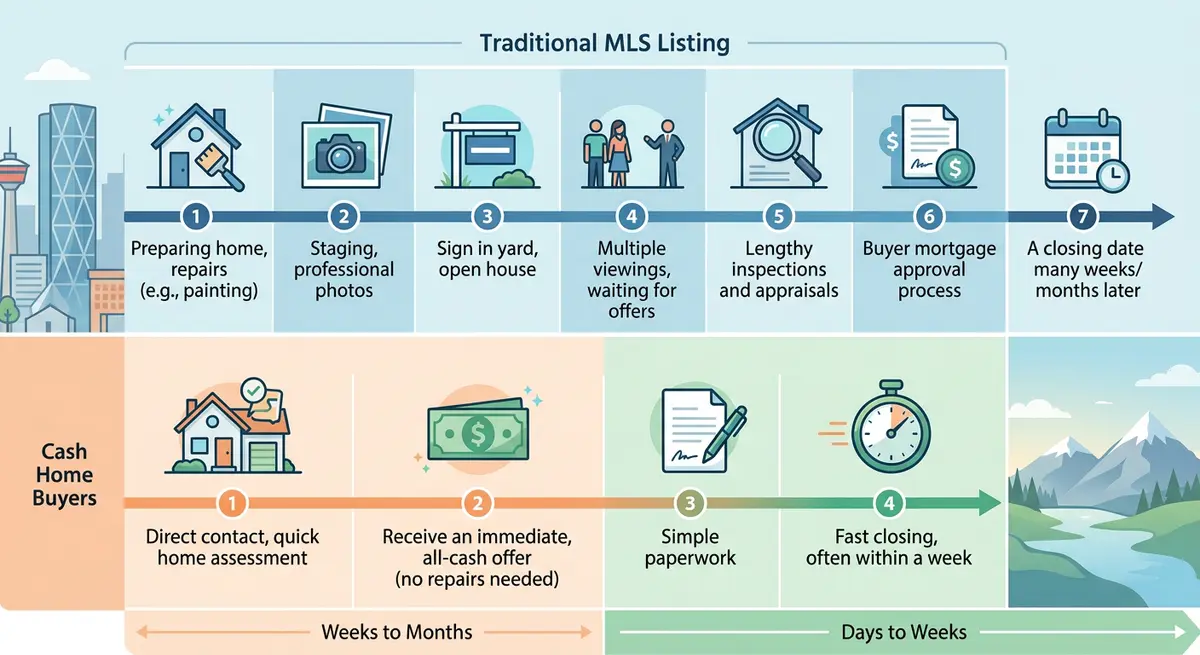
Homeowners facing foreclosure have three primary avenues for selling their property. Each method balances speed, convenience, and final sale price differently. Reviewing these options ensures you select the path that aligns with your specific court deadlines.
| Selling Method | Average Timeline | Expected Sale Price | Best Suited For… |
|---|---|---|---|
| Traditional MLS Listing | 30 – 90 Days | 95% – 100% of Market Value | Homeowners in the early stages of pre-foreclosure with homes in good condition. |
| Cash Home Buyers | 7 – 21 Days | 70% – 80% of Market Value | Homeowners facing imminent court deadlines or properties requiring major repairs. |
| iBuyer Platforms | 14 – 30 Days | 85% – 90% of Market Value | Homes in standard subdivisions that require minimal repairs and fit algorithmic criteria. |
According to the Real Estate Council of Alberta (RECA), working strictly with licensed professionals ensures that your transaction complies with provincial regulations, especially when dealing with complex court-ordered timelines.
Legal and Financial Implications of a Distressed Sale
Selling a home under the threat of foreclosure involves complex legal mechanics that standard sellers never face. If your property sells for less than the total amount owed to the lender, you may be subject to a deficiency judgment. This means the lender can pursue your other assets or garnish your wages to recover the remaining balance. Understanding deficiency judgment calculations is vital for homeowners who are underwater on their mortgages.
In scenarios where negative equity exists, a short sale may be necessary. A short sale requires the lender’s explicit approval to accept less than the full mortgage balance as payment in full. While a short sale damages your credit, data from the Canada Mortgage and Housing Corporation (CMHC) indicates it is significantly less destructive than a completed foreclosure, allowing for faster credit rehabilitation.
Furthermore, ignoring legal notices will only accelerate the seizure process. Responding to a foreclosure Statement of Claim promptly is essential, even if your sole intention is to sell the home. Filing a Statement of Defence or a Demand for Notice ensures you are kept informed of all court proceedings and prevents the lender from obtaining a default judgment behind your back.
Assembling Your Professional Distressed Property Team
Attempting to navigate a pre-foreclosure sale alone is highly risky and often ends in failure. Assembling a team of specialized professionals is the most effective way to protect your financial interests. Generalist realtors often lack the urgency and specific legal knowledge required for distressed sales.
Your team should include a real estate agent with a proven track record of pre-foreclosure sales, a real estate lawyer experienced in Alberta’s judicial system, and potentially a specialized mortgage broker. Your lawyer will handle communications with the lender’s legal counsel and ensure that the foreclosure trustee responsibilities are properly executed during the final payout phase.
Marcus Thorne, Lead Real Estate Attorney at Calgary Legal Advocates, notes: “Homeowners often misunderstand the redemption period. It is not a grace period to do nothing; it is your final window to liquidate the asset before the court transfers the title. Having legal representation ensures the lender does not prematurely seize the property while you are in the middle of a sale.”
Preparing Your Home for a Rapid Sale on a Budget
When capital is tight due to financial hardship, you must focus exclusively on high-impact, low-cost improvements. The goal is to remove visual objections that might cause a buyer to hesitate or lower their offer. First impressions dictate the pace of the sale.
Begin with aggressive decluttering and deep cleaning. Remove at least 30% of your belongings and place them in storage. A minimalist environment makes rooms appear larger and allows buyers to envision their own lives in the space. Real estate market data shows that well-staged and decluttered homes can decrease time on the market by up to 30%.
Next, address minor cosmetic defects. Patch holes in the drywall, apply a fresh coat of neutral paint to high-traffic areas, and ensure all lightbulbs are functioning. You do not need to renovate the kitchen or bathrooms; simply ensuring the home is spotless, bright, and functional is enough to attract serious buyers.

Edge Cases: Navigating Co-Borrowers and Spousal Rights
Foreclosures are frequently triggered by major life events, such as divorce or separation. Selling a distressed property becomes exponentially more complicated when multiple parties are on the title, especially if the relationship is adversarial.
In Alberta, the Dower Act protects the rights of a spouse who is not on the property title but has lived in the home. You cannot legally sell the property without their written consent. Understanding spousal consent and Dower Act requirements is mandatory before listing the property. If you are navigating a separation, exploring spousal buyouts and separation mortgages might provide an alternative to selling the home entirely, allowing one partner to assume the debt and keep the property.
If a buyout is impossible, both parties must cooperate to facilitate the sale. Delays caused by domestic disputes only benefit the lender. In cases where one partner refuses to cooperate, removing a co-borrower through a court order may be necessary, though this process consumes valuable time during a strict foreclosure timeline.
Real-World Case Study: Preserving Equity in Calgary
Consider the case of a Calgary family in early 2026 who faced sudden job loss in the energy sector. After missing three mortgage payments, they received a Statement of Claim from their lender. Their total mortgage debt was $450,000, and their home’s estimated market value was $520,000.
Instead of ignoring the notices, they immediately hired a realtor specializing in distressed sales. They priced the home aggressively at $495,000. Within 12 days, they received a clean, no-condition offer from an investor for $485,000. They accepted the offer and requested a 30-day closing period. The sale closed smoothly before the court issued a Final Order of Foreclosure.
After paying off the $450,000 mortgage, $15,000 in arrears and legal fees, and $10,000 in realtor commissions, the family walked away with $10,000 in cash. More importantly, they avoided a foreclosure on their credit report, allowing them to rent a new apartment without issue.
As David Chen, Chief Economist at the Canadian Housing Research Institute, notes: “In the 2026 Calgary market, distressed properties that are priced correctly receive offers within 14 days, preventing catastrophic credit damage and preserving generational wealth.”
Frequently Asked Questions (FAQ)
Can I still sell my house if the bank has started foreclosure?
Yes, you maintain the legal right to sell your property right up until the court issues a Final Order of Foreclosure. During the redemption period, the Alberta court explicitly grants you time to sell the home to pay off the mortgage debt and clear the title.
How long does a foreclosure stay on my credit report in Alberta?
A completed foreclosure will remain on your Equifax and TransUnion credit reports for six to seven years from the date of the first missed payment. Selling your house before the foreclosure is finalized prevents this specific derogatory mark, though the missed payments will still be recorded.
What happens if I sell my house for less than I owe?
If the sale proceeds do not cover the mortgage balance, you are left with a financial shortfall. In Alberta, depending on whether your mortgage is insured or uninsured, the lender may pursue a deficiency judgment to collect the remaining balance from your other assets or wages.
Do I have to pay the lender’s legal fees if I sell?
Yes, once the judicial foreclosure process begins, the lender’s legal fees are automatically added to your total mortgage payout amount. The longer the legal process drags on, the higher these fees become, which directly reduces your remaining home equity.
Can a cash buyer really close in 7 days?
Yes, real estate investors and cash buyers do not rely on traditional bank financing, appraisals, or mortgage approvals. If the property title is clear and the payout statement is ready, cash transactions can legally close in as little as 7 to 14 days in Alberta.
Should I tell my realtor I am facing foreclosure?
Absolutely. Total transparency with your real estate agent is crucial. They need to understand your exact legal timeline to price the home correctly, market it aggressively, and negotiate closing dates that align perfectly with your court-ordered deadlines.
Conclusion
Selling your house before foreclosure in Calgary is a high-stakes endeavor, but it is entirely possible with the right strategy and professional support. By acting swiftly during the redemption period, pricing the property to attract immediate offers, and understanding the legal nuances of Alberta’s judicial system, you can protect your equity and save your credit score. Do not let the bank dictate your financial future. If you are facing missed payments or have received a Statement of Claim, take control of the situation today. Contact our team of experts to discuss your options and build a customized plan to sell your home on your terms.