Securing secondary financing for a stigmatized home in Alberta requires navigating strict lender risk assessments and specialized appraisal processes. While traditional banks often reject properties with psychological or historical defects, private lenders frequently offer equity loans provided the borrower has sufficient equity and, if applicable, proper environmental remediation certificates. By understanding how lenders quantify stigma and structure their loan-to-value (LTV) ratios, homeowners can successfully access their trapped equity even when their property carries a complex history.
Key Takeaways
- Lender Appetite: Traditional banks generally avoid stigmatized real estate, making private and alternative lenders the primary source for secondary financing.
- Valuation Discounts: Appraisers typically apply a 10% to 25% “stigma discount” to the property’s market value, directly impacting borrowing power.
- Environmental Clearance: Former grow-ops or drug labs require strict remediation certificates from Alberta Health Services before any lender will approve financing.
- Loan-to-Value Limits: Expect maximum LTV ratios to be capped at 60% to 65% for homes with significant psychological or physical stigmas.
- Disclosure Laws: Alberta real estate regulations in 2026 mandate the disclosure of material latent defects, though psychological stigmas remain a gray area requiring careful legal navigation.
Understanding Stigmatized Real Estate in Alberta
In the real estate industry, a stigmatized property is a home that buyers or lenders may find undesirable for reasons unrelated to its physical condition or features. These properties carry a history that creates a psychological or emotional barrier to sale, which in turn affects their liquidity and market value.
According to the Real Estate Council of Alberta (RECA), stigmas generally fall into two distinct categories: material latent defects and psychological defects. Understanding which category your home falls into is the first step in determining your financing options.
Material Latent Defects vs. Psychological Stigmas
A material latent defect is a physical issue that is not visible during a standard inspection but poses a significant risk to the property’s structural integrity or the occupants’ health. In Alberta, former cannabis grow operations or synthetic drug laboratories fall strictly into this category. The chemical residues and moisture damage associated with these activities require extensive remediation.
Conversely, psychological stigmas involve events that leave no physical trace but deeply impact public perception. This includes properties where a violent crime, suicide, or highly publicized tragedy occurred. Even reputed hauntings can classify a home as stigmatized. Because these issues do not affect the physical structure, their impact on value is entirely driven by market sentiment.

How Lenders View Stigmatized Homes in 2026
When you apply for a home equity loan, the lender’s primary concern is capital preservation. If you default on the loan, the lender must be able to sell the property quickly to recover their funds. Stigmatized properties inherently take longer to sell and often require price reductions, making them higher-risk assets.
As David Chen, Senior Underwriter at Alberta Equity Partners, explains: “We don’t underwrite the ghost or the history; we underwrite the exit strategy. If the property can sell in the current Alberta market, we can lend against it. However, we must insulate ourselves against the extended days-on-market by reducing our maximum loan-to-value ratio.”
For standard properties in 2026, private lenders might extend secondary financing up to 80% LTV. However, for a stigmatized property, lenders typically cap their exposure at 60% to 65% LTV. This ensures that even if the property must be sold at a steep discount during a foreclosure, the lender’s principal remains protected.
The Impact of Stigma on Property Valuation and Equity
Before any lender approves secondary financing, they will require a comprehensive appraisal. Valuing a stigmatized property is a highly technical process. According to guidelines from the Appraisal Institute of Canada, appraisers must analyze historical sales data of similar stigmatized homes to determine an appropriate discount rate.
Research from the Alberta Real Estate Association in 2026 shows that properties with a known violent criminal history can see a 15% to 25% reduction in appraised value compared to identical, non-stigmatized homes in the same neighborhood. Furthermore, these properties sit on the market 42% longer.
For homeowners, this means your usable equity might be significantly lower than anticipated. If you are comparing secondary financing to cash-out refinancing, you must calculate your borrowing power based on the discounted appraised value, not the standard neighborhood comparables.
Financing Options: Traditional vs. Private Lenders
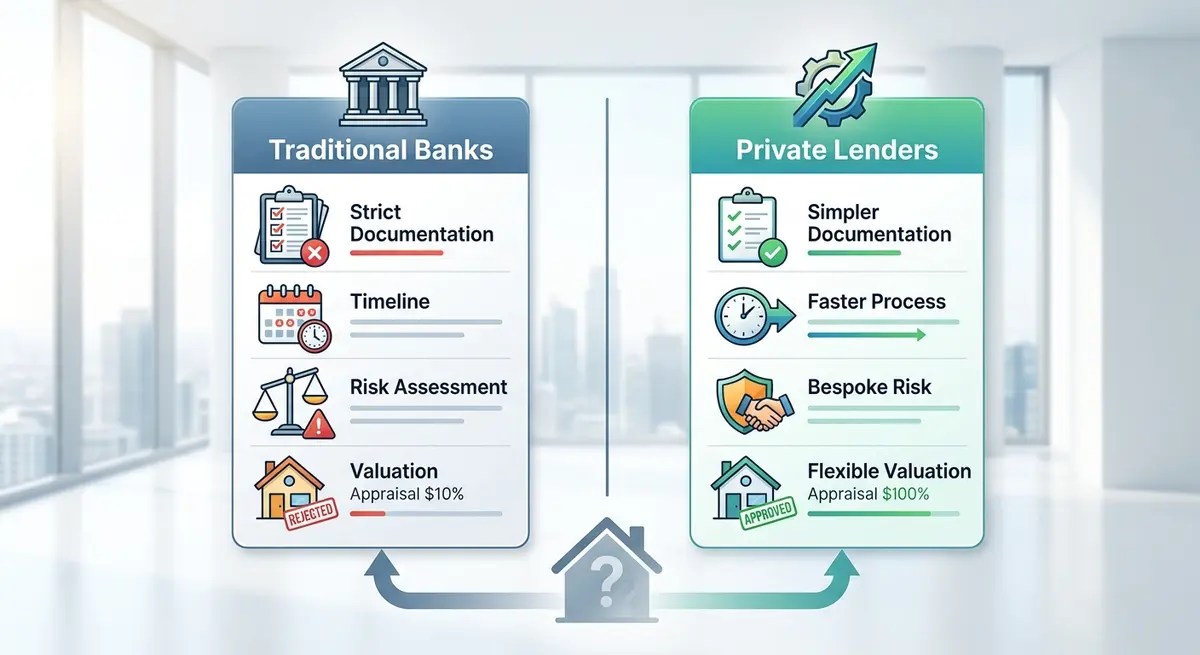
The lending landscape for complex real estate is highly polarized. Traditional financial institutions (A-lenders) have rigid underwriting guidelines that automatically flag and reject properties with known stigmas, particularly former grow-ops, even after full remediation.
Private lenders, on the other hand, take a pragmatic, equity-based approach. They are the primary source of capital for these scenarios, funding approximately 85% of all stigmatized property loans in Alberta as of 2026.
| Feature | Traditional Banks (A-Lenders) | Private / Alternative Lenders |
|---|---|---|
| Approval Probability | Extremely Low | High (Equity Dependent) |
| Max LTV Ratio | N/A (Usually declined) | 60% – 65% |
| Interest Rates | Prime Rates | Prime + 3% to 6% Premium |
| Income Verification | Strict T4 / NOA required | Flexible / Stated Income allowed |
Step-by-Step Guide to Securing Secondary Financing
If you own a stigmatized property and need to access your equity, following a structured approach will significantly improve your chances of approval. Here is the exact process for 2026:
- Obtain a Specialized Appraisal: Do not rely on automated valuation models (AVMs) or standard appraisals. Hire an appraiser experienced in complex valuations who can accurately quantify the stigma discount.
- Gather Remediation Documentation: If the stigma is physical (e.g., a former drug lab), you must provide a clean Phase 1 Environmental Site Assessment and a remediation certificate from Alberta Health Services. Lenders will not proceed without proof that the property is habitable.
- Organize Your Financial Paperwork: While private lenders focus on equity, they still need to verify your ability to make monthly interest payments. Spend time organizing your mortgage paperwork, including property tax statements and first mortgage statements.
- Explore Alternative Income Verification: If you are self-employed or have non-traditional income, look into alternative documentation options. Private lenders are highly adept at verifying self-employed income using bank statements rather than tax returns.
- Partner with a Specialized Broker: Do not apply directly to multiple lenders, as this will damage your credit score. Work with a mortgage broker who has established relationships with private syndicates that specialize in distressed or stigmatized assets.
Disclosure Requirements and Legal Considerations in 2026
One of the most complex aspects of financing a stigmatized property is navigating disclosure laws. In Alberta, the Real Estate Council of Alberta (RECA) mandates that all material latent defects must be disclosed to buyers and lenders. Failing to disclose a former grow-op to a secondary lender constitutes mortgage fraud.
Psychological stigmas, however, exist in a legal gray area. While RECA does not explicitly force sellers to disclose a murder or suicide that occurred on the property, deliberately hiding this information from a lender during the financing process can trigger a “call provision” if discovered later. Most private lending contracts in 2026 include a “full disclosure of material facts” clause. If a lender discovers a severe psychological stigma post-funding that was intentionally concealed, they have the legal right to demand immediate repayment of the loan.
To protect yourself, transparency is always the best policy. Lenders price risk; they do not automatically reject it. By disclosing the stigma upfront, the lender can price the loan accordingly, ensuring a stable and legally sound financial agreement.
Case Study: Overcoming a Former Grow-Op Stigma
Consider the case of a homeowner in Edmonton who purchased a remediated former grow-op in 2022. By 2026, the homeowner needed $75,000 to fund a small business expansion. Despite having over $300,000 in raw equity, their primary bank refused to offer a Home Equity Line of Credit (HELOC) due to the property’s history.
The homeowner shifted their strategy toward leveraging home equity through a private lender. They provided the original environmental clearance certificates, a recent air quality test, and a specialized appraisal. The appraiser noted a 12% stigma discount on the property’s value. The private lender, satisfied with the environmental reports and the conservative 55% LTV ratio, approved the $75,000 equity loan within eight business days. The homeowner utilized the funds to expand their business, demonstrating that with the right documentation, stigma does not permanently lock away your equity.

Edge Cases and Common Mistakes to Avoid
Borrowers often make critical errors when attempting to finance complex properties. One common mistake is assuming that time erases stigma. While the impact of a psychological defect diminishes over decades, lenders in 2026 still utilize digital property history databases that flag incidents from over twenty years ago.
Another edge case involves the use of co-signers. If your property’s stigma requires you to bring on a family member to strengthen the application, it is vital to fully grasp the legal implications. You must ensure they are understanding guarantor liability before signing. If you default, the lender will pursue the guarantor’s assets. Using a parent as a guarantor can secure the loan, but they must be fully aware of the property’s history and the associated risks.
Finally, never skip the specialized appraisal to save money. Providing a standard appraisal that ignores the stigma will result in an immediate decline when the lender’s underwriter conducts their own due diligence.
Frequently Asked Questions (FAQ)
Can a bank force me to pay back my first mortgage if they find out my house is stigmatized?
If the stigma is a material latent defect (like a former drug lab) that you knew about and failed to disclose during the initial mortgage application, the bank can technically call the loan due to misrepresentation. However, if a psychological stigma occurs after you secure the mortgage, the bank generally cannot penalize you as long as you maintain your payments.
How long does a psychological stigma last on an Alberta property?
There is no legal expiration date for a stigma. However, real estate economists note that the financial impact of a psychological stigma typically halves every five to seven years, provided no new incidents occur and the property is well-maintained.
Will a second mortgage lender require a new environmental test for a remediated grow-op?
Yes, most private lenders in 2026 will require an updated Phase 1 Environmental Site Assessment or a recent indoor air quality test, even if the property was remediated years ago. This ensures no residual mold or chemical issues have resurfaced.
Does a death in the home automatically make it stigmatized?
No. Natural deaths or peaceful passings are generally not considered stigmas by the market or lenders. Stigmas are typically reserved for violent crimes, highly publicized tragedies, or suicides that significantly impact public perception.
Are interest rates significantly higher for stigmatized properties?
Yes. Because these properties carry higher liquidity risks, private lenders typically charge a premium. You can expect interest rates to be 2% to 4% higher than standard private mortgage rates for non-stigmatized homes.
Can I use stated income to get a loan on a stigmatized house?
Yes, many private lenders offer stated income or alternative documentation programs. However, because the property itself is high-risk, the lender will likely require a lower Loan-to-Value (LTV) ratio to offset the combined risk of the property and the unverified income.
Conclusion
Securing a second mortgage on a stigmatized property in Alberta is entirely possible, provided you approach the right lending channels with total transparency. While traditional banks may close their doors, the private lending sector offers robust solutions for homeowners willing to accept adjusted loan-to-value ratios and specialized appraisal requirements. By gathering the necessary environmental documentation, understanding the true discounted value of your home, and working with specialized mortgage professionals, you can successfully unlock your property’s equity in 2026.
If you are struggling to find financing for a complex or stigmatized property, you do not have to navigate the private lending market alone. Get in touch with our team today to discuss your unique situation and explore your equity financing options.