Yes, Calgary homeowners can successfully leverage a subordinate lien on their property to pay off a consumer proposal ahead of schedule. By securing alternative financing against their home equity, individuals can disburse a lump-sum payment to their Licensed Insolvency Trustee, obtaining a Certificate of Full Performance years before the standard term concludes. This strategy accelerates the credit rebuilding process, though it requires sufficient property equity and an understanding of alternative lending rates.
Key Takeaways
- Accelerated Credit Recovery: Paying off a proposal early starts the mandatory 3-year credit purge countdown immediately, rather than waiting up to 5 years.
- Equity Requirements: Calgary alternative lenders typically require homeowners to retain at least 20% to 25% equity in their property (maximum 75-80% Loan-to-Value).
- Direct Disbursement: Funds from the new financing are sent directly from the real estate lawyer to the Insolvency Trustee to guarantee the proposal is legally discharged.
- Alternative Lenders Only: Traditional “A” banks will not approve secondary financing while a proposal is active; homeowners must utilize “B” or private lenders.
- No Prepayment Penalties: The Office of the Superintendent of Bankruptcy does not penalize individuals for settling their consumer proposal ahead of schedule.
Understanding Consumer Proposals and Home Equity in Alberta
In the 2026 economic landscape, many Albertans are navigating the complexities of debt restructuring. A consumer proposal is a legally binding agreement administered by a Licensed Insolvency Trustee (LIT) that allows debtors to pay a percentage of what they owe over a maximum of 60 months. While it is a highly effective tool for avoiding bankruptcy, an active proposal severely restricts financial mobility. Traditional financial institutions categorize individuals in active proposals as high-risk, effectively locking them out of standard mortgage renewals, vehicle financing, and unsecured credit.
However, Calgary’s real estate market has maintained robust valuations through 2026, leaving many homeowners with substantial, untapped equity. Data from the Office of the Superintendent of Bankruptcy (OSB) indicates that while consumer insolvencies fluctuate, a significant percentage of filers in Alberta are property owners. For these individuals, the equity trapped in their homes represents a viable exit strategy from their insolvency proceedings.
As Marcus Thorne, Chief Underwriter at Alberta Alternative Lending, explains: “Homeowners in active consumer proposals are often trapped in a credit freeze. Utilizing a subordinate lien allows them to break that freeze years ahead of schedule, provided they have maintained at least 25% equity in their property.”
How Early Discharge Works for Calgary Homeowners
When you enter a consumer proposal, the total settlement amount is fixed. Unlike traditional loans, there is no interest accumulating on the proposal balance itself. If you agreed to pay $30,000 over 60 months ($500 per month), and you have $20,000 remaining after two years, you can pay that exact $20,000 as a lump sum to conclude the agreement immediately.
Once the Trustee receives the final payment, they issue a Certificate of Full Performance. This document is legally significant. It is immediately forwarded to the OSB and major credit bureaus like Equifax Canada, officially marking the debt restructuring as completed. This is the critical turning point where true credit rehabilitation begins.
The Role of Secondary Financing in Debt Restructuring
Because traditional banks are bound by strict federal stress tests and internal risk policies, they will universally decline lending to someone with an active R7 credit rating (the rating assigned during a proposal). Therefore, homeowners must pivot to the alternative lending market. Alternative lenders, often referred to as “B lenders” or private mortgage investment corporations (MICs), base their underwriting primarily on the asset’s value rather than the borrower’s credit score.
These lenders are highly active in Calgary in 2026, offering tailored solutions for debt consolidation. They will register a secondary charge against the property title, subordinate to the primary mortgage. The capital generated from this loan is then utilized to satisfy the Trustee. For borrowers with complex income structures, exploring stated income financing can streamline the approval process, especially for self-employed Calgarians.
Pros and Cons: Using Home Equity to Settle a Proposal
Before committing to this financial strategy, it is imperative to weigh the advantages against the inherent costs. Transitioning unsecured debt (the proposal) into secured debt (a mortgage) carries distinct risks and rewards.
| Advantages of Early Payout | Disadvantages & Risks |
|---|---|
| Faster Credit Purge: The 3-year clock for removing the R7 rating from your credit report starts immediately. | Higher Interest Rates: Alternative financing carries higher interest rates than traditional bank mortgages. |
| Improved Cash Flow: Replaces the rigid proposal payment with an interest-only mortgage payment, often lowering monthly obligations. | Setup Fees: Borrowers must pay lender fees, brokerage fees, and legal costs, which are deducted from the loan advance. |
| Access to Better Rates Sooner: Allows you to transition back to “A” lenders years faster, saving thousands in long-term interest. | Secured Risk: You are converting legally protected unsecured debt into debt secured against your primary residence. |
When comparing home equity versus unsecured credit, the reality for individuals in a proposal is that unsecured credit is simply unavailable. The equity in the home acts as the sole lever to force an early discharge.
Step-by-Step Guide to Securing Alternative Financing
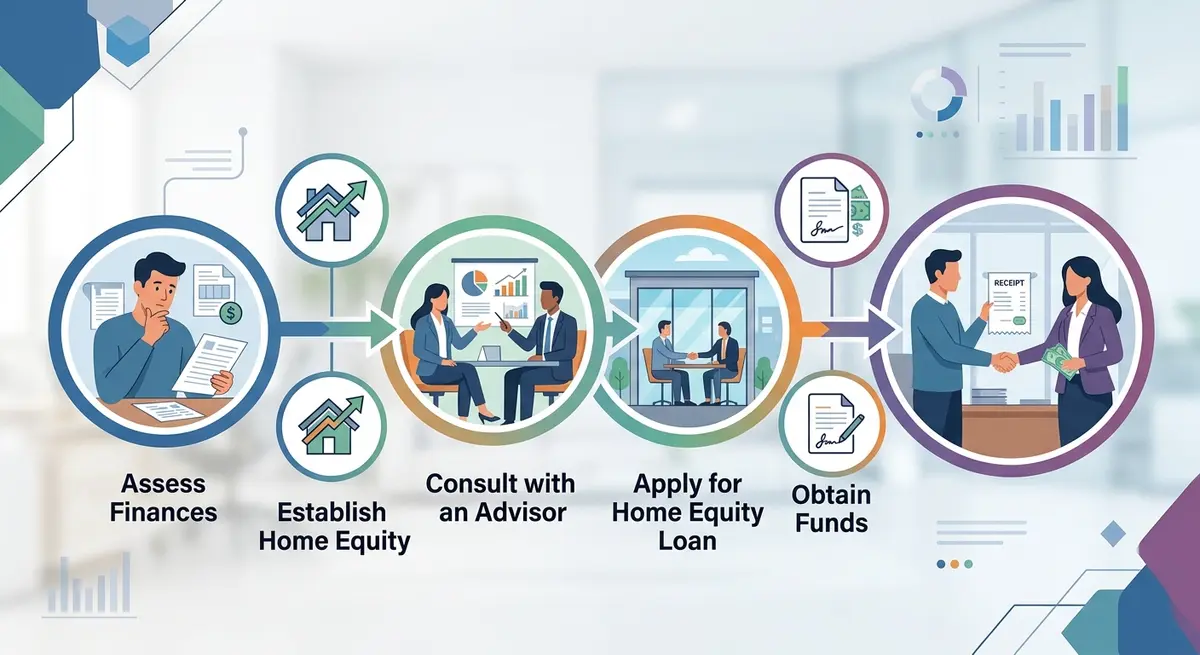
Executing an early discharge requires precision. Lenders and legal professionals must coordinate to ensure the funds are routed correctly. Here is the exact process for Calgary homeowners in 2026:
- Determine Your Property’s Equity: Calculate your Loan-to-Value (LTV) ratio. Take your current primary mortgage balance and divide it by a conservative estimate of your home’s current market value. If the resulting number is below 75%, you are a strong candidate.
- Request a Payout Statement: Contact your Licensed Insolvency Trustee and request an official payout statement. This document confirms the exact dollar amount required to satisfy the proposal in full.
- Compile Financial Documentation: Gather your recent mortgage statements, property tax bills, home insurance policy, and income verification. Reviewing a comprehensive secondary mortgage document checklist will prevent underwriting delays.
- Secure an Appraisal: The alternative lender will order a full interior appraisal through an Appraisal Institute of Canada (AIC) certified appraiser to confirm the exact market value of your Calgary property.
- Legal Disbursement: Once approved, you will meet with a real estate lawyer. The lawyer receives the funds from the lender, pays off the Trustee directly, and disburses any remaining funds to you.

Financial Requirements and Lender Expectations in 2026
Alternative lenders operate on risk mitigation. While they forgive poor credit, they are stringent about property metrics. In the 2026 Calgary market, the absolute maximum LTV permitted by most private lenders is 80%, though 75% is the standard threshold to secure more favorable interest rates. For example, if your home is appraised at $600,000, your total debt secured against the property (first mortgage plus the new secondary loan) cannot exceed $450,000 to maintain a 75% LTV.
Income verification remains a component of the approval process, though it is far more flexible than traditional banking. Lenders want to ensure you can service the new debt. For entrepreneurs and contract workers, verifying self-employed income often involves looking at 6-12 months of business bank statements rather than relying strictly on Notice of Assessments (NOAs).
Furthermore, lenders will scrutinize your credit report to understand the narrative behind your insolvency. Being prepared to provide a letter explaining recent credit inquiries or the circumstances that led to the consumer proposal can significantly strengthen your application.
Rebuilding Your Credit Post-Discharge
The primary motivation for this financial maneuver is credit rehabilitation. According to the Financial Consumer Agency of Canada (FCAC), a consumer proposal remains on your Equifax credit report for three years from the date of completion (the date the Certificate of Full Performance is issued), or six years from the date it was filed, whichever comes first.
If you are in a 5-year (60-month) proposal and you let it run its course, your credit will be impaired for a total of 8 years (5 years active + 3 years post-completion). By utilizing your home equity to pay it off in year 2, the 3-year purge clock starts immediately. By year 5, your credit report is completely clear of the insolvency record, allowing you to refinance your entire property back with an “A” lender at prime rates.
Sarah Jenkins, a Licensed Insolvency Trustee based in Alberta, notes: “The mathematical advantage of early payout is undeniable for homeowners. The slightly higher cost of alternative borrowing for a short 12-to-24-month term is vastly outweighed by the ability to renew a primary mortgage at standard bank rates years earlier than otherwise possible.”
Long-Term Strategy: The Exit Plan
Taking on secondary financing is a transitional strategy, not a permanent solution. When you secure this loan, it typically comes with a 1-year or 2-year term. The goal is to use this time to aggressively rebuild your credit score. You must ensure all new trade lines (credit cards, auto loans, and the new mortgage itself) are paid flawlessly.
As you approach the end of your alternative loan term, your credit score should have recovered sufficiently to qualify for a traditional refinance. At this stage, you will combine your primary mortgage and the secondary loan into one single, low-interest mortgage with a prime lender. Understanding cash-out refinancing options is crucial for planning this final step of your financial recovery.
Additionally, ensure you maintain meticulous records throughout this process. Proper mortgage document retention will make your eventual transition back to a traditional bank seamless, as they will require a clear paper trail of your proposal discharge and subsequent payment history.
Frequently Asked Questions (FAQ)
Can I get a traditional bank loan to pay off my consumer proposal?
No. Traditional banks and credit unions in Canada will not approve new credit facilities, including mortgages or personal loans, for individuals with an active consumer proposal due to strict federal lending guidelines.
What is the maximum Loan-to-Value (LTV) allowed for this strategy in Calgary?
In the 2026 Calgary market, alternative and private lenders typically cap the LTV at 75% to 80%. This means you must have at least 20% to 25% equity remaining in your home after the new loan is applied.
Will paying off the proposal early improve my credit score immediately?
Your numerical score will not jump overnight. However, paying it off early changes the status to “completed” and immediately starts the mandatory 3-year countdown for the total removal of the R7 public record from your credit file.
Do I have to pay a penalty to the Trustee for early payout?
No. There are no prepayment penalties associated with a consumer proposal. You simply pay the remaining balance of the agreed-upon settlement amount.
Can self-employed Calgarians qualify for this type of financing?
Yes. Alternative lenders focus heavily on property equity rather than standard income verification. Self-employed individuals can often qualify using business bank statements to prove cash flow instead of traditional tax documents.
How are the funds sent to the Insolvency Trustee?
To protect the lender and ensure the legal discharge of the debt, the funds are never given directly to the borrower. The real estate lawyer handling the mortgage closing will disburse the exact payout amount directly to the Trustee’s trust account.
Conclusion
Navigating a consumer proposal while managing a mortgage can feel restrictive, but Calgary homeowners possess a powerful tool: home equity. By utilizing a subordinate lien through alternative lending channels, you can satisfy your Trustee, obtain your Certificate of Full Performance, and drastically accelerate your journey toward financial freedom. While this strategy involves higher short-term interest rates, the long-term benefits of early credit rehabilitation and faster access to prime banking rates make it a highly effective financial maneuver in 2026.
If you are ready to explore your equity options and take the first step toward discharging your proposal, get in touch with our team today for a confidential assessment of your property’s borrowing potential.