Securing a second mortgage on a mobile or manufactured home in Alberta requires navigating specific lender guidelines regarding land ownership, structural foundations, and the age of the unit. While traditional homes easily qualify for secondary financing, manufactured homes are often classified as chattel rather than real estate unless they are permanently affixed to owned land. However, in 2026, Alberta homeowners can successfully access their mobile home equity by meeting CSA Z240 standards, demonstrating a maximum Loan-to-Value (LTV) ratio of 65% to 75%, and providing comprehensive documentation to specialized equity lenders.
Key Takeaways
- Land Ownership Dictates Loan Type: Homes on owned land qualify for traditional second mortgages, while homes on leased pads require chattel loans.
- LTV Limits are Stricter: Lenders typically cap secondary financing at 65% LTV for leased land and up to 75% LTV for owned land in 2026.
- CSA Z240 Certification is Mandatory: Your manufactured home must meet the Canadian Standards Association (CSA) Z240 MH series standards to qualify for institutional financing.
- Age Restrictions Apply: Homes manufactured before 1992 face significant financing hurdles, with most lenders preferring units under 20 years old.
- Foundation Requirements: Permanent foundations, proper skirting, and approved tie-downs are critical for appraisal approvals.
Understanding Mobile and Manufactured Home Financing in Alberta
The terminology surrounding prefabricated housing often causes confusion during the financing process. Legally and financially, there is a distinct difference between a “mobile home” and a “manufactured home” in the 2026 Alberta real estate market. According to the Canada Mortgage and Housing Corporation (CMHC), the term “mobile home” technically refers to factory-built homes constructed prior to 1992. Homes built after this date, which adhere to stricter national building codes, are classified as manufactured homes.
When you apply for secondary financing, lenders assess the asset’s depreciation curve. Traditional stick-built homes generally appreciate over time, whereas older mobile homes—particularly those not affixed to a permanent foundation—can depreciate similarly to vehicles. As Marcus Thorne, Senior Underwriter at Alberta Equity Partners, explains: “In 2026, the secondary mortgage market for prefabricated homes is entirely dependent on structural permanence. If the home can be hitched to a truck and moved within 24 hours, the risk profile skyrockets, and we must price the loan accordingly.”
The Impact of Land Ownership on Equity Access
The most critical factor in determining your eligibility for a home equity loan is whether you own the land beneath your unit. This distinction dictates whether your transaction falls under the Land Titles Act or the Personal Property Security Act (PPSA).
Homes on Owned Land (Real Estate)
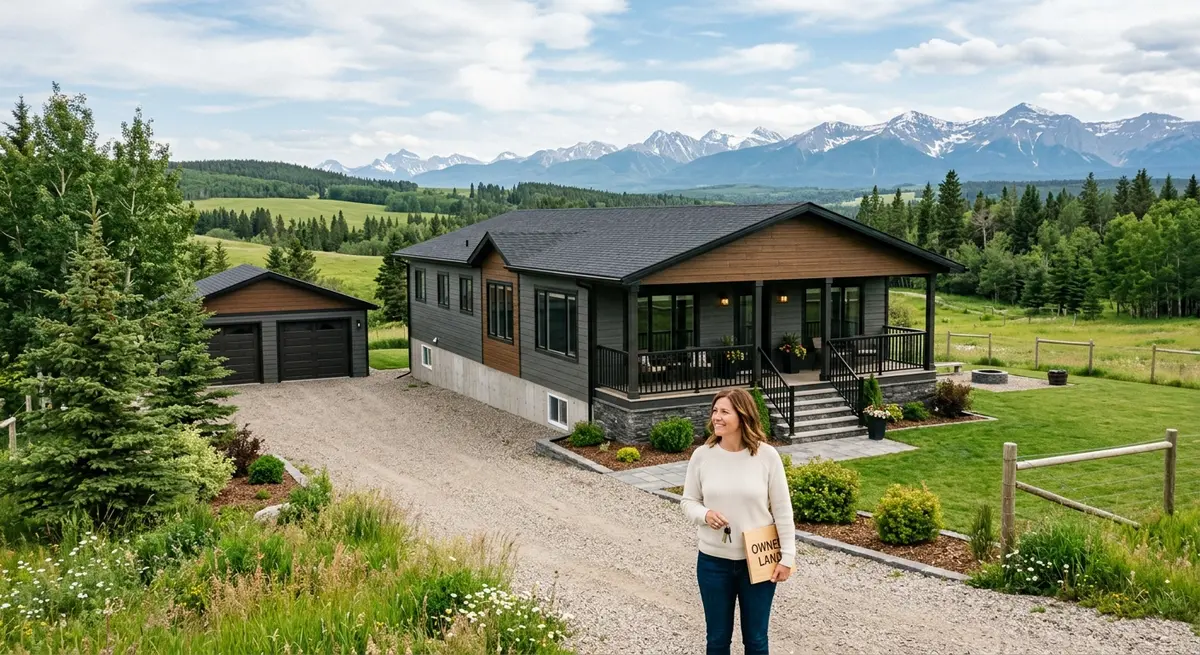
If you own the parcel of land where your manufactured home rests, and the home is permanently affixed to a foundation (such as concrete pilings or a basement), lenders treat the property as traditional real estate. In these scenarios, homeowners can access up to 75% of their combined property value. Because the land itself appreciates, lenders are far more willing to offer competitive interest rates. If you are exploring cash-out refinancing alternatives, having owned land provides the most flexibility and the lowest borrowing costs.
Homes on Leased Land (Chattel Loans)
Approximately 42% of manufactured homeowners in Alberta reside in mobile home parks or on leased rural land, according to 2026 data from Statistics Canada. Because you do not own the land, the home is legally considered personal property (chattel). Securing a second mortgage in a trailer park is inherently more difficult. Lenders will register a lien against the home itself through the provincial PPSA registry rather than a traditional land title mortgage. Consequently, Loan-to-Value maximums are typically restricted to 55% to 65%, and interest rates can be 2% to 4% higher than traditional equity loans.
2026 Market Conditions for Alberta Manufactured Homes
The economic landscape of 2026 has created unique opportunities for prefabricated homeowners. With the Bank of Canada stabilizing benchmark interest rates after years of volatility, the alternative lending market has expanded its portfolio to include non-traditional properties. Recent market analyses indicate that manufactured homes on owned land in rural Alberta have seen an average appreciation of 4.2% over the past 12 months, driven by housing affordability challenges in major urban centers.
This equity growth means that many homeowners who purchased their units between 2018 and 2022 now have sufficient equity to borrow against. Whether you are looking to consolidate high-interest debt or fund a business venture, leveraging home equity against unsecured credit is often the most mathematically sound financial decision, provided you meet the structural requirements.
Appraisal and Inspection Requirements (CSA Z240)
You cannot secure secondary financing without a specialized appraisal. Unlike a standard residential appraisal, evaluating a manufactured home requires the appraiser to verify specific safety and structural standards. The most critical of these is the CSA Z240 MH Series standard. According to the Canadian Standards Association, this certification ensures the home meets rigorous requirements for structural deformation, energy efficiency, and electrical safety.
During the appraisal process, the inspector will look for:
- The CSA Certification Label: Usually located on the electrical panel or inside a kitchen cabinet. Without this label, institutional lenders will automatically decline the application.
- Foundation and Tie-Downs: The home must be secured to block piers, concrete pads, or steel pilings with approved tie-downs to prevent wind uplift.
- Skirting: Insulated, vented skirting must enclose the perimeter of the home to protect plumbing from Alberta’s harsh winter freezing cycles.
- Remaining Economic Life: The appraiser will calculate the home’s remaining economic life. Lenders require the amortization period of the second mortgage to be shorter than the home’s remaining viable lifespan.
Step-by-Step: How to Secure Secondary Financing for Your Mobile Home
Navigating the application process requires preparation. Follow these steps to maximize your chances of approval in 2026:
- Determine Your Legal Classification: Confirm whether your home is registered as real property (with Land Titles) or chattel (with the PPSA). This will dictate which lenders you can approach.
- Calculate Your Available Equity: Estimate your home’s current value and subtract your primary mortgage balance. Remember that lenders will only allow you to borrow up to 65% (leased land) or 75% (owned land) of the total value.
- Gather Your Documentation: Alternative lenders require extensive paperwork. You will need your original purchase agreement, the CSA certification number, park management lease agreements (if applicable), and standard income verification. Reviewing a comprehensive secondary mortgage document checklist beforehand can save weeks of processing time.
- Verify Your Income: If you are a traditional employee, recent pay stubs and T4s are sufficient. If you run your own business, you will need to understand the nuances of verifying self-employed income, which may involve providing bank statements to prove cash flow.
- Order a Specialized Appraisal: Work with an appraiser who specializes in prefabricated housing. Ensure they are on your chosen lender’s approved list.
- Submit to a Specialized Broker: Do not apply at a standard “Big Six” bank branch, as they generally reject secondary financing for mobile homes. Work with a mortgage broker who has direct access to Private Investment Corporations (PICs) and Mortgage Investment Corporations (MICs) that understand the asset class.

Comparing Financing Options for Manufactured Homes
When you need capital, a second mortgage is not your only option. Depending on your credit score and the amount you need, different financial vehicles may be more appropriate. Below is a comparison of the most common financing methods available to Alberta manufactured homeowners in 2026.
| Feature | Second Mortgage (Owned Land) | Chattel Loan (Leased Land) | Unsecured Personal Loan |
|---|---|---|---|
| Maximum LTV | Up to 75% | Up to 65% | N/A (Based on Income) |
| Interest Rates | Moderate (8% – 12%) | Higher (10% – 15%) | Highest (12% – 20%+) |
| Approval Speed | 2-3 Weeks | 1-2 Weeks | 1-3 Days |
| Appraisal Required? | Yes (Full Appraisal) | Yes (Chattel Appraisal) | No |
| Risk to Home | Foreclosure Risk | Repossession Risk | No Direct Asset Risk |
Common Challenges and How to Overcome Them
Borrowers frequently encounter roadblocks when attempting to leverage their prefabricated homes. Understanding these hurdles ahead of time allows you to structure your application for success.
The Age Restriction Hurdle
Many alternative lenders implement a hard cutoff for the age of the home. In 2026, homes manufactured before 2006 (20 years old) face intense scrutiny. If your home is older, you must prove that it has been substantially updated. Providing receipts for a new roof, upgraded electrical panels, modern plumbing, and energy-efficient windows can convince a lender to extend the home’s remaining economic life calculation.
Income and Credit Challenges
Because the collateral (the home) is viewed as higher risk, lenders place heavier emphasis on the borrower’s ability to repay. If your credit score is below 600, or if you have non-traditional income, you may need to explore stated income secondary financing. Alternatively, bringing on a co-signer can strengthen your application. If you choose this route, ensure your co-signer fully understands the guarantor liability implications before signing the commitment letter.
Spousal Consent and Dower Rights
In Alberta, the Dower Act protects the rights of a spouse who is not listed on the property title. If you are married and only your name is on the land title or chattel registry, your spouse must still sign a consent form acknowledging the new debt. If you are jointly applying, understanding the process of adding a spouse to your home equity loan is essential for a smooth legal closing.

Frequently Asked Questions (FAQ)
Can I get a second mortgage on a mobile home in a trailer park?
Yes, but it is legally structured as a chattel loan rather than a traditional mortgage. Because you lease the land, lenders will register a lien against the physical structure through the Personal Property Security Registry, typically limiting your borrowing power to 65% of the home’s appraised value.
What is the minimum credit score required for a manufactured home equity loan?
While traditional banks require scores above 680, alternative lenders in Alberta focus more on your available equity. In 2026, you can secure secondary financing with a credit score as low as 550, provided you have at least 35% equity in the home and verifiable income.
Do I need a new appraisal if I just bought the home two years ago?
Yes, lenders require a current appraisal dated within the last 90 days. The manufactured housing market fluctuates, and lenders need an up-to-date assessment of the home’s structural integrity, remaining economic life, and current market value.
What happens if my home does not have a CSA Z240 label?
Without a CSA Z240 or equivalent provincial safety certification (such as a Silver Label from the electrical safety authority), institutional and alternative lenders will decline the loan. You would need to hire a certified inspector to recertify the home before applying.
Can I use the funds from the loan for anything I want?
Yes, once the funds are disbursed, there are no restrictions on their use. Common uses in 2026 include consolidating high-interest credit card debt, funding home renovations, paying for a child’s education, or injecting capital into a small business.
Are the interest rates higher for mobile homes compared to regular houses?
Generally, yes. Because manufactured homes (especially those on leased land) carry a higher depreciation risk and are harder for lenders to liquidate in the event of default, interest rates are typically 1.5% to 4% higher than standard residential second mortgages.
Conclusion
Accessing the equity in your prefabricated home is entirely possible in 2026, provided you understand the specific criteria lenders demand. Whether your property is classified as real estate on owned land or chattel in a leased park, the key to approval lies in structural compliance, accurate appraisals, and working with specialized alternative lenders. By ensuring your home meets CSA Z240 standards and maintaining a reasonable Loan-to-Value ratio, you can unlock the capital you need to achieve your financial goals.
Navigating the complexities of chattel loans and alternative financing requires expert guidance. If you are ready to explore your equity options or need help determining your home’s eligibility, contact us today. Our team of Alberta mortgage specialists is ready to help you secure the best possible rates and terms for your unique situation.