Family office private lending for subordinate debt in Calgary is a specialized alternative credit strategy where high-net-worth wealth management firms provide capital secured by local real estate. This asset class bridges the critical gap between traditional bank financing and equity capital, delivering risk-adjusted yields typically ranging between 9.5% and 13.5%. By leveraging substantial liquidity and agile underwriting processes, these private entities secure predictable fixed-income returns while maintaining robust collateral protection in Alberta’s expanding property market.
Key Takeaways
- Superior Yield Generation: Subordinate real estate debt offers annualized returns of 9.5% to 13.5%, significantly outperforming traditional public fixed-income securities in 2026.
- Asset-Backed Security: Capital is protected by tangible, appreciating commercial and residential assets, providing a strong hedge against inflation.
- Agile Deployment: Private wealth managers can fund customized credit facilities in 7 to 14 days, capturing opportunities that rigid institutional banks miss.
- Strict Risk Mitigation: Successful portfolios rely on conservative Loan-to-Value (LTV) limits (typically capped at 75%-80%) and comprehensive Intercreditor Agreements.
- Tax Optimization: Structuring investments through Mortgage Investment Corporations (MICs) allows family offices to maximize after-tax returns on interest income.
The Evolution of Private Credit in Alberta’s 2026 Economy
The landscape of wealth management and capital deployment has transformed significantly over the past decade. In 2026, institutional investors and private equity funds are increasingly crowding traditional real estate markets, compressing cap rates and forcing sophisticated wealth managers to pivot toward private lending. This shift is largely driven by macroeconomic fundamentals and regulatory environments.
According to Statistics Canada, Calgary’s population growth continues to exceed 3.1% annually, driving unprecedented demand for both residential housing and commercial infrastructure. This demographic surge, coupled with stringent federal banking regulations, has created a massive liquidity vacuum. Traditional lenders are constrained by rigid Loan-to-Value (LTV) limits and inflexible Debt Service Coverage Ratio (DSCR) requirements.
Here, the agility of family offices becomes a distinct competitive advantage. They possess the unencumbered capital reserves necessary to structure creative financing solutions that benefit both borrowers seeking rapid capital deployment and investors seeking inflation-hedging yields. Furthermore, while the Bank of Canada has stabilized benchmark interest rates, the premium on private credit remains robust due to the speed and flexibility it offers to borrowers.
Why Calgary’s Real Estate Market Attracts High-Net-Worth Capital
Calgary’s economic diversification efforts have successfully decoupled the city’s real estate performance from historical energy price volatility. Research from Invest Alberta indicates that the technology, logistics, and healthcare sectors now account for over 40% of new commercial leasing activity in the metropolitan area. This structural diversification provides a highly stable foundation for private lenders.
As Marcus Thorne, Chief Investment Officer at Prairie Wealth Partners, explains: “The appeal of subordinate private credit in this region lies in the underlying asset quality. We are lending against tangible, appreciating assets in a market with structural supply deficits. When underwritten correctly, the risk-adjusted returns far outpace public fixed-income markets, while providing a tangible margin of safety.”
For family offices, the local market offers a unique blend of high yield potential and strong legal frameworks for creditor protection, making it an ideal environment for alternative fixed-income allocations.
Institutional Banks vs. Family Office Lenders: A Comparative Analysis
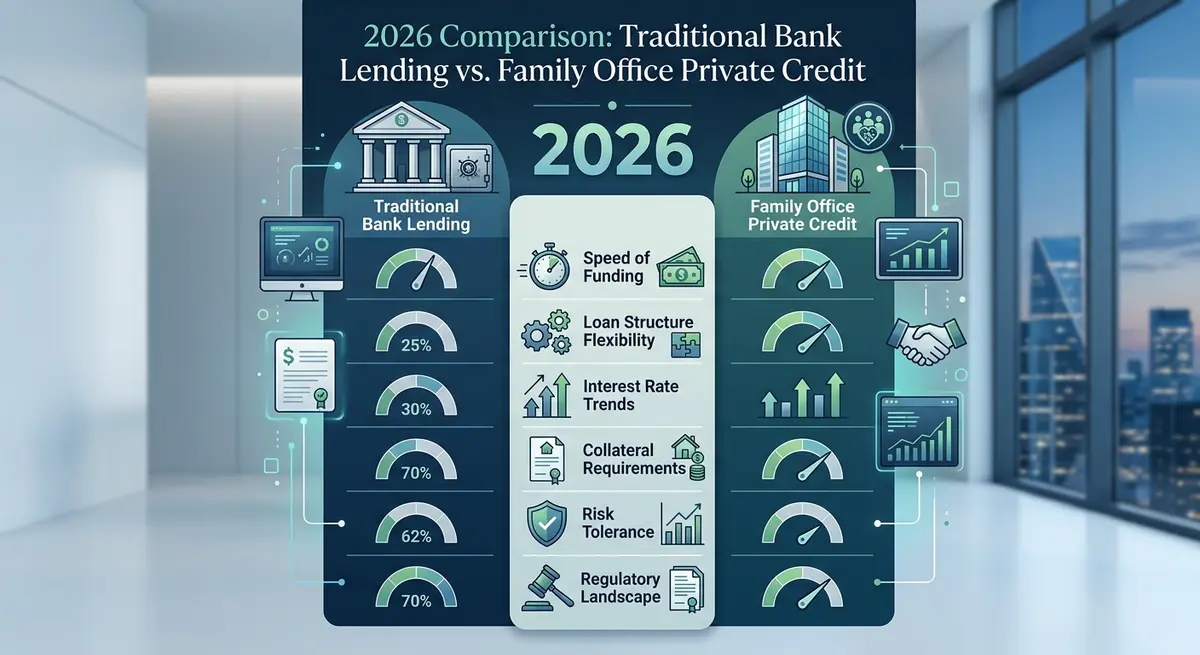
Understanding the fundamental differences between traditional bank lending and private family office capital is crucial for both investors deploying capital and borrowers seeking leverage. Family offices dictate terms based on asset quality, borrower character, and viable exit strategies rather than relying on rigid bureaucratic checklists.
| Lending Metric | Traditional Bank Lenders | Family Office Private Lenders |
|---|---|---|
| Approval Timeline | 45 to 90 days | 7 to 14 days |
| Maximum LTV | Typically 65% (Subordinate Position) | Up to 80% (Asset Dependent) |
| Interest Rates (2026) | Prime + 3% to 5% | 9.5% to 13.5% |
| Income Verification | Strict T4 / NOA requirements | Flexible (Asset-based / Stated Income) |
| Customization | Rigid, standardized terms | Highly bespoke, customized covenants |
For borrowers who do not fit the standard banking mold, such as self-employed entrepreneurs or real estate developers in the pre-revenue phase, private wealth funds offer viable alternatives. In fact, many business owners rely on stated income alternatives to access their property’s equity without the friction of traditional, backward-looking income verification.
Structuring Subordinate Debt: Best Practices for Investors
Effective structuring of private subordinate loans requires meticulous attention to legal documentation, security arrangements, and performance monitoring. Unlike primary mortgages, subordinate debt carries inherent structural risks. If the borrower defaults, the primary mortgage holder must be satisfied entirely before the subordinate lender recovers their principal.
To mitigate this structural vulnerability, sophisticated wealth managers utilize comprehensive Intercreditor Agreements. These vital legal documents define the relationship between the primary and subordinate mortgagees, outlining specific cure rights, standstill periods, and notification protocols in the event of a borrower default. This ensures the private lender is never caught off guard by a primary lender’s enforcement actions.
Furthermore, investors must carefully consider the mathematical mechanics of the loan. The impact of compounding frequency when drafting promissory notes significantly affects both the annualized yield for the family office and the carrying costs for the borrower. Semi-annual compounding versus monthly compounding can alter the internal rate of return by several basis points over a 12-to-24-month term.
Risk Mitigation and Due Diligence Strategies
Risk management in private real estate credit requires a deep understanding of both property-specific factors and broader macroeconomic influences. While localized market fluctuations pose risks to collateral values, thorough due diligence acts as the primary defense mechanism.
This process is non-negotiable and includes independent property appraisals, Phase 1 Environmental Site Assessments for commercial assets, and rigorous borrower credit analysis. Dr. Elena Rostova, Professor of Real Estate Finance at the University of Calgary, notes: “The most successful private credit portfolios in 2026 are those that underwrite the exit strategy just as heavily as the collateral. If the borrower’s path to refinancing or selling the asset is flawed, the loan is inherently risky, regardless of the LTV.”
Step-by-Step Guide: The Family Office Underwriting Process
Successful private lenders adopt systematic approaches that balance aggressive yield generation with strict capital preservation. The underwriting process typically follows these critical steps:
- Initial Screening and Triage: The lending team evaluates the borrower’s executive summary, focusing on the requested loan amount, the property’s location, and the proposed exit strategy (e.g., property sale or transitioning to a cash-out refinance).
- Collateral Valuation: The lender engages an independent, third-party appraiser registered with the Real Estate Council of Alberta (RECA) to determine the current “As-Is” market value and calculate the exact cumulative Loan-to-Value ratio.
- Borrower Vetting: Analysts review the borrower’s net worth, liquidity, and real estate experience. This step determines the borrower’s ability to service the debt during the interest-only term.
- Legal and Title Review: Legal counsel scrutinizes the property title for existing encumbrances, builder’s liens, or restrictive covenants that could jeopardize the lender’s security position.
- Term Sheet Issuance: The family office drafts a binding commitment letter outlining the interest rate, lender fees, term length, and specific funding conditions.
- Funding and Administration: After registering the charge on title and disbursing funds, the firm establishes strict protocols for retaining mortgage documentation to ensure compliance and facilitate future auditing.

Case Study: The Beltline Commercial Bridge Loan
To illustrate the practical application of these strategies, consider a recent 2026 transaction in Calgary’s Beltline district. A mid-sized commercial developer required $2.5 million to complete tenant improvements on a mixed-use retail space. Traditional banks refused the loan because the property lacked immediate cash flow prior to occupancy.
A local family office stepped in, providing a 12-month subordinate loan at 11.5% interest, requiring interest-only payments, secured behind a $6 million primary mortgage. The property was appraised at $12 million, resulting in a conservative 70.8% cumulative LTV.
The developer successfully completed the improvements, secured long-term commercial tenants, and paid out the family office using traditional institutional refinancing nine months later. The family office achieved an annualized internal rate of return (IRR) of 14.2% after factoring in origination and exit fees, demonstrating the immense power of localized, relationship-based private credit.

Navigating Defaults and Legal Enforcement in Alberta
Even with pristine underwriting and robust due diligence, defaults occasionally occur. Wealth managers must be prepared to act swiftly to protect their deployed capital. In Alberta, the legal enforcement process is strictly regulated by the Court of King’s Bench.
If a borrower defaults, the lender must understand the precise legal mechanisms available. Sarah Jenkins, Senior Partner at Calgary Real Estate Law Group, advises: “Private lenders must be proactive. Waiting too long to enforce security can result in rapidly eroded equity, especially if the primary mortgagee initiates their own action. Understanding the difference between a simple demand letter and filing a formal statement of claim is the first step in capital recovery.”
Investors should familiarize themselves with the provincial foreclosure timeline, including how the courts calculate redemption periods based on the equity remaining in the property. In some instances, working collaboratively with a distressed borrower on principal reduction strategies or short-term loan modifications can yield better net financial outcomes than forcing a protracted, expensive legal battle.
Tax Efficiency and Portfolio Allocation
From a portfolio management perspective, private real estate debt provides excellent diversification away from volatile public equities. Typically, sophisticated wealth managers allocate between 10% and 25% of their alternative investment portfolio to private mortgages.
However, tax efficiency is a vital consideration. Interest income earned from lending activities is generally taxed at the highest marginal rate in Canada. Therefore, family offices often structure these investments through specialized corporate entities. According to guidelines from the Canada Revenue Agency, utilizing a Mortgage Investment Corporation (MIC) allows the entity to flow interest income through to shareholders as dividends, which can then be held in tax-advantaged accounts like RRSPs or TFSAs, drastically optimizing the after-tax yield of the portfolio.
Frequently Asked Questions
What is the typical minimum investment for private real estate debt in Calgary?
Most wealth management firms and family offices require a minimum capital deployment of $500,000 to $1,000,000 per transaction. This threshold ensures that the administrative costs, legal drafting, and extensive due diligence fees are mathematically justified by the absolute return generated by the loan.
How do private lenders protect themselves if property values decline?
Lenders protect their capital by strictly enforcing maximum Loan-to-Value (LTV) ratios, typically capping their total exposure at 75% to 80% of the property’s current appraised value. This built-in 20% to 25% equity buffer absorbs potential market corrections before the lender’s principal is ever threatened.
Can subordinate debt be used for commercial real estate development?
Yes, subordinate loans are frequently utilized in commercial development as mezzanine financing or bridge loans. They provide developers with the rapid, flexible capital necessary to complete construction phases, fund soft costs, or finish tenant improvements before securing long-term, lower-cost institutional refinancing.
What happens if the borrower defaults on the primary mortgage but not the subordinate loan?
If a borrower defaults on the primary mortgage, that lender can initiate legal proceedings, which immediately threatens the subordinate lender’s security. To prevent this, private lenders use Intercreditor Agreements that grant them the right to cure the default (pay the missed primary payments) and subsequently add those costs to their own loan balance while initiating their own enforcement actions.
How long are typical private real estate loan terms?
Private credit facilities are generally structured as short-term bridge solutions, with terms typically ranging from 6 to 24 months. These short durations protect lenders from long-term macroeconomic interest rate risk and align perfectly with the borrower’s goal of transitioning to traditional financing or liquidating the asset.
Are private lending returns guaranteed?
No investment returns are entirely guaranteed in any asset class. However, because these loans are secured by registered legal charges against tangible real property, they offer a highly predictable fixed-income stream with strong, court-enforced legal recourse for capital recovery in the rare event of non-payment.
Conclusion
Family office private lending in Calgary represents a sophisticated, high-yield alternative to traditional fixed-income investments. By bridging the gap between rigid institutional banking and the dynamic capital needs of local real estate developers and entrepreneurs, private wealth managers can secure impressive risk-adjusted returns. Success in this sector requires a deep understanding of local market fundamentals, rigorous due diligence protocols, and meticulous legal structuring. Whether you are an investor looking to deploy capital or a borrower seeking agile financing solutions, navigating this landscape requires expert guidance. Get in touch with our team today to explore how alternative real estate financing can align with your 2026 financial objectives.