Securing a subordinate loan against your property directly impacts your credit profile in three distinct phases: an initial temporary dip from hard inquiries, a shift in your debt-to-income ratio upon funding, and long-term score improvements generated by consistent repayment history. When Calgary homeowners access their built-up equity, credit bureaus evaluate this new debt based on utilization rates, credit mix, and payment reliability. While taking on additional debt inherently increases your financial obligations, strategically managing these funds can ultimately strengthen your overall creditworthiness.
Key Takeaways
- Hard Inquiries: Credit checks during the application process typically cause a temporary 5 to 10-point reduction in your credit score.
- Ratio Adjustments: Your debt-to-income (DTI) ratio will increase, a metric lenders closely monitor for future borrowing capacity.
- Payment History: Consistent, on-time payments on secondary property loans contribute positively to your payment history, which accounts for 35% of your credit calculation.
- Lending Thresholds: Calgary’s 2026 economic landscape requires borrowers to maintain loan-to-value (LTV) ratios strictly below 80% for prime lending rates.
- Strategic Consolidation: Rolling high-interest revolving debt into a lower-interest equity loan can rapidly improve credit utilization metrics and boost your score.
The Mechanics of Equity Borrowing and Your Credit Profile
Understanding the precise mechanisms by which credit bureaus assess new property debt is essential for maintaining financial health. When you apply for additional financing, lenders initiate a hard pull on your credit report to assess your risk level. According to Equifax Canada, a single hard inquiry typically lowers a consumer’s score by 5 to 10 points. This reduction is temporary, usually rebounding within three to six months, provided no other negative marks occur.
Beyond the initial inquiry, opening a new account alters your “average age of credit.” Because the new loan is brand new, it lowers the average age of all your open accounts, which accounts for approximately 15% of your total score calculation. However, secondary property loans also diversify your credit mix. Adding an installment loan to a profile that previously only contained revolving credit cards can positively influence the 10% of your score dedicated to credit diversity.
As Sarah Jenkins, Senior Credit Analyst at the Canadian Bankers Association, explains: “Secondary financing fundamentally alters a borrower’s debt-to-income ratio. However, if the borrower uses those funds to extinguish high-interest unsecured debt, the net effect on their credit profile is overwhelmingly positive within a six-month window.”

Calgary’s 2026 Economic Climate: Local Factors Influencing Approvals
The economic environment in Alberta plays a significant role in how financial institutions assess risk and grant approvals. In 2026, Calgary’s stabilizing energy sector and steady population growth have created a unique lending landscape. Lenders are increasingly scrutinizing employment stability and neighborhood-specific property appraisals before approving equity extraction.
Research from the Bank of Canada indicates that regional economic resilience directly correlates with lender confidence. In Calgary, traditional lenders typically cap combined borrowing at 80% of a home’s appraised worth. For example, if your property is valued at $600,000 and your primary mortgage balance is $350,000, your total allowable debt is $480,000. This leaves $130,000 in accessible equity.
Exceeding these thresholds often pushes borrowers into alternative lending tiers with stricter terms. If you are concerned about how multiple lender checks might affect your profile during this process, it is crucial to know how to explain credit inquiries to lenders effectively. Grouping your applications within a 14 to 45-day window ensures that credit bureaus treat them as a single inquiry for scoring purposes, protecting your rating from unnecessary damage.
HELOC vs. Fixed-Term Equity Loans: A Credit Impact Comparison
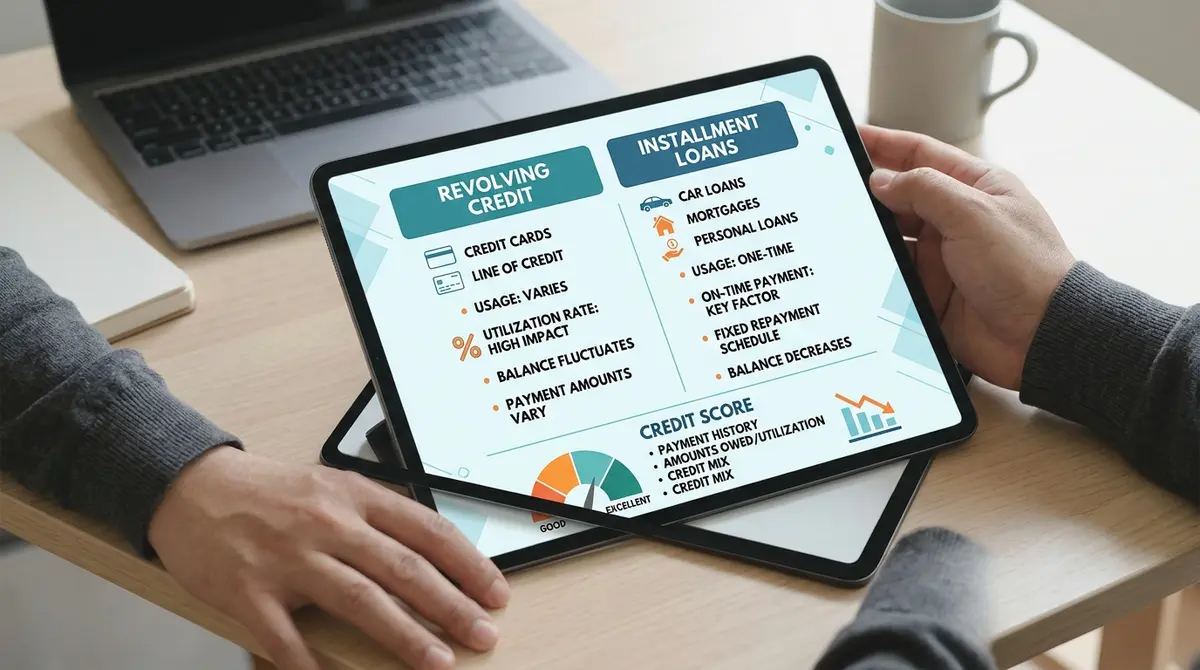
Homeowners generally choose between two primary structures when accessing their property’s value: Home Equity Lines of Credit (HELOCs) and fixed-term lump-sum loans. Each product interacts with your credit report differently, and choosing the wrong structure can inadvertently suppress your credit score.
A HELOC functions as revolving debt. You are approved for a maximum limit and draw funds as needed. Because it is revolving, it impacts your credit utilization ratio—the amount of credit you are using compared to your total available limits. Maxing out a HELOC can severely depress your score, even if you make timely payments. Conversely, keeping the balance low demonstrates excellent credit management.
Fixed-term equity loans provide a single lump sum with a predictable repayment schedule. These are classified as installment debts. They do not factor into your revolving credit utilization ratio in the same way credit cards or HELOCs do. Instead, their primary impact is on your payment history and debt-to-income metrics.
| Feature | HELOC (Revolving) | Fixed Equity Loan (Installment) |
|---|---|---|
| Credit Report Classification | Revolving Credit | Installment Loan |
| Impact on Utilization Ratio | High (Balances directly affect ratio) | Low (Does not affect revolving utilization) |
| Payment Predictability | Variable (Based on drawn amount and prime rate) | Fixed (Consistent monthly payments) |
| Best For | Ongoing projects, emergency funds | Debt consolidation, single large expenses |
When deciding between these options, many borrowers also weigh the benefits of cash-out refinancing. While refinancing replaces your entire primary mortgage, subordinate financing leaves your original, potentially lower-interest rate intact.
How Lenders Calculate Your Risk: The DTI and LTV Ratios
Financial institutions rely heavily on mathematical ratios to determine your capacity to handle new debt. The two most critical metrics are the Debt-to-Income (DTI) ratio and the Loan-to-Value (LTV) ratio. Your DTI ratio compares your gross monthly income to your mandatory monthly debt payments.
According to guidelines from the Financial Consumer Agency of Canada (FCAC), a healthy Gross Debt Service (GDS) ratio should not exceed 39%, while the Total Debt Service (TDS) ratio should remain below 44%. Adding a new property loan increases your monthly obligations, pushing your TDS higher. If your TDS exceeds 44%, traditional banks will likely decline the application, forcing you to seek alternative lenders.
Mark Thompson, a Calgary-based real estate economist, notes: “The 2026 housing market in Alberta requires borrowers to be acutely aware of their equity position. Property values have stabilized, meaning homeowners can no longer rely on rapid appreciation to artificially lower their LTV ratios. Precision in debt management is non-negotiable.”
Understanding how compounding frequency impacts your total debt load is also vital. Loans that compound semi-annually versus monthly will result in different long-term interest costs, subtly affecting your ability to pay down the principal balance efficiently.
Step-by-Step: How to Protect Your Credit Score When Applying
Taking proactive measures before and during the application process can insulate your credit rating from unnecessary damage. Follow these structured steps to ensure your financial profile remains robust:
- Audit Your Credit Reports: Obtain free copies of your reports from both Equifax and TransUnion. Dispute any inaccuracies or fraudulent accounts at least 60 days before applying for property financing.
- Calculate Your Current Ratios: Determine your exact LTV and DTI ratios. If your DTI is hovering near 40%, focus on paying down smaller consumer debts before submitting an application.
- Consolidate Your Applications: Rate shopping is smart, but space your applications strategically. Submit all inquiries within a 30-day window so scoring algorithms recognize you are shopping for a single loan, rather than attempting to open multiple credit lines simultaneously.
- Automate Your Payments: Once funded, set up automatic withdrawals for your new loan. Payment history accounts for 35% of your total score. Even a single 30-day late payment can slash a prime score by over 100 points.
- Implement Repayment Tactics: Explore principal reduction strategies to pay down the balance faster than the amortized schedule, which lowers your overall debt burden and saves thousands in interest.
Strategic Uses for Home Equity That Can Actually Boost Your Score
While taking on debt seems counterintuitive to building credit, strategic equity extraction can serve as a powerful financial tool. The most common and effective strategy is debt consolidation. In 2026, the average Canadian carries significant unsecured consumer debt. Credit cards frequently charge interest rates between 19.99% and 24.99%.
By using a subordinate property loan—which typically carries an interest rate between 7% and 12%—to pay off these high-interest balances, you achieve two immediate benefits. First, your monthly cash flow improves due to the lower blended interest rate. Second, your revolving credit utilization drops to zero.
Because credit utilization accounts for 30% of your credit score, paying off maxed-out credit cards with an installment loan can trigger a score increase of 30 to 50 points within a single billing cycle. When evaluating home equity versus unsecured credit, the secured nature of property loans almost always provides superior interest rates and higher borrowing limits.

Navigating Private and Alternative Lending Options in Alberta
Not all homeowners possess the pristine credit histories required by major banks. For those with scores below 650, non-traditional income sources, or high debt ratios, private and alternative lenders offer viable pathways to access equity. Private lenders focus primarily on the asset—your property—rather than your credit score. They typically require a minimum of 20% to 25% equity remaining in the home after all loans are accounted for.
While these lenders provide crucial lifelines, their products come with higher interest rates and setup fees to offset the increased risk. David Chen, Director of Risk Management at Alberta Financial Services, advises: “Alternative lending should be viewed as a short-term bridge, not a permanent solution. The goal is to use the private funds to consolidate debt, repair your credit profile over 12 to 24 months, and then refinance back into a prime lending product.”
Borrowers must also understand their legal rights in these agreements. For instance, Alberta law provides specific consumer protections, such as knowing when you can rescind a high-interest private mortgage if the terms are predatory or misrepresented. Furthermore, if you require a co-signer to secure alternative financing, it is critical to comprehend guarantor liability, as any missed payments will equally damage their credit profile.
Frequently Asked Questions (FAQ)
Will applying for secondary financing ruin my credit score?
No, it will not ruin your score. Applying triggers a hard inquiry, which typically causes a minor, temporary drop of 5 to 10 points. Your score will recover within a few months as long as you maintain good financial habits.
How long does a new property loan take to appear on my credit report?
Most financial institutions report new accounts to TransUnion and Equifax within 30 to 60 days of funding. You will see the new balance and your updated debt-to-income ratio reflected in your subsequent monthly credit updates.
Can I use home equity to fix a bad credit score?
Yes, using equity to consolidate high-interest revolving debt (like maxed-out credit cards) into a single, lower-interest installment loan drastically reduces your credit utilization ratio. This is one of the fastest ways to improve a damaged credit rating.
What credit score is required for a subordinate loan in Calgary?
Traditional banks typically require a minimum score of 680. However, alternative and private lenders in Calgary focus more on property equity than credit scores, often approving applicants with scores below 600, provided there is sufficient equity (usually 20-25%).
Does a HELOC affect my credit differently than a fixed loan?
Yes. A HELOC is revolving credit, meaning high balances negatively impact your credit utilization ratio, similar to a credit card. A fixed-term loan is an installment debt, which does not factor into revolving utilization and is generally viewed more favorably if paid consistently.
What happens to my credit if I miss a payment on my secondary loan?
Missing a payment by 30 days or more will result in a derogatory mark on your credit report, potentially dropping your score by 90 to 110 points. Consistent defaults can lead to legal action and severe, long-term credit damage.
Conclusion
Leveraging your property’s value through secondary financing is a significant financial decision that directly influences your credit profile. While the initial application process may cause a slight, temporary dip in your score, the long-term effects depend entirely on your debt management strategy. By understanding the differences between revolving and installment debt, keeping your loan-to-value ratios within acceptable limits, and using funds strategically to consolidate high-interest obligations, you can actually transform new debt into a tool for credit enhancement.
Calgary’s 2026 economic landscape offers unique opportunities for homeowners to utilize their equity responsibly. Whether you are looking to fund major renovations, consolidate consumer debt, or bridge a financial gap, expert guidance is essential to protect your financial future. If you are ready to explore your equity options while safeguarding your credit rating, contact our team today for a personalized assessment.