Homeowners in Alberta typically secure a secondary mortgage to access up to 80% of their property’s accumulated equity for debt consolidation, home renovations, or business investments, all without breaking the favorable interest rate on their primary mortgage. By placing a subordinate lien on the property, borrowers can liquefy their real estate wealth while keeping their original lending agreement entirely intact.
Key Takeaways
- Rate Preservation: Access large sums of capital without refinancing or losing your current low-rate primary mortgage.
- High Borrowing Limits: Qualify for loans up to 80% of your home’s appraised value minus your existing mortgage balance.
- Debt Consolidation: Pay off high-interest credit cards (averaging 21.99%) with a lower-rate secured loan.
- Flexible Structures: Choose between a lump-sum fixed loan or a revolving Home Equity Line of Credit (HELOC).
- Fast Funding: The approval and funding process typically takes just 5 to 7 business days with proper documentation.
- Risk Awareness: Understand that secondary lenders hold a subordinate position, meaning your property remains collateral for both loans.
The 2026 Equity Landscape in Alberta’s Largest City
The real estate market has evolved significantly over the past few years, creating a unique financial environment for property owners. According to recent data from the Canadian Real Estate Association, the average property owner in the region has accumulated over $315,000 in untapped home equity by early 2026. This represents a substantial financial reservoir that remains dormant for many families.
As property values have stabilized at higher baselines, the traditional advice of selling a home to access its value has been replaced by strategic equity borrowing. Homeowners are increasingly realizing that their property is not just a place to live, but a dynamic financial tool. Leveraging this tool correctly requires understanding the mechanics of subordinate financing and how it interacts with your overall financial portfolio.

How Secondary Financing Protects Your Primary Rate
Understanding home-secured financing requires knowing how different loans interact with your property’s value. A secondary mortgage operates under specific rules that differ fundamentally from your original agreement. The most critical concept is the “subordinate lien” position.
When you take out an additional loan against your property, the new lender registers a second charge on the title. In the event of a default, the primary lender is paid first from the proceeds of a property sale, and the secondary lender is paid from whatever remains. Because this subordinate position carries higher risk for the financial institution, interest rates are typically higher than first mortgages, but still significantly lower than unsecured personal loans.
As Dr. Michael Chen, Chief Economic Analyst at the Alberta Real Estate Institute, explains: “The strategic use of subordinate financing allows property owners to liquefy their assets without surrendering the historically low primary rates they secured years prior. In the 2026 economic climate, preserving a low first-mortgage rate is paramount.”
This is why comparing secondary financing to cash-out refinancing is so important. Refinancing replaces your entire mortgage, subjecting your entire principal to current market rates. A secondary loan only applies the current market rate to the newly borrowed amount.
Top Strategic Reasons to Leverage Your Home Equity
Property owners access their accumulated wealth for a variety of strategic reasons. The decision usually stems from a need for substantial capital combined with a desire for manageable repayment terms.
1. High-Interest Debt Consolidation
With credit card interest rates consistently hovering around 21.99% to 24.99%, carrying revolving unsecured debt is financially draining. Consolidating this debt into a single, secured monthly payment is the most common reason for equity borrowing. For example, moving $50,000 of credit card debt to a secured loan at 8.5% can save a borrower over $6,000 annually in interest payments alone, while simultaneously improving their credit utilization ratio.
2. High-ROI Home Renovations
Investing borrowed funds back into the property is a highly effective wealth-building strategy. In 2026, the development of legal secondary basement suites remains one of the highest return-on-investment renovations. Not only does this increase the appraised value of the home, but it also generates rental income that can be used to offset the loan payments.
3. Business Capital and Entrepreneurship
For self-employed individuals, securing traditional business loans can be challenging due to strict income verification rules. Leveraging residential equity provides a viable alternative. Many entrepreneurs use these funds for inventory purchases, equipment upgrades, or bridging cash flow gaps. Lenders often provide stated income options for self-employed applicants, making the approval process smoother for business owners.
4. Funding Real Estate Investments
Savvy investors frequently use the equity in their primary residence to generate a down payment for a rental property. This strategy, often called the “BRRRR” method (Buy, Rehab, Rent, Refinance, Repeat), relies heavily on the ability to access capital quickly. If you are considering this route, understanding how to use equity for funding a down payment for an investment property is essential.
Comparing Your Options: HELOCs vs. Fixed-Term Equity Loans
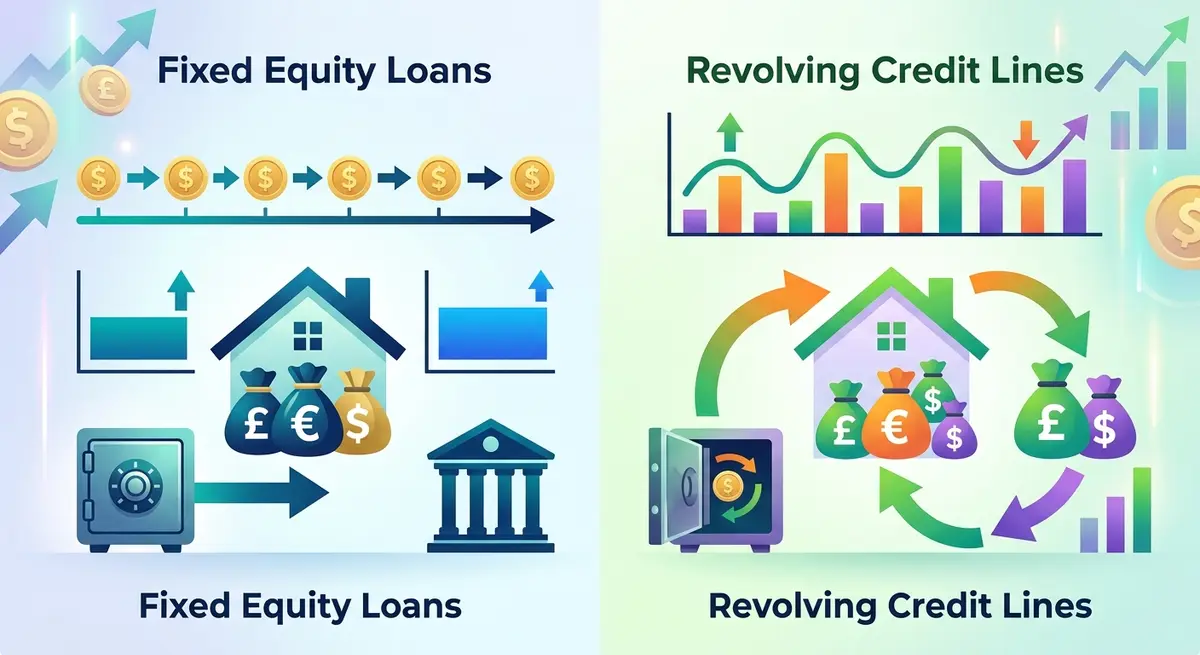
When accessing property wealth, borrowers generally choose between two primary structures: a Home Equity Line of Credit (HELOC) or a traditional lump-sum loan. Selecting the right product depends entirely on your capital needs and repayment preferences.
| Feature | Traditional Equity Loan | HELOC (Line of Credit) |
|---|---|---|
| Fund Disbursement | Single lump-sum payment upfront | Revolving credit, draw as needed |
| Interest Rate | Typically fixed for the term | Variable, tied to the Prime Rate |
| Repayment Structure | Fixed monthly principal and interest | Interest-only minimums during draw period |
| Best Used For | Debt consolidation, single large purchases | Ongoing renovations, emergency funds |
According to the Financial Consumer Agency of Canada, borrowers must carefully evaluate their ability to absorb potential rate hikes if they opt for a variable-rate HELOC, especially in fluctuating economic environments.
Qualification Requirements for Alberta Homeowners
Securing approval for subordinate financing is generally faster than a primary mortgage, but lenders still enforce strict underwriting guidelines to mitigate their risk. The three pillars of qualification are equity, credit history, and income stability.
The Loan-to-Value (LTV) Calculation
Lenders use the Loan-to-Value ratio to determine your maximum borrowing capacity. In Canada, the legal maximum LTV for refinancing and equity borrowing is typically 80%. To calculate your available funds, lenders multiply your home’s current appraised value by 0.80, then subtract your existing mortgage balance.
For example, if your home is appraised at $600,000, 80% of that value is $480,000. If you currently owe $300,000 on your primary mortgage, you have $180,000 in available borrowing power.
Credit and Income Metrics
While traditional banks usually require a minimum credit score of 680, alternative and private lenders often accept scores as low as 620, provided there is substantial equity in the property. Income verification is also crucial. Lenders will calculate your Total Debt Service (TDS) ratio to ensure your total monthly debt obligations do not exceed 42% to 44% of your gross monthly income. For business owners, verifying self-employed income may require Notice of Assessments (NOAs) or specialized stated-income declarations.
The 5-Step Application and Approval Process
Navigating the financing landscape is straightforward when you understand the procedural milestones. The entire process, from initial consultation to funds in your bank account, typically takes 5 to 7 business days.
- Initial Equity Assessment: A broker evaluates your estimated property value and current mortgage balance to provide a preliminary borrowing estimate.
- Document Collection: You must gather income proofs, property tax statements, and existing mortgage details. Reviewing a comprehensive required documentation checklist speeds up this phase.
- Formal Appraisal: A licensed appraiser visits your property to determine its current fair market value. This is a mandatory step to finalize the LTV calculation.
- Underwriting and Approval: The lender reviews the appraisal, credit report, and income documents. Once satisfied, they issue a formal commitment letter detailing the interest rate, term, and conditions.
- Legal Closing and Disbursement: You will meet with a real estate lawyer to sign the final documents. The lawyer registers the new charge on your property title and disburses the funds to your designated accounts (or directly to creditors if consolidating debt).

Understanding the Risks of Subordinate Liens
While leveraging property wealth offers immense benefits, it is not without risk. The most significant consideration is that your home serves as collateral for both loans. Failure to maintain payments on either the primary or secondary loan can result in foreclosure proceedings.
Furthermore, taking on additional debt increases your monthly financial obligations. Borrowers must ensure they have sufficient cash flow to manage the new payments, especially if they choose a variable-rate product where payments can increase alongside the Bank of Canada policy rate. It is highly recommended to explore principal reduction strategies early in the loan term to build a safety buffer and reduce long-term interest costs.
Before committing to a secured loan, borrowers should always compare it against alternative unsecured credit options. While unsecured loans have higher rates, they do not put your property at risk in the event of a financial emergency.
Frequently Asked Questions
What is the minimum equity required to qualify?
You generally need to retain at least 20% equity in your home after the new loan is applied. This means your total combined debt (primary mortgage plus the new loan) cannot exceed 80% of the property’s appraised value.
Can I get approved with bad credit?
Yes, approval is possible with lower credit scores (typically down to 620, or even lower with private lenders). However, lower credit scores represent higher risk to the lender, which will result in higher interest rates and potentially higher setup fees.
How long does the approval process take in 2026?
With digital document submission and automated valuation models, initial pre-approvals can happen within 24 hours. The full process, including the physical appraisal and legal closing, usually takes 5 to 7 business days.
Are the interest payments tax-deductible?
In Canada, interest payments on borrowed money may be tax-deductible if the funds are used for the purpose of earning investment or business income. If you use the funds for personal debt consolidation or personal renovations, the interest is not deductible. Always consult a certified tax professional regarding your specific situation.
Will this affect my primary mortgage?
No. A subordinate loan is a completely separate legal agreement. Your primary mortgage rate, term, and amortization schedule remain entirely unchanged.
What happens when the term ends?
Most fixed-term equity loans have a 1-to-3 year term with a longer amortization period (e.g., 25 years). At the end of the term, you must either pay the remaining balance in full, renew the loan with the current lender at prevailing market rates, or refinance the debt.
Conclusion
Accessing your property’s accumulated wealth through secondary financing is a powerful financial strategy in 2026. Whether your goal is to eliminate high-interest credit card debt, fund a major home renovation, or inject capital into your small business, leveraging your home equity offers a cost-effective alternative to unsecured borrowing. By understanding the qualification metrics, comparing loan structures, and respecting the risks associated with collateralized debt, you can make informed decisions that strengthen your long-term financial health.
If you are ready to explore your borrowing options and find out exactly how much equity you can access, our team of experts is here to guide you through every step of the process. Contact us today for a free, no-obligation equity assessment.