
When a property in Alberta becomes encumbered by several concurrent financial claims, homeowners face immediate risks of legal action and property loss. The definitive solution to resolving multiple simultaneous property encumbrances is securing specialized equity-based financing, which leverages the remaining appraised value of the real estate to systematically pay out or subordinate the existing claims. By restructuring these debts into a single manageable facility, property owners can halt enforcement actions, discharge restrictive caveats, and regain full control over their title.
Key Takeaways
- Priority of Claims: The order of lien registration dictates repayment priority, with municipal taxes and certain Crown debts holding super-priority over standard mortgages.
- Equity Utilization: Specialized financing uses the home’s accrued value to discharge simultaneous judgments, caveats, and tax arrears.
- Legal Enforcement Halt: Consolidating claims immediately stops aggressive collection tactics, including forced sales and Certificates of Lis Pendens.
- Cost Mitigation: Paying out multiple creditors reduces the compounding legal fees associated with multi-party enforcement actions.
- Restored Solvency: This financial strategy provides a structured exit plan, transitioning distressed debt into a unified, predictable payment schedule.
The Mechanics of Multiple Property Encumbrances in 2026
Navigating the modern real estate landscape in Calgary requires a deep understanding of how various debts attach to a property title. Unlike a standard mortgage, a property lien is a legal right or interest that a creditor has in another’s property, lasting usually until a debt or duty that it secures is satisfied. When a homeowner experiences compounded financial distress, it is common for multiple creditors to register claims simultaneously. This creates a complex web of liabilities that traditional lending institutions typically refuse to touch.
Data from Statistics Canada confirms that Canadian household debt as a percentage of disposable income has persistently hovered around the 180% mark over recent years. In a highly leveraged environment, an income disruption can quickly trigger missed payments across various sectors—leading to municipal tax arrears, unpaid contractor invoices, and defaulted unsecured loans, all of which can eventually manifest as registrations on a property title.
The presence of multiple liens fundamentally impairs the marketability of a title. Without a clear title, a homeowner cannot sell the property or refinance through conventional banking channels. Specialized equity financing becomes the only viable mechanism to bypass the strict underwriting parameters of primary banks and address the encumbrances directly.
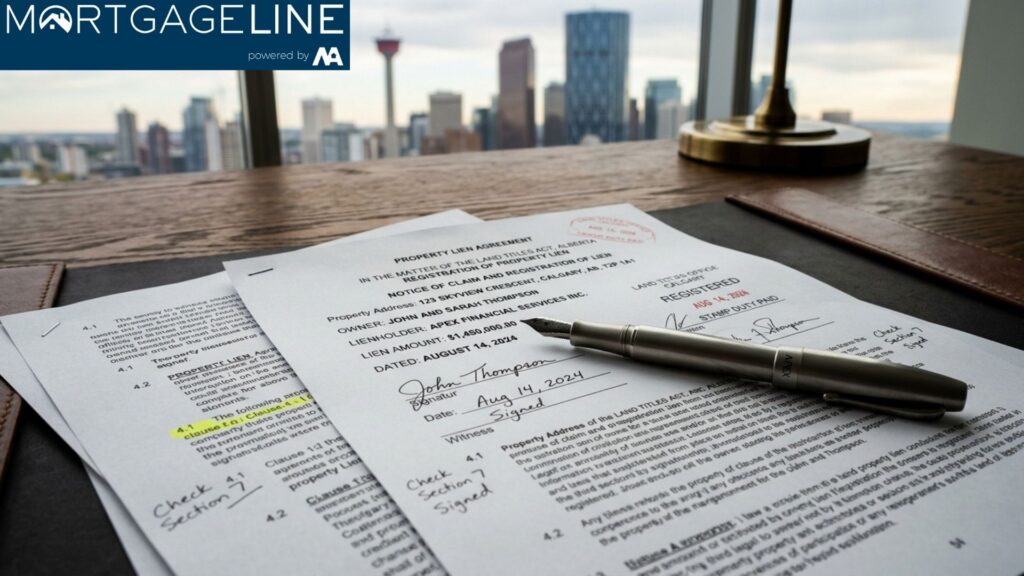
Hierarchy of Claims on Calgary Real Estate
In Alberta, the Land Titles Act governs the registration and priority of interests in land. Understanding this hierarchy is crucial when structuring a rescue loan, as the new lender needs to know exactly which debts must be paid out to secure their position. The general rule is chronological priority—meaning the first to register is the first to be paid—but there are critical statutory exceptions.
First, municipal property taxes hold an absolute super-priority. If a homeowner falls behind, the municipality can initiate recovery processes that supersede even the first mortgage. Therefore, provincial tax arrears solutions and municipal payouts are always prioritized in any equity consolidation plan.
Second, condominium corporations wield significant power under the Condominium Property Act. Unpaid assessments can be registered against the title and often take precedence over standard mortgages, making the process of resolving unpaid condo fees a top priority to prevent rapid legal escalation.
Third, claims from the Canada Revenue Agency (CRA) can attach to the property. Finally, private creditors, collection agencies, and contractors follow. For instance, contractors can register builders’ liens for unpaid work, and homeowners must act quickly in halting mechanics lien enforcement before the property is forced into a judicial sale.
How Equity Rescue Financing Reestablishes Solvency
Equity-based lending focuses primarily on the underlying asset’s value rather than the borrower’s immediate credit score or income stability. When multiple liens are present, the property’s Loan-to-Value (LTV) ratio is calculated by taking the sum of the first mortgage and all registered liens, divided by the current appraised value.
As the Bank of Canada formally noted in its Financial System Review, “Vulnerabilities associated with elevated household debt remain high.” For heavily indebted households facing multiple legal claims, a rescue loan acts as a financial circuit breaker. The specialized lender advances funds specifically allocated in trust to the borrower’s legal counsel. The lawyer then requests payout statements from every registered creditor, disburses the funds, and obtains registrable discharges for each caveat and lien.
The result is a clean title, carrying only the original first mortgage and the new, consolidated equity loan. This structure stops the compounding interest and aggressive legal fees that multiple creditors would otherwise accumulate.
Comparing Remediation Options
When multiple creditors are aggressively pursuing a Calgary property, homeowners have limited options. The table below illustrates why equity rescue loans are uniquely suited for complex title issues compared to traditional pathways.
| Feature | Traditional Refinance | Unsecured Loan | Equity Rescue Loan |
|---|---|---|---|
| Approval Metric | Credit Score & Income | Strict Credit History | Available Property Equity |
| Accepts Existing Liens? | No (Requires Clean Title) | Yes, but limits are very low | Yes (Designed for Payout) |
| Funding Speed | 30 to 60 Days | Fast, but rarely sufficient | 7 to 14 Days |
| Stops Legal Action | Too slow to halt enforcement | Ineffective for large debt | Immediate upon commitment |

Legal Procedures Surrounding Enforcement
If simultaneous liens are ignored, creditors will eventually force a sale to recover their funds. In Alberta, this process is highly structured and overseen by the judiciary. A creditor will typically file a Statement of Claim, followed by registering a Certificate of Lis Pendens (CLP) on the title, which serves as public notice of pending litigation.
As the legal process advances, hearings are scheduled. Homeowners must understand the function of Master in Chambers foreclosure hearings, where initial procedural decisions, including redemption periods, are mandated. If the debt remains unsatisfied, the file may escalate, requiring intervention through Court of King’s Bench proceedings. Navigating these judicial layers is extremely stressful and expensive.
According to the Canadian Bankers Association, while national mortgage arrears rates historically remain low, localized economic pressures in specific provinces require careful monitoring. Calgary homeowners facing these overlapping legal actions must act decisively before the courts grant an Order for Sale, at which point control of the property is relinquished to the creditors.
Step-by-Step: Consolidating Property Debt
Executing a rescue loan to clear a clustered title requires precision and professional coordination. Homeowners should follow this formalized sequence:
- Accurate Valuation: Before applying, the exact market value of the home must be determined. Lenders strictly follow property appraisal guidelines to calculate the available equity.
- Title Search and Discovery: Legal counsel pulls the current land title to identify every registered caveat, writ, and lien. This uncovers the total scope of the encumbrances.
- Requesting Payout Statements: The lawyer contacts each creditor to obtain binding payout statements. These documents state the exact numerical figure required to discharge the debt as of a specific closing date.
- Structuring the Loan: The specialized lender approves a facility large enough to cover the sum of all payout statements, plus any required legal and administrative fees.
- Disbursement and Discharge: Upon funding, the lawyer directly pays the creditors from the trust account. The creditors then provide discharge documents, which are registered at the Land Titles Office, effectively clearing the title.
Navigating Specialized Encumbrances in Calgary
Not all liens are treated equally, and understanding the specific nature of each claim is vital to a successful debt restructuring.
Clearing Collection Agency Writs
Unsecured debts, such as credit cards or personal loans, can eventually become secured against your home if a collection agency successfully sues and obtains a judgment. These judgments are registered as Writs of Enforcement. Proactively clearing collection agency liens through an equity injection prevents these relatively small debts from triggering a massive property seizure.
Managing Builders’ and Mechanics’ Liens
Contractor disputes frequently result in builders’ liens. Under the Alberta Builders’ Lien Act, these must be registered within specific statutory timeframes. If a homeowner disputes the quality of the work but faces a forced sale due to the lien, equity financing can be used to pay the disputed funds into court. This clears the title while the dispute is litigated independently of the real estate.

The Financial Impact: Costs and Considerations
While equity rescue financing is highly effective, it is a specialized financial product that carries specific costs. Because the lender is taking on a risk profile that primary banks reject, the interest rates reflect this augmented risk. Furthermore, the administrative process of coordinating multiple payouts involves distinct legal costs associated with foreclosure and title clearing.
According to official guidelines from the Canada Mortgage and Housing Corporation (CMHC), accessing existing equity remains a primary mechanism for homeowners to consolidate high-interest liabilities during periods of financial strain. The initial setup costs of a rescue loan must be weighed against the disastrous financial consequences of losing the property altogether.
When multiple creditors are involved, each is adding their own legal fees, late penalties, and interest to the homeowner’s burden. By consolidating everything into one loan, the homeowner immediately stops the financial bleeding. The long-term strategy always involves using the rescue loan as a bridge—restoring credit over 12 to 24 months, and eventually refinancing back into a traditional, lower-rate mortgage once the title has remained clean and credit scores have rebounded.
Frequently Asked Questions
Can I get an equity loan if my credit score has been severely damaged?
Yes. Specialized equity lenders focus primarily on the appraised value of the property and the amount of equity available, rather than strict credit score requirements.
How fast can a multiple-lien buyout be funded?
Depending on how quickly the current creditors provide accurate payout statements, these transactions can typically be funded and closed within 7 to 14 business days.
Do I need to deal with the creditors directly?
No. Once the legal process begins, your real estate lawyer will communicate with the creditors to request payout statements and negotiate the discharges, shielding you from aggressive collection calls.
What happens if the total liens exceed my home’s value?
If the liabilities exceed the property value (negative equity), an equity rescue loan is not viable. Homeowners in this position must consult with a Licensed Insolvency Trustee to explore consumer proposals or bankruptcy.
Will the new loan have a higher interest rate?
Yes, because it is an alternative lending product designed to solve complex legal and title issues, the interest rates are higher than conventional bank mortgages. It is designed as a short-term transitional tool.
Conclusion
Dealing with multiple simultaneous liens on a Calgary property is a severe financial crisis that demands immediate and strategic intervention. Traditional lenders are unequipped to handle the complexities of clustered title encumbrances, leaving specialized home equity rescue loans as the most effective mechanism to halt legal enforcement and regain financial stability. By leveraging the built-in wealth of the property, homeowners can systematically discharge tax arrears, condo liens, judgments, and builder caveats, consolidating chaotic debt into a single, structured pathway forward. If you are facing compounding legal claims against your property, do not wait until the courts strip away your control. Contact our team today to explore your equity options and secure your home’s title.