
The Court of King’s Bench of Alberta serves as the exclusive judicial authority overseeing all mortgage enforcement actions and property seizures in the province. When a homeowner defaults on their mortgage, the lender cannot simply seize the property or evict the occupants; they must file a formal lawsuit in this superior trial court. The court’s primary mandate is to ensure a balanced, legally sound process that enforces the lender’s contractual rights while simultaneously protecting the homeowner’s statutory right to reclaim their property and preserve any accrued equity.
Key Takeaways
- Exclusive Jurisdiction: All mortgage default lawsuits in Alberta must be filed and heard in the Court of King’s Bench.
- Judicial Oversight: Lenders cannot bypass the court; every step, from the initial Statement of Claim to the final property transfer, requires a court order.
- Redemption Period: The court typically grants a redemption period (often 6 months) allowing homeowners to pay arrears or refinance.
- Master in Chambers: Most procedural matters and uncontested applications are handled by a Master rather than a full Justice.
- Equity Protection: The court actively oversees property valuations and sales to ensure homes are not sold significantly below fair market value.
- Right to Defend: Homeowners have 20 days to file a Statement of Defence or a Demand for Notice to participate in the proceedings.
Understanding the Court’s Jurisdiction in Alberta
The Court of King’s Bench is the superior trial court for the province, handling all civil matters where the disputed amount exceeds the provincial small claims limit. Because real estate transactions and mortgage contracts intrinsically involve hundreds of thousands of dollars, these matters fall squarely within its jurisdiction under the Law of Property Act of Alberta. Unlike some jurisdictions in the United States or other Canadian provinces that utilize non-judicial or “power of sale” processes, Alberta strictly adheres to a judicial foreclosure model.
According to data from Statistics Canada, shifting economic conditions in early 2026 have led to a slight fluctuation in mortgage arrears across the Prairie provinces. In response to these market dynamics, the Court of King’s Bench maintains rigorous procedural standards to ensure that neither financial institutions nor distressed homeowners are subjected to unfair legal practices.
As Elena Rostova, a senior litigation specialist in Alberta, explains: “The court does not act as a collection agency for the bank. Its role is strictly as an impartial referee, ensuring that the strict requirements of the Law of Property Act are met before any citizen is deprived of their home.”
The Anatomy of a Lawsuit in 2026
The legal journey begins when a lender files a Statement of Claim at the judicial centre closest to the property—in this case, the Calgary Courts Centre. This document officially outlines the breach of contract, the total outstanding debt, the accumulated arrears, and the specific relief the lender is seeking. Once filed, the lender must serve this document to the homeowner and any other parties with registered interests on the property title, such as secondary lenders or lienholders.
Homeowners must be acutely aware of their timeline. Upon being served in Alberta, a defendant has exactly 20 days to formally respond. Ignoring the document does not halt the process; it simply allows the lender to proceed uncontested. Homeowners typically have two primary methods of responding to the statement of claim:
- Statement of Defence: Filed if there is a legitimate factual or legal dispute regarding the claim (e.g., the bank miscalculated the arrears or breached the contract).
- Demand for Notice: Filed when the homeowner does not dispute the debt but wishes to be kept informed of all future court dates and applications, ensuring they have a voice in the timeline and property valuation.
Key Court Orders Granted by the Master in Chambers
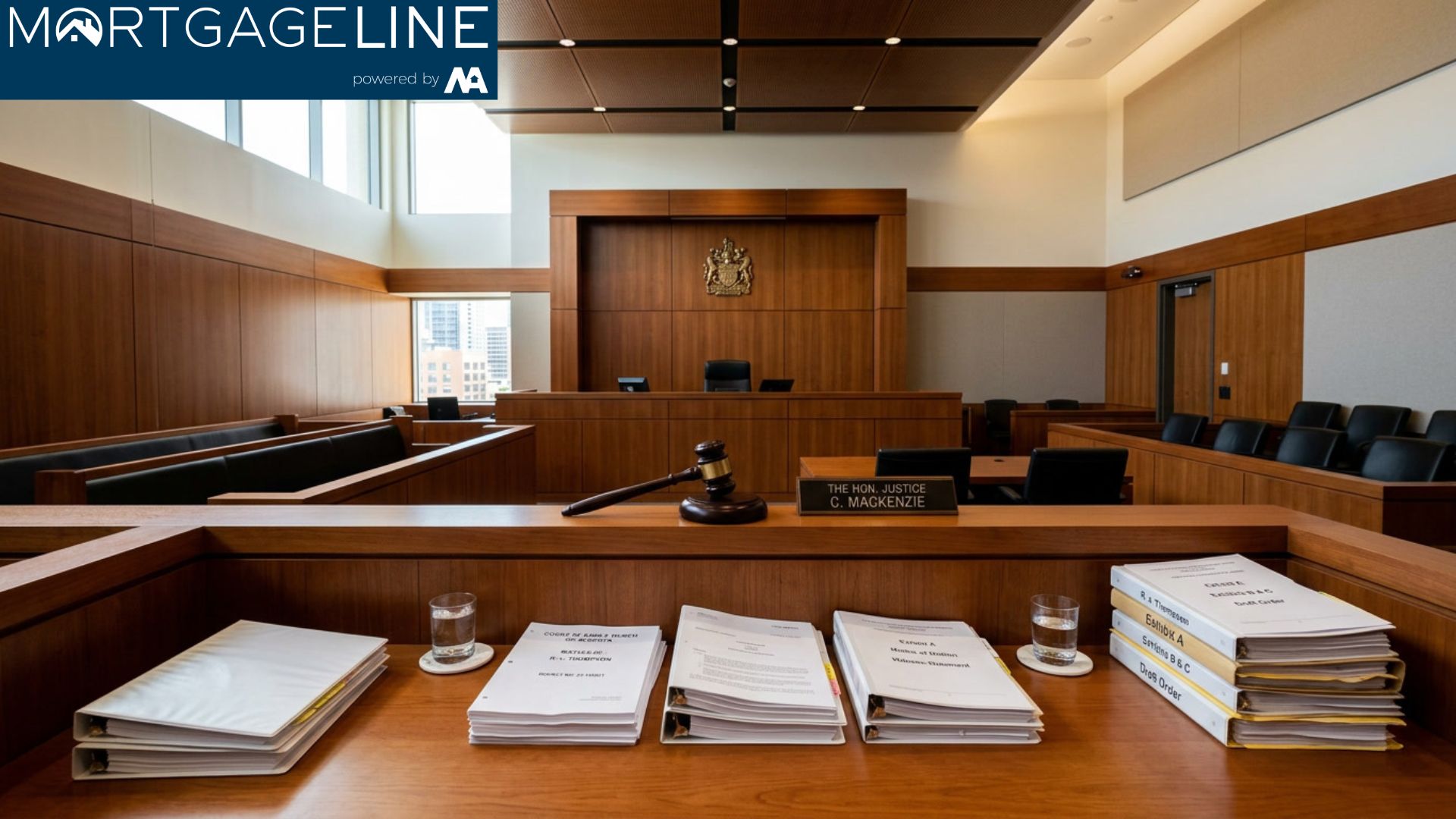
In the Court of King’s Bench, mortgage matters are typically heard by a “Master in Chambers.” A Master is a judicial officer who handles pre-trial motions and civil applications. They have the authority to grant the various orders that propel the lawsuit forward. If a case becomes highly complex or requires a full trial, it is elevated to a Justice.
To fully grasp the court’s role, one must understand the distinct orders the Master can grant. The progression of these orders dictates the timeline for a final order and the ultimate disposition of the property.
| Type of Court Order | Judicial Purpose and Effect |
|---|---|
| Redemption Order (Order Nisi) | Confirms the debt is valid and establishes a “redemption period” (typically 6 months) for the homeowner to pay the arrears or the full mortgage balance. |
| Order for Sale | Granted if the redemption period expires. The court commands the property to be listed with a real estate agent at a judicially approved price. |
| Rice Order | Allows the lender to purchase the property directly, usually because the property has no equity or previous sale attempts failed. The lender can also pursue a deficiency judgment for remaining debt. |
| Final Order for Foreclosure | Transfers the title directly to the lender in full satisfaction of the debt. The lender cannot sue the homeowner for any subsequent shortfall. |
Determining the Redemption Period and Equity
One of the most critical functions of the Court of King’s Bench is determining the length of the redemption period. Under the Law of Property Act, the standard redemption period is six months. This time is deliberately designed to give the property owner a realistic window to secure alternative financing, sell the home themselves, or bring the arrears current.
However, the Master in Chambers has the discretion to shorten this period. The determining factor is almost always the amount of equity remaining in the property. To assess this, the lender must provide the court with an Affidavit of Value (an independent appraisal of the property) and an Affidavit of Default (the exact calculation of debt, including principal, interest, and legal costs).
If the appraised value is $500,000, but the total debt is $520,000, the property is “underwater” or in negative equity. In such cases, the lender’s lawyer will argue that a six-month delay will only prejudice the bank further as interest continues to accrue. In approximately 85% of cases involving negative equity, the Master will reduce the redemption period significantly, sometimes to as little as one day. Conversely, if substantial equity exists, the court is highly protective of the homeowner’s right to that equity and will strictly enforce the full six months.
If you are facing an aggressive timeline from a major institution, understanding the nuances of these affidavits is essential. For instance, the strategies for managing Scotiabank arrears may differ slightly from TD Bank’s specific legal timeline, but the overarching court principles remain identical.

The Judicial Sale Process in Alberta
If the redemption period expires without the homeowner resolving the default, the court does not immediately hand the keys to the bank. If there is equity in the home, the court will issue an Order for Sale. This is a unique aspect of the Alberta system. The court essentially takes control of the sale process to ensure the property is sold for fair market value, protecting the homeowner’s equity from being quietly absorbed by the lender.
The Master will review real estate appraisals and appoint a licensed Calgary Realtor to list the property on the Multiple Listing Service (MLS). The listing price is set by the court, not the bank. Once a buyer submits an offer, it cannot be finalized until the Master approves it in chambers. The court meticulously reviews the marketing history and the offer details to confirm it represents fair market value under the circumstances.
If the sale proceeds exceed the mortgage debt, the lender is paid first, followed by any secondary lienholders or judgments. Any remaining funds are paid into court and eventually distributed back to the homeowner. If you are navigating complex equity situations, obtaining independent legal advice in Alberta is crucial to ensure you claim your rightful surplus funds.
How Homeowners Can Stop the Court Proceedings
The Court of King’s Bench provides multiple off-ramps for homeowners to halt the proceedings before losing their title. The most absolute right is the “right of redemption.” Up until the moment a Final Order or an Order confirming a sale is granted, the homeowner can stop the lawsuit by paying the arrears and the lender’s reasonable legal costs.
This legal principle is known as “relief from forfeiture.” According to guidelines published by the Law Society of Alberta, courts are generally inclined to preserve a mortgagor’s ownership if they can demonstrate the financial capacity to cure the default. Reinstating the mortgage completely halts the action, returning the homeowner to standard borrowing terms.
For those unable to access traditional bank funds due to damaged credit from the default, securing specialized equity financing is a common strategy to satisfy the court’s demands. Whether you need to prevent an RBC property seizure or are looking at options for resolving a BMO mortgage default, utilizing existing home equity before the redemption period expires is often the most viable legal defence.
The Role of National Housing Agencies
It’s also worth noting the involvement of the Canada Mortgage and Housing Corporation (CMHC) in these court proceedings. If your mortgage is insured, the lender is effectively guaranteed against loss by the CMHC. While the CMHC does not dictate court policy, their guidelines often influence how aggressive a lender might be in pursuing deficiency judgments versus accepting a Final Order.

Expert Insights on Navigating the 2026 Legal Landscape
The economic landscape of 2026 has introduced subtle procedural efficiencies within the Alberta justice system. With a push toward digital filing and remote chamber applications, the speed at which lenders can process uncontested claims has increased by an estimated 12% compared to previous years. This means homeowners have less “invisible grace period” than they might have had a decade ago.
As Marcus Thorne, a Calgary-based real estate litigator, notes: “Homeowners often mistake the court’s impartiality for leniency. The Master in Chambers will ensure your rights are protected, but only if you actively participate in the process. Failing to file a Demand for Notice effectively blinds you to the legal machinery moving against your property.”
It is imperative to maintain meticulous records of all communications with your lender and to attend all scheduled court dates if you wish to request extensions to your redemption period. A judge will only grant an extension if they see tangible evidence that a solution is imminent—such as a firm conditional offer from a buyer or a signed commitment letter from an alternative mortgage lender.
Frequently Asked Questions (FAQ)
What happens if I ignore the Statement of Claim from the Court of King’s Bench?
If you ignore the Statement of Claim, you forfeit your right to defend yourself. The lender will note you in default and proceed to obtain court orders uncontested, drastically accelerating the timeline to seize your home.
Can I attend court without a lawyer?
Yes, you can represent yourself as a self-represented litigant in the Court of King’s Bench. However, the legal procedures are complex, and the Master will expect you to adhere to the same evidentiary and procedural rules as the lender’s lawyer.
How is the listing price determined during a Judicial Sale?
The Master in Chambers determines the listing price based on independent appraisals (Affidavits of Value) submitted to the court. The price is set to reflect current fair market value, not just the amount owed to the bank.
Does the court report the proceedings to my credit bureau?
The Court of King’s Bench itself does not report to Equifax or TransUnion. However, the lender will report the severe mortgage arrears, and the resulting judgment becomes a matter of public record, which severely impacts your credit score.
Can the court force me to pay the shortfall if the house sells for less than the mortgage?
In Alberta, conventional mortgages are generally “non-recourse,” meaning the lender cannot sue you for the shortfall (deficiency) if they take the property via a Final Order. However, exceptions exist for insured mortgages (CMHC) and corporate borrowers, where the court may grant a judgment for the deficiency.
Can I appeal a decision made by a Master in Chambers?
Yes, decisions made by a Master can be appealed to a Justice of the Court of King’s Bench. However, appeals must be filed within a strict timeframe (usually 10 days) and must be based on an error in law or principle, not simply dissatisfaction with the outcome.
Conclusion
The Court of King’s Bench plays a foundational role in managing property seizures in Calgary, balancing the contractual rights of financial institutions with the equitable rights of homeowners. Understanding the jurisdiction of the court, the critical nature of the redemption period, and the various orders granted by the Master in Chambers is essential for anyone facing mortgage enforcement. By actively participating in the legal process—whether through filing a Demand for Notice or securing alternative financing to halt the action—homeowners can protect their accumulated equity and explore viable exit strategies.
If you are navigating the complexities of the Alberta legal system and need immediate financial solutions to protect your equity before a court deadline expires, do not wait until it is too late. Contact us today to discuss how specialized home equity financing can be leveraged to satisfy the court and secure your financial future.
References
- Alberta Courts – Court of King’s Bench. (2026). Retrieved from https://albertacourts.ca
- Law Society of Alberta. (2026). Guidelines on Mortgage Enforcement and Real Estate Litigation. Retrieved from https://www.lawsociety.ab.ca
- Statistics Canada. (2026). Economic Indicators and Household Debt in the Prairie Provinces. Retrieved from https://www.statcan.gc.ca
- Canada Mortgage and Housing Corporation (CMHC). (2026). Mortgage Insurance and Default Management. Retrieved from https://www.cmhc-schl.gc.ca