The eviction process after a foreclosure in Calgary is a legally structured sequence that begins when a lender obtains a Final Order for Foreclosure from the Alberta Court of King’s Bench. Following this judicial order, the court issues a Writ of Possession, which mandates that the occupants must vacate the property, typically within 30 days. If the residents do not leave voluntarily by the specified deadline, a licensed civil enforcement agency is legally authorized to physically remove the occupants, change the property locks, and officially transfer full possession to the lender.
Key Takeaways
- Alberta law strictly requires lenders to obtain a court-issued Writ of Possession before any physical eviction can legally occur.
- Homeowners typically receive a 6-month redemption period to settle their arrears before a final foreclosure order is granted.
- Once a Notice of Possession is officially served, occupants generally have a strict 30-day window to vacate the premises.
- Tenants residing in a foreclosed property are protected under the Alberta Residential Tenancies Act and must receive 90 days’ notice to move.
- Proactive negotiation, such as refinancing or requesting a payment deferral, can halt the eviction process if initiated early in the delinquency cycle.
- Civil enforcement bailiffs are the only entities legally permitted to physically remove individuals or belongings from a foreclosed home.
Understanding the Foreclosure and Eviction Timeline in Alberta
In 2026, the economic landscape in Calgary has prompted many homeowners to seek a deeper understanding of property laws. When a homeowner falls behind on mortgage payments, the transition from missed payments to physical displacement is not instantaneous. The Alberta judicial system is designed to provide borrowers with multiple opportunities to rectify their financial standing.
The process is heavily regulated to prevent arbitrary displacement. Lenders cannot simply lock a borrower out of their home after a few missed installments. Instead, they must navigate a rigorous legal framework that balances the creditor’s right to recover funds with the homeowner’s right to due process.
The Initial Default and Legal Notices
The journey toward potential eviction begins with the initial default. According to the Financial Consumer Agency of Canada (FCAC), a mortgage is technically in default the day after a missed payment. However, most lenders in Calgary wait until an account is 30 to 60 days delinquent before issuing a formal demand letter.
If the arrears remain unpaid, the lender’s legal counsel will file a Statement of Claim at the courthouse. This document officially initiates the lawsuit. Understanding the difference between a Notice of Default vs. Statement of Claim in Alberta is crucial, as the latter requires a formal legal response within 21 days to prevent a default judgment.
The Redemption Period Explained
Once the court validates the lender’s claim, it typically issues a Redemption Order. This order establishes a specific timeframe—usually six months in Alberta—during which the homeowner can pay the outstanding arrears, plus legal fees, to halt the foreclosure entirely.
“Many Calgary residents mistakenly believe a foreclosure notice means immediate eviction. In reality, Alberta’s judicial process builds in a redemption period specifically designed to give homeowners a fighting chance,” explains Sarah Jenkins, Lead Foreclosure Advisor at The Second Mortgage Store. During this phase, exploring Alberta foreclosure redemption periods can help borrowers strategize their financial recovery.
The Legal Steps to Eviction: From Court Order to Writ of Possession
If the redemption period expires without the debt being settled, the lender will apply for a Final Order for Foreclosure. This is the critical juncture where ownership officially transfers from the borrower to the financial institution. Once this transfer occurs, the former homeowner becomes an unauthorized occupant in the eyes of the law.
To remove the occupants, the lender must follow a precise sequence of legal actions. Skipping any of these steps can result in severe legal penalties for the financial institution and delays in the property recovery process.
Step-by-Step Eviction Execution
- Issuance of the Final Order: The Court of King’s Bench grants the lender full title to the property, extinguishing the borrower’s ownership rights.
- Service of the Notice of Possession: The lender serves the occupants with a formal notice, typically granting them 30 days to voluntarily pack their belongings and vacate the premises.
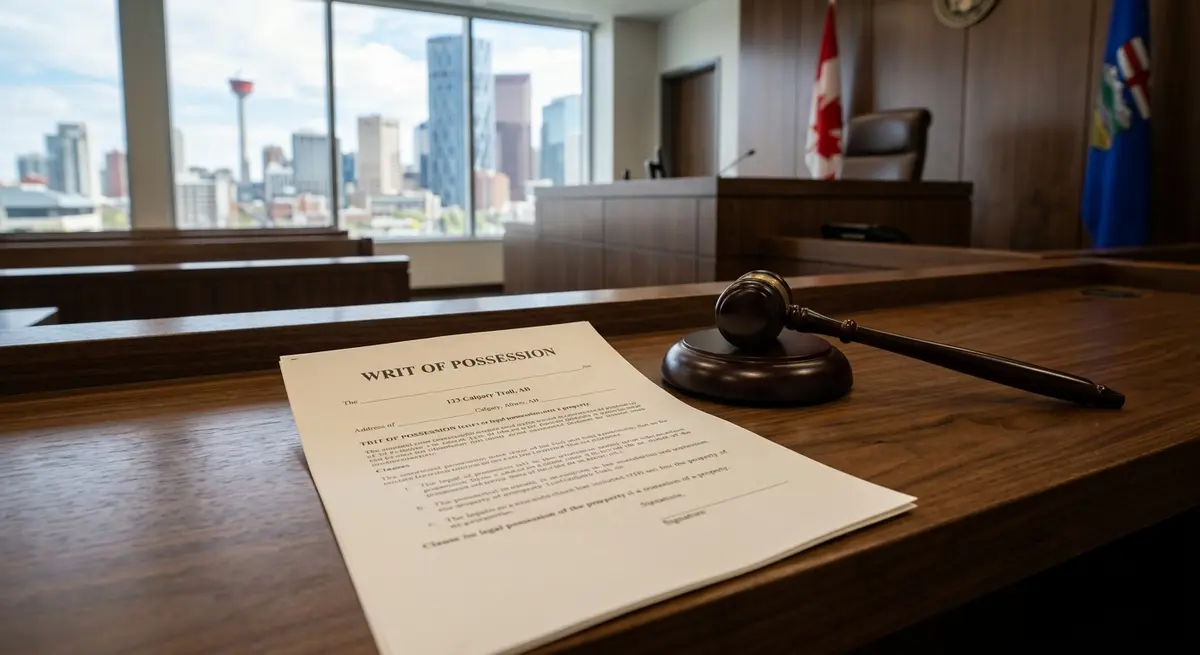
- Application for a Writ of Possession: If the occupants refuse to leave after the 30-day window, the lender’s lawyer applies to the court for a Writ of Possession.
- Engagement of Civil Enforcement: The lender hires a licensed civil enforcement agency. These bailiffs serve the Writ on the occupants, providing a final 7 to 14-day warning.
- Physical Eviction: On the scheduled date, bailiffs arrive at the property, physically remove any remaining occupants, and immediately change the locks.
The Role of Civil Enforcement Agencies in Alberta
It is a common misconception that local police handle foreclosure evictions. In Alberta, the physical removal of occupants is exclusively the jurisdiction of private, licensed civil enforcement agencies. These professionals operate under the strict guidelines of the Alberta Civil Enforcement Act.
Bailiffs are trained to handle high-stress situations professionally and safely. If an occupant becomes violent or refuses to comply with the bailiff’s orders, the local Calgary Police Service may be called to assist, but only to keep the peace and ensure the safety of all parties involved.
Understanding the Final Order of Foreclosure timeline in Calgary is essential for homeowners to anticipate when these enforcement agencies might become involved. Ignoring correspondence from a bailiff is one of the most detrimental mistakes a displaced homeowner can make.
Judicial Foreclosure vs. Power of Sale in Calgary
When lenders seek to recover their funds, they generally utilize one of two primary legal mechanisms: Judicial Foreclosure or Power of Sale. While both can ultimately lead to eviction, the timelines, legal oversight, and financial outcomes for the borrower differ significantly.
In 2026, data indicates that while judicial foreclosures remain the standard in Alberta, power of sale clauses are increasingly utilized by private lenders seeking faster resolutions. Knowing which process your lender is pursuing dictates how much time you have before eviction becomes a reality.
| Feature | Judicial Foreclosure | Power of Sale |
|---|---|---|
| Average Timeline to Eviction | 12 to 18 months | 4 to 6 months |
| Court Involvement | Mandatory at every stage | Minimal to none |
| Handling of Property Equity | Lender retains title and equity | Surplus funds returned to borrower |
| Average Legal Costs | $8,000 – $12,000 | $3,000 – $5,000 |
If you are facing a complex property dispute, understanding the nuances between foreclosure vs. quiet title actions in Alberta can also provide clarity on how ownership is legally contested and resolved in provincial courts.
How Eviction Impacts Homeowners and Tenants
The psychological and logistical toll of a forced relocation cannot be overstated. For homeowners, the loss of the property is compounded by the immediate need to secure alternative housing with a severely damaged credit profile. Landlords conducting background checks will see the recent foreclosure, making renting a new property exceptionally difficult.
However, the situation is uniquely complex when the foreclosed property is occupied by renters rather than the owner. Tenants often find themselves caught in the crossfire of a financial dispute to which they are not a party.
Tenant Rights Under the Alberta Residential Tenancies Act
Renters in Alberta are afforded specific protections under the law. According to Service Alberta, a lender who takes possession of a tenanted property effectively becomes the new landlord. They cannot simply evict the tenants with a 30-day notice.
“Tenants are often the collateral damage in foreclosure proceedings. However, the 2026 updates to the Residential Tenancies Act ensure they cannot be displaced overnight,” notes Marcus Thorne, a Calgary-based real estate litigator. If the lender wishes to sell the property vacant, they must provide the tenants with a minimum of 90 days’ written notice to terminate the tenancy.

Strategic Alternatives to Halt the Eviction Process
The most effective way to handle an eviction is to prevent the foreclosure from reaching its final stages. Homeowners have several strategic avenues available to them, provided they act swiftly. Ignoring the problem inevitably accelerates the legal timeline and limits available options.
“Early intervention is the single most effective tool against property loss. Once a Writ of Possession is issued, the legal avenues for homeowners shrink dramatically,” says David Chen, Senior Financial Analyst at the Canadian Mortgage and Housing Corporation (CMHC). Taking proactive steps can preserve both your housing stability and your financial future.
Negotiating with Lenders and Refinancing
Communication is your first line of defense. Many financial institutions prefer to avoid the costly and time-consuming foreclosure process. By contacting your lender’s loss mitigation department, you may be able to negotiate a forbearance agreement, which temporarily pauses your payments, or a loan modification that extends your amortization period to lower monthly costs.
If your current lender is unwilling to negotiate, seeking alternative financing is the next logical step. Exploring second mortgages vs. cash-out refinancing in Calgary can provide the capital needed to pay off the arrears and halt the legal proceedings entirely. Private lenders are often more flexible than traditional banks when dealing with distressed properties.
Legal Interventions and Consumer Proposals
If refinancing is not viable, legal and insolvency tools can offer a lifeline. Filing a formal defense to the Statement of Claim can force the lender to prove every aspect of their case, potentially buying the homeowner several additional months to secure funds. It is highly recommended to seek professional guidance when responding to a foreclosure Statement of Claim in Calgary.
Alternatively, filing a consumer proposal or declaring bankruptcy triggers an automatic stay of proceedings. This legal mechanism immediately halts all collection actions, including foreclosure and eviction, allowing the homeowner to restructure their debts under the supervision of a Licensed Insolvency Trustee.
The Financial Aftermath: Credit Scores and Deficiency Judgments
The consequences of a foreclosure extend far beyond the physical eviction. The financial reverberations can impact a borrower’s economic mobility for nearly a decade. According to Equifax Canada, a foreclosure remains on a consumer’s credit report for six to seven years from the date of the first missed payment.
This negative reporting typically causes a credit score to plummet by 150 to 250 points. Such a drastic drop makes it incredibly difficult to secure future mortgages, auto loans, or even premium credit cards. Furthermore, the borrower may still owe money even after the house is taken.
Understanding Deficiency Judgments
If the lender sells the foreclosed property for less than the outstanding mortgage balance, they may pursue the borrower for the difference. This is known as a deficiency judgment. For example, if you owe $400,000 and the home sells at auction for $350,000, the lender can legally garnish your wages or seize other assets to recover the remaining $50,000.
Alberta law has specific provisions regarding when a lender can and cannot pursue these shortfalls. Conventional mortgages (those with a 20% or more down payment) are generally non-recourse in Alberta, meaning the lender cannot sue for the deficiency. However, insured mortgages (CMHC) are recourse loans. Navigating deficiency judgment calculations after foreclosure in Alberta is vital for understanding your true financial liability post-eviction.

Conclusion
Navigating the eviction process after a foreclosure in Calgary is an intensely stressful experience, but understanding the legal timeline empowers homeowners to make informed decisions. From the initial Notice of Default to the final execution of a Writ of Possession by civil enforcement bailiffs, Alberta law provides specific windows of opportunity for borrowers to intervene.
Whether through negotiating a redemption period, securing alternative financing, or understanding your rights as a tenant, proactive action is your greatest asset. Ignoring legal notices will only accelerate displacement and compound financial damage through deficiency judgments and severe credit impacts.
If you are facing the threat of property loss, you do not have to navigate this complex legal landscape alone. Early intervention can open doors to solutions you may not have realized were available. Contact our team today to explore tailored financial strategies and protect your home.
Frequently Asked Questions (FAQ)
How long does the eviction process take after foreclosure in Calgary?
The timeline varies based on court schedules and the specific legal route taken by the lender. After a final foreclosure order is granted, occupants typically have 30 days to vacate. If a Writ of Possession is required, civil enforcement can execute the eviction within an additional 7 to 14 days.
Can a lender physically remove me from my home?
No, a bank or private lender cannot physically remove you or change your locks themselves. They must obtain a Writ of Possession from the court and hire a licensed civil enforcement agency to legally execute the eviction in Alberta.
What happens to my belongings if I am evicted?
If you do not remove your personal property before the bailiffs arrive, the civil enforcement agency will secure the items. You will typically be given a brief, supervised window to retrieve essential belongings, but the remaining items may be stored at your expense or eventually sold to cover costs.
Are tenants protected if their landlord is foreclosed upon?
Yes, tenants have robust protections under the Alberta Residential Tenancies Act. The new owner (the lender) must honor the existing lease or provide a minimum of 90 days’ written notice if they intend to terminate the tenancy to sell the property vacant.
Can I stop an eviction once the Writ of Possession is issued?
Stopping an eviction at this late stage is extremely difficult and requires immediate emergency legal intervention. Filing for bankruptcy or a consumer proposal can trigger a stay of proceedings, but you must consult with a Licensed Insolvency Trustee and a lawyer immediately.
How does a foreclosure eviction affect my credit score?
A foreclosure is one of the most damaging events that can occur on a credit profile, typically causing a score to drop by 150 to 250 points. The record of the foreclosure will remain on your Equifax and TransUnion reports for six to seven years.
What is a redemption period in Alberta?
A redemption period is a court-ordered timeframe, usually lasting six months, granted to the homeowner after a Statement of Claim is validated. During this time, the homeowner has the legal right to pay off the mortgage arrears and legal fees to completely halt the foreclosure process.
Will I still owe money after the bank takes my house?
It depends on your mortgage type. If you have a conventional, uninsured mortgage in Alberta, it is typically non-recourse, meaning the lender cannot sue for a shortfall. However, if your mortgage is insured by the CMHC, the lender can pursue a deficiency judgment for any remaining balance after the property is sold.