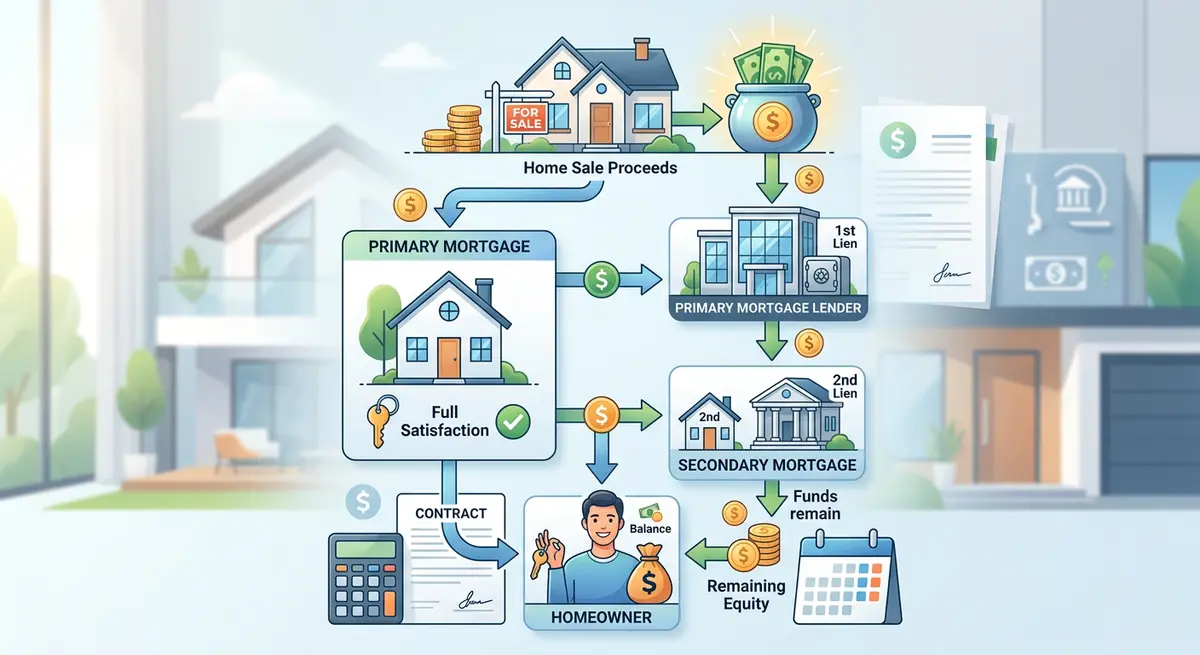
When you sell a property carrying multiple loans, the sale proceeds follow a strict legal hierarchy governed by provincial real estate law. The funds from your buyer first pay off the primary mortgage balance, including any accrued interest and prepayment penalties. Next, the remaining capital flows to your secondary lender to clear the second mortgage balance in full. Only after all registered lien holders, legal fees, and real estate commissions are completely satisfied do you, the seller, receive the remaining equity as net profit.
Key Takeaways
- Strict Payment Hierarchy: Primary lenders are legally entitled to be paid first from sale proceeds, followed by secondary lenders, before any funds reach the seller.
- Hidden Discharge Costs: Sellers must account for prepayment penalties, which can range from three months of interest to complex Interest Rate Differential (IRD) calculations.
- Equity Requirements: Your property’s sale price must exceed the combined total of both mortgages plus roughly 5-8% in closing costs to avoid a short sale scenario.
- Legal Coordination: Discharging multiple mortgages requires a real estate lawyer to manage payout statements and ensure clean title transfer to the buyer.
- Market Timing: In Calgary’s 2026 real estate market, strategic listing times can maximize your final payout and offset high borrowing costs.
The Financial Hierarchy: How Lenders Get Paid
Navigating a property transaction with layered financing requires a deep understanding of lien priority. In Alberta, mortgages are registered on your property title in chronological order. This registration sequence dictates who gets paid first when the property changes hands. The institution holding your initial loan assumes the least risk and holds the first position. Private lenders or alternative financial institutions providing additional capital hold the second position.
According to the Financial Consumer Agency of Canada (FCAC), secondary lien holders charge higher interest rates precisely because they face a higher risk of not being fully repaid if the property value drops. If your home sells for less than the total debt, the primary lender still gets their full share, while the secondary lender absorbs the shortfall.
“Sellers often underestimate the complexity of clearing multiple titles,” explains Sarah Jenkins, a Senior Underwriter at Calgary Financial. “A secondary lender will not release their lien until their specific payout statement is satisfied to the penny. Delays in coordinating these statements are the number one cause of postponed closing dates in 2026.”
Comparing Primary and Secondary Mortgage Discharges
Understanding the differences between your two loans is critical for forecasting your net proceeds. Below is a breakdown of how these financial instruments behave during a sale.
| Feature | Primary Mortgage | Secondary Mortgage |
|---|---|---|
| Payout Priority | First position (Paid immediately after legal fees) | Second position (Paid only from remaining funds) |
| Prepayment Penalties | Often uses complex Interest Rate Differential (IRD) | Typically 3 to 6 months of interest, or fixed administrative fees |
| Discharge Fees | Standard bank fees ($250 – $400) | Often higher, including private lender legal reviews ($400 – $800) |
| Processing Time | Standardized (10-15 business days) | Variable, depending on the private lender’s responsiveness |
Calculating Your True Home Equity in Calgary’s 2026 Market
Your property’s current market valuation minus your outstanding debts determines your true borrowing and selling capacity. In 2026, Calgary’s real estate landscape has seen localized adjustments. Data from the Canadian Real Estate Association (CREA) indicates a 4.2% year-over-year stabilization in benchmark prices across the metropolitan area, meaning sellers must be precise with their equity calculations.
To calculate your net proceeds, you cannot simply subtract your loan balances from your asking price. You must account for real estate commissions (typically 7% on the first $100,000 and 3% on the remainder in Alberta), legal fees, and mortgage discharge penalties. Implementing effective principal reduction strategies in the months leading up to your sale can significantly boost your final cash payout.
For example, a $600,000 home with a $350,000 primary loan and a $100,000 secondary loan leaves $150,000 in gross equity. However, after deducting $22,000 in commissions, $5,000 in combined prepayment penalties, and $2,000 in legal fees, the seller’s net equity drops to $121,000. Understanding how compounding frequency impacts your daily interest accrual is vital, as your payout balance increases slightly every single day until the official closing date.
Step-by-Step Guide to Discharging Multiple Mortgages
Selling a property with layered debt requires meticulous administrative coordination. Missing a single document can derail the entire transaction. Here is the exact process your legal and financial team will follow:
- Request Preliminary Payout Statements: Before listing your home, request estimated payout statements from both lenders. This provides a baseline for setting your asking price.
- Review Penalty Clauses: Analyze both contracts to determine exact prepayment penalties. Some open secondary loans have zero penalties, while closed private loans may charge exorbitant fees for early termination.
- Accept an Offer and Notify Lenders: Once a buyer’s offer becomes unconditional, your real estate lawyer will formally request official payout statements calculated to the exact closing date.
- Fund Distribution: On closing day, the buyer’s lawyer transfers the purchase funds to your lawyer’s trust account. Your lawyer then wires the exact payout amounts to Lender 1 and Lender 2.
- Title Transfer and Discharge: Upon receiving the funds, the lenders issue a discharge document to the Alberta Land Titles registry, removing their liens and providing the buyer with a clean title.
During this process, proper documentation is paramount. We highly recommend reviewing guidelines on retaining your mortgage documents to ensure you have all original agreements available for your legal counsel.

Hidden Costs: Prepayment Penalties and Administrative Fees
Unexpected costs frequently blindside sellers carrying additional loans. When you break a mortgage contract before its maturity date, financial institutions levy penalties to recoup their anticipated interest income. For primary bank mortgages, this is usually the greater of three months’ interest or the Interest Rate Differential (IRD). The IRD compares your current rate to the lender’s current posted rate for the remainder of your term, which can result in penalties exceeding $10,000 in high-rate environments.
Secondary loans, often sourced from private lenders or Mortgage Investment Corporations (MICs), utilize different penalty structures. Research from the Bank of Canada highlights that alternative lending agreements frequently stipulate a rigid three-to-six-month interest penalty regardless of market rate fluctuations. Furthermore, private lenders routinely add administrative discharge fees ranging from $300 to $800 to cover their internal legal reviews.
“Homeowners must request their payout statements at least 15 days prior to closing,” advises Marcus Thorne, a Calgary-based real estate attorney. “We frequently see secondary lenders take up to a week to generate these documents. If the payout statement isn’t ready on closing day, the buyer cannot take possession, and the seller may be in breach of contract.”
What Happens if You Lack Sufficient Equity? (Short Sales)
Market shifts or over-leveraging can create scenarios where your property’s sale price fails to cover the combined total of your primary loan, secondary loan, and closing costs. This is known as a short sale. In 2026, approximately 6% of Calgary transactions involving layered financing require short sale negotiations.
If proceeds are insufficient, the primary lender is still prioritized. The secondary lender faces a deficit. In these cases, you cannot simply sell the home and walk away. You must obtain explicit written approval from the secondary lender to sell the property for less than what is owed. The lender will likely require you to sign a promissory note, converting the remaining mortgage debt into an unsecured personal loan that you must continue paying after the sale.
Failure to negotiate this properly can lead to severe legal consequences. If a lender refuses the short sale, they may initiate legal action. Understanding the final order of foreclosure timeline is critical for homeowners who find themselves trapped in negative equity situations with uncooperative creditors. In extreme cases involving property disputes, you may even need to look into discharging a lis pendens to clear the title for a prospective buyer.
Strategic Timing: When to List Your Property
Timing your sale can drastically alter your financial outcome. Calgary’s real estate market exhibits distinct seasonal patterns, with May through July historically generating the highest buyer demand and most competitive offers. Listing during these peak months increases the likelihood of securing a sale price that comfortably clears all debt obligations.
Furthermore, timing your sale to align with your mortgage maturity dates is the most effective way to bypass prepayment penalties entirely. If your secondary loan matures in October, and you sell your home with an October closing date, you will pay zero early termination fees. If your timelines do not align, you might explore cash-out refinancing options to consolidate the debt into a single, more manageable loan before listing the property.
Life events also dictate timing. For instance, couples navigating a divorce must carefully structure their property sale to satisfy joint debts. Exploring spousal buyouts and separation agreements can sometimes prevent the need to sell the home entirely, allowing one partner to assume the layered financing.

Expert Advice for a Smooth Transaction
Successfully selling a heavily financed property requires assembling the right team. A standard real estate agent may lack the technical expertise to navigate private lender payout structures. You need a specialized real estate lawyer and a knowledgeable mortgage broker working in tandem.
Your lawyer will handle the trust ledger, ensuring that funds are distributed strictly according to Alberta’s legal hierarchy. Your mortgage broker can assist in negotiating reduced penalties with private lenders, especially if you plan to use that same lender for the purchase of your next property. Transparency is your greatest asset; disclose all financing layers to your real estate team during the initial consultation to prevent closing day catastrophes.
Frequently Asked Questions (FAQ)
How are sale proceeds applied to mortgages when selling a home in Calgary?
Proceeds from your sale are first used to pay off your primary mortgage balance, including any penalties and legal fees. Once the primary lender is fully satisfied, the remaining funds are directed to the second mortgage lender. Only after both loans are cleared do you receive the leftover equity.
Can I sell my house if the second mortgage is larger than my remaining equity?
Yes, but this is considered a short sale. You will need explicit permission from your secondary lender to proceed, as they will take a loss on the property. You will likely be required to sign a promissory note to repay the remaining unsecured balance over time.
What penalties apply for repaying a second mortgage early?
Most secondary lenders charge a prepayment penalty, typically equivalent to three to six months of interest. Private lenders may also charge administrative discharge fees ranging from $300 to $800. Always review your specific loan contract to verify these exact costs before listing.
Do I need a special lawyer to sell a house with multiple mortgages?
While any licensed real estate lawyer in Alberta can process the transaction, it is highly recommended to use one experienced with private lenders. Coordinating multiple payout statements and managing strict discharge timelines requires specialized administrative efficiency.
Can I port my second mortgage to a new property to avoid penalties?
Unlike primary bank mortgages, most secondary loans provided by private lenders cannot be ported to a new property. You generally must discharge the loan entirely upon the sale of the home and apply for a new loan for your next property.
How long does it take for a secondary lender to remove their lien?
Once the secondary lender receives their full payout funds on closing day, they are legally obligated to issue a discharge. In Alberta, this process typically takes 10 to 15 business days to officially register and reflect on the provincial Land Titles system.
Conclusion
Selling a Calgary home with a second mortgage in 2026 is a highly structured financial process that demands careful planning. By understanding the strict payment hierarchy, calculating your true equity after hidden penalties, and coordinating closely with legal professionals, you can protect your investment and ensure a seamless title transfer. Never let closing costs or payout delays catch you off guard. If you are preparing to list your property and need expert guidance on managing your layered financing, contact us today to speak with our specialized mortgage team.