Mortgage default insurance is a mandatory financial protection policy required by Canadian lenders when a homebuyer’s down payment is less than 20% of the property’s purchase price. In Calgary’s 2026 real estate market, this coverage mitigates lender risk, allowing buyers to secure high-ratio mortgages with as little as 5% down. While the borrower pays the premium, the insurance strictly protects the lending institution in the event of a loan default, ensuring stability within the broader Canadian housing finance system.
Key Takeaways
- Mandatory Requirement: Any down payment below 20% triggers the legal requirement for default insurance in Canada.
- Premium Capitalization: Insurance premiums (ranging from 2.80% to 4.00%) are typically added to the total mortgage principal rather than paid upfront.
- Alberta Tax Advantage: Unlike Ontario or Quebec, Alberta charges 0% Provincial Sales Tax (PST) on mortgage insurance premiums, though the 5% GST still applies.
- Three Major Providers: The market is dominated by the Canada Mortgage and Housing Corporation (CMHC), Sagen, and Canada Guaranty.
- Strategic Savings: Increasing a down payment from 5% to 10% significantly reduces the premium rate, saving thousands over the loan’s amortization period.
- Strict Qualification: Properties over $1 million are ineligible for default insurance, requiring a minimum 20% down payment regardless of the buyer’s financial profile.
Understanding the Mechanics of High-Ratio Mortgages in 2026
Buying a home in Calgary is an exciting milestone, but navigating the complexities of real estate financing requires a deep understanding of lender requirements. When a down payment represents less than 20% of a property’s appraised value, the loan is legally classified as a “high-ratio mortgage.” Because the borrower has less initial equity at stake, statistical models indicate a higher probability of default. To offset this risk, federal banking regulations mandate protective coverage.
This insurance acts as a critical safety net for the financial sector. If a borrower ceases payments and the property enters foreclosure, the insurer reimburses the lender for any financial losses incurred after the property is sold. It is crucial to distinguish this from mortgage life or disability insurance, which protects the borrower’s family. Default insurance exists solely to protect the bank, even though the homebuyer foots the bill.
“High-ratio mortgage insurance is the cornerstone of Canadian real estate accessibility. Without it, the average first-time buyer in 2026 would need nearly a decade to save a standard 20 percent down payment,” explains Dr. Marcus Vance, Senior Housing Economist at the Canadian Real Estate Research Institute. By transferring the risk to a third-party insurer, lenders can offer competitive interest rates to buyers who would otherwise be priced out of the market.

The Big Three: Canada’s Mortgage Insurance Providers
In 2026, the Canadian mortgage insurance landscape is regulated by the federal government and serviced by three primary organizations. While their premium rates are virtually identical due to strict federal oversight, their underwriting guidelines for self-employed individuals, newcomers, and alternative credit profiles can vary slightly.
| Provider Name | Organization Type | Maximum LTV | Key Focus Area in 2026 |
|---|---|---|---|
| CMHC | Federal Crown Corporation | 95% | Standard residential, multi-unit, and affordable housing initiatives. |
| Sagen (formerly Genworth) | Private Corporation | 95% | Flexible underwriting for self-employed borrowers and real estate investors. |
| Canada Guaranty | Private Corporation | 95% | Rapid approval processes and specialized programs for new Canadians. |
The Canada Mortgage and Housing Corporation (CMHC) sets the baseline standards for the industry. However, private firms like Sagen and Canada Guaranty offer competitive alternatives, particularly when borrowers have unique income structures. Regardless of which insurer your lender chooses, the financial impact on your monthly payment remains standardized.
How Loan-to-Value (LTV) Ratios Dictate Your Premiums
Determining the cost of protective coverage requires a clear understanding of your Loan-to-Value (LTV) ratio. The LTV ratio compares your total borrowed amount to the property’s appraised value or purchase price (whichever is lower). A higher LTV ratio indicates greater lender risk, which directly translates to a higher insurance premium.
As of 2026, the premium tiers are strictly defined based on the percentage of your down payment. If you put down exactly 5%, your LTV is 95%, placing you in the highest risk bracket. In this scenario, the premium is calculated at 4.00% of the total loan amount. If you manage to save a 10% down payment, the LTV drops to 90%, and the premium rate decreases significantly to 3.10%.
For buyers who can achieve a 15% down payment, the LTV falls to 85%, resulting in a premium rate of just 2.80%. This tiered system heavily incentivizes buyers to maximize their upfront equity. Before finalizing your budget, it is highly recommended to review organizing your mortgage paperwork to ensure all down payment sources are properly documented and verified by your lender.
Step-by-Step: The Process of Securing Default Coverage in Alberta
Navigating the path to homeownership involves a synchronized effort between you, your mortgage broker, the lending institution, and the insurer. The process of obtaining default insurance is largely invisible to the borrower, as the lender handles the direct communication with the insurer. However, understanding the timeline is essential for a smooth closing.
- Pre-Approval and Application: You submit your financial documents, including income verification, credit reports, and proof of down payment, to your lender or broker.
- Property Valuation: Once you have an accepted offer on a Calgary home, the lender orders an appraisal. The insurer uses this appraised value to confirm the property meets their collateral guidelines.
- Insurer Underwriting: The lender submits your application to an insurer like CMHC or Sagen. The insurer evaluates your debt service ratios (GDS and TDS) and credit history against federal stress test requirements.
- Approval and Capitalization: Upon approval, the insurer issues a certificate of insurance to the lender. The premium cost is calculated and added directly to your total mortgage principal.
- Closing and Tax Payment: At the lawyer’s office, you sign the final documents. While the premium is rolled into the mortgage, you must pay the applicable provincial taxes on that premium as an upfront closing cost.
“Lenders act as intermediaries, streamlining approvals while insurers assess risk profiles. The premium is simply the cost of transferring that default risk away from the bank,” notes Sarah Jenkins, Lead Underwriter at Sagen. Familiarizing yourself with Sagen’s underwriting guidelines can provide deeper insight into how these risk profiles are evaluated.

Calculating Your Costs: A Real-World Calgary Example
To illustrate the true cost of default insurance, let’s examine a typical transaction in the 2026 Calgary real estate market. Assume you are purchasing a detached home for $600,000. You have saved $30,000, which equates to a minimum 5% down payment. This leaves a base loan amount of $570,000.
Because your down payment is 5%, your premium rate is 4.00%. Multiplying your $570,000 loan by 4.00% results in an insurance premium of $22,800. This $22,800 is not paid out of pocket; instead, it is added to your base loan, bringing your total mortgage principal to $592,800. Your monthly payments and interest calculations will be based on this higher figure.
However, taxes cannot be rolled into the mortgage. According to Alberta’s provincial housing regulations, the province does not charge PST, but the federal 5% GST still applies to the insurance premium. Therefore, you must pay 5% of $22,800—which is $1,140—in cash at closing. Understanding how compounding frequency impacts your newly increased principal balance is vital for long-term financial planning.
Strategic Down Payment Planning for Calgary Real Estate
Smart financial planning can drastically reduce the burden of insurance premiums. Every percentage point saved upfront reduces your reliance on protective coverage. For example, if you increase your down payment on that same $600,000 home from 5% ($30,000) to 10% ($60,000), your base loan becomes $540,000. Your premium rate drops from 4.00% to 3.10%.
At 3.10%, your new premium is $16,740—a direct savings of $6,060 compared to the 5% down scenario. Furthermore, your upfront GST payment drops to $837. Over a standard 25-year amortization period, financing a smaller premium saves thousands of dollars in interest. “In Calgary’s dynamic 2026 market, we are seeing buyers strategically utilize gifted funds and alternative credit to reach that crucial 10 percent threshold, significantly reducing their lifetime premium costs,” says Elena Rostova, a Calgary-based certified financial planner.
Some buyers explore creative avenues to boost their initial equity. For instance, using secondary financing for a down payment is a strategy employed by experienced investors, though it requires strict adherence to debt servicing limits. Alternatively, buyers might look into adding a co-borrower to your application to pool resources and achieve a higher down payment tier.
Alternative Lending: When Traditional Insurance Doesn’t Fit
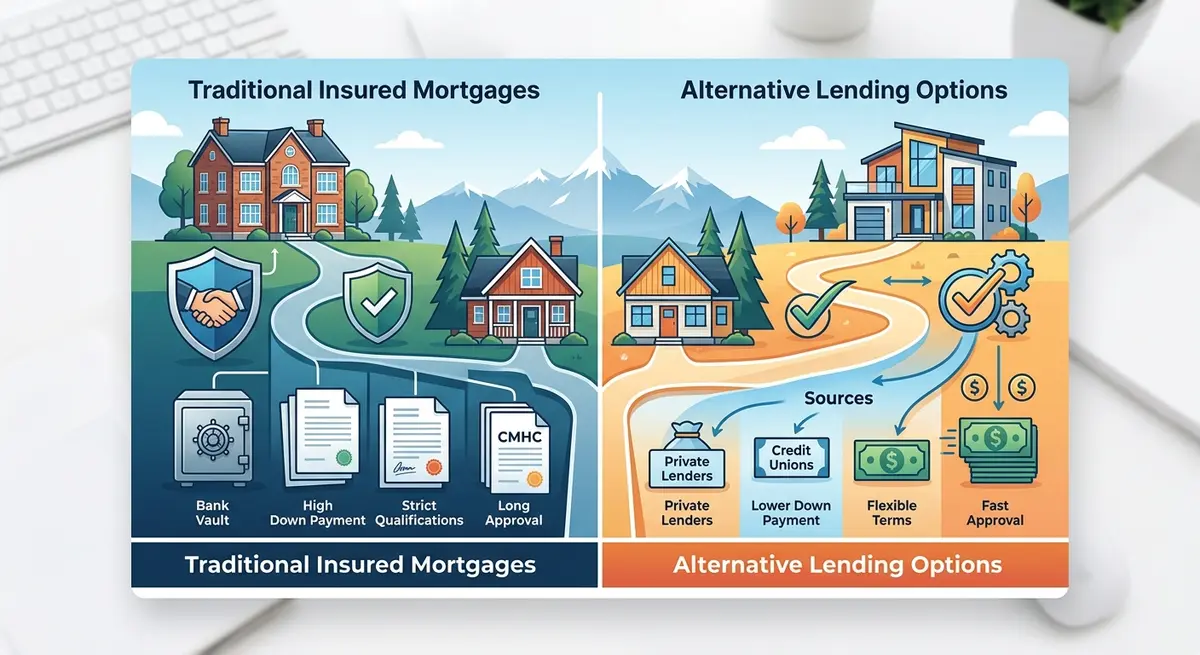
Not all borrowers fit neatly into the strict underwriting boxes required by CMHC, Sagen, or Canada Guaranty. Self-employed individuals with complex corporate structures, newcomers without established Canadian credit, or borrowers with recent credit blemishes may face rejections from traditional insurers. In these cases, alternative lending solutions become necessary.
B-lenders and private mortgage investment corporations (MICs) operate outside the traditional insured framework. Because these lenders take on the default risk directly without federal backing, they typically require a minimum 20% down payment and charge higher interest rates. However, they offer immense flexibility. For entrepreneurs, stated income alternative loans provide a pathway to homeownership without requiring traditional T4 tax slips.
If you already own a home and are looking to leverage equity, default insurance rules differ. Refinancing transactions are generally not eligible for new default insurance. Homeowners looking to access capital often weigh the benefits of second mortgages against cash-out refinancing options. Understanding these nuances ensures you choose the most cost-effective borrowing strategy for your specific needs.
Managing Your Mortgage Post-Closing
Once your high-ratio mortgage is funded and the keys are in your hand, the insurance premium becomes a permanent part of your loan structure. Unlike private mortgage insurance (PMI) in the United States, which can be canceled once a homeowner reaches 20% equity, Canadian default insurance is a one-time premium that remains capitalized into the loan for its entire lifespan.
Because you are paying interest on the premium over 25 years, implementing principal reduction strategies is highly beneficial. Making lump-sum prepayments or increasing your bi-weekly payment amount accelerates the amortization schedule. This reduces the total interest paid on both the base loan and the capitalized insurance premium.
It is also important to monitor macroeconomic trends. The Bank of Canada regularly adjusts the overnight rate, which influences the qualifying stress test rates. While your insurance premium is locked in at closing, future renewals will be subject to the prevailing interest rate environment. Maintaining a strong credit score—aiming for at least a 50-point improvement over your initial application—ensures you secure the best possible rates at renewal.
Conclusion
Strategic financial planning transforms homeownership from an aspiration into a tangible reality. For Calgary buyers with down payments below 20%, mortgage default insurance remains an indispensable tool. It bridges the gap between limited upfront savings and the strict risk requirements of Canadian lenders. By understanding how Loan-to-Value ratios dictate premium costs, and by recognizing the subtle differences between providers like CMHC, Sagen, and Canada Guaranty, borrowers can make informed, cost-saving decisions.
Whether you are optimizing your down payment to drop into a lower premium tier, or exploring alternative lending solutions due to complex income structures, knowledge is your greatest asset. The 2026 real estate market requires precision, preparation, and expert guidance to navigate successfully. If you are ready to explore your financing options or need assistance structuring a complex mortgage application, contact our team today for a personalized consultation.
Frequently Asked Questions (FAQ)
What triggers the mandatory requirement for mortgage default insurance?
This coverage becomes legally mandatory in Canada when a homebuyer’s down payment is less than 20% of the property’s purchase price or appraised value. Federal regulations require lenders to insure these “high-ratio” loans to protect the financial institution against potential borrower default.
How does the Loan-to-Value (LTV) ratio affect my insurance premium?
Higher LTV ratios, which correspond to lower down payments, result in higher insurance premiums. For example, a 5% down payment (95% LTV) incurs a 4.00% premium, whereas increasing your down payment to 15% (85% LTV) reduces the premium rate to 2.80%.
Are mortgage default insurance premiums taxable in Alberta?
Yes, but only partially compared to other provinces. While Alberta does not charge Provincial Sales Tax (PST) on mortgage insurance premiums, the federal 5% Goods and Services Tax (GST) still applies. This tax must be paid in cash as an upfront closing cost and cannot be rolled into the mortgage.
Can I cancel my mortgage default insurance once I reach 20% equity?
No. Unlike the system in the United States, Canadian mortgage default insurance is a one-time premium calculated at the time of purchase and capitalized into the life of the loan. It cannot be canceled or refunded once you build 20% equity in the property.
Does mortgage default insurance protect me if I lose my job?
No. Mortgage default insurance strictly protects the lending institution against financial loss if you default on the loan. If you want protection for personal circumstances like job loss, disability, or death, you must purchase separate mortgage life or creditor protection insurance.
Can real estate investors use default insurance for rental properties?
Generally, no. Mortgage default insurance is primarily restricted to owner-occupied properties. Real estate investors purchasing non-owner-occupied rental properties are typically required to provide a minimum 20% down payment, rendering default insurance unnecessary.
What happens if the appraised value of the home drops after I buy it?
The insurance policy protects the lender against market fluctuations and default, not the borrower. As the homeowner, you remain legally responsible for the full balance of your mortgage loan, regardless of whether the local Calgary property market experiences a downturn.