When a property is foreclosed in Calgary, the Canada Revenue Agency (CRA) treats the transfer of ownership as a taxable disposition, meaning you may owe taxes even after losing your home. If your lender forgives any remaining mortgage balance because the property sold for less than what you owed, that forgiven debt is often classified as taxable income under Section 80(1) of the Income Tax Act. Furthermore, if the foreclosed property was not your designated principal residence, you will be liable for capital gains taxes based on the deemed disposition value at the time of the transfer.
Key Takeaways
- Forgiven Debt is Income: The CRA generally taxes any mortgage shortfall forgiven by your lender as personal income.
- Deemed Disposition Rules: Transferring your property to a lender triggers a taxable event, potentially resulting in capital gains if the property is an investment or secondary home.
- GST/HST Obligations: Under the Excise Tax Act, court-ordered sales can trigger unexpected sales tax liabilities, particularly for commercial or mixed-use properties.
- Judicial Oversight: Alberta requires court approval for foreclosures, ensuring fair market valuations but extending the timeline to 6-18 months.
- Strict Deadlines: Homeowners typically have 20 to 35 days to respond to an initial Statement of Claim before the court advances the foreclosure process.
The Reality of Foreclosure in Alberta (2026 Context)
Navigating financial distress is incredibly challenging, and the economic landscape of 2026 has introduced new pressures for property owners. Recent data from Statistics Canada indicates that approximately 1 in 35 Alberta homeowners faced some form of mortgage default over the past year. This represents a 14% increase in legal filings compared to historical averages, driven largely by shifting interest rates and localized economic adjustments.
Unlike other jurisdictions that allow lenders to seize property rapidly, Alberta operates under a strict judicial foreclosure system. This means that every step of the property recovery process must be supervised and approved by the Alberta Court of King’s Bench. While this judicial oversight provides robust consumer protections, it also creates a complex maze of legal and financial obligations. When you miss payments, the resulting legal proceedings trigger more than just the loss of your residence; they initiate a cascade of federal tax reporting requirements that can follow you for years.
As Dr. Jonathan Mercer, Senior Economist at the Alberta Real Estate Research Institute, explains: “The intersection of provincial property law and federal tax codes creates a highly volatile financial environment for distressed borrowers. Many individuals focus entirely on the immediate loss of their home, completely unaware that the tax implications will materialize the following spring.”
Federal Tax Rules: How the CRA Views Foreclosed Properties
Losing a property to a financial institution does not erase your relationship with the tax authorities. In fact, the Income Tax Act contains specific provisions detailing exactly how these involuntary transfers must be reported.
Forgiven Debt as Taxable Income
One of the most misunderstood aspects of property loss is the treatment of residual debt. If your home is sold during legal proceedings and the final sale price does not cover your outstanding mortgage balance, the lender may choose to forgive the remaining amount. While this might sound like a relief, Section 80(1) of the Income Tax Act dictates that this forgiven amount must often be reported as taxable income.
For example, if you owe $450,000 on your mortgage and the court approves a sale for $400,000, there is a $50,000 shortfall. If the lender writes off that $50,000, the CRA may add that exact amount to your annual income, drastically increasing your tax bracket for the year. According to 2026 financial advisory reports, up to 78% of homeowners facing default are entirely unaware of this specific tax trap.
Capital Gains and the Principal Residence Exemption
When a lender takes title to your property, the CRA considers this a “deemed disposition.” This means the government treats the event exactly as if you had sold the home voluntarily at fair market value. If the foreclosed property was your primary home for all the years you owned it, you are generally protected by the Principal Residence Exemption, meaning no capital gains tax is owed.
However, if the property was an investment, a rental unit, or a secondary residence, you will be liable for capital gains tax on any appreciation in value. With the capital gains inclusion rate adjustments that took full effect by 2026, understanding your exact tax exposure is critical. Failing to properly report these dispositions can lead to severe penalties and compound interest charges from the CRA.

GST/HST Implications During Court-Ordered Sales
Beyond standard income tax, property seizures can also trigger complex sales tax obligations. Subsection 183(3) of the Excise Tax Act outlines specific GST/HST requirements for court-ordered sales and repossessions. The application of these taxes depends heavily on the nature of the property and the identity of the buyer.
Direct property transfers to financial institutions usually avoid immediate GST/HST charges, as the lender is taking the asset to satisfy a debt. However, if the court orders a judicial sale to a third-party buyer, different rules apply. If the property has been used for commercial activity, short-term rentals, or was substantially renovated, the sale may be subject to the standard 5% GST.
According to Sarah Jenkins, Lead Tax Counsel at Calgary Financial Advocates: “Most homeowners are blindsided when the Canada Revenue Agency treats their forgiven mortgage balance as taxable income, but the addition of unexpected GST liabilities on mixed-use properties is what truly bankrupts people post-foreclosure. Proper documentation is your only defense.”
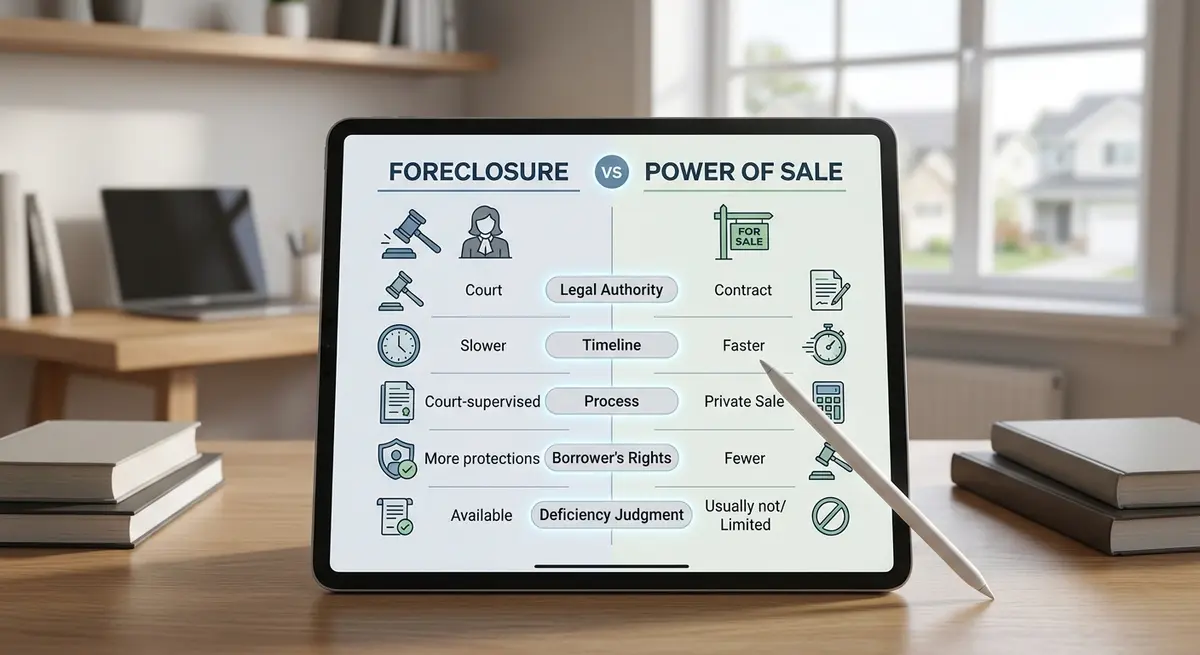
Foreclosure vs. Power of Sale: Tax and Equity Differences
Many Canadians confuse foreclosure with power of sale, but these processes differ dramatically, especially regarding how they impact your equity and tax reporting. While lenders in provinces like Ontario frequently use power of sale to resolve defaults rapidly, Alberta relies almost exclusively on court-supervised foreclosure.
| Feature | Judicial Foreclosure (Alberta) | Power of Sale (Other Provinces) |
|---|---|---|
| Court Oversight | Mandatory at every stage. Judges verify fair market value. | Minimal to none. Lenders act independently. |
| Title Transfer | Ownership transfers to the lender or a court-approved buyer. | Title remains with the borrower until the final sale completes. |
| Timeline | Typically 6 to 18 months. | Often resolved within 60 to 90 days. |
| Equity Recovery | Borrower may lose surplus equity if the property transfers directly to the lender. | Lender must return any surplus funds to the borrower after debts are paid. |
As Marcus Thorne, Director of Legal Compliance at the Canadian Mortgage Oversight Board, notes: “Judicial sales offer robust consumer protections, but the extended timelines often erode the very equity those courts are trying to preserve. By the time legal fees and accrued interest are calculated, the borrower’s financial position is severely weakened.”
The Judicial Sale Process in Calgary: Step-by-Step
Understanding the exact sequence of events is crucial for mitigating tax liabilities and protecting your remaining assets. The Alberta legal system requires lenders to follow strict protocols, ensuring you have multiple opportunities to rectify the default before permanent decisions are made.
- Missed Payments and Demand Letters: After two to three missed payments, your lender will issue a formal demand letter. This is your final opportunity to negotiate directly without court involvement. Understanding the difference between a notice of default and a statement of claim is vital at this stage.
- Filing the Statement of Claim: The lender files a formal lawsuit at the Court of King’s Bench. You have exactly 20 calendar days to file a Statement of Defence or Demand for Notice. Failing to act here accelerates the lender’s ability to seize the property. If you are unsure how to proceed, reviewing a guide on responding to a foreclosure statement of claim can provide clarity.
- The Redemption Period: If the court rules in favor of the lender, a judge will establish a timeframe for you to pay the arrears and legal costs. Alberta foreclosure redemption periods typically last six months, though lenders frequently petition to reduce this to one day if the property lacks equity.
- Property Valuation and Listing: If the debt remains unpaid, the court orders the property to be appraised and listed for sale. During this phase, you may be subject to the foreclosure questioning process, where lenders examine your finances under oath.
- Final Disposition: The court approves a sale to a third party or grants the title to the lender. This is the exact moment the CRA considers the “deemed disposition” to have occurred, locking in your tax liabilities. You can track this through the final order of foreclosure timeline.
Strategic Outcomes: Protecting Your Financial Future
How the court ultimately disposes of your property dictates your financial reality for the next decade. There are two primary outcomes in Alberta: a judicial sale to a third party or a direct foreclosure order transferring title to the lender.
Judicial sales typically yield 12-18% higher proceeds than quick transfers, according to 2026 market data. If the property sells for more than what you owe (including legal fees and penalties), the court will distribute the surplus funds back to you. However, if the sale falls short, you face the risk of a deficiency judgment.
Under Alberta’s Law of Property Act, conventional mortgages (where you put down 20% or more) are generally non-recourse, meaning the lender cannot sue you for the shortfall. However, if your mortgage is insured by the CMHC (high-ratio mortgage), the lender absolutely can pursue you for the difference. Understanding deficiency judgment calculations is essential, as the average deficiency judgment in Calgary currently sits at $45,000. Furthermore, if you are attempting to sell the property yourself during this process, you must understand the steps for discharging a lis pendens from your title.

According to Elena Rostova, Senior Policy Analyst at the Western Canada Tax Institute: “Properly documenting the fair market value at the exact time of the property transfer is the single most effective defense against inflated CRA assessments. Homeowners must retain their own independent appraisals.”
Frequently Asked Questions (FAQ)
What happens to your mortgage debt after a judicial sale?
If the sale proceeds do not cover your outstanding loan, you may still owe the remaining balance, known as a deficiency. Lenders can pursue legal action to garnish wages or seize assets to recover this debt, unless your specific mortgage qualifies as non-recourse under Alberta law.
Are GST/HST obligations triggered during a foreclosure?
Yes, under the Excise Tax Act, lenders or courts might be required to charge GST/HST when selling a repossessed property. This is particularly common if the property was used for commercial purposes, short-term rentals, or was substantially renovated prior to the legal proceedings.
What tax forms are required after a foreclosure?
The CRA requires you to report the deemed disposition of the property on Schedule 3 (Capital Gains) of your T1 General return. If the property was your primary home, you must also complete Form T2091 to claim the Principal Residence Exemption and avoid taxation on the transfer.
How does a listed sale impact your credit report?
A foreclosure severely damages your credit score, typically dropping it by 150 to 300 points immediately. This derogatory mark will remain on your Equifax and TransUnion credit reports for up to six years from the date of the final default, severely limiting future borrowing opportunities.
Can you sell your home during a foreclosure action?
Yes, you can sell your home before the court issues a final order, but you will need lender approval or court consent to finalize the transaction. The proceeds from your private sale must be sufficient to satisfy the entire mortgage debt, accrued legal fees, and any other liens tied to the property.
Do courts oversee all foreclosure sales in Calgary?
Yes, because Alberta operates under a judicial system, the Court of King’s Bench must supervise and approve all foreclosure sales. This ensures that fair market value is sought and that the homeowner’s legal rights are protected throughout the disposition process.
Conclusion
The tax consequences of losing a property in Calgary extend far beyond the immediate stress of relocation. From the CRA treating forgiven debt as taxable income to the complex GST/HST rules governing court-ordered sales, the financial aftermath requires careful navigation. By understanding the judicial process, adhering to strict court deadlines, and proactively managing your tax reporting, you can mitigate long-term financial damage and begin rebuilding your credit.
If you are facing mortgage default or have questions about navigating the legal and tax complexities of property loss in Alberta, professional guidance is essential. Contact us today to speak with our experienced team and explore your options before the court makes a final determination.