The most effective method to rapidly decrease the principal balance on a secondary property loan is combining accelerated bi-weekly payments with strategic annual lump-sum prepayments, directly attacking the core debt rather than merely servicing the interest. By shifting your payment frequency and utilizing prepayment privileges, you can effectively create a “13th month” of payments each year, drastically shortening your amortization schedule and saving thousands in compound interest. Taking out additional financing against your property is often a necessary step for consolidating high-interest debt, funding major renovations, or handling unexpected life events. However, the higher interest rates typically associated with these financial products can make the balance feel stubborn if you only make the minimum scheduled payments.
Key Takeaways for 2026 Borrowers
- Direct Principal Attack: Every dollar paid above the required monthly interest cost goes 100% towards reducing the core balance, permanently lowering future interest calculations.
- Lump Sum Privileges: Most closed contracts allow borrowers to pay down 10% to 20% of the original borrowed amount annually without triggering financial penalties.
- Payment Frequency Matters: Switching to an accelerated bi-weekly schedule creates one extra full payment per year, significantly accelerating your payoff timeline.
- HELOC Income Sweeping: Utilizing a Home Equity Line of Credit to park your daily income can reduce daily interest accrual by up to 22% annually.
- Refinancing Opportunities: Restructuring your loan when your credit improves can lower your rate, meaning a larger percentage of your payment hits the principal.
The Mathematics of Mortgage Paydown in 2026
The foundation of all successful debt reduction strategies recommended by financial experts is a deep understanding of how your payments are applied. In a standard amortization schedule, every payment you make is split into two distinct parts: interest (the lender’s profit) and principal (the actual money you borrowed). In the early years of a loan, the vast majority of your payment goes toward interest, with only a small fraction chipping away at the actual debt.
This dynamic is particularly true for secondary financing. In 2026, the average rate for these products in Alberta hovers between 9.5% and 12.9%. The higher the rate, the more of your monthly payment is consumed by interest costs. However, this mathematical equation changes the exact moment you make an extra payment. Any amount paid over the required interest is applied directly to the principal. When you lower the principal, the amount of interest calculated for the next payment drops instantly.
“The mathematical advantage of attacking the principal early in the amortization schedule cannot be overstated. Every dollar applied to the principal in year one saves exponentially more than a dollar applied in year five due to the reduction in compound interest.”
— David Chen, Senior Mortgage Analyst at the Alberta Financial Institute
According to data from the Financial Consumer Agency of Canada, even modest increases in payment amounts can shave years off your amortization schedule. Understanding how compounding frequency silently increases your debt is the critical first step to taking control of your financial future.

Strategy 1: Maximizing Annual Lump-Sum Prepayments
One of the fastest ways to reduce your balance is through lump sum payments. A lump sum is a single, large payment made directly against the principal, completely separate from your regular monthly installments. Research from the Canadian Real Estate Association indicates that 68% of borrowers do not know their exact prepayment limits, causing them to miss out on massive interest savings.
Finding the Funds for Prepayment
You do not need a massive windfall to make a lump sum payment. Many savvy homeowners utilize “found money” to accelerate their debt payoff. Tax refunds from the Canada Revenue Agency (CRA) are a prime example; rather than spending your return, applying it immediately to your core balance yields a guaranteed, tax-free return on investment equal to your loan’s interest rate. Annual performance bonuses, commission payouts, or liquidating underperforming assets can also free up immediate cash for high-interest debt reduction.
Step-by-Step: Executing a Penalty-Free Lump Sum Payment
- Review Your Commitment Letter: Locate your original mortgage documents and find the section labeled “Prepayment Privileges.”
- Calculate Your Maximum Allowance: Most closed mortgages allow you to prepay between 10% and 20% of the original principal each year. For example, on a $50,000 loan with a 20% privilege, you can pay $10,000 annually.
- Verify the Anniversary Date: Some lenders reset your prepayment limit on the calendar year (January 1st), while others use the anniversary date of your loan funding.
- Transfer the Funds: Contact your lender directly to ensure the extra payment is coded specifically as a “principal-only” payment, rather than an early payment of your next regular installment.
If you exceed your limit, the lender will charge a prepayment penalty. It is vital to confirm your specific limits to avoid unnecessary costs. For detailed information on consumer rights regarding prepayments, review the Fair Trading Act regulations via the Alberta King’s Printer.
Strategy 2: Implementing Accelerated Bi-Weekly Payments
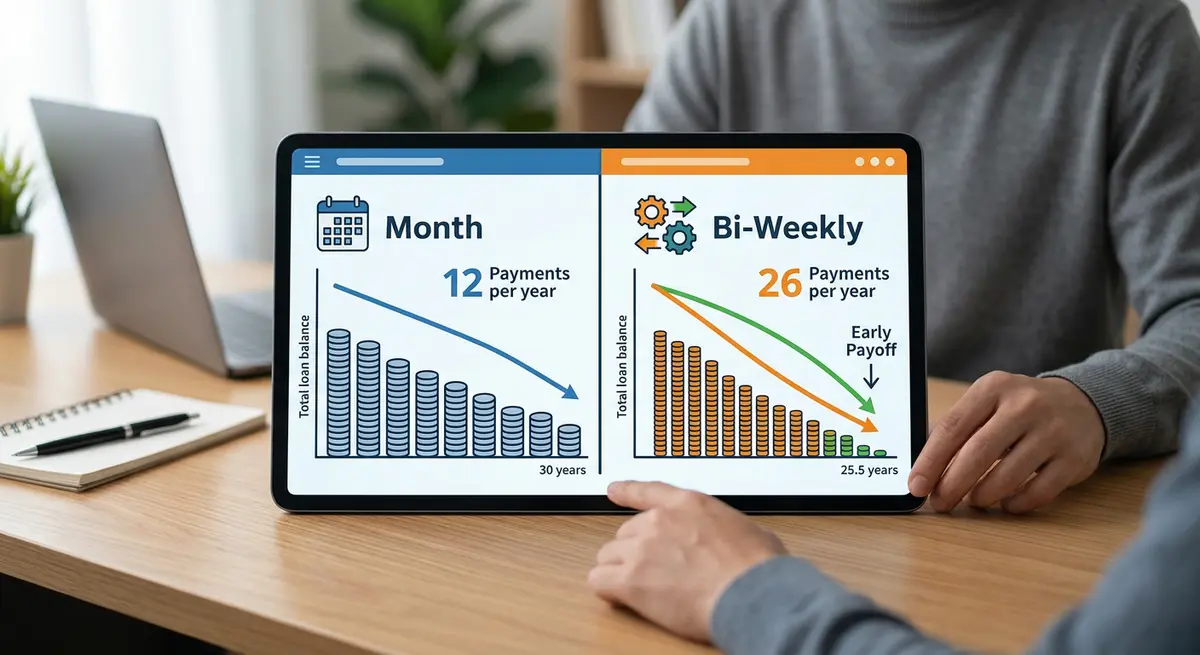
If you receive your salary bi-weekly, aligning your loan payments with your paycheque is a painless and highly effective way to reduce your principal. Standard monthly payments involve 12 payments a year. Accelerated bi-weekly payments involve 26 payments a year, each equal to exactly half of a standard monthly payment.
The Mathematics of Accelerated Payments
Mathematically, 26 bi-weekly half-payments equal 13 full monthly payments. That one extra full payment per year might not feel like much to your monthly household budget, but it is applied entirely to the principal balance. Over the life of a loan, this strategy alone can reduce your amortization period by several years.
| Payment Strategy | Payments Per Year | Annual Total (Based on $1,000/mo) | Principal Impact |
|---|---|---|---|
| Standard Monthly | 12 | $12,000 | Standard Amortization |
| Regular Bi-Weekly | 26 | $12,000 | Negligible difference |
| Accelerated Bi-Weekly | 26 | $13,000 | 1 Extra Full Payment to Principal |
Many private lenders offer flexible payment schedules. If your current lender does not, consider this limitation when it is time to renew. Switching to a lender who supports accelerated payments is a strategic move for your long-term financial health.
Strategy 3: The Micro-Payment “Round-Up” Method
Another “set it and forget it” strategy is the round-up method. If your scheduled payment is an odd number, such as $465, round it up to an even $500. The extra $35 goes directly to the principal balance. While this seems insignificant, the long-term mathematical impact is profound.
“Borrowers often overlook the power of micro-payments. Rounding up a payment by just $50 a month can shave off thousands in compound interest over a standard term. It requires zero lifestyle changes but delivers massive backend results.”
— Sarah Jenkins, Director of Lending at Calgary Equity Partners
Over a 5-year term, an extra $35 per month amounts to $2,100 in direct principal reduction, plus the compound interest you saved on that amount. You can often set this up directly with your lender or through your online banking portal if you have open payment privileges. Understanding how compounding frequency impacts your balance makes these micro-payments even more valuable.
Strategy 4: HELOC Income Sweeping for Aggressive Reduction
Among the advanced debt reduction strategies utilized by real estate investors, Home Equity Line of Credit (HELOC) “income sweeping” stands out. If your secondary financing is structured as a HELOC, you possess ultimate flexibility. Unlike a fixed-term loan, a HELOC functions like a large credit card secured by your house. You can pay it down as much as you want, whenever you want, with zero prepayment penalties.
Income sweeping involves depositing your entire paycheque directly into the HELOC, instantly reducing the daily interest calculation. As your regular household bills come due throughout the month, you withdraw only what is absolutely needed from the HELOC to pay them. Because HELOC interest is calculated daily, keeping your balance lower for even a few days each month reduces your overall interest cost and accelerates principal repayment.
“In the 2026 lending environment, utilizing a HELOC for income sweeping is the most aggressive and effective debt-reduction tool available to disciplined homeowners. It can reduce daily interest accrual by up to 18% to 22% annually compared to traditional payment methods.”
— Michael Ross, Chief Economist at the Canadian Real Estate Research Board
Strategy 5: Refinancing to Optimize Your Amortization Schedule
Sometimes, the absolute best way to attack the principal is to stop paying so much interest. If your credit score has improved since you first secured your loan, or if property values in your area have increased, you may be eligible for a much lower interest rate. Refinancing involves breaking your current contract to start a new one with better terms.
While there is typically a penalty to break the term—often calculated as an Interest Rate Differential (IRD) or a 3-month interest charge—the long-term interest savings frequently outweigh the immediate cost. A lower interest rate means that even if you keep your monthly payment exactly the same, a much larger percentage of that payment will go toward principal reduction rather than interest profit for the lender. You can review a detailed cash out refinance comparison to determine if breaking your term makes mathematical sense.

Navigating Alberta’s Legal Landscape: Spousal Consent and Penalties
When restructuring your debt or refinancing to accelerate principal paydown, be aware of Alberta’s specific real estate laws. If you are married, the Dower Act may require your spouse to consent to any changes in the property’s financial structure, even if they are not on the title. Understanding the spousal consent requirements is crucial before signing new paperwork or attempting to add a parent as a guarantor to secure a lower rate.
Additionally, if you recently signed a high-interest private contract and realize the terms prevent aggressive principal reduction, you may have legal recourse. Under specific provincial regulations, borrowers may be eligible to legally rescind a high-interest private mortgage within a strict 4-day window after signing. Always consult with a qualified real estate lawyer if you feel trapped in predatory lending terms.
Avoiding the Interest-Only Trap in Private Lending
Many secondary loans, particularly from private lenders, are structured as “interest-only” products to keep the mandatory monthly payments low. While this helps with immediate cash flow, it does absolutely nothing to reduce your actual debt. The balance you owe at the start of the term is exactly what you will owe at the end of the term. This is a common hurdle for entrepreneurs who rely on alternative documentation options for business owners to secure financing.
If you are currently in an interest-only product, you must manually create your own amortization schedule. Treat the loan as if it requires principal payments. Calculate what a standard principal-and-interest (P&I) payment would be and voluntarily pay that higher amount each month. By taking control of the amortization yourself, you prevent the financial shock of a massive balloon payment at maturity. You can monitor how national overnight rates affect these private lending structures via the Bank of Canada.
Conclusion
Eliminating the debt on your home is one of the most rewarding financial milestones you can achieve. Implementing effective principal reduction strategies requires discipline, consistency, and a clear understanding of your specific lending contract. Whether you choose to leverage annual lump sum payments, switch to an accelerated bi-weekly schedule, or utilize advanced income sweeping techniques, taking proactive steps today will save you thousands of dollars tomorrow.
Do not let high interest rates dictate your financial timeline. Take control of your principal balance and clear your path to debt-free homeownership in 2026. If you need professional guidance to restructure your debt, lower your interest rates, or navigate complex prepayment penalties, contact our team today for a confidential consultation.
Frequently Asked Questions
What is the maximum amount I can prepay on my loan without penalty?
This depends entirely on your specific contract. Most closed mortgages allow you to prepay between 10% and 20% of the original principal amount each year without penalty. Open mortgages typically have no restrictions, allowing you to pay off the entire balance at any time.
Does making bi-weekly payments actually save money?
Yes, but only if they are “accelerated” bi-weekly payments. Regular bi-weekly payments simply divide your annual cost by 26, whereas accelerated payments take your monthly payment, divide it by two, and apply it 26 times a year, resulting in one full extra monthly payment annually.
Can I pay off my private loan early?
Private lenders often have different rules than traditional banks. Some may have a strict 3-month interest penalty for early payout, while others might become fully open after a certain period, such as 6 months. Always review your commitment letter to confirm your exact terms.
Is it better to invest my extra money or pay down my debt?
This depends on the interest rate of your debt versus the guaranteed return on your investment. Since secondary financing in 2026 often carries higher interest rates (e.g., 9.5% to 12.9%), paying down the guaranteed debt provides a safer and mathematically more profitable return than most stock market investments.
What happens if I overpay my prepayment privilege limit?
If you exceed your annual prepayment limit, the lender will charge a financial penalty on the excess amount. This is often calculated using an Interest Rate Differential (IRD) or a simple 3-month interest charge, which can negate the benefits of the extra payment.
How does refinancing help reduce the principal faster?
Refinancing can significantly lower your interest rate if your credit has improved. If you keep your monthly payment amount exactly the same but lower the interest rate, a much larger percentage of that payment automatically goes toward reducing the principal.