Does a foreclosure affect your immigration status in Canada? The definitive answer is no. A standard civil foreclosure will not result in deportation, nor will it revoke your Permanent Resident (PR) status, work permit, or student visa. Immigration is a federal matter governed by Immigration, Refugees and Citizenship Canada (IRCC), while property foreclosure is a provincial civil dispute. However, how you handle the resulting debt—specifically if you file for bankruptcy or if the default uncovers mortgage fraud—can severely impact your ability to sponsor family members or finalize pending PR applications.
Key Takeaways
- No Automatic Deportation: A civil foreclosure is a provincial property dispute and does not trigger a removal order or loss of PR status.
- Sponsorship Risks: Filing for bankruptcy to escape mortgage debt makes you legally ineligible to sponsor family members to Canada.
- Proof of Funds Impact: Frozen bank accounts or wage garnishments from a foreclosure can disqualify you from Express Entry or Provincial Nominee Programs (PNPs).
- The Fraud Exception: Committing mortgage fraud (e.g., forged income documents) is a criminal offense that can lead to deportation.
- Alternative Solutions: Leveraging home equity through alternative financing can stop a foreclosure without jeopardizing your immigration goals.
Civil Debt vs. Federal Immigration Law in Canada
Building a new life in Canada requires immense effort, sacrifice, and meticulous financial planning. For many newcomers in Alberta, buying a house is the ultimate symbol of having “made it.” However, as we navigate the economic landscape of 2026, life remains unpredictable. Job loss, sudden illness, or high mortgage renewal rates can quickly turn the dream of homeownership into a terrifying financial crisis. When missed payments lead to a letter from the bank’s lawyer, the fear of losing your home is instantly compounded by a much darker anxiety for newcomers: Will this financial failure get me deported?
Understanding the true impact of foreclosure and immigration status Calgary residents face is essential for protecting both your family and your future in Canada. Misinformation spreads quickly within communities, leading many to believe that a poor credit score or a seized property will automatically trigger a removal order. This guide separates legal facts from common rumors, explaining exactly how IRCC views financial hardship in 2026.
The most important fact to understand is the separation of powers in Canada. Immigration is strictly a federal matter governed by IRCC and the Canada Border Services Agency (CBSA) under the Immigration and Refugee Protection Act (IRPA). Foreclosure, on the other hand, is a matter of civil property law governed by the province of Alberta and the Court of King’s Bench.
In Canada, owing money to a private institution like a bank or a mortgage lender is a civil issue, not a criminal one. There is no “debtor’s prison,” and there is no “debtor’s deportation.” IRCC does not monitor the Alberta land titles registry to see if you have missed a mortgage payment. A bank seizing your house is a dispute over a contract you signed; it is not an immigration violation. Therefore, losing a civil lawsuit to a bank will not result in a removal order.
As Dr. Elena Rostova, a senior immigration policy analyst at the Canadian Migration Institute, explains: “Civil debt is entirely decoupled from residency rights under the IRPA. The government evaluates your right to remain in Canada based on criminality, security, and residency obligations, not your credit score or your ability to maintain a mortgage.”

The Real Impact of Foreclosure on Immigration Status Calgary Residents Face
If you are already a Permanent Resident (PR) of Canada, your status is incredibly secure. According to a 2026 report by Statistics Canada, over 34% of new immigrants purchase a home within their first five years of arrival, making mortgage education critical. To lose your PR status, you generally must fail to meet the residency obligation, commit a serious crime, or commit misrepresentation on your application. A foreclosure falls into none of these categories.
You can lose your house, have your credit score destroyed, and even face wage garnishment after foreclosure, but your PR card remains valid. You are still legally allowed to live and work anywhere in Canada. When examining foreclosure and immigration status Calgary homeowners must separate their financial liabilities from their legal right to remain in the country.
How Mortgage Debt Affects Spousal and Family Sponsorship
While your own status is safe, a foreclosure can severely complicate your ability to bring your family to Canada. This is the most common area where financial hardship collides with immigration goals. When you apply to sponsor a spouse, child, or parent, you must sign an “undertaking.” This is a legally binding promise to the Canadian government that you will provide financial support for your sponsored relative so they do not need to rely on social assistance.
If a foreclosure results in a massive deficiency judgment (the remaining debt after the bank sells your house for less than you owe), your financial capacity to fulfill this undertaking may be questioned by immigration officers, though debt alone is not an automatic disqualifier unless it leads to bankruptcy.
The Bankruptcy Trap for Immigrants
If you are facing foreclosure, you might consider declaring bankruptcy to clear the remaining debt. This is a massive red flag for IRCC. According to IRCC’s 2026 family sponsorship guidelines, you are completely ineligible to sponsor a relative if you are an undischarged bankrupt.
If you file for bankruptcy to deal with your mortgage debt, your sponsorship application will be returned or denied. You cannot sponsor anyone until you have been fully discharged from the bankruptcy, a process that can take nine months to several years. To mitigate the negative effects of foreclosure and immigration status Calgary newcomers must avoid bankruptcy if family reunification is an immediate priority.
Express Entry, AAIP, and Proof of Funds in 2026
If you are in Canada on a work permit or student visa and are applying for PR through systems like Express Entry or the Alberta Advantage Immigration Program (AAIP), your finances are under strict scrutiny. Many immigration pathways require you to demonstrate “Proof of Funds.” You must prove to IRCC that you have enough unencumbered money to support yourself and your family while you settle.
The foreclosure problem arises when your bank accounts are frozen due to a garnishment order resulting from a foreclosure shortfall, or if your savings are drained trying to fight the bank in court. If this happens, you may no longer meet the minimum Proof of Funds requirement. IRCC looks at your net worth (assets minus liabilities). A massive mortgage debt combined with falling property values can negatively impact this assessment if you are relying on property equity to prove your financial stability.
The Fraud Exception: When Foreclosure Triggers Deportation
There is one specific scenario where a foreclosure can absolutely destroy your immigration journey: Mortgage Fraud. Sometimes, newcomers are pressured by unscrupulous brokers to exaggerate their income, forge employment letters, or hide debts to qualify for a mortgage. If you default on that mortgage and the bank discovers that the original application was fraudulent, they may report it to the police.
If you are charged and convicted of fraud over $5,000 in Canada, this is a serious criminal offense under the Criminal Code. The only criminal impact regarding foreclosure and immigration status Calgary officials pursue involves this type of misrepresentation.
- For Temporary Residents: A criminal conviction will likely result in immediate deportation and a ban from re-entering Canada.
- For Permanent Residents: A serious criminal conviction makes you “criminally inadmissible” to Canada under Section 36 of the IRPA, leading to the revocation of your PR status and a removal order.
Marcus Thorne, a Calgary-based real estate litigation attorney, notes: “Banks in 2026 are employing advanced AI to audit defaulted mortgages. If a foreclosure reveals forged income documents, it rapidly escalates from a civil property dispute to a criminal fraud investigation, which is catastrophic for non-citizens.”
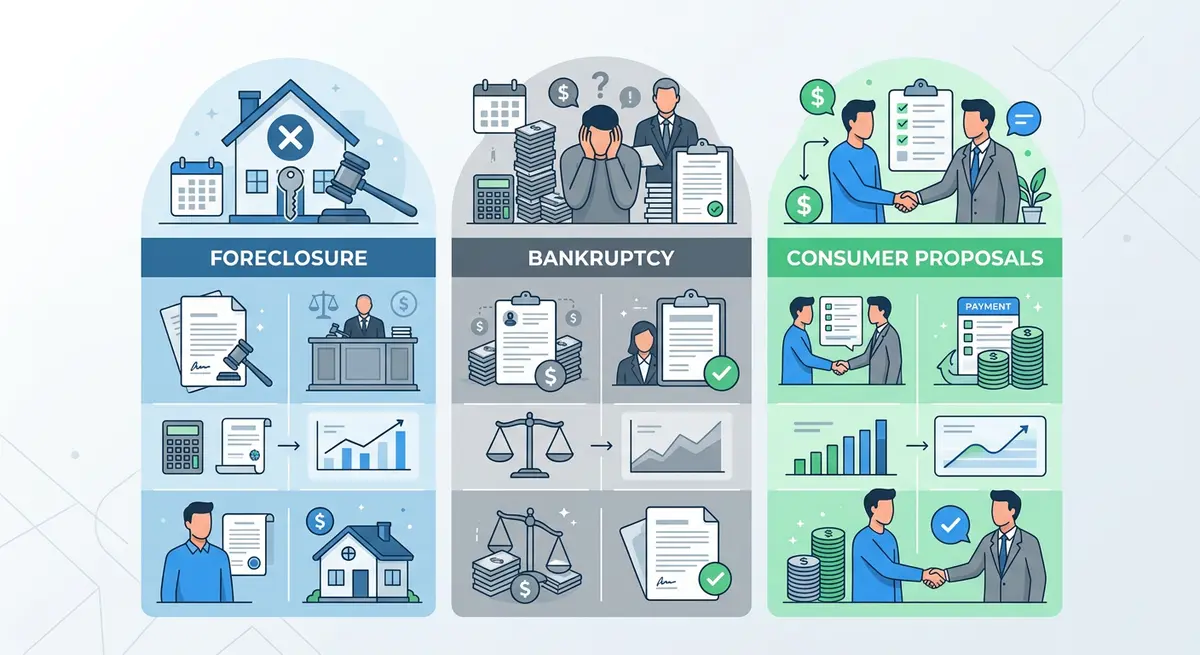
Comparison: Foreclosure vs. Bankruptcy vs. Consumer Proposal
Understanding how different financial actions affect your immigration journey is vital. The table below outlines the consequences of various debt resolution strategies in 2026.
| Financial Action | Impact on PR Status | Impact on Family Sponsorship | Credit Damage Duration |
|---|---|---|---|
| Civil Foreclosure | None. Status remains secure. | None directly, unless it affects your minimum income requirements. | 6 to 7 years on Equifax/TransUnion. |
| Bankruptcy | None. Status remains secure. | Severe. Ineligible to sponsor until fully discharged. | 6 to 7 years after discharge (first time). |
| Consumer Proposal | None. Status remains secure. | Moderate. Does not automatically disqualify you, but IRCC will assess financial capacity. | 3 years after completion. |
| Mortgage Fraud Conviction | Severe. Criminal inadmissibility and deportation. | Severe. Ineligible due to criminal record and removal order. | Permanent criminal record. |
Step-by-Step: How to Protect Your Status and Stop a Foreclosure
While a foreclosure might not get you deported, the resulting financial devastation makes building a life in Canada incredibly difficult. The stress alone can derail your career and your family life. Here is a 2026 step-by-step guide to managing the crisis:
- Do Not Abandon the Property: Leaving the home empty accelerates the legal process and increases the bank’s costs, which are passed on to you. Continue living in the home while you resolve the issue.
- Read the Legal Documents: Understand the difference between a Notice of Default vs. Statement of Claim. A demand letter is a warning; a Statement of Claim means the lawsuit has officially begun.
- File an Appearance: You must respond to a Statement of Claim within 20 days in Alberta. Filing a Demand for Notice ensures the bank cannot take your home in secret and keeps you informed of all court dates.
- Calculate Your Time: Work with a lawyer to determine your foreclosure redemption period. This is the court-ordered timeframe (usually 6 months) you have to pay the arrears and halt the foreclosure.
- Avoid Knee-Jerk Bankruptcy: If you are planning to sponsor a family member, consult an immigration lawyer before speaking to a Licensed Insolvency Trustee.
- Seek Alternative Financing: Use the equity in your home to pay off the aggressive lender before the final order of foreclosure timeline expires.
Alternative Financing: Saving Your Home and Your Status
Data from the Canada Mortgage and Housing Corporation (CMHC) indicates a 12.4% rise in mortgage arrears in early 2026 due to higher renewal rates. If traditional banks will not help you because of missed payments, you must leverage the asset itself. Alternative financing, such as a private second mortgage, uses the remaining equity in your property to generate capital.
You can use these funds to pay off the arrears, cover the aggressive lender’s legal fees, and reinstate your mortgage. This action stops the lawsuit, protects your credit from the catastrophic “Order Absolute” rating, and allows you to keep your home without resorting to immigration-killing options like bankruptcy. When exploring equity extraction strategies, remember that if you are married, Alberta law requires spousal consent requirements to be met under the Dower Act, even if your spouse is not on the title or is not a Canadian resident.

Frequently Asked Questions (FAQ)
Will IRCC check my credit score during a PR application?
No. IRCC does not pull your Equifax or TransUnion credit report to determine your eligibility for Permanent Residency. They rely on official bank statements and employment records to verify your Proof of Funds.
Can a collection agency get me deported from Canada?
Absolutely not. Collection agencies have no authority over your immigration status. They often use aggressive and manipulative tactics, but threats of deportation over a civil debt are entirely illegal and empty.
If I lose my house to the bank, do I have to leave Canada?
No. Losing your house simply means you have to find a new place to rent or live. It does not mean you have lost your right to remain in the country, provided your visa or PR status is otherwise valid and current.
Does a Consumer Proposal affect my ability to sponsor my spouse?
It is a grey area, but generally safer than bankruptcy. While an undischarged bankruptcy absolutely disqualifies you from sponsorship, a Consumer Proposal does not automatically bar you. However, IRCC will meticulously assess if you are financially capable of fulfilling the sponsorship undertaking.
I received a Statement of Claim for foreclosure. Should I tell Immigration?
No. A Statement of Claim is a civil lawsuit regarding property initiated by your lender. You have no obligation to report private civil disputes to IRCC unless they escalate to criminal fraud charges.
Can I use borrowed money to show “Proof of Funds” for Express Entry?
No. IRCC strictly requires that the funds you show must be unencumbered, meaning they cannot be borrowed. Getting a personal loan to hide the financial damage of an impending foreclosure will result in your application being rejected if discovered.
Conclusion
The stress of an impending property loss is overwhelming, but you must not let rumors dictate your actions. The direct link between foreclosure and immigration status Calgary authorities recognize is very specific: civil debt does not equal deportation. Your residency, your right to work, and your path to citizenship remain intact even if the bank takes your home.
However, the secondary effects—such as filing for bankruptcy or having your accounts frozen—can severely disrupt your ability to sponsor loved ones or finalize your PR application. When navigating foreclosure and immigration status Calgary residents should consult both legal and financial experts before making irreversible decisions. Before choosing drastic measures like bankruptcy, explore alternative equity financing to satisfy the lender, keep your home, and secure your Canadian dream.
If you are facing a property crisis and need immediate guidance on leveraging your home equity to stop a foreclosure, do not wait until it is too late. Get in touch with our team today to explore your alternative financing options and protect your family’s future in Alberta.