Having a secondary loan alters your primary mortgage renewal by increasing your total debt-to-income ratio, changing the lender’s risk assessment, and potentially limiting your ability to switch providers without triggering a full refinance. Financial institutions must account for the subordinate debt when calculating your Total Debt Service (TDS) ratio, which can result in higher renewal rates, stricter qualification terms, or the requirement to consolidate both loans into a single new agreement. Navigating this process requires proactive planning, as the presence of a subordinate charge transforms a standard administrative renewal into a comprehensive underwriting review.
Key Takeaways
- Risk Reassessment: Primary lenders recalculate your Gross Debt Service (GDS) and Total Debt Service (TDS) ratios at renewal, factoring in all registered property debt.
- Switching Complexities: Moving to a new lender at renewal is complicated by existing subordinate loans, often requiring a subordination agreement or a complete payout.
- Consolidation Opportunities: Renewing offers a strategic window to combine multiple loans into one, potentially lowering your blended interest rate.
- Equity Matters: Calgary’s 2026 property market trends directly impact your Loan-to-Value (LTV) ratio, dictating your negotiating power.
- Proactive Timing: Homeowners with multiple loans should begin the renewal shopping process 120 days before maturity to allow time for complex underwriting.
The Mechanics of Mortgage Renewal with Multiple Loans in 2026
The average Canadian homeowner renews their property financing four times before achieving mortgage-free status. In a standard scenario, renewing is a straightforward process: your current institution sends an offer, and you either sign it or shop around for a better rate. However, when you have leveraged your property’s equity through additional financing, the mechanics shift dramatically. Secondary financing sits behind your primary loan in priority, meaning if a default occurs, the primary lender is paid first. While this protects the primary institution, the additional monthly obligations increase the overall risk of default.
According to guidelines from the Financial Consumer Agency of Canada (FCAC), federally regulated institutions must send renewal statements at least 21 days before the term matures, though most initiate contact 120 days in advance. For borrowers with multiple encumbrances, this 120-day window is critical. If you attempt to switch primary lenders to secure a lower rate, the new institution must agree to take the first position on the title, while the secondary lender must formally agree to remain in the second position—a legal process known as a subordination agreement.
As Sarah Jenkins, Senior Underwriter at the Canadian Mortgage Institute, explains:
“When a subordinate charge is registered on the title, the primary institution must re-evaluate the total debt burden. It transforms a standard administrative renewal into a comprehensive underwriting review. Lenders are increasingly cautious in 2026, and a high combined loan-to-value ratio can disqualify you from prime rate discounts.”

How Secondary Financing Alters Lender Risk Assessments
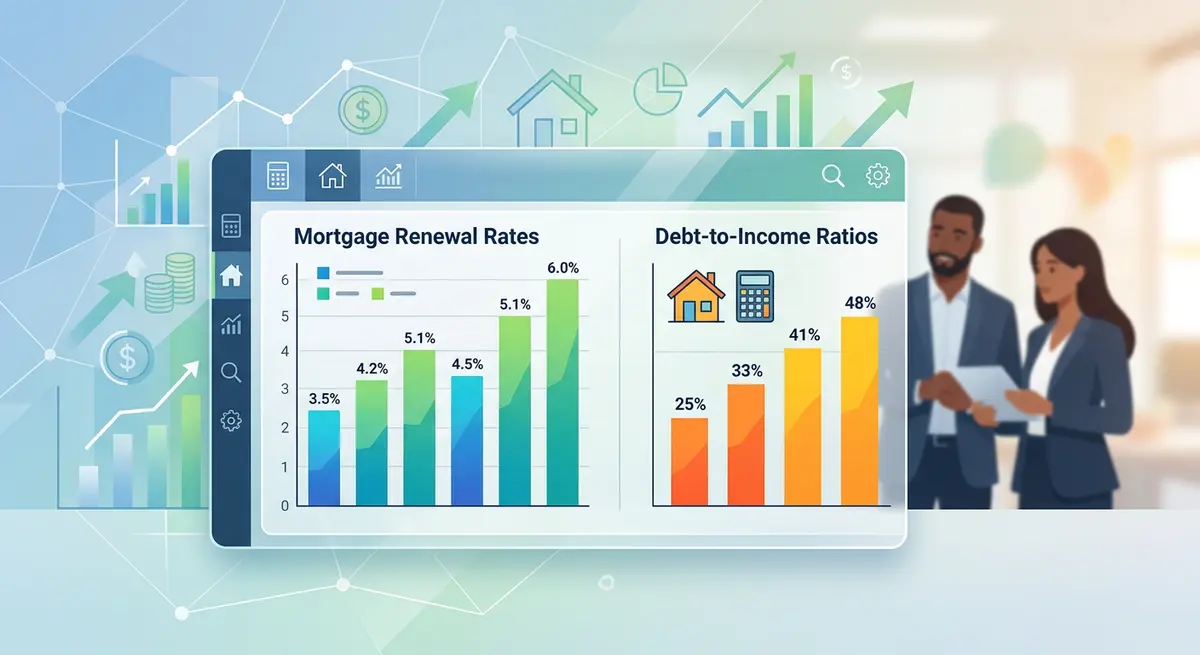
When evaluating a renewal application, lenders rely heavily on two critical metrics: the Gross Debt Service (GDS) ratio and the Total Debt Service (TDS) ratio. The Canada Mortgage and Housing Corporation (CMHC) mandates that for insured loans, the GDS should not exceed 39%, and the TDS must remain under 44%. Even for uninsured loans, prime lenders strictly adhere to these benchmarks in 2026 to mitigate risk.
Your secondary loan directly impacts your TDS ratio. Even if your secondary financing is a Home Equity Line of Credit (HELOC) with a zero balance, lenders calculate your TDS based on the total available credit limit, assuming a fully drawn balance amortized over a standard period. This regulatory requirement ensures borrowers can handle maximum debt loads, but it often surprises homeowners during renewal negotiations.
Research from Statistics Canada indicates that the average household debt-to-disposable-income ratio remains elevated in 2026, hovering around 180%. Consequently, lenders are meticulously scrutinizing credit profiles. A credit score above 680 is typically required to access the most competitive renewal rates. If your secondary payments have caused any late payments or increased your credit utilization above 30%, your primary lender may classify your renewal as high-risk, resulting in a premium interest rate.
To mitigate these risks, borrowers should focus on principal reduction strategies in the months leading up to renewal, lowering the outstanding balances to improve their TDS calculations.
Calgary’s 2026 Real Estate Market and Your Equity Position
Your negotiating power during a renewal is intrinsically tied to your property’s equity. Equity is calculated by subtracting all registered loan balances from the current market value of your home. In 2026, the Calgary real estate market has experienced steady, localized growth. Data from the Calgary Real Estate Board (CREB) shows an average year-over-year property value increase of 4.2% in key suburban corridors, which naturally bolsters homeowner equity.
Higher equity provides a buffer against strict lending criteria. For instance, prime lenders generally cap the maximum combined Loan-to-Value (LTV) ratio at 80% for refinancing. If Calgary’s rising property values have pushed your combined LTV below 65%, you present a significantly lower risk profile. This opens the door to aggressive rate negotiations or the ability to seamlessly switch lenders.
Conversely, if localized market corrections have stagnated your property’s value, your combined LTV might hover near the 80% threshold. In these scenarios, primary lenders are less likely to offer discretionary rate discounts, knowing that your ability to switch to a competitor is limited by the high LTV and the presence of a subordinate loan.
Comparing Renewal Scenarios: Single vs. Multiple Loans
Understanding the stark differences between a standard renewal and a dual-loan renewal helps set realistic expectations. The following table outlines how the presence of secondary financing alters the landscape:
| Renewal Factor | Single Primary Mortgage | Primary + Secondary Loan |
|---|---|---|
| Underwriting Speed | Often automated; 24-48 hours. | Manual review required; 1-3 weeks. |
| Switching Lenders | Simple process; new lender handles discharge. | Complex; requires subordination agreement or payout. |
| Rate Negotiation | High leverage; easy to price-match competitors. | Lower leverage; restricted by combined LTV limits. |
| Documentation | Minimal; often just a signature if staying with the same lender. | Extensive; requires updated income verification and property appraisal. |
Step-by-Step Guide: Preparing for a Dual-Mortgage Renewal
Proactive preparation is the most effective way to secure favorable terms when managing multiple property loans. Follow these structured steps starting 120 days before your primary term matures:
- Calculate Your Combined LTV: Obtain a realistic estimate of your Calgary property’s current 2026 market value. Divide your total outstanding property debt (primary + secondary) by this value. If the result is over 80%, your options for switching lenders will be highly restricted.
- Review Subordination Clauses: Examine your secondary loan contract. Determine if the lender charges a fee to grant a subordination agreement (often ranging from $200 to $500) and how much notice they require to process the paperwork.
- Assess Your TDS Ratio: Calculate your total monthly debt obligations, including credit cards, auto loans, and both property loans. Divide this by your gross monthly income. If it exceeds 44%, you must pay down unsecured debt before applying for renewal.
- Organize Your Paperwork: Unlike an automated single-loan renewal, you will need comprehensive documentation. Start organizing your mortgage paperwork early, including recent T4s, NOAs, and statements for all registered debts.
- Consult a Broker: Engage a mortgage professional who understands the nuances of the Calgary market. They can model whether it is more cost-effective to renew the primary loan as-is or consolidate both debts into a new facility.
The Impact on Interest Rates and Payment Structures
The interplay between fixed and variable rates becomes highly complex when managing two separate loan facilities. The Bank of Canada‘s monetary policy decisions in 2026 have created a dynamic rate environment, making the choice between fixed predictability and variable flexibility crucial.
If your secondary loan carries a high variable rate, your total monthly obligations can fluctuate, straining your cash flow. Primary lenders observe this volatility during the renewal underwriting process. To mitigate their perceived risk, they may offer you a slightly higher fixed rate on your primary renewal to ensure your baseline payments remain stable.
“Calgary homeowners often underestimate how a home equity line of credit impacts their primary renewal rate,” notes David Chen, Director of Risk Management at Alberta Financial Group. “Even if the balance is zero, the available credit is factored into your Total Debt Service ratio. If you want the best prime rate, you may need to reduce the limit on your secondary facility before the renewal application is submitted.”
Borrowers must also consider how compounding frequency impacts their total interest costs. Aligning the payment schedules and compounding periods of both loans during the renewal phase can yield significant long-term savings.
Consolidation vs. Separate Renewals: Making the Right Choice
One of the most critical decisions at renewal is whether to keep the loans separate or consolidate them. Consolidation involves breaking the secondary loan (if it has a fixed term) and rolling the balance into a newly sized primary mortgage. This is essentially a cash-out refinance.
Dr. Emily Carter, Real Estate Economist at the University of Calgary, states:
“Consolidating a secondary loan into your primary mortgage at renewal can save you up to 300 basis points in interest, provided you have sufficient equity built up. However, borrowers must mathematically verify that the penalty for breaking the secondary loan doesn’t eclipse the interest savings.”
When comparing cash-out refinancing options against standard renewals, consider the amortization reset. Consolidating often stretches the repayment of your secondary debt over a new 25- or 30-year amortization period. While this drastically lowers your monthly payment and improves cash flow, it significantly increases the lifetime interest paid on that specific portion of the debt.
Alternatively, keeping the loans separate makes sense if your secondary financing is a HELOC that you use sporadically for business or investment purposes. In these cases, leveraging home equity versus unsecured credit remains a powerful financial tool that shouldn’t be permanently rolled into a static primary mortgage.

Navigating Contractual Clauses and Lender Restrictions
The fine print of your existing contracts dictates your maneuverability at renewal. The Office of the Superintendent of Financial Institutions (OSFI) regulates how federally chartered banks handle collateral charges and standard charges. If your primary loan is registered as a collateral charge, it may be registered for up to 125% of the property’s value, even if you owe much less. This makes it incredibly difficult for a secondary lender to maintain their position if you attempt to switch primary institutions.
Furthermore, if your credit profile has experienced recent turbulence, you may need to explain recent credit inquiries to your primary lender during the renewal review. Multiple hard checks can signal financial distress. In such cases, drafting a letter of explanation that clearly outlines your financial strategy can prevent the lender from revoking a competitive rate offer.
“The 2026 regulatory environment requires lenders to stress-test all registered debt,” warns Marcus Thorne, Chief Lending Officer at Prairie Credit Union. “Meaning your secondary financing could push you past the 44% TDS threshold if not managed proactively. Borrowers must read their discharge clauses carefully; some alternative lenders charge a 2-3% penalty for early payouts, which complicates consolidation strategies at renewal.”
Frequently Asked Questions (FAQ)
Can my primary lender deny my renewal because I took out a secondary loan?
While federally regulated banks rarely deny a straight renewal if your payments have been perfect, they can refuse to offer discounted rates. If your new combined debt ratios exceed their maximum risk thresholds, they may only offer their posted rates, which are significantly higher than competitive market rates.
Do I need permission from my secondary lender to renew my primary mortgage?
If you are simply signing a renewal with your existing primary lender without changing the loan amount, permission is usually not required. However, if you switch to a new primary lender, the secondary lender must sign a subordination agreement to allow the new institution to take the first position on the title.
Will consolidating both loans at renewal save me money?
Consolidation typically lowers your blended interest rate and reduces your monthly payment by extending the amortization. However, you must calculate whether the long-term interest costs and any potential prepayment penalties on the secondary loan outweigh the immediate monthly savings.
How does a HELOC with a zero balance affect my renewal?
Even with a zero balance, lenders calculate your Total Debt Service (TDS) ratio based on the total available credit limit of the HELOC. They assume you could max out the line of credit at any time, which increases your perceived debt load and can impact the rates you qualify for.
Should I pay off my secondary loan right before my primary renewal?
If you have the liquid funds, paying off the subordinate debt before renewal eliminates the complex underwriting process and improves your debt ratios. This positions you to negotiate the best possible prime rates or easily switch lenders without requiring subordination agreements.
How far in advance should I plan a dual-loan renewal?
You should begin the process at least 120 days before your maturity date. This provides ample time to calculate combined LTVs, request subordination agreements if switching lenders, and gather the extensive documentation required for manual underwriting.
Conclusion
Renewing your primary property financing while holding a subordinate loan is a multifaceted financial event. The presence of additional debt alters your Gross and Total Debt Service ratios, triggers comprehensive underwriting reviews, and complicates your ability to switch lending institutions. However, by understanding Calgary’s 2026 equity trends and proactively managing your combined Loan-to-Value ratio, you can turn this complex process into a strategic opportunity. Whether you choose to negotiate a subordination agreement to secure a lower primary rate or consolidate both debts to improve monthly cash flow, early preparation is your greatest asset. Don’t wait for the renewal letter to arrive in the mail. Contact us today to review your current debt structure and build a customized renewal strategy that protects your long-term financial health.