Recent immigrants to Alberta can secure secondary home financing by leveraging their property’s existing equity rather than relying on a lengthy local credit history. Alternative lending institutions focus on a maximum Loan-to-Value (LTV) ratio of 75% to 80%, accepting foreign income verification, substantial down payments, and alternative credit references to approve applications. By prioritizing real estate collateral over traditional banking metrics, newcomers can access capital for business investments, property renovations, or debt consolidation within two to four weeks.
Key Takeaways for Newcomer Financing
- Equity is the Primary Metric: Lenders prioritize your property’s built-up equity over your Canadian Equifax or TransUnion score.
- Alternative Income is Accepted: Foreign income, international contract work, and self-employment are valid if properly documented and translated.
- Speed of Execution: Private secondary mortgages typically close in 14 to 28 days, bypassing the lengthy approval processes of conventional banks.
- Flexible Credit Rules: A lack of local credit history is not an automatic disqualifier; alternative references like utility payments and international reports are widely accepted.
- Strategic Capital Use: Funds are unrestricted and frequently used by newcomers for business startups, education, or family sponsorship costs.
The 2026 Alberta Real Estate Landscape for New Canadians
Alberta’s diverse economy, driven by the energy, technology, and financial services sectors, has created a remarkably stable real estate environment. According to a 2026 report by Statistics Canada, over 45% of newcomers to the province purchase a home within their first five years of arrival. This rapid transition to homeownership is a testament to the economic opportunities available, but it also creates a unique financial dynamic when these new homeowners require additional liquidity.
Research published by the Canadian Real Estate Association (CREA) indicates that the benchmark property price in major Alberta markets stabilized at $625,000 in early 2026. This resilience provides alternative lenders with immense confidence in the collateral value of local real estate. For recent immigrants, this market strength is a massive advantage. Property values have shown consistent growth, meaning newcomers who purchased homes even a year or two ago have likely accumulated significant equity.
“The strict stress-test regulations of conventional banks often result in application denials for new Canadians, trapping vital capital inside their properties,” notes Dr. Elena Rostova, Senior Economist at the Canadian Housing Research Institute. “However, the alternative lending sector has adapted to view this demographic as a low-risk, high-reward segment, provided the underlying asset is sound.”

Core Qualification Requirements for Secondary Financing
The qualification criteria for additional property financing differ drastically from initial purchase applications. Lenders evaluate risk through a different lens, focusing on asset protection and tangible equity rather than purely on rigid debt-service ratios.
Property Equity and Loan-to-Value (LTV) Limits
Your equity position stands as the most critical factor in the underwriting process. Most private and alternative lenders require homeowners to maintain at least 20% to 25% equity in their property after the new loan is registered. This translates to a maximum Loan-to-Value (LTV) ratio of 75% to 80%.
The equity calculation involves obtaining a current property appraisal and subtracting all existing encumbrances. If a newcomer purchased a home with a large initial deposit, this requirement is easily met. Providing acceptable proof of down payment during your initial purchase helps establish the baseline for your current equity calculation.
Alternative Income Verification Methods
While conventional lenders demand two years of Canadian tax returns (T1 Generals and Notices of Assessment), alternative lenders utilize a common-sense approach. They accept shorter employment histories, contract income, and even foreign income documentation when properly translated and verified.
For entrepreneurs and freelancers, verifying self-employed income through bank statements and business contracts is a standard practice in 2026. Comprehensive income documentation should include employment letters, recent pay stubs, and international bank statements demonstrating consistent earning capacity.
Credit Assessment Without a Canadian Equifax File
A strong local credit score is beneficial but not strictly mandatory. Many specialized lenders understand that recent immigrants have limited local credit history due to their recent arrival. They are willing to consider alternative credit references such as utility payments, rent history, and international credit reports.
If you have recent credit inquiries from setting up your life in Canada—such as applying for a cell phone, car loan, or credit card—crafting a perfect letter of explanation can easily mitigate lender concerns and demonstrate your financial responsibility.
Residency Status and Legal Documentation
Most lenders prefer permanent resident status or Canadian citizenship. However, specialized alternative lenders in 2026 frequently work with individuals on valid work permits, provided they have strong equity positions. Applicants must provide comprehensive documentation of their legal status, aligning with guidelines from Immigration, Refugees and Citizenship Canada (IRCC).
Traditional Banks vs. Alternative Lending Institutions
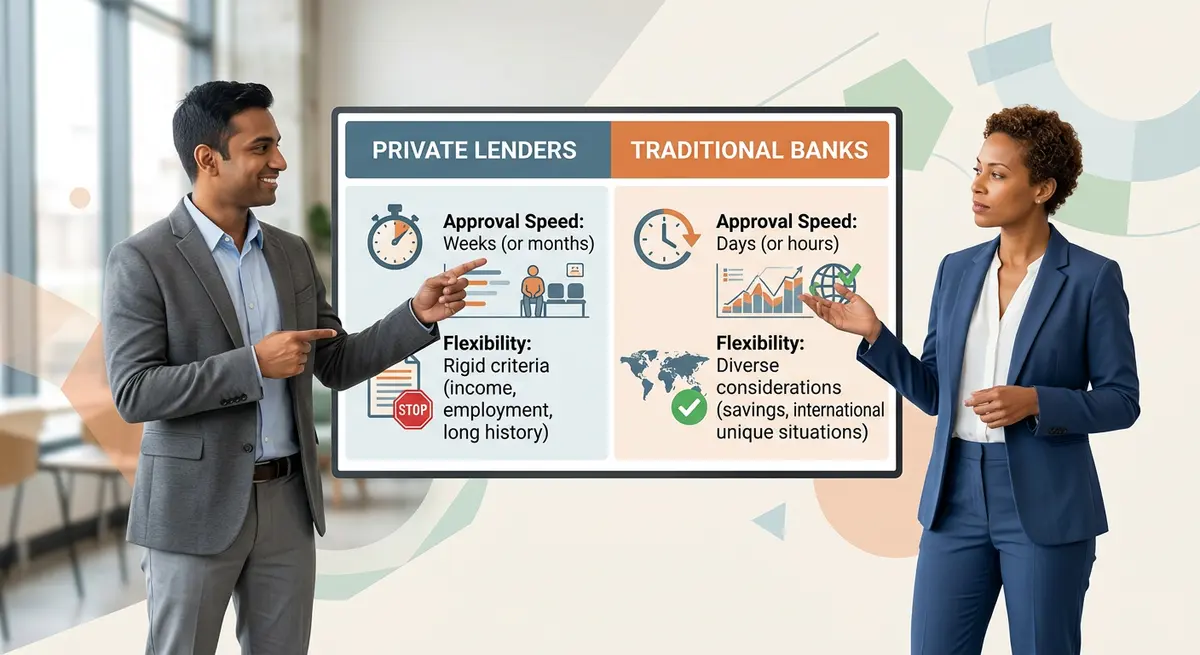
Understanding where to apply is just as important as knowing how to apply. Submitting applications to the wrong institution can result in unnecessary credit inquiries and frustrating delays. The table below outlines the primary differences between lending institutions for newcomers in 2026.
| Lender Type | Credit Requirement | Income Verification | Approval Speed | Best Suited For |
|---|---|---|---|---|
| Traditional Banks | Strict (680+ Score) | 2+ Years Canadian T4/NOA | 4-6 Weeks | Established citizens with long, flawless credit histories. |
| Credit Unions | Moderate (620+ Score) | 1-2 Years Canadian Income | 3-5 Weeks | Newcomers with permanent residency and stable local jobs. |
| Private Lenders | Flexible (Equity Based) | Alternative/Foreign Accepted | 1-2 Weeks | Recent immigrants with high equity and non-traditional income. |
Step-by-Step Application Process for Newcomers
The application timeline for secondary financing typically ranges from two to four weeks. Newcomers can expedite this process by following a structured, proactive approach.
- Calculate Your Available Equity: Determine your home’s current market value using a professional appraisal or a Comparative Market Analysis (CMA). Multiply this value by 0.80 (for an 80% LTV limit), then subtract your current primary mortgage balance. The resulting number is your maximum potential borrowing amount.
- Gather Alternative Documentation: Preparation is vital. Collect your Canadian identification, immigration documents, international income verification, and property details. Properly organizing your secondary mortgage paperwork prevents underwriting delays and demonstrates financial sophistication to prospective lenders.
- Partner with a Specialized Broker: Do not apply directly to multiple banks, as this will damage your fragile local credit score. Work with a licensed mortgage broker who specializes in newcomer financing. They have established relationships with Mortgage Investment Corporations (MICs) and private lenders who understand international financial profiles.
- Appraisal and Closing: Once conditionally approved, the lender will order an independent property appraisal. After the value is confirmed, the legal documents are drafted. You will meet with a real estate lawyer to sign the registration, and the funds are deposited directly into your bank account.
Overcoming Common Underwriting Roadblocks
Even with substantial equity, recent immigrants may encounter specific underwriting hurdles. Fortunately, the 2026 alternative lending market offers strategic solutions to bypass these obstacles.
Utilizing Co-Borrowers and Guarantors
If your individual income or credit profile is insufficient, adding a co-signer can instantly strengthen your application. Many newcomers leverage their extended family networks. For instance, adding a non-occupant co-borrower who is an established Canadian citizen can secure better interest rates and higher approval limits.
Alternatively, using a parent as a guarantor provides lenders with secondary recourse, significantly lowering the perceived risk of the loan without requiring the parent to be on the property title.
Navigating Spousal Title and Dower Rights
In Alberta, specific legislation protects spousal property rights, regardless of whose name is on the deed. If only one spouse is on the property title, the other must still provide legal consent to any new encumbrances. Understanding spousal consent requirements is crucial to preventing last-minute legal delays during the closing process. In cases where both spouses share the financial burden, adding a spouse to your application can combine international incomes and improve your overall Debt Service Ratios (GDS/TDS).
Real-World Applications: How Immigrants Use Home Equity
Recent immigrants utilize secondary financing for various strategic purposes during their settlement period in Canada. According to a 2026 study by the Canada Mortgage and Housing Corporation (CMHC), the top uses for home equity among new Canadians include:
- Business Investment: Funding startup costs, purchasing commercial equipment, or securing retail inventory without requiring restrictive small business loans that demand years of local operational history.
- Debt Consolidation: Paying off high-interest international debts, relocation loans, or credit cards accumulated during the immigration and settlement process.
- Education and Licensing: Financing Canadian university tuition or professional licensing courses required to transition foreign credentials into the local job market.

Expert Insights on Newcomer Financing in 2026
Industry professionals emphasize that the narrative behind the numbers is crucial when applying for alternative financing. As David Chen, Chief Underwriter at Alberta Alternative Lending, explains:
“In 2026, we evaluate the global financial picture of an applicant. If a newcomer has 25% equity in an Alberta home and verifiable international contract income, their lack of a local Equifax score is a non-issue. We lend on the strength of the asset and the logical capacity to repay. The traditional banking model is simply too rigid for the modern, globalized workforce.”
Consider the case of the Sharma family, who immigrated to the province in 2024. They purchased a home with a 30% down payment using international savings. By 2026, they needed $50,000 to launch a logistics business. Traditional banks denied them due to a lack of two-year Canadian tax history. However, by working with a specialized broker and leveraging private lenders, they secured the funds in just 12 days based purely on their 35% equity position and a solid business plan.
Frequently Asked Questions (FAQ)
Can I get additional property financing if I only have a work permit?
Yes, certain specialized private lenders and credit unions will approve applications for individuals on valid work permits. Approval heavily depends on having a substantial equity position (typically 25% or more) and verifiable local or international income.
How long does it take to approve secondary financing for a newcomer?
Private alternative loans can be approved and funded in as little as two to four weeks. Traditional bank approvals take significantly longer, often requiring four to six weeks due to extensive international document verification and rigid underwriting protocols.
Do foreign income sources count toward my qualification?
Alternative lenders frequently accept foreign income if it can be legally verified. You will need translated bank statements, international tax documents, and letters of employment to prove the income is stable, ongoing, and sufficient to cover the new debt obligations.
Will applying for alternative financing hurt my new Canadian credit score?
A single hard inquiry will cause a minor, temporary dip in your credit score. However, working with a licensed mortgage broker ensures your file is only sent to suitable lenders, preventing multiple damaging inquiries on your fresh credit profile.
What is the maximum amount a recent immigrant can borrow?
The borrowing limit is dictated by the property’s equity rather than a fixed dollar amount. Lenders typically allow you to borrow up to 75% or 80% of your home’s appraised value, minus the outstanding balance of your primary mortgage.
Can I use the funds to bring family members to Canada?
Yes, once the funds are deposited into your account, there are no restrictions on how you use the capital. Many immigrants use these funds to cover the sponsorship, legal, and relocation costs of bringing family members to Alberta.
Conclusion
Navigating the 2026 financial landscape as a recent immigrant doesn’t have to be an exercise in frustration. While traditional banks may focus heavily on local credit histories and years of domestic tax returns, the alternative lending market offers a viable, equity-based path forward. By understanding Loan-to-Value requirements, preparing alternative income documentation, and partnering with the right financial professionals, newcomers can unlock the wealth trapped in their real estate to fund their Canadian dreams.
If you are a recent immigrant looking to leverage your property’s equity for business, education, or debt consolidation, you don’t have to navigate this process alone. Get in touch with our team today to explore your alternative financing options and secure the capital you need to thrive.