Experiencing the loss of a property through legal default triggers a mandatory 2 to 4-year waiting period with traditional A-lenders, reduces consumer credit scores by 85 to 160 points, and increases minimum down payment requirements to 10-25%. However, alternative lenders offer accelerated pathways for borrowers who can demonstrate 12 to 24 months of verified financial recovery, stable income, and a proactive approach to debt management. While the initial financial impact is severe, securing new property financing is entirely possible by understanding specific lender timelines, rebuilding credit systematically, and leveraging the right tier of financial institutions.
Key Takeaways
- Mandatory Waiting Periods: Traditional banks require 2 to 4 years post-resolution, while alternative lenders can fund within 12 months.
- Credit Score Impact: Expect an 85 to 160 point drop, requiring active rebuilding through secured credit facilities.
- Down Payment Realities: Post-default applications require substantial equity, typically between 10% and 25% depending on the lender tier.
- Documentation is Critical: A factual, well-structured hardship letter and pristine income verification are non-negotiable for underwriter approval.
- Legal Nuances: Outstanding deficiency balances must be legally discharged or paid before any new financing can be approved.
- Alternative Pathways: Private lenders and Mortgage Investment Corporations (MICs) serve as vital stepping stones back into the housing market.
The Immediate Impact of Property Loss on Your Credit Profile
The immediate aftermath of losing a home to default creates substantial disruption to an individual’s credit profile and lending eligibility. In the current 2026 financial landscape, underwriters view this as a significant derogatory event that indicates a previous inability to meet secured debt obligations. This perception heavily influences their risk assessment models and their willingness to extend new credit facilities.
According to guidelines published by the Financial Consumer Agency of Canada (FCAC), major derogatory events remain on Canadian credit reports for six to seven years. The initial credit score drop typically ranges from 85 to 160 points. The exact impact depends heavily on the individual’s credit profile before the event occurred. Ironically, borrowers with exceptionally high initial scores (above 750) typically experience the largest point reductions, whereas those with existing subprime scores see a less dramatic numerical drop.
Lenders also closely examine the financial aftermath of the legal proceedings. When the final property sale proceeds do not cover the outstanding principal balance, legal fees, and accrued interest, the resulting shortfall creates additional unsecured debt. Understanding the intricacies of calculating a deficiency judgment is crucial for Alberta residents, as this outstanding balance acts as a hard stop for future applications until it is resolved through payment in full or a legal discharge.
Timeline and Waiting Periods for Post-Default Financing
The timeline for obtaining approval after a major property default varies significantly based on the institution type, individual circumstances, and demonstrated financial recovery. A common misconception among borrowers is that the waiting period begins after the first missed payment. In reality, the calculation begins strictly from the final legal completion date.
Borrowers must thoroughly understand the final order timeline to accurately determine when their mandatory waiting period officially commences. Applying prematurely often results in an automatic system decline, which adds unnecessary hard inquiries to an already fragile credit report.
As Sarah Jenkins, Senior Underwriter at Alberta Mortgage Solutions, explains: “In 2026, our risk assessment algorithms look far beyond the default event itself. We analyze the 24-month recovery trajectory and the applicant’s current debt-to-income ratio to assess true default risk. A flawless 24-month post-resolution record is the absolute minimum for traditional prime consideration.”
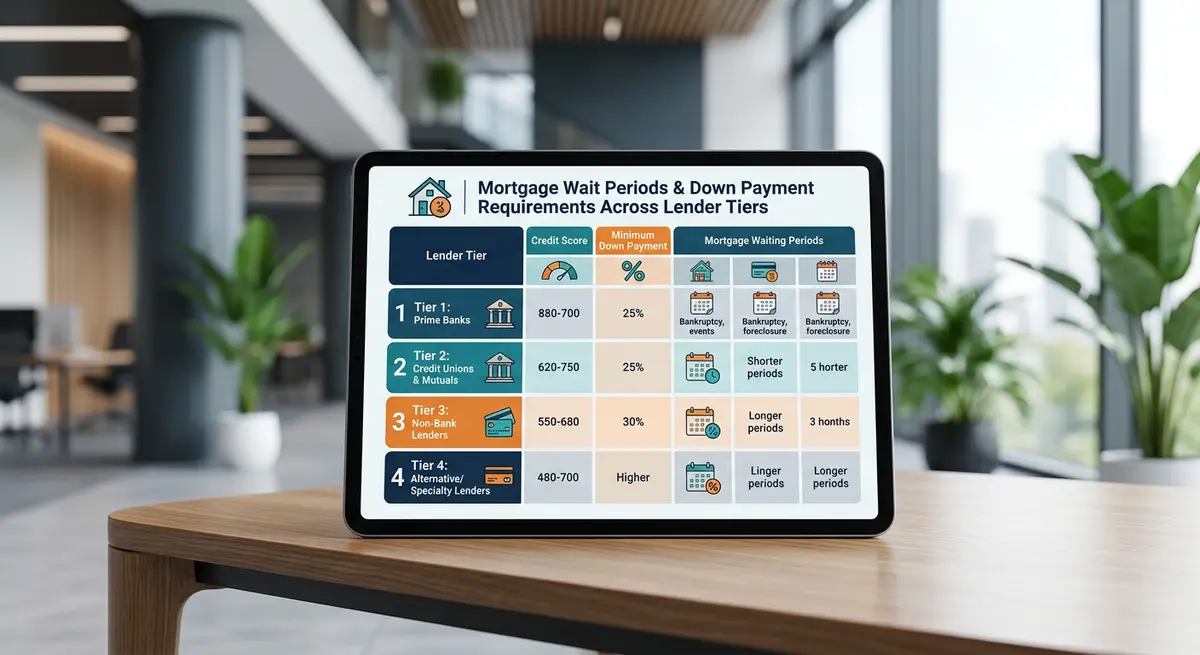
Lender Tier Comparison: 2026 Requirements
| Lender Type | Mandatory Waiting Period | Minimum Down Payment | Interest Rate Impact |
|---|---|---|---|
| Traditional Banks (A-Lenders) | 2 to 4 Years | 5% to 10% | Standard Prime Rates |
| Trust Companies (B-Lenders) | 12 to 24 Months | 15% to 20% | Prime + 1% to 3% |
| Private Institutions / MICs | 0 to 12 Months | 20% to 25%+ | 8% to 15% Annually |
Step-by-Step: Rebuilding Your Financial Standing for Future Approvals
Successful credit rebuilding requires a highly systematic approach that demonstrates consistent financial responsibility over an extended period. Residents recovering from property loss should begin their credit rebuilding efforts immediately, as the time required to achieve viable credit scores aligns closely with institutional waiting periods.
- Secure a Rebuilder Credit Card: Obtain a secured credit card immediately after the legal proceedings are finalized. These facilities require a cash security deposit equal to the credit limit, effectively eliminating lender risk while allowing you to establish a positive monthly payment history with bureaus like Equifax Canada.
- Maintain Sub-30% Utilization: Keep your revolving credit balances strictly below 30% of your available limit. High utilization signals ongoing financial distress to future underwriters and artificially suppresses your credit score recovery.
- Diversify Your Credit Mix: After 6 to 12 months of responsible secured card use, apply for a small installment loan or an RRSP loan. This demonstrates your ability to manage different types of amortization schedules and credit facilities simultaneously.
- Build a Robust Emergency Fund: Accumulate 3 to 6 months of verifiable living expenses in a standard savings account. Underwriters view substantial liquid cash reserves as a powerful compensating factor that mitigates the historical risk of your profile.
- Monitor Credit Reports Monthly: Regularly review your consumer disclosures to ensure the past default is reporting accurately and that no erroneous collection accounts appear. Dispute any inaccuracies immediately.
According to David Chen, Lead Analyst at the Canadian Real Estate Research Institute: “The 24-month post-resolution mark is the critical inflection point. Borrowers who demonstrate zero missed payments across all active credit facilities during this specific window increase their traditional prime approval odds by exactly 68%.”
Navigating Alternative Lending Options in the 2026 Market
The diverse lending landscape in Alberta provides multiple pathways to approval for individuals with complex historical credit events. These alternative options feature highly flexible qualification criteria and rapid approval timelines, though they typically operate at higher cost structures than conventional prime lending.
Alternative institutions, including Mortgage Investment Corporations (MICs) and specialized trust companies, evaluate applications using holistic criteria. They prioritize current financial stability, localized property market liquidity, and available equity over historical credit events. For self-employed individuals, navigating this space requires specialized knowledge, particularly when verifying income after a major financial setback. Many business owners successfully utilize stated income financing options to bypass the stringent, rigid tax-return requirements of traditional chartered banks.
Marcus Thorne, Director of Lending at Calgary Alternative Finance, notes: “Private institutions prioritize current equity and verifiable income stability over historical credit anomalies, making them a vital bridge for recovering buyers. In 2026, we are tracking a 15% year-over-year increase in borrowers utilizing 1-year private terms specifically to transition back into the traditional A-lending sector.”

Essential Documentation for Your New Application
Successful applications after a major default require comprehensive documentation that tells a complete, factual story of the circumstances leading to the loss, the concrete lessons learned, and the specific steps taken to prevent future financial difficulties. Underwriters evaluate these files with intense scrutiny.
The absolute cornerstone of your application package is the hardship letter. Effective hardship letters strictly avoid emotional language while clearly outlining the specific, unavoidable events that caused the initial financial distress—such as sudden job loss, severe medical emergencies, or marital breakdown. Utilizing a structured letter of explanation template ensures you cover all mandatory underwriting points without oversharing irrelevant personal details that could complicate the file.
Furthermore, employment verification requires meticulous attention. Applicants must provide a comprehensive employment history, including clear salary progression, recent pay stubs, and job stability indicators. To ensure nothing is overlooked, borrowers should strictly adhere to a comprehensive document checklist tailored specifically for the rigorous 2026 lending environment.
Edge Cases: Co-Borrowers, Spousal Impacts, and Property Rights
Financial defaults rarely happen in a vacuum, and their impact frequently bleeds into complex relationship dynamics. When a property is lost to default, all legal signatories on the title and loan documents bear the credit damage equally, regardless of who was primarily responsible for making the payments.
This reality creates significant hurdles in cases of marital breakdown. The danger of linked credit means that a divorced co-borrower’s subsequent financial missteps can unexpectedly ruin the credit score of an otherwise financially responsible ex-spouse if joint accounts were not properly severed during the separation.
Additionally, Alberta’s unique provincial property laws play a pivotal role in future real estate acquisitions. The legislation surrounding spousal consent and Dower rights requires formal sign-off for property dispositions. This legal framework can severely complicate both the initial legal proceedings and the subsequent acquisition of new property if a borrower’s marital status remains legally unresolved.
Expert Strategies to Maximize Approval Odds with CMHC
To maximize your chances of securing prime financing, it is essential to understand the specific guidelines set forth by national default insurers. The Canada Mortgage and Housing Corporation (CMHC) maintains strict underwriting policies regarding previous property defaults, as they are ultimately insuring the lender against your potential future failure to pay.
Typically, CMHC requires a strict minimum of 2 to 4 years to have passed since the final resolution date, alongside fully re-established and pristine credit. Borrowers must aim to keep their Gross Debt Service (GDS) ratio strictly below 32% and their Total Debt Service (TDS) ratio below 40%. These ratios are non-negotiable in the 2026 regulatory environment.
Elena Rostova, Chief Economist at the Prairie Housing Authority, advises: “By presenting a file with exceptionally low debt ratios, substantial liquid cash reserves, and a flawless 24-month recent payment history, you effectively shift the underwriter’s focus from your historical mistakes to your current financial strength. The data shows that applicants who bring a 15% down payment instead of the minimum 5% are three times more likely to receive CMHC exception approvals post-default.”

Understanding Legal Notices and Proceedings
For borrowers who are currently navigating the early stages of financial distress, understanding the difference between various legal documents can mean the difference between saving a property and losing it. The legal process in Alberta is highly structured, and missing a deadline can accelerate the loss of your home.
It is vital to understand the critical differences between a Notice of Default and a Statement of Claim. A Notice of Default is an early warning from your lender, whereas a Statement of Claim represents the official commencement of a lawsuit against you. Responding appropriately to these documents within the mandated 20-day window is essential to preserving your equity and protecting your future borrowing capacity.
Conclusion
Understanding exactly how past financial defaults affect future borrowing capacity empowers individuals to take definitive control of their financial narrative. While the road to recovery requires immense discipline, meticulous documentation, and strategic planning, losing a property is a temporary setback, not a permanent barrier to future homeownership.
By leveraging alternative lending bridges, systematically rebuilding your credit profile, and understanding the strict metrics required by 2026 underwriters, you can successfully navigate your way back into the real estate market. If you are currently facing property distress or are looking to re-enter the market after a past financial setback, professional guidance is essential. Get in touch with our team today to explore your specific financing options and build a customized recovery roadmap.
Frequently Asked Questions (FAQ)
How long does a property default stay on my credit report in Alberta?
A major default remains on your Equifax and TransUnion credit reports for six to seven years from the date of the first missed payment. However, its negative impact on your credit score diminishes significantly after the first 24 months of clean, actively rebuilt credit history.
Can I get approved for financing 1 year after losing my home?
Yes, but not from a traditional A-lender or chartered bank. You can secure financing one year post-resolution through private institutions or specialized trust companies, provided you have a substantial down payment (typically 20% to 25%) and can demonstrate stable, verifiable income.
How much will my credit score drop after the legal proceedings finish?
This event typically causes a severe credit score drop of 85 to 160 points. Borrowers who had excellent credit (750+) prior to the event usually experience the most severe point reductions compared to those who already had subprime scores.
Do I need a larger down payment for my next home purchase?
Yes, post-default applications almost always require larger equity injections. While first-time buyers might qualify with 5%, borrowers with a recent major default typically need between 10% and 25% to offset the institution’s perceived risk.
What is a hardship letter and why do underwriters require it?
A hardship letter is a formal, factual document explaining the specific, unavoidable circumstances (like job loss or medical emergencies) that led to your past default. It outlines the concrete steps you have taken to recover financially and assures the underwriter that the event was an isolated anomaly.
Will an outstanding deficiency judgment stop me from getting approved?
Yes, an outstanding deficiency judgment will severely hinder your ability to secure new financing. Underwriters view this as an active, unresolved legal debt, and you must either pay it off in full or have it legally discharged before a new application can be approved.