Calgary homeowners can effectively eliminate high-interest educational debt by borrowing against their accumulated property value, converting unsecured, double-digit interest loans into secured, lower-rate mortgage debt. By utilizing financial tools such as a home equity line of credit (HELOC), a cash-out refinance, or secondary financing, borrowers can significantly reduce their monthly carrying costs, simplify their repayment schedules, and accelerate their journey toward total financial freedom.
Key Takeaways
- Interest Rate Arbitrage: Swapping private student loans (often exceeding 9-12% in 2026) for secured property debt (typically 5-7%) can save thousands in interest.
- Accessing Funds: Homeowners can borrow up to 80% of their property’s appraised value minus their outstanding primary mortgage balance.
- Financing Options: Borrowers can choose between HELOCs, cash-out refinancing, or secondary mortgages depending on their current mortgage rate and penalty fees.
- Credit Impact: Consolidating multiple debt facilities into one secured payment generally improves your credit utilization ratio and overall credit score.
- Risk Management: Converting unsecured debt to secured debt means your property is collateral; maintaining reliable income to service the new loan is critical.
The 2026 Educational Debt Landscape in Alberta
The cost of higher education has continued to climb, leaving many recent graduates and mid-career professionals burdened with substantial financial obligations. According to Statistics Canada, the average university graduate in Alberta enters the workforce with over $32,000 in student debt, while those pursuing specialized professional degrees in medicine, law, or dentistry frequently accumulate balances exceeding $150,000.
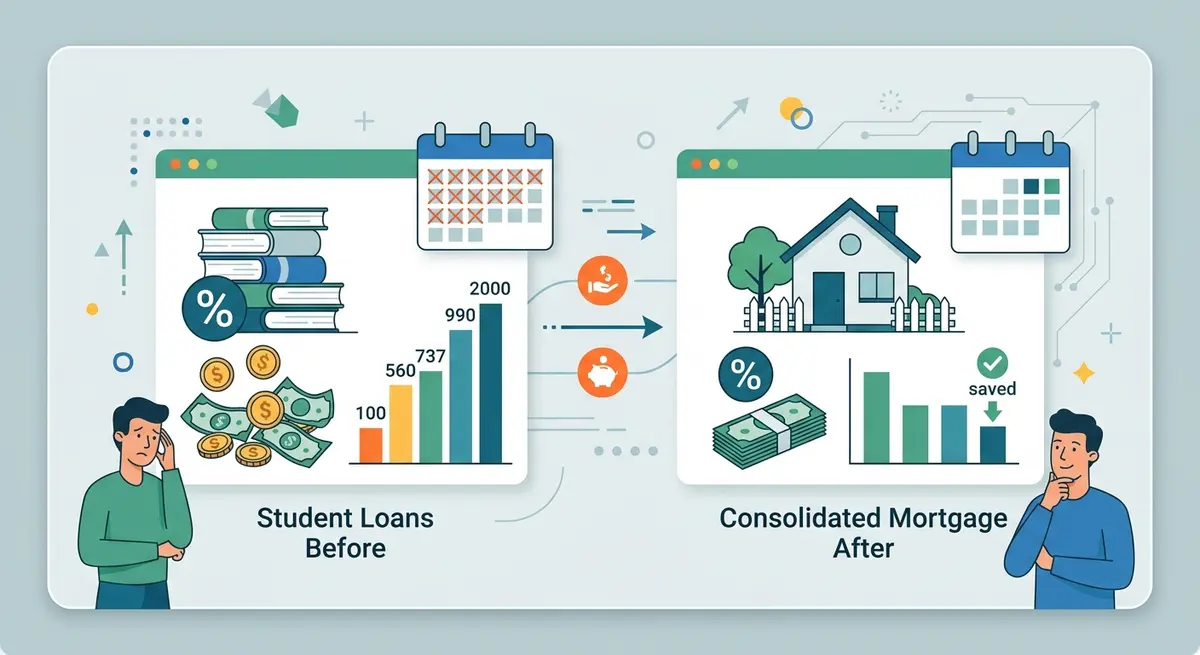
While federal and provincial government loans offer relatively favorable terms, many students are forced to rely on private student lines of credit or high-interest personal loans to bridge funding gaps. In the 2026 economic climate, these unsecured private loans often carry variable interest rates that fluctuate with the Bank of Canada prime rate, sometimes pushing borrowing costs into the double digits. This creates a compounding debt cycle that aggressively eats into monthly cash flow.
“For many young professionals in Calgary, their largest asset is their real estate, while their largest liability is their education,” notes Dr. Aris Thorne, a senior financial economist. “Bridging the gap between these two balance sheet items is the most effective wealth-building strategy available in today’s market.”
Understanding the Mechanics of Property Equity Extraction
Before restructuring your debt, it is essential to understand how lenders calculate your available borrowing power. In Canada, federally regulated financial institutions allow homeowners to borrow up to 80% of their home’s current market value, a metric known as the Loan-to-Value (LTV) ratio.
As of early 2026, the benchmark price for a detached home in Calgary hovers around $740,000. If you own a property valued at this benchmark and currently owe $400,000 on your primary mortgage, your equity calculation looks like this:
- Appraised Property Value: $740,000
- Maximum Allowable LTV (80%): $592,000
- Current Mortgage Balance: -$400,000
- Available Borrowing Power: $192,000
This $192,000 represents the maximum capital you can extract to deploy toward eliminating expensive educational liabilities. By liquidating those high-interest balances, you effectively consolidate your obligations into a single, manageable monthly payment.
Comparing Your Financing Vehicles
Extracting capital from your property is not a one-size-fits-all process. Calgary homeowners generally have three primary avenues to access these funds, each with distinct advantages and drawbacks.
| Financing Option | Best Used For | Pros | Cons |
|---|---|---|---|
| Cash-Out Refinance | Large debt balances when current mortgage rates are high | Lowest overall interest rate; single monthly payment | Breaks current mortgage term; potential prepayment penalties |
| HELOC | Ongoing educational costs or flexible repayment needs | Interest only paid on funds used; reusable credit limit | Variable interest rates; requires excellent credit |
| Secondary Financing | Preserving a low-rate primary mortgage | No penalties on primary mortgage; flexible qualification | Higher interest rates than primary mortgages; setup fees |
The Strategic Role of Secondary Mortgages
For many homeowners in 2026, breaking a primary mortgage to access capital is financially detrimental due to steep prepayment penalties or the loss of a historically low fixed interest rate. In these scenarios, securing an additional loan registered behind the primary mortgage is often the most mathematically sound decision. This strategy is particularly popular among specialized demographics; for instance, many medical professionals and residents use this exact method to clear their medical school lines of credit without disturbing their primary home financing.

Step-by-Step Process: Consolidating Educational Debt
Executing a successful debt consolidation strategy requires careful planning and adherence to lender requirements. Follow these steps to streamline the process:
- Audit Your Current Debt: Compile a comprehensive list of all educational loans, noting the outstanding balances, current interest rates, and minimum monthly payments. Identify which loans are private (unsecured) versus government-backed, as government loans often have tax-deductible interest and built-in repayment assistance programs that you may not want to lose.
- Determine Property Value: Review recent comparable sales in your Calgary neighborhood to estimate your home’s current market value. A formal appraisal will eventually be required by the lender.
- Calculate Debt Service Ratios: Lenders will evaluate your Gross Debt Service (GDS) and Total Debt Service (TDS) ratios. According to the Financial Consumer Agency of Canada, your TDS ratio (total debt obligations divided by gross income) should generally not exceed 44%.
- Prepare Documentation: Gather recent pay stubs, T4s, NOAs, and property tax statements. If you are self-employed or have non-traditional income, you may need to explore alternative documentation options to prove your ability to service the loan.
- Address Credit Report Anomalies: If you have recently shopped around for loans, you may have multiple hard checks on your credit file. Be prepared to explain credit inquiries to your prospective lender to ensure smooth approval.
- Finalize and Disburse: Once approved, the lender or your real estate lawyer will typically disburse the funds directly to your student loan providers, ensuring the debt is officially retired.
Financial Implications and Long-Term Costs
While the immediate relief of lower monthly payments is attractive, it is crucial to understand the long-term financial implications of amortizing short-term debt over a 25- or 30-year mortgage period.
“Stretching a 5-year student loan over a 25-year amortization schedule will lower your monthly payment dramatically, but it will cost you significantly more in total interest over the life of the loan if you only make minimum payments,” warns Marcus Chen, a certified financial planner based in Calgary. “The optimal strategy is to take the monthly cash flow savings generated by the lower interest rate and apply it as prepayments directly against the principal.”
Understanding the Tax Implications
In Canada, the interest paid on a mortgage is generally not tax-deductible if the property is your primary residence. However, if you are using the borrowed funds for investment purposes or a business venture, the rules change. When restructuring debt, it is vital to consult with an accountant regarding the tax implications of secondary financing to ensure you are maximizing your after-tax returns.
Risks and Common Pitfalls to Avoid
Leveraging your home to pay off unsecured debt is a powerful tool, but it carries inherent risks. The most significant risk is the conversion of unsecured debt into secured debt. If you default on a private student loan, the lender can damage your credit and potentially sue you, but they cannot immediately seize your home. However, if you default on a mortgage product, the lender has the legal right to initiate foreclosure proceedings.
To mitigate these risks, homeowners should:
- Maintain an Emergency Fund: Ensure you have 3-6 months of living expenses saved to cover mortgage payments in the event of job loss.
- Seek Objective Counsel: Before signing any complex financing agreements, it is highly recommended to obtain independent legal advice to fully understand your obligations and liabilities.
- Beware of Predatory Lenders: The alternative lending space can sometimes attract unscrupulous operators. Homeowners must be vigilant in identifying and preventing lending scams by working exclusively with licensed mortgage brokerages and reputable institutions.
Looking Ahead: Future-Proofing Your Finances
Once the burden of high-interest educational debt is lifted, Calgary homeowners often find themselves with newfound monthly cash flow. This capital can be redirected toward wealth-building activities, such as maximizing RRSP and TFSA contributions, upgrading the property, or even funding university education for their own children without relying on predatory student loans.
According to the Canadian Mortgage and Housing Corporation (CMHC), homeowners who actively manage their equity and consolidate high-interest consumer debt are 40% less likely to face severe financial distress during economic downturns.
Frequently Asked Questions
Can I use my property’s value to pay off government student loans?
Yes, you can use borrowed capital to pay off both provincial and federal government loans. However, because government loans often feature lower interest rates, tax-deductible interest, and repayment assistance programs, it is usually more strategic to focus on consolidating private, high-interest student lines of credit first.
Will consolidating my debt affect my credit score?
Initially, applying for new financing will result in a hard credit inquiry, which may cause a temporary dip in your score. However, paying off multiple high-balance revolving accounts and replacing them with a single installment loan significantly improves your credit utilization ratio, typically leading to a higher credit score over the medium to long term.
How long does the approval process take in Calgary?
The timeline varies depending on the financing vehicle chosen. A HELOC or cash-out refinance with an A-lender may take 2 to 4 weeks, as it requires rigorous stress-testing and appraisals. Alternative financing options can often be approved and funded in as little as 5 to 10 business days.
Do I have to pay penalties to access my equity?
If you choose to break your current primary mortgage term to do a cash-out refinance, you will likely face prepayment penalties (either three months’ interest or the Interest Rate Differential). Utilizing a HELOC or an additional financing layer behind your first mortgage avoids these penalties entirely.
What happens if property values in Calgary drop?
If you have already secured the loan, a drop in property value does not immediately impact your outstanding balance or terms, provided you continue making payments. However, it will reduce your remaining equity, which could limit your ability to refinance or borrow additional funds in the future.
Are there upfront costs associated with this strategy?
Yes. Borrowers should budget for appraisal fees (typically $300-$500), legal and registration fees ($1,000-$1,500), and potential broker or lender fees if utilizing alternative lending channels. These costs can often be rolled into the total loan amount.
Conclusion
Utilizing the accumulated value in your Calgary property to extinguish high-interest educational debt is a sophisticated financial strategy that can yield massive long-term savings. By understanding the mechanics of Loan-to-Value ratios, carefully comparing your financing options, and navigating the process with professional guidance, you can transform a crippling monthly liability into manageable, low-rate secured debt. If you are ready to take control of your financial future and explore the equity options available for your specific property, contact us today to speak with a licensed Alberta mortgage professional.