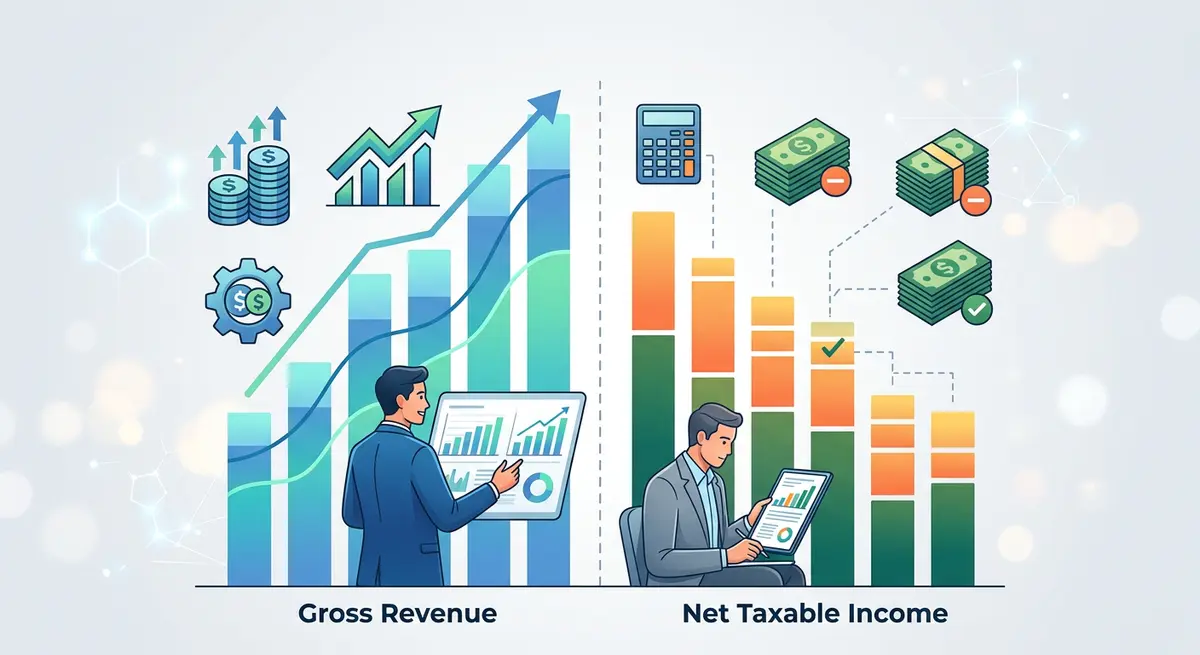
A stated income second mortgage is an alternative real estate financing solution that allows self-employed homeowners to secure equity loans based on their gross business revenue rather than their net taxable income. In 2026, this asset-based lending model bypasses traditional federal stress tests by utilizing business bank statements and a strict reasonability test to verify actual cash flow. This provides crucial liquidity for entrepreneurs who legally minimize their tax burdens, allowing them to access their home equity without providing traditional T1 General tax returns.
Key Takeaways
- Gross Over Net: Alternative lenders evaluate your gross business revenue and actual cash flow, ignoring the artificially low net income reported on official tax filings.
- Equity is the Primary Metric: Your approval hinges heavily on the Loan-to-Value (LTV) ratio of your property. Keeping your total encumbrance under 75% yields the highest approval odds.
- Bank Statements Replace NOAs: Providing 6 to 12 months of clean, consistent business bank statements is the modern 2026 standard for proving income in the alternative lending space.
- The Reasonability Test: Lenders will cross-reference your stated income with industry averages, your time in business, and your corporate structure to ensure the figures make logical sense.
- Short-Term Bridge Solutions: These financial products are typically structured for 12 to 24 months, designed to solve immediate capital needs while you transition back to traditional lending.
The Self-Employed Mortgage Paradox in 2026
If you own a business or operate as a sole proprietor in Calgary, you understand the delicate dance of corporate accounting. You work tirelessly to maximize your gross revenue, but you also collaborate closely with your accountant to minimize your taxable income through legitimate expenses, write-offs, and strategic corporate structuring. While this strategy is excellent for reducing your annual tax liabilities with the Canada Revenue Agency (CRA), it creates a significant hurdle when you need to borrow capital.
When a traditional “A-tier” bank reviews your application, they are strictly bound by federal B-20 underwriting guidelines. They look directly at your Notice of Assessment (NOA). They see a low net income that rarely reflects your actual purchasing power or your true ability to repay a loan. According to recent data from Statistics Canada, approximately 15.2% of Alberta’s workforce is self-employed, meaning thousands of successful entrepreneurs are left feeling “house rich but cash poor.”
Consider a realistic scenario: If your company grossed $250,000 in 2026 but you legally wrote off $180,000 in business expenses, the bank assumes you only earn $70,000. In a city with Calgary’s current cost of living, that net income rarely qualifies for a significant loan. This is exactly where securing a second mortgage with low taxable income becomes a vital financial tool, bridging the gap between what you report to the government and the actual capital flowing through your business accounts.

What is “Stated Income” Alternative Documentation?
“Stated Income” is a lending classification where you declare your actual, realistic annual income to the underwriter, even if it is substantially higher than what is shown on your official tax returns. However, it is critical to understand that in the 2026 regulatory environment, these are not the undocumented “liar loans” of the early 2000s. You cannot simply invent a number. Lenders require robust alternative documentation to back up your claims, offering a lifeline for those with complex corporate structures.
The Reasonability Test Explained
To prevent fraud and ensure responsible lending practices, alternative and private lenders apply a strict “Reasonability Test.” They evaluate your profession, your specific industry in the Calgary market, your tenure in business, and your overall lifestyle when verifying self-employed income in Alberta.
- Scenario A (Reasonable): A Master Plumber operating in Calgary with 12 years of experience states an income of $140,000, despite an NOA showing $55,000. Given current industry rates and contract values in 2026, this passes the reasonability test with ease.
- Scenario B (Unreasonable): A part-time freelance graphic designer with four months of operating history states an income of $300,000. Without massive, verifiable corporate contracts to prove this anomaly, the underwriter will reject the stated income.
If your stated income passes this logic check, the lender will accept it for their Total Debt Service (TDS) and Gross Debt Service (GDS) calculations, provided you have sufficient equity in your real estate asset.
Bank Statement Verification vs. Traditional Proof
One of the most effective forms of alternative documentation in 2026 is the Bank Statement Program. Instead of analyzing your T1 Generals, the lender requests 6 to 12 months of your primary business operating account statements. The underwriter reviews the total deposits going into your business account. They then apply an “expense factor” typical for your specific industry—usually ranging from 30% to 50%—to estimate your true net income.
| Underwriting Feature | Traditional Bank Mortgage | Alternative Stated Income Mortgage |
|---|---|---|
| Income Verification | 2 Years of NOAs & T1 Generals | 6-12 Months Business Bank Statements |
| Focus Metric | Net Taxable Income (After write-offs) | Gross Revenue & Actual Cash Flow |
| Approval Speed | 3 to 6 Weeks | 5 to 10 Business Days |
| Primary Security | Borrower’s Credit & Income Ratio | Property Equity (Loan-to-Value) |
For example, if your consulting firm deposits $20,000 per month ($240,000/year) and the lender assumes a 30% overhead, your qualifying income is calculated at $168,000. This method offers a highly accurate reflection of your ability to service a new debt obligation.
Understanding “Add-Backs” for Business Owners
If an alternative “B-Lender” does require a review of your financial statements, they may still offer immense flexibility through a process called “add-backs.” This underwriting technique involves identifying non-cash deductions that reduce your taxable income on paper but do not actually reduce your day-to-day cash flow.
Common add-backs utilized by underwriters in 2026 include:
- Capital Cost Allowance (Depreciation): You deducted the depreciating value of heavy machinery or a commercial vehicle over time, but you did not actually spend that cash this fiscal year.
- Business-Use-of-Home: A portion of your primary mortgage interest, utilities, and property taxes that you wrote off as a legitimate business expense.
- One-Time Capital Expenditures: Large, non-recurring purchases (like a major software upgrade) that temporarily depressed your net income for a single tax year.
Private Lenders: The Asset-Based Approach
While trust companies offer excellent alternative programs, private lenders are the true champions of the stated income space. Private lenders focus primarily on the hard asset: your Calgary real estate. If you have significant equity, a private lender sees a highly secure investment. Because their risk is mitigated by the physical property value, they are far less concerned with auditing every dollar of your income.
In many cases, if your Loan-to-Value (LTV) ratio is under 65% or 75%, private lenders may not require any income verification beyond a simple signed declaration and a standard credit check. This is known as pure “equity lending.” For more details on how provincial regulations protect consumers in these transactions, the Real Estate Council of Alberta (RECA) provides comprehensive resources on mortgage standards. Ultimately, this approach proves why leveraging home equity often beats a second mortgage versus an unsecured line of credit for self-employed individuals.
Step-by-Step: Applying for Alternative Financing in Calgary
Securing alternative financing requires a strategic, well-documented approach. Follow these steps to maximize your approval odds in 2026:
- Calculate Your Available Equity: Determine your home’s current 2026 market value and subtract your first mortgage balance. Lenders typically lend up to 75% of the total home value.
- Gather Alternative Documentation: Download 12 months of pristine business bank statements in PDF format. Ensure your business and personal finances are strictly separated.
- Draft a Compelling Narrative: Write a clear letter of explanation detailing your business model, your revenue streams, and exactly how you plan to use the funds to scale your operations.
- Partner with a Specialized Broker: Do not apply directly to traditional banks. Work with a licensed mortgage broker who has direct access to Alberta’s private lending network.
- Prepare an Exit Strategy: Lenders want to know how you will eventually pay off the principal. Will you refinance with an A-lender once your tax returns show higher net income in two years? Will you sell a secondary property?
Document Checklist for Alternative Lending
Just because you are bypassing the CRA tax return requirement does not mean you can skip the paperwork. To expedite your file, review this second mortgage document checklist:
- Business Verification: Articles of Incorporation, active GST number, or a valid 2026 Calgary municipal business license.
- Bank Statements: The last 6 to 12 months of statements for your main operating account.
- Client Contracts: Ongoing service agreements, retainers, or recent large invoices that prove future revenue stability.
- Property Details: Your most recent City of Calgary property tax assessment or a certified independent appraisal.
- First Mortgage Statement: A recent statement showing the exact balance, interest rate, and good standing of your primary mortgage.
Risks, Trade-Offs, and Interest Rates in 2026
It is crucial to be entirely transparent about the costs associated with alternative lending. A stated income product will carry higher interest rates than a standard prime bank mortgage. This premium exists because the lender is assuming significantly more risk by not verifying your income through traditional government channels.
Depending on the baseline overnight rates set by the Bank of Canada, you can expect alternative B-lender rates to be 1% to 3% higher than prime, while private lender rates will be higher still, often ranging from 8% to 12%. These are frequently accompanied by lender setup fees ranging from 1% to 3% of the total loan amount.
However, for a savvy business owner, this cost is simply a strategic business expense. The ability to access $100,000 in equity immediately—to purchase bulk inventory at a discount, pay off aggressive CRA tax arrears, or consolidate high-interest business credit cards—almost always outweighs the higher interest rate on the short-term mortgage itself. These are bridge loans, typically structured for 12 to 24 months, designed to act as temporary equity extraction strategies until your financials stabilize.

Expert Insights & Real-World Application
The lending landscape has shifted dramatically to accommodate the modern gig economy and entrepreneurial sector. As Sarah Jenkins, Senior Underwriter at Alberta Alternative Lending, explains: “In 2026, we look at the cash flow engine of the business, not just the exhaust pipe of the tax return. If a Calgary entrepreneur has 30% equity in their home and consistent deposits, declining them based on a legally optimized NOA is simply bad business for everyone.”
Similarly, David Chen, a Calgary-based commercial finance analyst, notes that “Over 40% of our self-employed applicants who are initially rejected by major banks easily qualify for alternative financing once we pivot to an asset-based underwriting model.” For many, this is the difference between stagnation and scaling their enterprise, especially for retail business owners in Calgary who need rapid capital injections for inventory.
Frequently Asked Questions (FAQ)
Are stated income loans legal in Canada in 2026?
Yes, absolutely. They are fully legitimate financial products offered by regulated B-Lenders and private mortgage investment corporations (MICs). They strictly adhere to Canadian real estate laws but utilize different, asset-based risk assessment models than federally regulated A-tier banks.
What credit score is required for alternative income verification?
While a strong Beacon score (650+) helps justify the “reasonability” of your stated income, it is not strictly mandatory. According to Equifax Canada, credit is just one factor; private lenders can frequently approve borrowers with bruised credit (under 600) if there is substantial equity (low LTV) in the real estate.
Can I use this type of loan for a commercial property?
Yes. While this guide focuses on residential home equity, many alternative lenders offer stated income programs for commercial real estate. Commercial lenders often rely heavily on the Debt Service Coverage Ratio (DSCR) of the property itself rather than the personal income of the business owner.
Do I still need to provide my Notice of Assessment (NOA)?
In many cases, yes, but not to prove your income. Alternative lenders often request your most recent NOA solely to verify that you do not have outstanding tax arrears with the CRA. Unpaid income taxes can result in a government lien on your property, which jeopardizes the lender’s security position.
What if my business has been operating for less than two years?
While traditional banks strictly require a two-year operating history, private lenders are much more flexible. If you have previous, verifiable experience in the exact same industry, alternative lenders will often count that history toward your approval.
Is a cash-out refinance better than a second mortgage?
It depends on your current first mortgage rate. If you have a highly favorable rate locked in on your primary mortgage, breaking it to refinance could trigger massive penalties. In these cases, a second mortgage versus a cash out refinance is often the superior choice to preserve your primary low-interest debt.
Conclusion
Navigating the financial landscape as a self-employed professional in 2026 requires understanding that traditional banks are not your only option. By leveraging the equity in your property and utilizing alternative documentation like business bank statements, you can bypass the restrictive B-20 stress tests that penalize you for smart tax planning. Stated income solutions are powerful, short-term bridge loans designed to provide the liquidity your business needs to thrive. If you are a Calgary entrepreneur feeling locked out of your own home equity, it is time to explore the asset-based lending market. Contact our team today to discuss your specific scenario and find the right alternative financing solution for your business.