Securing a second mortgage in Calgary’s new development areas requires navigating strict 6-to-12-month property seasoning periods, specialized cost-approach appraisals, and conservative Loan-to-Value (LTV) limits typically capped between 75% and 80%. Because emerging neighborhoods lack long-term historical sales data, alternative lenders enforce these stringent criteria to mitigate the financial risks associated with unproven micro-markets, phased infrastructure rollouts, and ongoing construction impacts. Successfully extracting equity from a recently constructed home depends entirely on timing your application to coincide with major municipal development milestones.
Key Takeaways
- Mandatory Seasoning: Lenders in 2026 strictly require a minimum of 6 to 12 months of property ownership before approving secondary financing on new builds.
- Conservative Valuations: Expect lower Loan-to-Value (LTV) maximums (75% to 80%) due to the inherent data scarcity in emerging subdivisions.
- Appraisal Methodology: Evaluators rely heavily on the cost-approach method rather than direct comparisons, often resulting in more conservative equity estimates.
- Strategic Timing: Waiting for major community amenities—such as schools, commercial plazas, or transit links—to be completed can significantly boost your home’s assessed value.
- Extensive Documentation: Borrowers must provide comprehensive builder documentation, including Alberta New Home Warranty certificates and phase completion schedules.
Understanding Calgary’s 2026 New Development Landscape
Calgary’s real estate landscape continues to evolve at a breakneck pace, with master-planned communities sprouting across the city’s expanding perimeters. As of early 2026, Calgary’s population has officially surpassed 1.48 million, driving unprecedented demand for innovative neighborhoods in the deep south and the northwest corridors. These emerging zones offer homeowners unique opportunities for rapid wealth accumulation, but they also present distinct challenges when it comes to secondary financing options.
New development areas present a distinct set of economic circumstances that differ significantly from established, mature neighborhoods like Mount Royal or Brentwood. Properties in these newly minted sectors often experience accelerated appreciation as municipal infrastructure develops and community amenities come online. According to 2026 housing data from Statistics Canada, property values in Calgary’s master-planned communities increased by an average of 15.3% year-over-year, creating substantial equity reserves for early buyers who purchased during the initial pre-construction phases.
The appeal of Calgary’s newest subdivisions lies in their modern architectural guidelines, energy-efficient building standards, and integrated community features. Areas like Belmont, Carrington, Rockland Park, and Alpine Park have become increasingly popular among young families and strategic real estate investors. However, translating this rapid on-paper growth into liquid capital requires a deep understanding of how financial institutions view unseasoned real estate. Lenders do not view a home in a half-finished subdivision through the same lens as a century home in an established grid.
Valuation Challenges in Emerging Neighborhoods
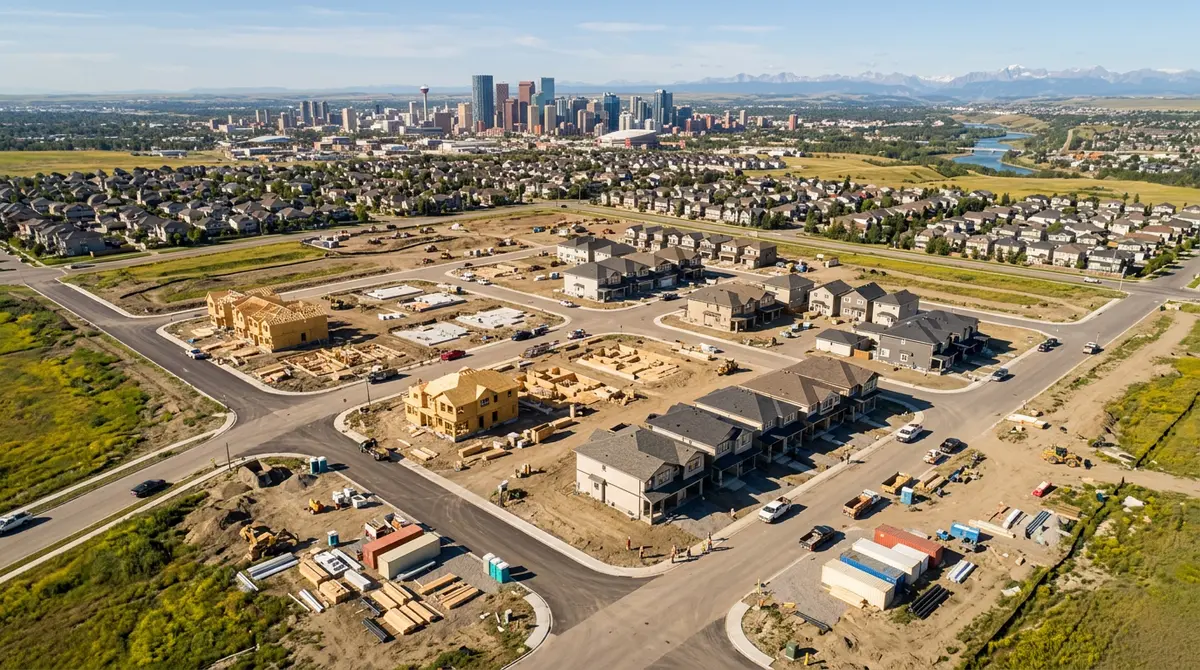
When evaluating an application for secondary financing in a new development, appraisers face a unique set of hurdles that directly impact your overall borrowing power. Unlike established neighborhoods with decades of predictable, easily accessible sales data, new developments often lack the comprehensive market history that traditional and alternative lenders prefer. This data scarcity forces appraisers to rely on alternative, often more conservative, valuation methodologies to protect the lender’s investment.
The limited comparable sales data in Phase 1 and Phase 2 developments means appraisers frequently utilize the cost-approach valuation method. This highly technical technique calculates the exact cost to replace the physical structure, subtracts any physical depreciation, and adds the raw land value. It is a stark contrast to the direct comparison approach used in mature markets.
“The cost-approach valuation is absolutely mandatory for properties under two years old in these emerging zones,” explains Elena Rostova, a senior residential appraiser certified by the Appraisal Institute of Canada. “Because it relies heavily on current construction material costs rather than speculative market demand or bidding wars, it directly impacts the accessible equity for secondary financing. We cannot appraise a home based on what the neighborhood might look like in five years; we must appraise it based on the dirt and lumber present today.”
Construction quality variations among different builders also significantly influence property assessments. Premium builders with established, decades-long track records may see their properties valued 5% to 8% higher than those built by newer, unproven contractors within the exact same subdivision. Furthermore, properties appraised during active construction phases almost always face a “nuisance discount.” This discount, which can reduce the appraised value by up to 20%, accounts for the noise, dust, heavy machinery, and general lack of curb appeal that deters potential buyers if the lender were forced to foreclose and sell the property immediately.
Lender Requirements and Strict Approval Processes
The underwriting process for extracting equity in a new development differs significantly from standard refinancing protocols. Traditional lending criteria are heavily modified to account for the unique characteristics and potential volatility associated with newer communities. Most notably, lenders enforce strict “seasoning periods” before they will even consider an application, regardless of your credit score or income level.
A seasoning period is the minimum amount of time you must legally own the property before borrowing against its newly acquired equity. In 2026, most Calgary alternative lenders require a seasoning period of 6 to 12 months. This mandatory waiting period serves a dual purpose: it allows the local micro-market to stabilize, and it proves to the underwriter that the initial purchase price wasn’t artificially inflated by hidden builder incentives or cash-back rebates.
Income verification is also scrutinized much more intensely in these scenarios. Because the property itself carries a higher perceived risk profile due to its unseasoned nature, lenders want absolute certainty regarding your debt-servicing capabilities. If you are a business owner or contractor, you must be prepared for rigorous financial checks. Understanding the nuances of verifying self-employed mortgage income is critical, as lenders will deeply analyze your Notice of Assessment (NOA), T1 Generals, and corporate financial statements to ensure long-term economic stability.
Comparison: Established vs. New Development Mortgages
To illustrate the stark differences in lending criteria, consider the following baseline metrics applied by Calgary underwriters in 2026:
| Lending Criteria | Established Calgary Neighborhoods | New Development Areas (Under 2 Years) |
|---|---|---|
| Maximum Loan-to-Value (LTV) | Up to 85% | Capped at 75% – 80% |
| Property Seasoning Required | None (Immediate equity access) | 6 to 12 months minimum |
| Appraisal Methodology | Direct Comparison Approach | Cost-Approach + Limited Direct Comparison |
| Average Interest Rates (2026) | 7.9% – 11.5% | 8.5% – 12.9% |
| Approval Timeline | 10 to 14 days | 21 to 45 days |

Step-by-Step: Securing Secondary Financing in a New Subdivision
Navigating the secondary financing landscape in a developing community requires a highly methodical approach. Follow these specific, actionable steps to maximize your approval odds and secure the most favorable interest rates available in the current economic climate.
- Verify Your Seasoning Period: Check your exact possession date on your land title. Ensure you have definitively passed the mandatory 6-month threshold before initiating any hard credit inquiries, as premature applications will result in automatic rejections and damaged credit scores.
- Compile Builder Documentation: Gather your original purchase agreement, the Alberta New Home Warranty documents, the statement of adjustments, and the developer’s phase completion schedule. Lenders use these to assess the long-term viability of the subdivision. Having a complete document checklist for secondary mortgages ready before applying will shave weeks off your approval timeline.
- Order a Specialized Appraisal: Work directly with a licensed mortgage broker to hire an appraiser who specializes specifically in new builds. They will know how to properly weight the cost-approach against the limited direct comparisons available, ensuring you get the highest possible valuation without triggering lender pushback.
- Review the Subordination Terms: Carefully read the terms of the new loan commitment. Pay special attention to the compounding frequency, as this dictates your true, annualized cost of borrowing. Educate yourself on the impact of compounding frequency before signing any legally binding documents.
- Prepare a Clear Use of Funds Statement: Lenders want to know exactly where their money is going. Whether you are consolidating high-interest debt, funding a home renovation, or utilizing the second mortgage for a down payment on an investment property, a clear, logical explanation reduces the perceived risk for the underwriter.
Strategic Market Timing and Infrastructure Milestones
Timing your application can dictate both your approval odds and your final interest rate. The cyclical nature of suburban real estate development creates specific windows of opportunity that savvy borrowers can leverage. Applying at the wrong time—such as during the muddy, noisy peak of Phase 2 construction—can result in a low appraisal and a swiftly rejected application.
The optimal timing usually coincides with major municipal milestones. The completion of a neighborhood school, the opening of a commercial retail plaza, or a direct connection to major arteries like the Stoney Trail ring road instantly boosts the perceived value and marketability of the surrounding homes. According to urban planning documents from the City of Calgary, properties located within 800 meters of a newly completed transit hub see an immediate 4% to 7% bump in assessed value.
“The rapid infrastructure deployment in Calgary’s deep south has fundamentally altered how private lenders assess risk,” explains Dr. Sarah Jenkins, Senior Urban Economist at the University of Calgary. “A property appraised the week before a major commercial hub opens will yield significantly less equity than one appraised the week after the ribbon is cut. Borrowers must treat their neighborhood’s development schedule like a corporate earnings report—timing is everything.”
Macroeconomic factors also play a pivotal role. The Bank of Canada policy rate directly influences the liquidity of the private lending market. During periods of economic expansion, lenders are aggressive, offering higher LTVs up to 85%. Conversely, in tighter economic cycles, lenders retreat to highly conservative 70% LTV maximums for unseasoned properties to insulate themselves against potential housing corrections.
Risk Assessment and Mitigation Strategies
Pursuing secondary financing in an emerging zone carries inherent market risks that require proactive mitigation. Property values in these zones can fluctuate dramatically due to unforeseen construction delays, sudden zoning amendments, or macroeconomic shifts in buyer preferences. Borrowers must stress-test their personal finances against these potential fluctuations to avoid over-leveraging their primary residence.
Developer financial stability is a critical, yet frequently overlooked, risk factor. If the primary developer of your subdivision faces insolvency or severe supply chain disruptions, planned amenities like parks, community centers, and paved roads may be abandoned indefinitely. This immediately stagnates property values and can trigger nervous lenders to call in high-risk subordinate loans or refuse renewal at the end of the term. Always research the developer’s historical track record and financial health before banking on future appreciation.
To mitigate these risks, borrowers should have a crystal-clear exit strategy. Whether your goal is debt consolidation or funding a business venture, you must know exactly how you plan to pay off the principal balance. Exploring principal reduction strategies can help you aggressively pay down the secondary debt once the property matures, the neighborhood finishes construction, and the home qualifies for a traditional A-lender refinance at a much lower interest rate.

Real-World Case Study: Equity Extraction in Carrington
To understand how these concepts apply in the real world, consider the scenario of a Calgary homeowner who purchased a detached, pre-construction home in the Carrington subdivision in early 2024 for $650,000. By mid-2026, the community’s primary commercial plaza was completed, the final layer of asphalt was poured on their street, and a new K-9 school opened just three blocks away.
Recognizing this optimal timing window, the homeowner ordered a specialized appraisal which valued the home at $780,000, creating $130,000 in gross equity. Because the property had safely surpassed the mandatory 12-month seasoning requirement and the immediate area was free of active heavy construction, the homeowner qualified for an 80% LTV limit.
They successfully extracted $65,000 in liquid capital at a rate of 9.5%. Instead of using unsecured, high-interest credit cards or predatory business loans, they utilized these funds to purchase inventory and expand their local logistics company. This scenario perfectly highlights the power of leveraging home equity for entrepreneurs when timed perfectly with neighborhood development milestones.
Furthermore, some aggressive buyers use the equity gained in their primary new-build residence to fund additional real estate investments. By extracting equity, they can purchase a rental property in another emerging phase of the exact same subdivision, effectively compounding their real estate portfolio while staying within a geographic area they intimately understand.
Conclusion
Ultimately, extracting equity from a newly built home in Calgary is a powerful financial tool when executed with precision and patience. By understanding the unique, conservative underwriting criteria of 2026, preparing meticulous builder documentation, and timing your application to align perfectly with municipal infrastructure completions, you can safely unlock the rapid equity growth characteristic of Calgary’s expanding suburban frontier.
If you are a homeowner in a new development looking to navigate these complex valuation hurdles, professional guidance is essential to avoid costly rejections and secure the best possible rates. Contact our team today to discuss your specific property, review your seasoning timeline, and build a strategic plan to access your home’s hidden capital.
Frequently Asked Questions (FAQ)
Can I get a second mortgage immediately after taking possession of a new build?
No, almost all alternative and private lenders require a mandatory “seasoning period” before approving secondary financing on a new build. In Calgary, this waiting period is typically 6 to 12 months to ensure the property’s market value has stabilized and to verify the original purchase price wasn’t inflated.
Why is the Loan-to-Value (LTV) ratio lower for new developments?
Lenders cap LTV ratios at 75% to 80% in new areas to heavily mitigate their financial risk. The lack of historical sales data, combined with the potential for short-term market volatility and construction delays, makes unseasoned properties riskier collateral than homes in established, mature neighborhoods.
How do appraisers value homes in brand new Calgary subdivisions?
Appraisers primarily use the cost-approach method for homes under two years old, calculating the raw land value plus current construction material and labor costs. They will also attempt a direct comparison approach, though finding three identical comparable sales within a one-kilometer radius is often difficult in early-phase developments.
Will ongoing construction near my home affect my appraisal?
Yes, active construction will almost certainly negatively impact your appraisal. Appraisers often apply a “nuisance discount” of up to 20% due to noise, dust, and heavy traffic, which temporarily lowers the marketability and assessed value of your property in the eyes of a lender.
What documents do I need from my builder to apply?
You must provide the original purchase agreement, the Alberta New Home Warranty certificate, the final statement of adjustments, and a copy of the land title. Lenders use these specific documents to verify the original purchase price and ensure there are no outstanding builder’s liens attached to the property.
Are interest rates higher for secondary financing in new communities?
Yes, interest rates are generally 0.5% to 1.5% higher for unseasoned properties compared to established homes. This rate premium compensates the private lender for the increased risk associated with the neighborhood’s incomplete infrastructure and unproven resale market.