Securing secondary financing on undeveloped property in Calgary involves placing a subordinate lien against raw land, allowing owners to access up to 50% to 70% of the appraised value. In 2026, these specialized financial instruments carry interest rates between 8.0% and 15.0% and require rigorous environmental assessments, strict zoning verification, and a well-documented exit strategy since the asset generates no immediate rental income. Traditional banks rarely fund these requests, making alternative lenders and Mortgage Investment Corporations (MICs) the primary capital sources for land developers and investors.
Key Takeaways
- Lower Leverage Limits: Expect maximum Loan-to-Value (LTV) ratios of 50% to 70%, requiring substantial borrower equity.
- Premium Pricing: 2026 interest rates for subordinate land loans range from 8.0% to 15.0%, reflecting the higher risk profile of non-income-producing assets.
- Mandatory Due Diligence: A Phase 1 Environmental Site Assessment (ESA) and municipal zoning confirmation are non-negotiable requirements for approval.
- Alternative Capital: Schedule I banks typically reject unserviced land loans; borrowers must utilize specialized private lenders or MICs.
- Exit Strategy Focus: Approvals hinge heavily on a clear, documented plan for repayment, such as construction takeout financing or property sale.
Understanding the 2026 Landscape for Undeveloped Property Financing
The fundamental structure of land financing involves registering a secondary charge against the property title, subordinate to any existing primary mortgage. This creates a hierarchical repayment structure that heavily influences risk assessment and lending terms. Unlike income-producing commercial real estate or residential homes with established market values, raw land generates zero rental yield and experiences significant value fluctuations based on municipal development approvals, infrastructure investments, and macroeconomic conditions.
According to the City of Calgary’s Municipal Development Plan, urban expansion and densification targets require robust infrastructure investments. Areas designated for future residential development, particularly in emerging sectors on the city’s periphery, present different financing opportunities compared to agricultural parcels or infill properties in established urban zones.
As David Chen, Director of Commercial Lending at Prairie Mortgage Investment Corp, explains: “Lenders are not just evaluating the dirt; they are underwriting the borrower’s vision, zoning approvals, and timeline to liquidity. In 2026, a well-documented exit strategy is the single most critical factor in securing subordinate financing for unserviced lots.”
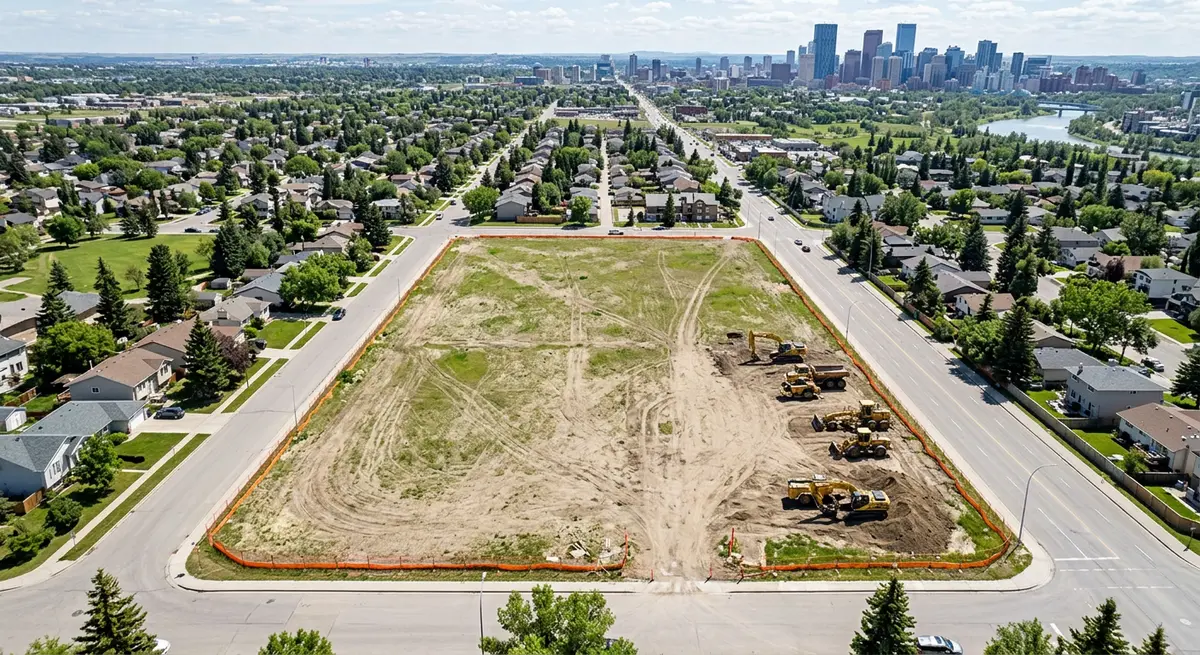
Residential vs. Raw Land Financing: A Comparative Analysis
Financial institutions approach undeveloped property with heightened caution due to several inherent risk factors, primarily the lack of cash flow and lower liquidity. To understand these differences, borrowers must examine the core metrics underwriters use to evaluate applications.
| Financing Feature | Residential Subordinate Loan | Undeveloped Land Subordinate Loan |
|---|---|---|
| Maximum Loan-to-Value (LTV) | Up to 80% – 85% | Typically 50% – 70% |
| Interest Rates (2026 Averages) | 6.5% – 10.5% | 8.0% – 15.0% |
| Primary Income Source | Personal income / Rental yield | Strictly external personal/business income |
| Key Documentation | Standard appraisal, Pay stubs | Environmental Site Assessment, Zoning permits |
| Typical Term Length | 1 to 5 years | 6 months to 2 years |
This risk profile translates into highly conservative lending practices. Underwriters typically limit loan-to-value ratios to a maximum of 70% of the appraised value and require higher interest rate premiums to compensate for increased uncertainty. Borrowers must maintain 30% to 50% equity in their land, ensuring they have a significant financial stake in successful project completion.
Core Qualification Metrics and Lender Criteria
Securing capital for undeveloped parcels requires meeting specific qualification criteria that differ substantially from standard housing requirements. Underwriters evaluate multiple risk factors simultaneously, creating a complex approval matrix.
Credit and Income Verification
Credit score requirements typically start at 650 for private lenders and 700+ for institutional lenders. However, credit scores alone rarely determine approval outcomes. Income verification and debt-service ratios receive intense scrutiny. Since the property itself generates no revenue, lenders rely entirely on the borrower’s external income sources to support debt payments.
Most alternative lenders require Total Debt Service (TDS) ratios below 40% to 44%, which must include the proposed new loan payments, existing primary mortgage obligations, and other consumer debts. Self-employed borrowers often face additional hurdles, though specialized private institutions do offer stated income options for business owners. In these scenarios, underwriters will rigorously apply the verifying self-employed income reasonability test to ensure the borrower’s corporate cash flow can sustain the carrying costs of the land.
Property-Specific Qualifications
Properties with approved development permits, completed environmental assessments, and confirmed utility access receive significantly more favorable consideration than completely raw, unserviced dirt. Location within Calgary’s municipal boundaries versus surrounding rural counties heavily affects lending terms. Urban properties generally qualify for better rates due to higher liquidity and established infrastructure networks.
Step-by-Step Guide to Securing Subordinate Land Financing
The application process for undeveloped property involves comprehensive due diligence that extends far beyond traditional real estate assessments. Follow these structured steps to maximize your approval odds in 2026:
- Conduct an Environmental Site Assessment (ESA): Before submitting an application, commission a Phase 1 ESA. Lenders will not fund raw land without verifying the absence of soil contamination, historical industrial use, or hazardous materials.
- Verify Zoning and Land Use: Obtain official documentation from the municipal planning department confirming the current zoning designation and any pending land-use amendments.
- Prepare a Comprehensive Exit Strategy: Document exactly how you plan to repay the principal. This could involve securing construction takeout financing, selling the entitled land to a developer, or utilizing cash-out refinancing alternatives once specific development milestones are achieved.
- Gather Financial Documentation: Compile your personal and corporate tax returns, business financials, and review a comprehensive document checklist to ensure no delays in underwriting.
- Submit to Specialized Land Lenders: Avoid traditional Schedule I banks, which rarely fund subordinate land loans. Target Mortgage Investment Corporations (MICs) and private commercial financiers who understand development timelines.

Interest Rates, Fees, and Term Structures
Interest rates for secondary financing on undeveloped parcels typically range from 8.0% to 15.0% annually. These rates fluctuate based on macroeconomic conditions, borrower qualifications, property characteristics, and the Bank of Canada’s policy interest rate. Term structures commonly feature shorter durations than residential loans, typically ranging from six months to two years. Many private lenders prefer shorter terms to reassess property values and borrower circumstances regularly.
Interest-only payment options frequently appear in this sector, allowing borrowers to minimize carrying costs while pursuing development approvals or municipal servicing. However, borrowers must also account for the fee structures accompanying these loans. Arrangement fees, specialized commercial appraisal costs, legal fees, and ongoing administration charges can add 2% to 4% to the total borrowing cost.
Furthermore, borrowers must understand how compounding frequency impacts their total interest obligations over the term of the loan. To ensure a smooth exit from these higher-interest private loans, developers should implement aggressive principal reduction strategies as soon as the land begins generating revenue or when initial lots are sold.
The Critical Role of Zoning and Environmental Due Diligence
Development potential significantly influences both property valuations and capital availability. Parcels with clear development pathways command higher appraisals and better financing terms than raw land without municipal approvals. Zoning classifications directly impact lending decisions. Residential zoning categories allowing higher density development, such as R-C2 (Residential – Contextual One / Two Dwelling) or M-C1 (Multi-Residential – Contextual Low Profile), support higher land values than single-family designations.
Environmental considerations play increasingly important roles in Alberta’s real estate sector. Properties requiring environmental remediation, located in flood-prone areas, or subject to environmental reserve restrictions face intense scrutiny. According to guidelines from Alberta Environment and Protected Areas, strict regulations govern land development near water bodies and historic industrial sites. Climate change considerations and updated flood mapping have affected property values in specific Calgary quadrants, making environmental due diligence essential.
“Environmental due diligence is non-negotiable in today’s market,” states Marcus Thorne, Senior Environmental Consultant at Calgary GeoTech. “A Phase 1 ESA protects both the lender’s capital and the borrower’s liability in an increasingly strictly regulated province. Skipping this step guarantees an immediate loan denial from any reputable institution.”
Alternative Lending Sources: Moving Beyond Traditional Banks
Traditional banks have highly restrictive policies for unserviced land, often outright refusing to take a subordinate position on dirt. This makes alternative lending sources crucial for land investors and developers. Mortgage Investment Corporations (MICs) and specialized private commercial lenders fill this void. These institutions focus heavily on the asset’s equity position and the viability of the exit strategy rather than just the borrower’s T4 income.
While some smaller developers look at peer-to-peer lending alternatives, structured private commercial loans offer larger capital pools and more reliable funding timelines for multi-million dollar land acquisitions. The Real Estate Council of Alberta (RECA) advises borrowers to work exclusively with licensed mortgage brokerages when navigating the private lending space to ensure transparent fee structures and fair lending terms.

Common Pitfalls to Avoid in Land Development Financing
Navigating the complexities of undeveloped property financing requires avoiding several common pitfalls that can derail a project or lead to severe financial distress:
- Lack of a Clear Exit Strategy: Underwriters will reject applications that rely on “hoping the land value goes up.” You must have a defined, realistic plan to sell, build, or refinance.
- Underestimating Carrying Costs: Vacant land consumes cash through property taxes, insurance, and interest payments without generating income. Borrowers must maintain robust liquid cash reserves.
- Ignoring Municipal Timelines: Development permits in Calgary can take 12 to 24 months to process. Securing a 6-month loan for a project requiring a 2-year entitlement process is a recipe for default.
- Overlooking Soil Conditions: Poor load-bearing soil, high water tables, or bedrock can exponentially increase development costs, destroying the project’s loan-to-value metrics and profitability.
Conclusion
Securing secondary financing on undeveloped property in Calgary during 2026 requires a strategic approach, substantial equity, and meticulous preparation. While traditional banks shy away from these non-income-producing assets, a robust network of private lenders and MICs exists to fund viable projects. Success depends on presenting a comprehensive package that includes environmental clearances, verified zoning, and a bulletproof exit strategy. By understanding the stringent requirements and higher costs associated with raw land, developers can effectively leverage these financial tools to bridge funding gaps and bring their projects to fruition. If you are looking to navigate this complex lending landscape, contact our team today to discuss your specific property and financing needs.