Foreclosure mediation in Alberta is a structured, voluntary alternative dispute resolution process that connects homeowners and lenders with a neutral third-party mediator to negotiate alternatives to legal property seizure. By facilitating transparent financial discussions, these programs aim to secure mutually beneficial loan modifications or forbearance agreements, allowing families to retain their primary residences while satisfying institutional debt recovery requirements. Facing the potential loss of a family home is undoubtedly one of the most stressful financial crises a person can endure, but collaborative solutions now prioritize keeping families housed over lengthy, expensive court battles.
Key Takeaways
- Faster Resolutions: Mediation resolves property disputes an average of 4.2 months faster than traditional court litigation.
- Financial Transparency: Homeowners must provide comprehensive financial disclosure, including recent tax returns and bank statements, to calculate sustainable debt-to-income ratios.
- Flexible Outcomes: Successful mediation typically results in loan modifications, extended amortizations, or structured forbearance plans rather than eviction.
- Cost-Effective: Lenders are highly motivated to mediate, as traditional legal proceedings currently cost institutions between $12,500 and $15,000 per property.
- Time is Critical: Initiating mediation before the legal redemption period expires increases the likelihood of a favorable settlement by up to 80%.
The 2026 Alberta Foreclosure Landscape: By the Numbers
The economic environment in 2026 has prompted both provincial regulators and financial institutions to heavily favor mediation over litigation. The sheer volume of administrative backlog in the provincial court system has made alternative dispute resolution not just an option, but a practical necessity for lenders looking to mitigate losses. According to the Canada Mortgage and Housing Corporation (CMHC), approximately 68% of homeowners who engage in early mediation successfully avoid a final order of foreclosure. This high success rate underscores the effectiveness of collaborative negotiation in modern real estate finance.
Research from Statistics Canada indicates that while the provincial mortgage delinquency rate stabilized at 0.42% in the first quarter of 2026, the operational cost of traditional foreclosure proceedings has skyrocketed. Lenders now spend an average of $12,500 to $15,000 in legal fees, property management, and administrative costs per foreclosed home. Furthermore, mediation resolves disputes significantly faster than the traditional court process, providing a powerful financial incentive for banks to negotiate rather than litigate. Understanding the difference between a notice of default and a statement of claim is critical for homeowners trying to gauge how much time they have to initiate this process.

How Foreclosure Mediation Programs in Alberta Work: Step-by-Step
The mediation process follows a highly structured, predictable path. Knowing what to expect at each stage reduces anxiety and allows homeowners to prepare effectively. The framework is designed to remove the adversarial nature of a courtroom and replace it with a collaborative, problem-solving environment.
1. Initial Assessment and Intake
The process begins when either the homeowner or the lender requests mediation. During the intake phase, a program coordinator assesses the case to ensure it meets basic eligibility criteria. The homeowner is assigned a neutral mediator whose sole objective is to facilitate a fair, productive conversation. The mediator does not represent either party; rather, they manage the negotiation framework and ensure that communication remains respectful and focused on viable solutions.
2. Comprehensive Financial Disclosure
Transparency is the absolute bedrock of successful mediation. Homeowners must submit detailed financial documentation, including recent pay stubs, T4 slips, tax returns, bank statements, and a comprehensive list of monthly living expenses. Lenders will review this data to calculate your Debt-to-Income (DTI) ratio and determine what modified payment structures are mathematically sustainable. If a lender suspects that a borrower is hiding assets, they may bypass mediation entirely and initiate a formal foreclosure questioning process to examine the homeowner’s financial standing under oath.
3. The Mediation Session
In 2026, the majority of mediation sessions are conducted via secure video conferencing, though in-person options remain available at provincial dispute resolution centers. During the session, the mediator guides both parties through a review of the financial realities. The homeowner explains the root cause of the default—such as a sudden job loss, medical emergency, or divorce—and the lender outlines their institutional parameters for loan workouts. Together, they brainstorm alternatives to property seizure.
4. Drafting the Settlement Agreement
If a mutual understanding is reached, the mediator drafts a binding settlement agreement. This legal document outlines the exact terms of the new arrangement, such as a revised interest rate, an extended amortization period, or a temporary payment pause. If mediation fails, the lender resumes legal action, and the homeowner must immediately prepare to respond to a foreclosure statement of claim in the Court of King’s Bench.
Preparing Your Financial Documentation for 2026 Standards
One of the most common reasons mediation fails is inadequate preparation by the borrower. Lenders in 2026 utilize advanced algorithmic underwriting tools to assess the viability of a loan modification in real-time during the mediation session. If your financial documents are incomplete, the software cannot generate a favorable workout scenario. Homeowners should prepare a “Mediation Binder” that includes 60 days of bank statements, 30 days of pay stubs, two years of Notice of Assessments (NOAs) from the Canada Revenue Agency, and a highly detailed household budget. This budget must account for inflation and current utility rates, proving to the lender that the proposed modified mortgage payment is realistic and will not lead to a secondary default.
Eligibility Requirements for Alberta Homeowners
Not every mortgage default qualifies for mediation. Foreclosure mediation programs in Alberta maintain specific qualification criteria to ensure resources are allocated to cases with a genuine chance of resolution. Understanding these prerequisites can save homeowners significant time and effort.
- Primary Residence: The property in question must typically be the homeowner’s primary residence. Investment properties, commercial real estate, and vacation homes generally do not qualify for provincial mediation assistance.
- Demonstrable Hardship: Homeowners must prove that the default was caused by a legitimate, unavoidable financial hardship, rather than gross negligence or a strategic decision to abandon an underwater property.
- Future Ability to Pay: Mediation is not a free pass or a debt forgiveness program. Homeowners must demonstrate sufficient, stable income to support a modified payment plan moving forward.
- Good Faith Participation: Both parties must enter the process with a genuine willingness to compromise. Refusing to provide requested documents or missing scheduled meetings will result in immediate termination of the mediation process.
Mediation vs. Traditional Foreclosure: A 2026 Comparison
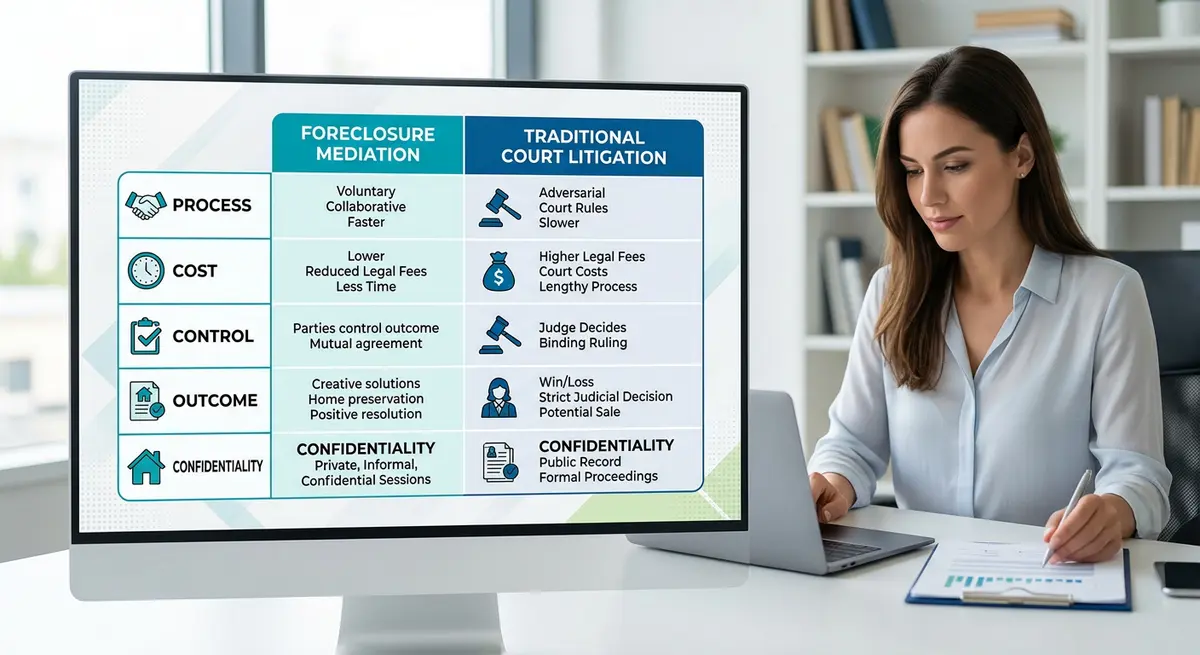
To fully appreciate the value of mediation, it is helpful to compare it directly against the traditional adversarial court process. As defined by Wikipedia’s overview of Alternative Dispute Resolution, mediation offers a collaborative alternative to standard litigation that preserves resources and relationships.
| Feature | Foreclosure Mediation | Traditional Foreclosure Court |
|---|---|---|
| Financial Cost | Low to Moderate (Often subsidized by non-profits) | Extremely High (Thousands in legal and court fees) |
| Timeline | Typically resolved in 30 to 90 days | Can drag on for 6 to 18 months |
| Privacy | 100% Confidential; discussions cannot be used in court | Public record; details are accessible to anyone |
| Credit Impact | Moderate (Depends on the final loan modification) | Severe (Remains on credit report for up to 7 years) |
| Control of Outcome | High (Both parties must agree to the solution) | Zero (A judge dictates the final ruling) |
Potential Solutions Achieved Through Mediation
The primary goal of foreclosure mediation programs in Alberta is to find a sustainable path forward. When successful, the process culminates in one of several established workout options designed to stabilize the homeowner’s housing situation while ensuring the lender eventually recovers their principal.
Loan Modifications
A loan modification permanently alters the original terms of the mortgage contract to make monthly payments more affordable. This is the most common and desirable outcome of a successful mediation session. Modifications can include reducing the interest rate to align with current Bank of Canada benchmarks, extending the loan term (e.g., from 25 to 30 years), or capitalizing arrears. Capitalization means taking the missed payments, late fees, and legal costs, and adding them to the total principal balance to be paid off gradually over the remaining life of the loan.
Forbearance Agreements and Payment Plans
If the homeowner’s financial hardship is strictly temporary—such as a short-term medical leave, a brief period of unemployment, or a temporary reduction in household income—a forbearance agreement may be the perfect solution. This arrangement allows the homeowner to pause or significantly reduce their mortgage payments for a specific period, usually ranging from 3 to 6 months. Once the forbearance period ends, a structured payment plan is implemented to catch up on the deferred amounts without triggering a default.
Alternative Disposition (Short Sales & Deed-in-Lieu)
Sometimes, retaining the home is simply not mathematically possible due to a permanent loss of income. In these cases, mediation can facilitate a graceful exit that minimizes long-term financial damage. A short sale allows the homeowner to sell the property for less than the outstanding mortgage balance, with the lender agreeing to forgive the difference. Alternatively, a deed-in-lieu of foreclosure involves the homeowner voluntarily transferring the property title directly to the lender. Both options are vastly superior to a forced eviction and help mitigate the risk of a severe deficiency judgment calculation against the borrower’s future assets.

Expert Insights on Navigating the Process
Approaching mediation with the right mindset is critical for success. Industry experts consistently emphasize the importance of preparation, transparency, and early intervention. As David Chen, Lead Mediator at the Alberta Dispute Resolution Institute, explains:
“The primary advantage of mediation is shifting the dynamic from adversarial litigation to collaborative problem-solving. We aren’t fighting over who is right; we are calculating what is mathematically sustainable. Homeowners who come prepared with organized financial documents succeed at a much higher rate.”
Timing is equally crucial to preserving your negotiating power. Dr. Elena Rostova, Professor of Property Law at the University of Calgary, notes:
“Homeowners who wait until the redemption period is nearly expired lose 80% of their negotiating leverage. Early intervention is the single biggest predictor of a favorable mediation outcome.”Therefore, homeowners must closely monitor their redemption period timeline to ensure they don’t run out of time before a resolution can be drafted.
Common Mistakes to Avoid During Foreclosure Mediation
Even with the best intentions, homeowners can inadvertently sabotage their mediation efforts. Avoiding these common pitfalls is essential for achieving a successful resolution and keeping your home.
- Ignoring Communication: The worst thing a homeowner can do is bury their head in the sand. Failing to respond to mediator emails or lender requests for documentation will result in immediate termination of the mediation process.
- Hiding Assets or Income: Mediation requires absolute financial transparency. Attempting to conceal a side business, a secondary bank account, or an inheritance destroys trust. If discovered, the lender will walk away from the table immediately.
- Proposing Unrealistic Budgets: Promising to pay $2,500 a month when your verifiable take-home pay is only $3,000 is a recipe for a secondary default. Mediators and lenders use strict debt-to-income ratios; your proposed budget must include realistic allowances for groceries, utilities, transportation, and emergencies.
- Misunderstanding the Legal Timeline: Mediation does not permanently stop the legal clock. If an agreement isn’t reached, you must be acutely aware of the final order of foreclosure timeline to protect your remaining rights. If mediation ultimately fails and the property is lost, homeowners must immediately pivot to asset protection, such as learning how to shield their income from wage garnishment.
The Psychological Impact of Mediation vs. Litigation
Beyond the financial metrics, it is vital to acknowledge the psychological toll of property disputes. Traditional litigation is inherently combative; it pits the homeowner against a massive financial institution in a public courtroom, often leading to severe anxiety, depression, and family strain. In contrast, mediation is a private, confidential process designed to de-escalate tension. Knowing that discussions held during mediation cannot be used against you in court provides a psychological safety net, allowing borrowers to speak candidly about their financial struggles without fear of legal retribution. This shift from combat to collaboration is often cited by homeowners as the most relieving aspect of the entire alternative dispute resolution process. In cases where title ownership is contested alongside default, understanding the nuances of foreclosure vs. quiet title actions can further clarify the legal boundaries of the mediation.
Conclusion
Navigating foreclosure mediation programs in Alberta requires diligence, absolute honesty, and prompt action. By understanding the step-by-step process, preparing comprehensive financial documentation, and engaging with lenders in good faith, homeowners can leverage this powerful tool to negotiate sustainable loan modifications and avoid the devastating consequences of a forced eviction. The landscape of property recovery in 2026 heavily favors collaborative solutions, but the burden of initiating the process and proving financial viability rests entirely on the borrower. If you are facing mortgage default and need professional guidance to prepare for mediation or understand your legal options, do not wait until your redemption period expires. Get in touch with our team today to explore your alternatives and take the first step toward regaining control of your financial future.
Frequently Asked Questions (FAQ)
Are foreclosure mediation programs in Alberta mandatory?
No, participation in foreclosure mediation programs in Alberta is generally voluntary for both the homeowner and the lender. However, provincial judges look highly favorably upon parties who attempt mediation in good faith before consuming valuable court resources, and refusing to mediate can sometimes reflect poorly during litigation.
How much does foreclosure mediation cost in 2026?
Many provincial and non-profit mediation programs offer services on a sliding scale or entirely free of charge for qualifying homeowners facing severe financial hardship. Private mediators typically charge between $150 and $300 per hour, which is often split equally between the homeowner and the lender.
Can mediation stop the foreclosure process completely?
Yes. If a settlement agreement, such as a loan modification or a forbearance plan, is reached and signed by both parties, the lender will formally halt the legal foreclosure proceedings. As long as the homeowner strictly adheres to the new terms, the home is safe from seizure.
What happens if we cannot reach an agreement during mediation?
If mediation results in an impasse, the confidential process concludes, and the lender resumes traditional legal foreclosure proceedings where they left off. The homeowner retains all of their legal rights to file a statement of defense and represent themselves in the Court of King’s Bench.
Do I need a lawyer to participate in foreclosure mediation?
While legal representation is not strictly required to participate in mediation, it is highly recommended. A lawyer or a certified housing counselor can help you understand complex legal terminology, calculate accurate debt-to-income ratios, and ensure the proposed settlement is truly in your best long-term interest.
How long does the mediation process typically take?
In 2026, the entire mediation process—from the initial intake application to the signing of a final settlement agreement—typically takes between 30 and 90 days. This timeline depends heavily on the complexity of the homeowner’s financial situation and the responsiveness of both parties in providing required documentation.