In 2026, Calgary homeowners can expect conventional secondary financing rates to range between 5.45% and 6.15%, while alternative and private lending options typically fall between 8.99% and 12.50%. These figures fluctuate based on the Bank of Canada’s policy rate, your property’s available equity, and your personal credit profile. Because supplementary loans sit in a subordinate position to your primary mortgage, lenders assume greater risk in the event of a default. This structural reality results in a pricing premium of 1% to 4% over standard first-mortgage rates. Understanding these baseline figures is the first step toward making an informed decision about leveraging your property’s built-up value.
Key Takeaways
- Current Rate Ranges: Conventional options sit between 5.45% and 6.15%, while private funds range from 8.99% to 12.50% in 2026.
- Risk Premiums: Subordinate liens inherently cost more due to the lender’s secondary position on the property title.
- Economic Influence: The Bank of Canada’s stabilized 4.25% policy rate directly dictates the pricing of variable-rate equity products.
- Equity Requirements: Traditional lenders cap combined loan-to-value (LTV) at 80%, whereas private institutions may extend up to 95% for qualified applicants.
- Hidden Costs: Borrowers must account for appraisal fees, legal disbursements, and lender setup fees, which can add 2% to 4% to the total loan cost.
The 2026 Landscape of Secondary Financing in Alberta
The economic environment in Alberta has shown remarkable resilience compared to other major Canadian markets. With the average Calgary home price stabilizing around $585,400 according to recent data from the Canadian Real Estate Association, homeowners are sitting on unprecedented levels of equity. This wealth accumulation has driven a surge in supplementary borrowing as residents look to consolidate debt, fund major renovations, or invest in secondary properties without disrupting the favorable fixed rates they secured on their primary mortgages years prior.
“Secondary financing inherently carries a higher risk profile for lenders, which is directly reflected in the premium added to the interest rate,” explains Sarah Jenkins, Senior Economist at the Canadian Real Estate Association. “However, Calgary’s robust employment sector and steady population growth in 2026 have mitigated some of this risk, allowing local institutions to offer slightly more competitive terms than we see in highly volatile markets like Toronto or Vancouver.”
This localized stability means that while national inflation trends and bond yields set the baseline, regional economic health plays a crucial role in final approval terms. Lenders are increasingly looking at neighborhood-specific data and local industry stability when pricing their risk models.

Current Interest Rate Breakdown: Traditional vs. Alternative Lenders
Navigating the lending ecosystem requires understanding the different tiers of financial institutions operating in Alberta. Each tier caters to a specific borrower profile and prices their capital accordingly. Traditional banks (A-lenders) offer the lowest borrowing costs but enforce the strictest qualification criteria, heavily regulated by federal stress tests. Conversely, Mortgage Investment Corporations (MICs) and private lenders offer flexible, rapid approvals but charge a significant premium for their capital.
| Lender Tier | 2026 Rate Range | Max LTV | Ideal Borrower Profile |
|---|---|---|---|
| Traditional Banks (A-Lenders) | 5.45% – 6.15% | 80% | Excellent credit (720+), verifiable T4 income, low debt ratios. |
| Alternative (B-Lenders) | 6.99% – 8.50% | 80% – 85% | Self-employed, minor credit blemishes, non-traditional income. |
| Private Lenders & MICs | 8.99% – 12.50%+ | Up to 95% | Poor credit, urgent funding needs, high existing debt loads. |
For entrepreneurs and self-employed individuals who may struggle with traditional income verification, exploring stated income alternative documentation can open doors to B-lender rates rather than defaulting immediately to high-cost private funds. The key is matching your financial reality with the appropriate institutional tier.
Key Factors Influencing Your Borrowing Costs
Lenders do not assign rates arbitrarily; they utilize complex risk assessment algorithms. Understanding these variables allows you to position your application favorably and potentially save thousands of dollars over the life of your loan.
Credit Score and Debt-to-Income Ratios
Your credit history acts as a behavioral blueprint for lenders. In 2026, securing preferred pricing typically requires a beacon score above 680. However, the score alone isn’t the entire picture. Institutions scrutinize your credit utilization and recent inquiries. If you have been shopping around excessively, knowing how to explain credit inquiries to an underwriter can prevent a rate hike or outright decline.
Equally critical is your Debt-to-Income (DTI) ratio. Lenders calculate this by comparing your total monthly debt obligations against your gross monthly earnings. Maintaining a DTI below 40% demonstrates a strong capacity to absorb new payments, which directly translates to lower borrowing costs.
Loan-to-Value (LTV) and Equity Position
The Loan-to-Value ratio is arguably the most heavily weighted metric in secondary financing. It represents the total percentage of your property’s value that is encumbered by debt. For example, if your home is appraised at $600,000 and your primary mortgage balance is $350,000, requesting an additional $100,000 loan brings your total debt to $450,000—an LTV of 75%.
“Calgary’s resilient housing market in 2026 provides a unique buffer, allowing local homeowners to access equity at more competitive terms than we see in highly volatile markets,” notes David Chen, Director of Mortgage Analytics at the Financial Consumer Agency of Canada. “When LTV remains below the 80% threshold, lenders feel secure that market fluctuations won’t erode their collateral, resulting in substantially better pricing for the consumer.”
Fixed vs. Variable Rates: Which Makes Sense in 2026?
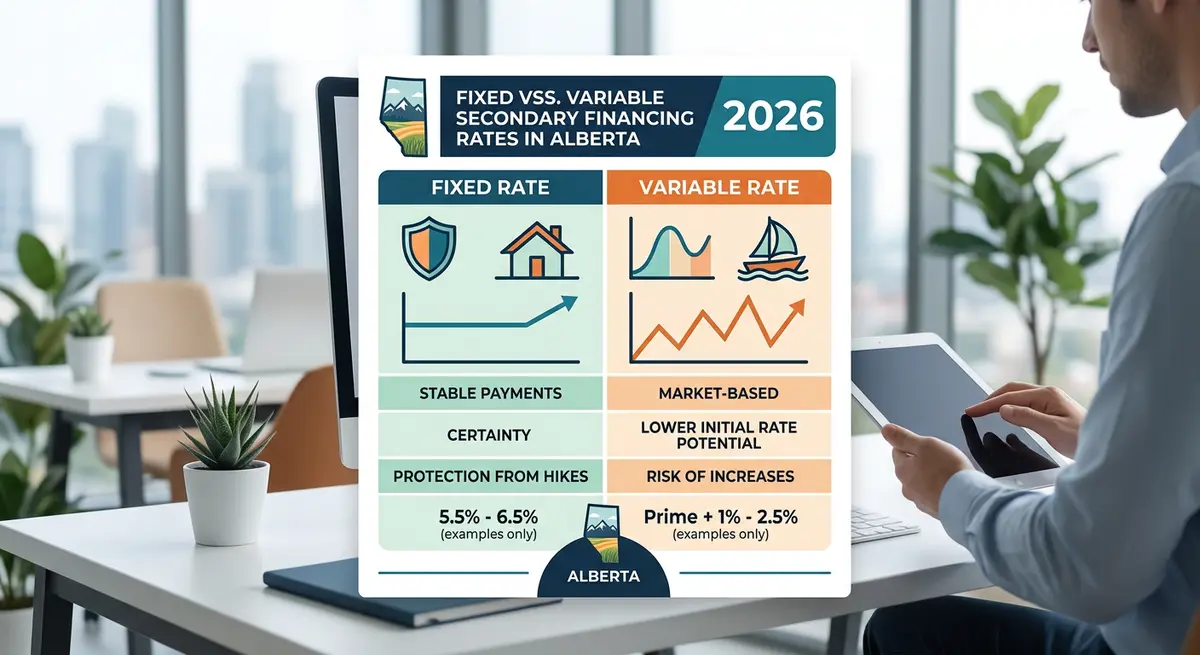
Choosing between a fixed and variable structure is a critical decision that hinges on your risk tolerance and economic outlook. Fixed agreements lock in your borrowing cost for the duration of the term (typically 1 to 5 years), shielding you from market volatility. This predictability is invaluable for strict budgeting, especially when consolidating high-interest consumer debt.
Variable options, conversely, fluctuate in tandem with the Bank of Canada‘s overnight lending rate. With the central bank stabilizing its policy rate around 4.25% in early 2026, variable products currently offer a slight initial discount compared to fixed terms. However, this discount comes with the inherent risk of payment shocks if inflation metrics force unexpected monetary tightening.
“When central banks adjust monetary policy, variable rate holders feel the impact within 30 days. Fixed terms offer a necessary psychological and financial shield during uncertain economic cycles,” says Dr. Elena Rostova, Professor of Finance at the University of Calgary. Borrowers must weigh the immediate savings of a variable product against the long-term security of a fixed commitment.
How to Secure the Best Possible Terms
Preparation is the ultimate leverage when negotiating with financial institutions. Follow these actionable steps to optimize your application profile before submitting it to an underwriter:
- Audit Your Credit Report: Pull your comprehensive credit file from Equifax and TransUnion at least 60 days prior to applying. Dispute any inaccuracies and pay down revolving credit card balances to below 30% of their limits to artificially boost your score.
- Gather Comprehensive Documentation: Delays breed lender skepticism. Prepare your T4s, recent pay stubs, NOAs (Notices of Assessment), and property tax statements in advance. Reviewing a comprehensive document checklist for secondary mortgages ensures you don’t miss critical paperwork.
- Commission an Independent Appraisal: While lenders will order their own valuation, having an independent, recent appraisal gives you a realistic understanding of your maximum borrowing power and prevents you from over-leveraging.
- Compare Structural Alternatives: Don’t assume a standard supplementary loan is your only option. Spend time comparing second mortgages versus cash-out refinancing to determine which vehicle offers the lowest blended cost of capital over a 5-year horizon.
- Work with a Specialized Broker: Retail bank branches only offer their proprietary products. An independent broker has access to the wholesale channel, including MICs and credit unions, forcing lenders to compete for your business.
Hidden Costs and Fees to Watch For
Focusing solely on the advertised percentage is a common pitfall. The true cost of borrowing includes a myriad of setup fees and structural nuances that can significantly inflate your financial burden. Standard disbursements include appraisal fees ($350 – $500) and legal registration costs ($900 – $1,600). Furthermore, alternative and private lenders typically charge a setup fee ranging from 1% to 3% of the total loan amount, deducted directly from your proceeds.
“Borrowers must look beyond the advertised percentage. The compounding frequency and associated setup fees often dictate the true cost of the loan,” warns Marcus Thorne, Principal Broker at Alberta Equity Partners. Understanding how compounding frequency silently increases your debt is vital. A loan compounding monthly versus semi-annually can add thousands to your total interest paid over a standard term.
Additionally, borrowers should be aware of their legal rights. If you feel pressured into an unfavorable private agreement, Alberta law provides specific consumer protections. Familiarize yourself with the 4-day exception to rescind a high-interest mortgage, which offers a brief cooling-off period for certain high-risk contracts.

Strategic Uses for Home Equity in Calgary
When accessed responsibly, property equity is a powerful wealth-building tool. According to recent demographic surveys by Statistics Canada, over 45% of supplementary loans in Alberta are utilized for debt consolidation. By rolling high-interest credit card debt (often sitting at 19.99% to 24.99%) into a single, lower-interest property loan, families can dramatically improve their monthly cash flow.
Another strategic application is property improvement. With the cost of relocation (realtor fees, land transfer taxes, moving expenses) easily exceeding $30,000, many Calgarians are choosing to renovate their existing spaces. Upgrading kitchens, adding legal basement suites, or improving energy efficiency not only enhances quality of life but actively forces appreciation, effectively paying for the cost of the borrowed capital over time.
Finally, proactive borrowers are implementing principal reduction strategies from day one. By making accelerated bi-weekly payments or utilizing annual lump-sum prepayment privileges, you can shave years off your amortization schedule and drastically reduce the lifetime interest paid to the institution.
Frequently Asked Questions
Can I get a secondary loan with a credit score under 600?
Yes, but you will likely be restricted to the private lending market. Traditional banks require scores above 680, while private lenders focus primarily on the equity in your home rather than your credit history. Expect to pay higher rates (10%+) and larger setup fees.
How long does the approval process take in Alberta?
The timeline varies by lender tier. Traditional banks may take 3 to 5 weeks due to rigorous stress-testing and income verification. Conversely, private lenders can often appraise the property, approve the file, and fund the loan within 5 to 10 business days.
Are the interest payments tax-deductible in Canada?
Interest payments are generally only tax-deductible if the borrowed funds are used directly for investment purposes that generate income (such as buying dividend stocks or a rental property). Funds used for personal renovations or consumer debt consolidation are not tax-deductible. Always consult a CPA for your specific situation.
What happens if my property value drops after I secure the loan?
Once your loan is funded and registered on the title, a subsequent drop in property value does not change your current terms or require immediate repayment. However, it may severely limit your ability to renew the loan or refinance when the term expires, as your LTV will have increased.
Do I have to use my current primary mortgage lender?
No. You are free to secure supplementary financing from any institution willing to take a subordinate position on your title. In fact, shopping around outside your primary bank is highly recommended to ensure you receive the most competitive market pricing.
What is the difference between a HELOC and a standard supplementary loan?
A Home Equity Line of Credit (HELOC) is a revolving credit facility with a variable rate, allowing you to draw and repay funds as needed. A standard supplementary loan provides a single lump-sum payout with a fixed repayment schedule and term, offering more predictability but less ongoing flexibility.
Conclusion
Navigating the 2026 lending landscape in Alberta requires a nuanced understanding of economic indicators, lender risk models, and your own financial profile. While borrowing costs for subordinate liens are inherently higher than primary financing, the strategic deployment of these funds can yield significant long-term benefits—whether through eliminating high-interest consumer debt or forcing property appreciation via renovations. By auditing your credit, understanding the true cost of compounding fees, and comparing traditional versus alternative lending tiers, you can secure terms that align with your financial objectives.
If you are considering leveraging your home’s equity and want to explore the most competitive options available in today’s market, expert guidance is invaluable. Contact us today to schedule a comprehensive review of your property’s borrowing potential and receive a customized financing strategy.