In Alberta, a condominium foreclosure typically takes between 12 to 18 months to complete in 2026, depending on court backlogs and homeowner responses. The legal process officially begins after three missed mortgage payments, followed by a formal Statement of Claim, a strict 20-day response window, and a standard six-month redemption period. Unlike single-family homes, condo foreclosures involve the condominium corporation as an active third party, which can register caveats for unpaid strata fees, further complicating the timeline and increasing the total settlement costs required to halt the repossession.
Key Takeaways
- Extended Timelines: Due to ongoing court backlogs in 2026, the average condo foreclosure now takes 40% longer than pre-pandemic averages, often exceeding 14 months.
- The 20-Day Rule: Homeowners have exactly 20 days to file a response after being served with a Statement of Claim to preserve their legal rights.
- Condo Board Intervention: Condominium corporations can register caveats against the title for unpaid fees, forcing lenders to address these arrears before a judicial sale.
- Redemption Period: The standard redemption period granted by the Court of King’s Bench remains six months, though abandoned properties can see this reduced to 30 days.
- Deficiency Risks: If the property sells for less than the mortgage balance, lenders can pursue homeowners for the remaining debt, making early intervention critical.
- Alternative Solutions: Filing a Demand of Notice buys time to secure alternative financing, negotiate a voluntary sale, or arrange a repayment plan.
The 2026 Landscape of Property Repossession in Alberta
The legal landscape surrounding property repossession has shifted significantly over the past few years. Legal complexities and persistent court backlogs have reshaped how lenders, condominium boards, and homeowners navigate financial defaults. In 2026, the timeline for resolving a distressed property has stretched considerably, creating both challenges and unexpected opportunities for those facing missed payments.
According to recent data from the Canada Mortgage and Housing Corporation (CMHC), the average duration of a contested foreclosure in Alberta has increased by 40% compared to historical baselines. What was once a predictable 9-to-12-month procedure now routinely spans 14 to 18 months. This delay is primarily driven by administrative bottlenecks within the provincial justice system and the increasing complexity of multi-creditor disputes.
“Condominium foreclosures introduce a third aggressive creditor into the mix: the condo corporation,” explains Sarah Jenkins, Senior Real Estate Litigator at the Alberta Legal Institute. “Unlike a standard residential property where the dispute is solely between the borrower and the bank, a condo board’s demand for unpaid special assessments and monthly fees can stall court proceedings for months.”
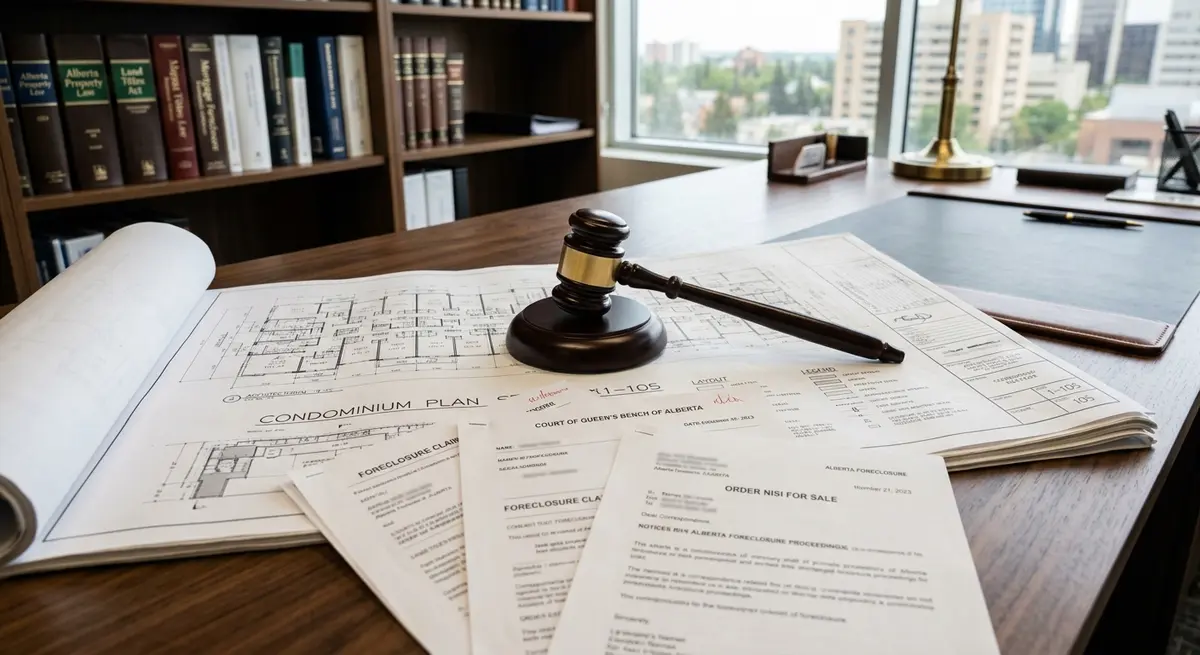
Critical Milestones: The Step-by-Step Condo Foreclosure Process
When you miss a mortgage payment, a carefully regulated sequence of events begins. Lenders must follow strict protocols mandated by provincial law to protect their financial interests while affording homeowners specific opportunities to resolve the debt. Understanding these milestones is essential for effective equity preservation.
- Mortgage Default and Initial Warnings (Days 15-25): Your first overdue payment triggers internal bank warnings. Lenders typically send written notices within 15 to 25 days of a missed payment. These initial communications outline repayment terms and impending deadlines.
- The Formal Demand Letter (Days 30-45): If the account remains in arrears after two missed payments, the lender’s legal counsel will issue a formal demand letter. This document provides a final deadline to pay the arrears before court action commences.
- Filing the Statement of Claim (Day 45+): Unresolved defaults lead to the lender filing a Statement of Claim with the Court of King’s Bench of Alberta. This is the official start of litigation. Understanding the difference between a default notice and a statement of claim is vital at this stage, as the latter requires a formal legal response.
- The 20-Day Response Window: Upon being served with the Statement of Claim, you have exactly 20 days to file a legal response. Failing to respond allows the lender to proceed with an uncontested application, drastically accelerating the timeline.
- The Redemption Period (Months 3-9): Once the court reviews the case, a Master in Chambers will typically grant a redemption period. This is a court-ordered window—usually six months—during which you can pay the full mortgage balance, interest, and legal costs to reclaim your property.
- Final Order or Judicial Sale (Month 10+): If the redemption period expires without payment, the court will issue a final order transferring the title to the lender or directing the property to be sold via a judicial listing.
Single-Family Homes vs. Condominiums: Key Legal Differences
While the overarching legal framework applies to all real estate in the province, condominiums are governed by additional legislation, specifically the Condominium Property Act of Alberta. This creates distinct procedural differences that homeowners and investors must understand.
| Legal Feature | Condominium Properties | Single-Family Homes |
|---|---|---|
| Third-Party Creditors | Condo Corporation actively involved. | Usually limited to Lender and Municipality. |
| Title Caveats | Board can register caveats for unpaid strata fees, blocking sales. | Caveats typically limited to property taxes or CRA liens. |
| Eviction of Tenants | Condo boards can redirect tenant rent to cover fee arrears. | Lender must obtain a specific court order for possession. |
| Average Timeline | 14 to 18 months due to multi-party negotiations. | 10 to 14 months. |
Condominium corporations often complicate cases by demanding unpaid fees during proceedings. Provincial laws require judges to approve every major action, and resolving these secondary debts can add months to the timeline. In many instances, condo arrears can add $5,000 to $15,000 to the total cost required to halt the legal action.
Navigating the Statement of Claim and Your 20-Day Window
The moment you receive court documents, your response shapes the entire trajectory of the litigation. You face critical choices within a strict 20-day window, each carrying lasting consequences for your property rights and financial future.
“The 20-day response window following a Statement of Claim is the most critical juncture in Alberta property law,” states Marcus Thorne, Director of Foreclosure Mitigation at The Second Mortgage Store. “Ignoring these documents is the fastest way to lose your equity. Filing the correct response forces the lender to keep you informed and allows you to present your case to a judge.”
Homeowners generally have two primary options when filing a response to court documents:
- Statement of Defence: This is used if you legitimately dispute the lender’s claims. Valid legal grounds might include errors in the lender’s accounting, violations of provincial consumer protection laws, or disputes over the validity of the mortgage contract. Financial hardship alone is not a valid legal defense.
- Demand of Notice: If you do not dispute the debt but want to remain involved in the process, filing a Demand of Notice is crucial. This legally obligates the lender to notify you of all future court dates, appraisals, and sale attempts. It preserves your right to negotiate and ensures you can review the lender’s property valuations.
In complex cases where owners avoid service, lenders must apply for substitutional service orders. This allows them to serve documents via email, posting on the door, or publishing in a local newspaper. Obtaining these orders typically adds 60 to 90 days to the process, though the costs are ultimately added to the homeowner’s debt.
Understanding the Redemption Period for Alberta Condos
The redemption period is the legal grace period granted by the court, allowing you to “redeem” your mortgage by paying the outstanding balance. Calculating your redemption period accurately is essential for planning your financial recovery.
In Alberta, the standard redemption period is six months. However, this is not guaranteed. If the lender can prove that the property is abandoned, uninsured, or that the total debt exceeds the property’s value (lack of equity), the court may reduce this period to 30 days or even one day.
“Homeowners often mistakenly believe that paying just their mortgage arrears will halt the process,” notes David Chen, Chief Financial Analyst at the Canadian Housing Data Consortium. “To successfully redeem a property, you must pay the entire accelerated mortgage balance, the lender’s legal fees, and any outstanding condo corporation charges. Partial payments will not stop the clock.”
During this period, the property remains in your name, and you have the right to live in it, rent it out, or sell it. If you choose to sell, the sale price must be sufficient to clear all registered debts, including the mortgage, legal fees, and condo caveats. If you are dealing with conflicting claims on the property title, you may need to look into resolving property title disputes before a sale can close.
Edge Cases and Complications in Condo Repossession
Legal roadblocks can transform straightforward property repossession into a months-long battle. Judges enforce rigid schedules, while unexpected complications create costly detours. Market conditions directly impact sale prices during repossession, which is particularly relevant for condominiums.
Recent cases in 2026 show that judicial sale valuations often drop 8% to 12% below market expectations, especially in slower seasons. Winter listings, for example, take 30% longer to sell than summer ones. This seasonal demand shift extends timelines and increases the carrying costs (interest and condo fees) that accumulate against the property.
If the property eventually sells for less than what is owed, the lender may seek a deficiency judgment. This allows them to garnish your wages or seize other assets to recover the shortfall. Understanding the risk of deficiency judgments is vital for homeowners who owe more than their condo is worth.
Another unique complication involves tenant-occupied condos. Under the Condominium Property Act, if an owner defaults on their condo fees, the corporation can legally demand that the tenant pay their rent directly to the condo board instead of the landlord. This cuts off the homeowner’s cash flow, making it even harder to catch up on mortgage payments.
Strategic Alternatives to Foreclosure for Condo Owners
Facing financial difficulties with your property can feel overwhelming, but knowing your options makes a crucial difference. Acting quickly preserves your ability to negotiate solutions before legal actions escalate to a final order of foreclosure.
“In 2026, court backlogs have inadvertently given homeowners more time to secure alternative financing, provided they file a Demand of Notice,” says Dr. Emily Rostova, Professor of Property Law at the University of Calgary. “This extra time is invaluable for arranging a strategic exit rather than suffering a forced judicial sale.”
Homeowners have several viable alternatives:
- Alternative Financing: If you have sufficient equity but poor credit, specialized lenders can provide secondary financing to pay off the arrears and legal fees. Exploring cash-out refinancing options can consolidate the debt into a manageable payment.
- Voluntary Sale: Listing the property with a real estate agent licensed by the Real Estate Council of Alberta (RECA) often yields a higher sale price than a court-ordered auction. You control the process and can negotiate the closing date.
- Quit Claim Deed: In some cases, you can voluntarily transfer the title to the lender in exchange for them dropping the lawsuit and waiving their right to pursue a deficiency judgment. This is highly dependent on the property’s current equity.

Conclusion
Navigating a condominium foreclosure in Alberta requires strict adherence to legal deadlines and a clear understanding of the unique role condo corporations play in the process. From the initial default notice to the expiration of the redemption period, the timeline is dictated by court schedules, homeowner responses, and market conditions. In 2026, while the process takes longer than in previous years, delays in addressing court documents will still lead to irreversible financial consequences.
Early action is your strongest defense. By understanding your rights, filing the appropriate court responses within the 20-day window, and exploring alternative financing or voluntary sale options, you can protect your equity and minimize long-term credit damage. Professional guidance is essential when dealing with aggressive lenders and complex condo board caveats.
If you are facing missed payments or have received a Statement of Claim, do not wait for the court to decide your financial future. Get in touch with our team today to explore your options and find a strategic solution tailored to your situation.
Frequently Asked Questions (FAQ)
How long does the redemption period typically last for condos in Alberta?
The standard redemption period granted by the Court of King’s Bench is six months from the date the order is issued. However, if the condo is vacant, abandoned, or lacks sufficient equity to cover the debt, a judge may reduce this period to 30 days or less.
What happens if I ignore the Statement of Claim?
If you fail to file a Statement of Defence or a Demand of Notice within 20 days, the lender will note you in default. This allows them to proceed with the foreclosure uncontested, drastically speeding up the timeline and removing your ability to challenge their appraisals or legal costs.
Can a condo board force a foreclosure independently of the bank?
Yes. Under the Condominium Property Act, a condo corporation can register a caveat against your title for unpaid strata fees or special assessments. If left unpaid, the board can initiate its own foreclosure proceedings to recover the debt, even if your primary mortgage is in good standing.
Will partial payments stop the foreclosure process?
No. Once a Statement of Claim is filed, making partial mortgage payments will not halt the legal proceedings. To stop the action, you must pay the arrears, accumulated interest, and the lender’s legal fees in full, or negotiate a formal forbearance agreement.
Can I sell my condo while it is in foreclosure?
Yes, you retain the right to sell your property during the redemption period. However, the sale proceeds must be sufficient to pay off the mortgage balance, legal fees, and any condo board caveats in full to transfer a clear title to the buyer.
What is a deficiency judgment?
If your condo is sold through a judicial sale and the proceeds do not cover the entire mortgage debt, the lender may apply for a deficiency judgment. This legal order allows them to pursue you personally for the remaining balance, potentially leading to wage garnishment.
How do court backlogs in 2026 affect my case?
Current administrative delays in the Alberta justice system mean that obtaining court dates for judicial sales or final orders takes significantly longer. This backlog inadvertently provides homeowners with extra months to secure refinancing, improve their financial situation, or arrange a private sale.
Can a second mortgage save my condo from repossession?
If you have built up sufficient equity in your condo, a second mortgage can be used to pay off the mortgage arrears, legal fees, and condo caveats. This brings your primary mortgage back into good standing and halts the legal action entirely.