Structuring a second mortgage in Calgary involves balancing loan-to-value (LTV) ratios up to the provincial limit of 80%, selecting between fixed, variable, or hybrid interest rates, and aligning amortization schedules with specific financial goals like debt consolidation or property renovation. By customizing the allocation between principal and interest payments, homeowners can leverage their existing equity without disrupting the favorable terms of their primary mortgage.
- Alberta regulations permit borrowing up to 80% of your home’s appraised value across all registered mortgages.
- Interest-only payment structures provide immediate cash flow relief but delay equity accumulation.
- Gross Debt Service (GDS) and Total Debt Service (TDS) ratios must remain within federal guidelines (typically 39% and 44%, respectively).
- Hybrid mortgage models offer a strategic blend of fixed-rate stability and variable-rate flexibility in the 2026 economic climate.
- Calgary-specific factors, such as municipal property tax reassessments and energy sector income volatility, require customized stress testing.
- Properly structured secondary financing often yields higher long-term savings compared to unsecured credit lines.
Understanding Second Mortgage Structures in Alberta
Many Calgary homeowners possess substantial untapped wealth within their properties. In 2026, data indicates that the average detached home in Calgary has appreciated significantly, leaving over 65% of homeowners with more than $200,000 in accessible equity. A second mortgage operates as a subordinate loan secured against this equity, sitting in second position behind your primary lender.
Because the primary lender holds the first lien position, secondary lenders assume a higher degree of risk. If a property defaults, the first mortgage is paid out entirely before the second mortgage receives any funds. To mitigate this risk, secondary financing typically features shorter terms (one to three years) and slightly higher interest rates. However, the distinct advantage is that it allows you to access capital without breaking your first mortgage—a crucial benefit if you secured a historically low rate on your primary loan.
According to the Canada Mortgage and Housing Corporation (CMHC), homeowners must maintain clear documentation of their repayment capacity. This means that any secondary financing structure must be rigorously tested against your current and projected income.
Core Components of a Payment Plan
Every secondary financing agreement in Calgary is built upon two foundational pillars: the allocation between principal and interest, and the amortization period. How you configure these elements dictates your monthly cash flow and the total cost of borrowing.
Principal vs. Interest Allocation
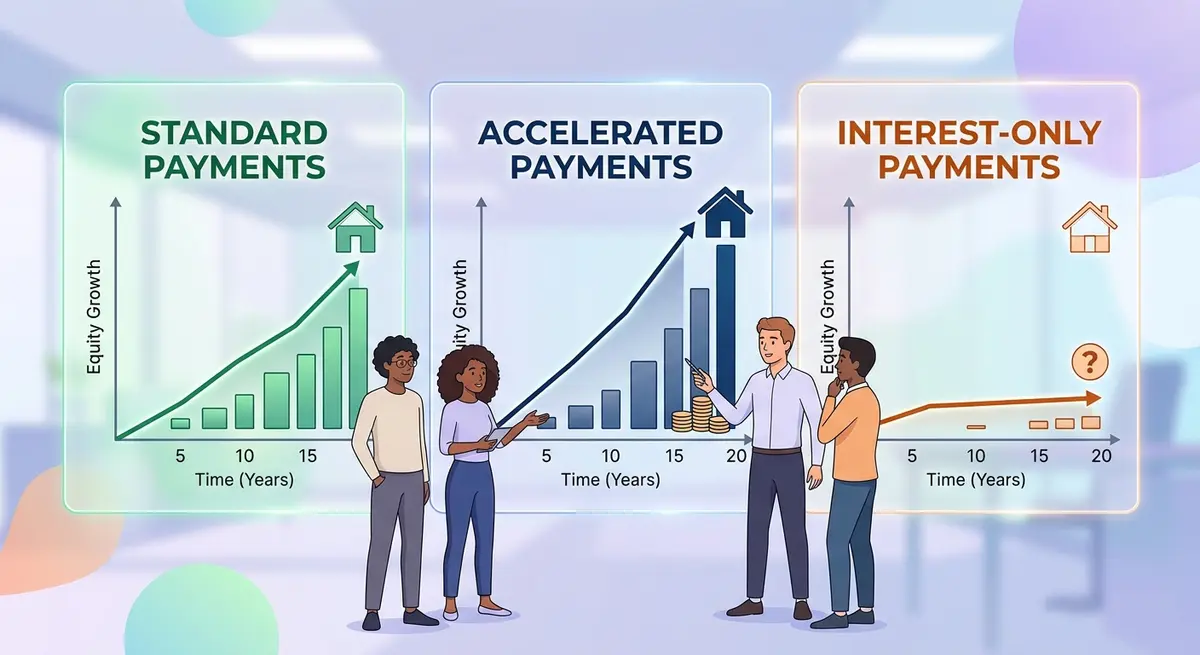
Homeowners must decide how aggressively they wish to pay down the borrowed amount. There are three primary strategies:
- Standard Amortizing Repayment: This structure mirrors a traditional mortgage, with a fixed split between principal and interest. It guarantees steady equity build-up over time.
- Accelerated Repayment: By utilizing bonuses, tax refunds, or seasonal income spikes, borrowers make lump-sum payments directly against the principal. This requires a lender that allows generous prepayment privileges without penalties.
- Interest-Only Payments: This option requires the borrower to pay only the interest accrued each month. The principal balance remains unchanged unless voluntary lump sums are made. It provides maximum cash flow flexibility, making it ideal for short-term needs like bridging a renovation project.
As Dr. Michael Chen, Chief Economist at the Canadian Real Estate Research Institute, notes: “In the 2026 lending environment, interest-only structures have become the preferred shock absorber for Calgary homeowners navigating temporary cash flow constraints, provided they have a clear exit strategy.”
Amortization and Term Lengths
While the term of a second mortgage is usually short (12 to 36 months), the amortization period—the time it would take to pay off the loan entirely—can be stretched up to 30 years. A longer amortization reduces the monthly payment burden but increases the total interest paid over the life of the loan. Conversely, a shorter amortization accelerates your path to being debt-free but requires a higher monthly commitment.
Fixed vs. Variable Rates: Navigating the 2026 Calgary Market
Choosing the right interest rate type is critical. The Bank of Canada policy rate directly influences the cost of borrowing, making the fixed versus variable decision a central part of your strategy.
| Feature | Fixed-Rate Structure | Variable-Rate Structure | Hybrid Structure |
|---|---|---|---|
| Interest Rate | Locked for the entire term | Fluctuates with the Prime Rate | Split between fixed and variable |
| Payment Stability | High (Payments never change) | Low (Payments may rise or fall) | Moderate (Base stability with some fluctuation) |
| Best Suited For | Risk-averse borrowers, tight budgets | Borrowers with emergency funds | Those seeking balanced risk |
| Prepayment Penalties | Typically higher (Interest Rate Differential) | Typically lower (3 months interest) | Blended penalty calculations |
In recent years, hybrid models have gained traction. By allocating 60% of the loan to a fixed rate and 40% to a variable rate, Calgary homeowners can protect their baseline budget while still capitalizing on potential rate drops. This approach is particularly effective when evaluating cash-out refinancing alternatives.
Calculating Your Sustainable Payment Threshold
Lenders utilize specific mathematical formulas to determine how much you can safely borrow. Understanding these metrics allows you to structure a loan that won’t jeopardize your financial stability.
Gross Debt Service (GDS) and Total Debt Service (TDS)
Your GDS ratio calculates the percentage of your gross monthly income required to cover housing costs (primary mortgage, second mortgage, property taxes, and heating). The TDS ratio includes all GDS elements plus any other debt obligations, such as car loans and credit cards.
- Maximum GDS Target: 39%
- Maximum TDS Target: 44%
For example, a Calgary homeowner earning $120,000 annually ($10,000/month gross) should ensure their total monthly debt obligations do not exceed $4,400. If their primary mortgage, taxes, and car loan total $3,200, they have $1,200 of monthly capacity for a second mortgage payment.
The Stress Test
Even if you qualify at the contract rate, federal guidelines require lenders to stress test your application. This involves calculating your ability to make payments if interest rates were to rise by 2%. Implementing your own internal stress test is a vital part of responsible borrowing, especially when considering home equity versus unsecured credit.

Aligning Your Mortgage Structure with Financial Goals
A well-structured loan is not just about affordability; it must serve a specific financial purpose. Calgary homeowners typically leverage secondary financing for three main reasons.
1. Strategic Debt Consolidation
Credit card interest rates in 2026 frequently exceed 20%. By consolidating high-interest unsecured debt into a second mortgage with a rate of 8% to 10%, homeowners can dramatically improve their monthly cash flow. When structuring for consolidation, the goal is to stretch the amortization to lower the monthly payment, while utilizing principal reduction strategies to pay off the balance aggressively when surplus funds are available.
2. High-ROI Property Renovations
Calgary’s real estate market rewards specific upgrades, particularly energy-efficient windows, basement suites, and modernized kitchens. When funding renovations, a draw-schedule structure is highly effective. Instead of taking the entire loan amount upfront and paying interest on idle cash, funds are released in tranches (e.g., 30% at project start, 40% at lock-up, 30% upon completion). This minimizes interest costs during the construction phase.
3. Business Capital and Investment
Entrepreneurs often use their homes to fund business expansion. In these cases, it is crucial to understand stated income options and the methods for verifying self-employed income. Furthermore, according to the Canada Revenue Agency (CRA), interest paid on funds borrowed for investment or business purposes may be tax-deductible, effectively lowering the true cost of borrowing.
Step-by-Step Guide to Setting Up Your Second Mortgage
- Assess Your Usable Equity: Calculate 80% of your home’s current appraised value and subtract your outstanding primary mortgage balance. This is your maximum borrowing limit.
- Define the Loan Purpose: Clearly identify whether the funds are for debt consolidation, renovation, or investment. This dictates whether you need an interest-only or amortizing structure.
- Gather Required Documentation: Prepare recent pay stubs, T4s, NOAs, property tax statements, and your primary mortgage statement. Familiarize yourself with document retention requirements to ensure compliance.
- Calculate Your Ratios: Run your income and debts through the GDS and TDS formulas to determine your maximum sustainable monthly payment.
- Select the Rate Type: Choose between fixed, variable, or hybrid based on your risk tolerance and the current Bank of Canada rate environment.
- Negotiate Prepayment Privileges: Ensure the contract allows for lump-sum payments (typically 10% to 20% annually) without triggering severe penalties.
Common Structuring Mistakes to Avoid
Even with careful planning, borrowers can fall into traps that compromise their financial security. One of the most prevalent errors is ignoring compounding frequency. A loan that compounds monthly will cost significantly more over time than one that compounds semi-annually, even if the advertised interest rate is identical.
Another common mistake is overestimating affordability by relying on variable income. Overtime pay, seasonal bonuses, and commission should be heavily discounted when calculating your ability to service debt. As Sarah Jenkins, Senior Underwriter at the Canadian Mortgage Institute, explains: “Borrowers who qualify based on peak-season income often face severe liquidity crises during economic shoulder seasons. We always recommend structuring payments based on a 24-month historical income average.”

Calgary-Specific Market Factors and Tax Implications
Structuring a mortgage in Alberta requires an understanding of local economic drivers. Calgary’s economy retains a strong tie to the energy sector, which can introduce income volatility for many residents. If your employment is tied to cyclical industries, an interest-only structure with aggressive prepayment privileges offers the safest harbor during downturns, allowing you to pay down principal only when times are good.
Additionally, municipal property taxes in Calgary undergo annual reassessments. A significant jump in your property’s assessed value will increase your monthly tax burden, directly impacting your GDS ratio. When structuring a second mortgage, always leave a 5% to 10% buffer in your monthly budget to absorb potential property tax hikes mandated by the Government of Alberta and local municipal councils.
Frequently Asked Questions (FAQ)
Can I pay off my second mortgage early without penalties?
Most second mortgages come with specific prepayment privileges, typically allowing you to pay off 10% to 20% of the original principal balance each year without penalty. However, paying off the entire loan before the term ends usually incurs a penalty, such as three months of interest or an Interest Rate Differential (IRD) charge.
How does a second mortgage affect my primary mortgage?
A second mortgage is an entirely separate legal agreement and does not alter the interest rate, term, or amortization of your primary mortgage. Your first mortgage remains intact and unaffected, which is why secondary financing is popular when primary rates are exceptionally low.
What is the minimum credit score required in Calgary?
While traditional banks typically require a credit score above 680, alternative and private lenders in Calgary focus more on the equity in your home. It is possible to secure a second mortgage with a credit score in the 500s, provided you have sufficient equity (usually at least 25% to 30% in these scenarios).
Are the legal fees higher for secondary financing?
Yes, setting up a second mortgage involves legal fees, appraisal costs, and sometimes broker fees. Because a new charge must be registered on your property title, you should budget between $1,500 and $3,000 for closing costs, which can often be deducted from the loan proceeds.
Can I use a second mortgage for a down payment on a rental property?
Absolutely. Leveraging equity from your primary residence to fund the down payment on an investment property is a common wealth-building strategy. Furthermore, the interest paid on the borrowed amount used for the investment property is generally tax-deductible.
What happens at the end of the second mortgage term?
Second mortgages typically have short terms of 1 to 3 years. At the end of the term, you must either pay off the remaining balance in full, renew the mortgage with the current lender at prevailing market rates, or refinance the loan with a different institution.
Conclusion
Structuring a second mortgage in Calgary requires a strategic approach that balances immediate capital needs with long-term financial security. By understanding the nuances of principal allocation, fixed versus variable rates, and federal debt servicing ratios, you can unlock the wealth tied up in your property safely and effectively. Whether you are consolidating high-interest debt, funding a major renovation, or investing in your business, the right payment structure acts as a powerful financial tool rather than a burden.
If you are ready to explore your equity options and need expert guidance tailored to the 2026 Alberta market, our team is here to help. We specialize in creating custom financing solutions that align with your unique goals. Get in touch with our team today to schedule a comprehensive equity review.