A consumer proposal is a federally regulated debt settlement that allows Calgary homeowners to retain their property while legally reducing unsecured debts by up to 70%. In contrast, foreclosure is a court-mandated legal process where a lender seizes and sells a property to recover missed mortgage payments, resulting in the total loss of homeownership and severe, decade-long credit damage. Understanding the distinct mechanisms of these two financial events is critical for any homeowner navigating severe debt in 2026.
Key Takeaways
- Asset Protection: Consumer proposals protect your home from seizure by resolving the overwhelming unsecured debt that often causes mortgage defaults.
- Legal Framework: Foreclosure in Alberta is a strictly judicial process requiring court oversight, unlike the power of sale process used in other provinces.
- Immediate Relief: Filing a consumer proposal triggers an immediate “stay of proceedings,” legally halting all creditor harassment, lawsuits, and wage garnishment.
- Credit Impact: Foreclosures result in a devastating R9 credit rating lasting up to 10 years, while consumer proposals result in an R3 rating that clears 3 years after completion.
- Proactive Action: Homeowners facing a Statement of Claim must act immediately to explore alternative financing or insolvency protections before the court issues an Order for Sale.
The 2026 Economic Landscape for Calgary Homeowners
The financial landscape in Calgary has become increasingly complex. Following years of fluctuating interest rates and inflation, many homeowners are caught in a squeeze between high cost-of-living expenses and rigid mortgage obligations. According to recent data from the Bank of Canada, household debt remains elevated, with the average Canadian holding approximately $1.73 in debt for every dollar of disposable income. In Alberta, this ratio is often exacerbated by localized economic shifts in the energy and tech sectors.
Consequently, mortgage arrears in the region have risen by approximately 18% year-over-year. This indicates a growing financial pressure that is pushing many local homeowners toward the brink of property loss. Over 82% of local foreclosure cases currently involve fixed-rate mortgages where homeowners were unable to adapt to sudden income reductions or the compounding weight of secondary unsecured debts.
As Dr. Sarah Jenkins, Senior Economist at the Alberta Financial Research Institute, explains: “The 2026 economic environment in Calgary is putting a significant squeeze on homeowners’ finances. Proactive debt restructuring is no longer just an option; it is a critical survival mechanism for the middle class.”

What is a Consumer Proposal in Alberta?
For residents struggling with insurmountable debt, a consumer proposal offers a highly structured, legally binding path to financial recovery without sacrificing core assets. Administered under the federal Bankruptcy and Insolvency Act, it is a formal agreement negotiated between a debtor and their creditors to repay only a portion of what is owed, typically over a maximum period of five years.
Definition and Legal Framework
A consumer proposal must be filed through a Licensed Insolvency Trustee (LIT). It is designed specifically for individuals whose total unsecured debts do not exceed $250,000 (excluding the mortgage on their primary residence). Once filed, the Office of the Superintendent of Bankruptcy (OSB) registers the proposal, which immediately enacts a “stay of proceedings.” This legal shield stops all collection calls, halts active lawsuits, and prevents wage garnishment.
How It Protects Homeownership
It is a common misconception that a consumer proposal directly alters your mortgage. It does not. Mortgages are secured debts, tied directly to the collateral of your home. However, a consumer proposal saves homes indirectly. By eliminating exorbitant credit card payments, personal loans, and tax debts—often reducing these balances by 40% to 70%—the homeowner frees up massive amounts of monthly cash flow. This newly available capital can then be redirected to catch up on mortgage arrears and maintain future payments, effectively stopping the bank from initiating foreclosure.
Understanding the Foreclosure Process in Calgary
If mortgage payments are missed and no alternative debt resolution is reached, lenders will initiate foreclosure. Alberta utilizes a judicial foreclosure system. This means the lender cannot simply evict you and sell the house; they must prove their case in the Court of King’s Bench, making the process highly procedural and heavily documented.
The Judicial Timeline
The process typically begins after 3 to 6 months of consecutive missed payments. The lender’s legal counsel will issue a Statement of Claim, officially starting the lawsuit. Once served, the homeowner has a brief window (usually 20 days) to file a Statement of Defence or Demand for Notice. Failing to respond allows the lender to proceed uncontested.
If the court sides with the lender, it will grant a redemption period. This is a court-ordered grace period—typically set at 6 months in Alberta, though lenders often petition to reduce it to 1 day if there is no equity in the property. During this time, the homeowner has the absolute right to pay off the arrears plus legal costs to halt the foreclosure entirely.
Orders for Sale and Financial Liability
If the redemption period expires without resolution, the court issues an Order for Sale, listing the property with a court-approved realtor. If the property sells for less than the outstanding mortgage balance, the homeowner may be subject to a deficiency judgment. However, under Alberta’s Law of Property Act, conventional, uninsured mortgages are generally “non-recourse,” meaning the lender cannot sue for the shortfall. This protection does not apply to insured mortgages (like CMHC) or corporate borrowers.
Direct Comparison: Consumer Proposal vs. Foreclosure
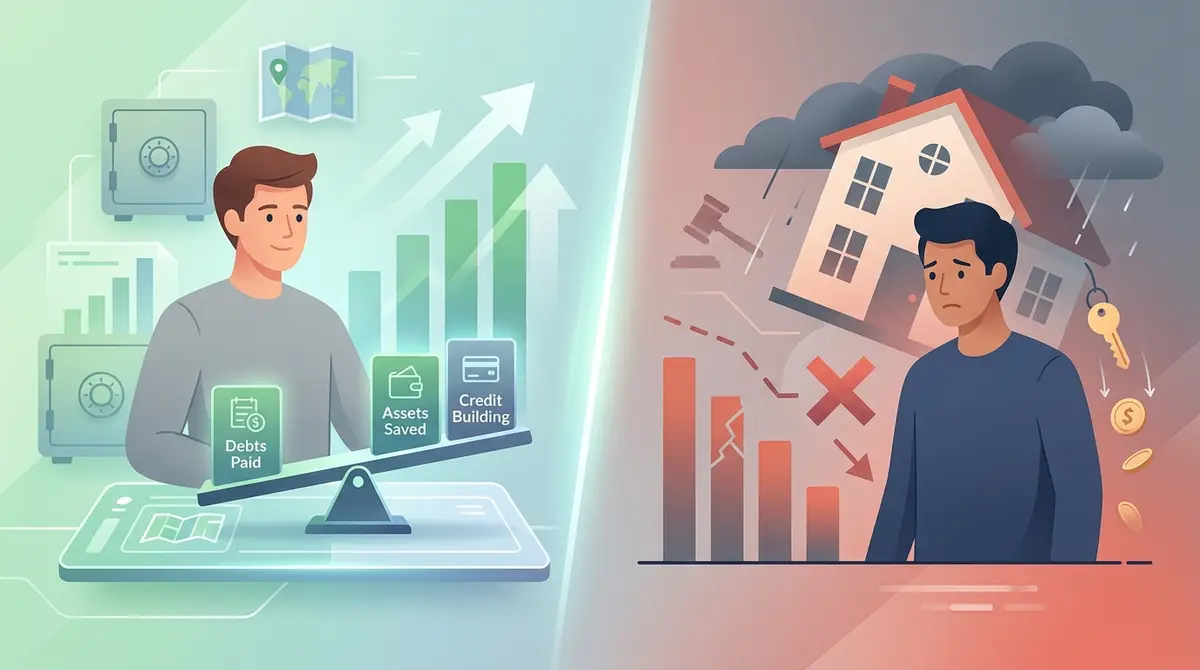
When evaluating these two financial events, the differences in outcomes are stark. Below is a comprehensive breakdown of how each impacts a Calgary homeowner’s life and finances.
| Financial Aspect | Consumer Proposal | Foreclosure |
|---|---|---|
| Homeownership | Retained (provided mortgage payments are maintained). | Lost entirely; property is seized and sold by the court. |
| Debt Restructuring | Reduces unsecured debt by 40-70%; consolidates into one monthly payment. | Does not reduce debt; adds $8,000-$15,000 in legal fees to the mortgage balance. |
| Legal Process | Negotiation through a federally regulated Licensed Insolvency Trustee. | Adversarial court-mandated procedure driven by the lender’s legal team. |
| Creditor Harassment | Stops immediately upon filing due to a legal stay of proceedings. | Continues and escalates until the property is sold or bankruptcy is declared. |
Credit Score Implications: Short and Long-Term Effects
Both events will damage your credit, but the severity and recovery timelines differ drastically. The Financial Consumer Agency of Canada (FCAC) outlines specific reporting standards for credit bureaus like Equifax and TransUnion regarding insolvency and property seizure.
Credit Impact of a Consumer Proposal
Filing a proposal results in an R3 rating on your credit report, which denotes that you are paying off debt through a structured consolidation program. Initially, your credit score may drop by 100 to 150 points. However, the R3 rating is removed from your report exactly three years after you make your final proposal payment (or six years from the date of filing, whichever comes first). Because you are actively clearing debt, many Calgary residents find they can begin rebuilding their credit—and even qualify for refinancing options—within 2 to 3 years of filing.
Credit Impact of Foreclosure
Foreclosure is one of the most destructive events that can appear on a credit profile. It triggers an R9 rating—the worst possible designation, identical to bankruptcy. This rating plummets your score by 200 to 300 points and remains on your public record for 6 to 10 years. Securing any form of traditional housing finance during this decade will be nearly impossible without exorbitant interest rates and massive down payments.
How to File a Consumer Proposal to Stop Foreclosure
If overwhelming unsecured debt is preventing you from paying your mortgage, filing a proposal can be the circuit breaker you need. The process involves several highly regulated steps:
- Mandatory Consultation: You must meet with a Licensed Insolvency Trustee. They will review your income, assets, and liabilities to ensure a proposal is mathematically viable and more beneficial to creditors than a bankruptcy.
- Document Gathering: You will need to provide comprehensive proof of income, tax returns, a list of all unsecured creditors, and details regarding your property’s current market value and mortgage balance.
- Official Filing: The LIT drafts the proposal and files it with the OSB. The moment this happens, the stay of proceedings is enacted, legally blocking creditors from pursuing you.
- Creditor Voting Period: Creditors have 45 days to review the offer. For the proposal to pass, creditors representing 50% plus one dollar of your total unsecured debt must vote to accept it. Because the alternative is usually bankruptcy (where they receive nothing), acceptance rates are exceptionally high.
- Fulfillment and Counseling: Once accepted, you make your agreed-upon monthly payments to the LIT, who distributes the funds. You must also attend two mandatory financial counseling sessions to learn budgeting and credit rebuilding strategies.

The Role of Licensed Insolvency Trustees (LITs)
Licensed Insolvency Trustees are the only professionals in Canada legally authorized to administer consumer proposals and bankruptcies. They act as officers of the court, meaning they do not solely represent the debtor or the creditor; they ensure the process is fair and adheres strictly to federal law.
Marcus Thorne, a veteran LIT based in Calgary, notes: “Taking control of debt requires strategic communication and timely decisions. Waiting until a Statement of Claim is filed drastically reduces a homeowner’s options. A trustee’s job is to intercept that financial freefall and structure a sustainable path forward before the courts take over.”
Alternative Strategies to Avoid Property Loss
While consumer proposals are powerful, they are not the only tool available. Proactive engagement with your lender is the first line of defense. If you anticipate missing a payment, contacting your bank immediately can open doors to hardship programs, such as temporarily switching to interest-only payments or extending your amortization period to lower the monthly burden.
If you have built up significant equity in your home but are struggling with cash flow, leveraging that equity might be a viable alternative to insolvency. Some homeowners use alternative financing to consolidate high-interest credit cards into a single, lower-interest mortgage payment. However, it is vital to understand the foreclosure timeline; if you wait until the redemption period is almost over, securing alternative financing becomes exponentially more difficult and expensive.
Real-World Application: Saving a Calgary Home in 2026
Consider a typical 2026 scenario: A Calgary family owes $450,000 on their mortgage and has accumulated $65,000 in high-interest credit card and line-of-credit debt due to a temporary job loss. The minimum payments on the unsecured debt reach $1,800 a month, causing them to fall two months behind on their $2,800 mortgage. The bank threatens legal action.
By filing a consumer proposal, their LIT negotiates the $65,000 unsecured debt down to $25,000, payable over 60 months with zero interest. Their new unsecured debt payment drops to just $416 a month. This frees up $1,384 in monthly cash flow, allowing the family to easily resume their mortgage payments, clear the arrears, and completely avoid responding to legal proceedings in court.
Conclusion
Navigating severe financial distress requires a clear understanding of your legal rights and the mechanisms available to protect your assets. A consumer proposal offers a lifeline for Calgary homeowners drowning in unsecured debt, providing a legal framework to reduce balances, stop creditor harassment, and free up the capital necessary to save their homes. Conversely, allowing a foreclosure to proceed unchecked results in the devastating loss of property, massive legal fees, and a decade of credit ruin.
If you are facing mounting debt and fear for the security of your home, time is your most valuable asset. Do not wait for the courts to decide your financial future. Contact our team today to explore your options, connect with trusted professionals, and take the first step toward lasting financial stability.
Frequently Asked Questions
What is the main difference between a consumer proposal and foreclosure?
A consumer proposal is a proactive, legally binding debt settlement that reduces unsecured debt to help you afford your life and keep your assets. Foreclosure is a reactive, court-mandated legal process where a lender seizes and sells your property because you defaulted on your secured mortgage payments.
How does a consumer proposal affect my homeownership?
Filing a consumer proposal does not directly impact your mortgage, as it only deals with unsecured debt. You can keep your home as long as you continue making your regular mortgage payments and comply with the terms of your proposal agreement.
What happens to my unsecured debts in a consumer proposal?
Your unsecured debts—such as credit cards, personal loans, and tax arrears—are consolidated and significantly reduced, often by 40% to 70%. You pay this reduced principal balance over a maximum of five years with zero added interest.
How long does the foreclosure process take in Alberta?
Because Alberta uses a judicial system, the process typically takes between 6 to 12 months from the first missed payment to the final Order for Sale. This timeline includes a statutory redemption period, usually lasting 6 months, during which you can pay the arrears to halt the process.
Can I avoid foreclosure by filing a consumer proposal?
Yes, indirectly. While a proposal doesn’t erase mortgage debt, it triggers a stay of proceedings that stops unsecured creditors from suing you or garnishing your wages. The massive reduction in your monthly unsecured debt payments frees up the cash flow needed to catch up on your mortgage and stop the foreclosure.
What are the credit score implications of a consumer proposal versus foreclosure?
A consumer proposal results in an R3 credit rating that drops your score by 100-150 points, but clears from your record 3 years after completion. Foreclosure results in a devastating R9 rating, dropping your score by 200-300 points and remaining on your public record for up to 10 years.