To successfully secure additional home equity financing in Calgary, applicants must provide lenders with four distinct categories of paperwork: valid government-issued identification, comprehensive income verification (such as recent pay stubs or Notice of Assessment forms), detailed property valuation records, and complete statements of existing debt obligations. Organizing these financial records before applying demonstrates repayment capacity and significantly accelerates the underwriting process.
Key Takeaways
- Properly organizing your financial file can reduce application processing delays by up to 40%.
- Lenders require a minimum of 20% retained equity in your property to approve additional financing.
- Income verification differs drastically between salaried employees and self-employed business owners.
- Recent property appraisals are heavily preferred over outdated municipal tax assessments.
- Digital document submission portals have decreased average approval timelines by 22% in 2026.
- Missing pages from bank statements or mismatched identification are the leading causes of underwriter rejections.
The 2026 Landscape of Home Equity Lending in Calgary
Navigating the financial sector requires a clear understanding of current underwriting standards. In 2026, financial institutions have adopted highly sophisticated automated verification systems. These platforms cross-reference your submitted paperwork with national credit bureaus and tax databases in real-time. Consequently, the accuracy of your submission is more critical than ever.
According to recent data from the
Canada Mortgage and Housing Corporation (CMHC), approximately 30% of homeowners delay accessing their built-up equity simply because they are intimidated by the paperwork requirements. However, understanding exactly what underwriters look for transforms a stressful administrative task into a straightforward checklist.
“Properly indexed financial records act as a catalyst for underwriting,” says Sarah Jenkins, Senior Underwriter at the Canadian Mortgage Professionals Association. “When an applicant presents a complete, logically ordered file, it immediately establishes trust and often leads to more favorable interest rate negotiations.”
Whether you are consolidating high-interest credit cards or funding a major home renovation, your documentation serves as your financial passport. It proves your historical reliability and your future capacity to manage concurrent debt obligations.
Core Identification and Property Documents
Before lenders assess your financial health, they must verify your identity and confirm the collateral’s legal standing. Fraud prevention protocols in 2026 mandate strict adherence to identification standards.
Applicants must provide two pieces of valid identification. The primary document must be a government-issued photo ID, such as a provincial driver’s license or a Canadian passport. The secondary piece can be a birth certificate, a major credit card, or a recent utility bill that confirms your primary residence. Discrepancies in your legal name across these documents will trigger immediate processing holds.
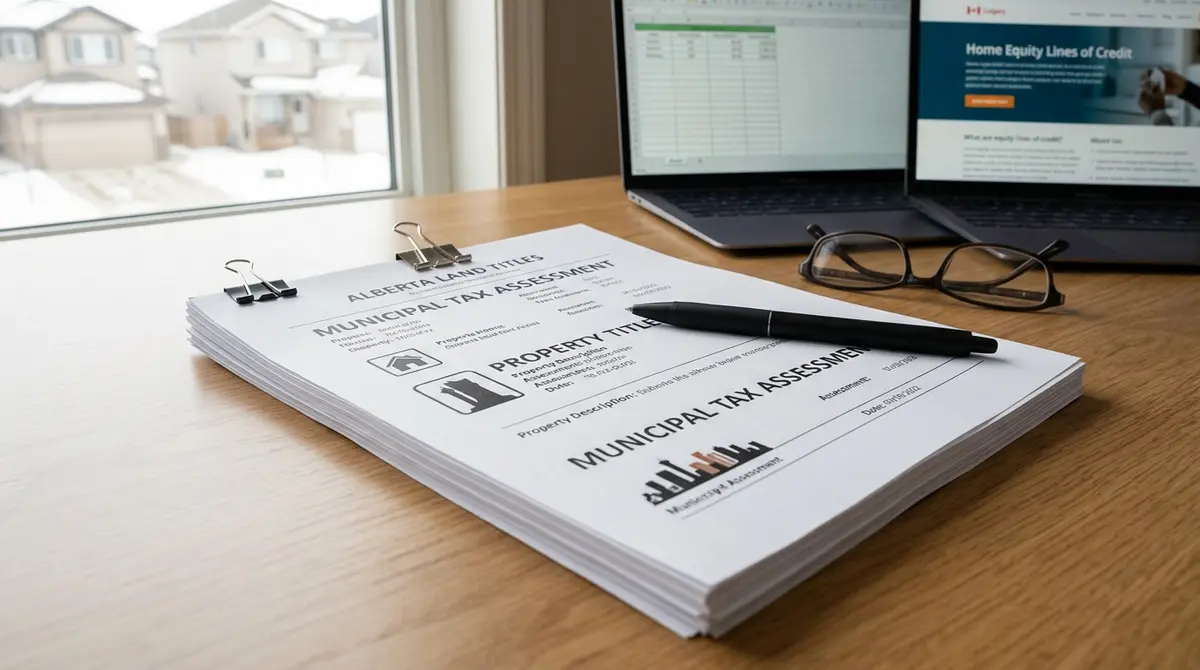
Equally important is the documentation proving your property’s current market value and your legal ownership. Lenders require a copy of your most recent property tax bill and your current primary mortgage statement. This statement must clearly show your outstanding principal balance, your current interest rate, and your monthly payment amount.
To determine exactly how much equity you can access, institutions rely on professional valuations. “Your property appraisal is the anchor of your equity loan; outdated municipal assessments rarely reflect the true accessible capital,” states Dr. Elena Rostova, Economics Professor at the University of Calgary. Because Calgary’s real estate market fluctuates, appraisals are typically only considered valid for 90 to 120 days.
Income Verification: Salaried vs. Self-Employed
Proving your ability to service a new loan alongside your existing primary mortgage is the crux of the approval process. Lenders calculate your Total Debt Service (TDS) ratio, which traditionally must not exceed 40% of your gross income. How you prove this income depends entirely on your employment structure.
Requirements for Traditional Employees
For salaried or hourly workers, the verification process is relatively standardized. You will need to provide your two most recent pay stubs, which must clearly display your year-to-date earnings and any standard deductions. Additionally, lenders require your T4 slips from the previous two tax years.
Most institutions also request a formal Letter of Employment. This document, printed on official company letterhead, must state your job title, your start date, your guaranteed base salary, and your current status (e.g., full-time, permanent). If your income relies heavily on overtime or performance bonuses, you will need a two-year track record to substantiate those variable earnings.
Alternative Documentation for Business Owners
Entrepreneurs and freelancers face a more complex underwriting process. Because self-employed individuals often utilize legal tax deductions to minimize their taxable income, their standard tax returns may not accurately reflect their true cash flow.
“Self-employed applicants must demonstrate a two-year trajectory of stable net income, as gross revenue is no longer sufficient for risk assessment,” explains Marcus Thorne, Director of Lending at Calgary Equity Partners.
Business owners must typically supply their T1 General tax returns and
Canada Revenue Agency (CRA) Notices of Assessment (NOA) for the past two to three years. The NOA is crucial because it confirms that you have no outstanding tax arrears, which could result in a government lien against your property.
For those who cannot prove sufficient income through traditional tax filings, understanding
alternative documentation for stated income loans becomes essential. These specialized products often require six to twelve months of business bank statements to verify consistent revenue deposits.

Credit History and Existing Debt Records
Your credit profile acts as a historical record of your financial behavior. While your property provides the collateral, your credit score dictates the interest rate you will be offered. In 2026, a credit score of 680 or higher is generally required to unlock prime rates from traditional “A” lenders.
When you apply, the lender will pull a comprehensive credit report from bureaus like Equifax or TransUnion. However, you must also proactively disclose all existing liabilities. This includes providing recent statements for auto loans, student lines of credit, and any outstanding credit card balances.
If your credit report shows recent anomalies, such as multiple hard inquiries or a missed payment, you must address them immediately. Providing a
well-crafted letter of explanation helps underwriters understand the context behind credit blips, such as a sudden medical expense or a temporary job loss.
Furthermore, if you are using the new loan to consolidate existing debts, lenders will require the exact payout statements for those specific accounts. The funds are often disbursed directly to those creditors by your real estate lawyer to ensure the debt is actually cleared.
Step-by-Step Guide: Organizing Your Application File
Industry data reveals that 58% of processing delays stem from missing, expired, or mismatched records. To ensure a frictionless experience, follow this systematic approach to compiling your
complete documentation checklist:
- Audit Your Identification: Ensure your primary and secondary IDs are valid and that the names match your property title exactly.
- Download Tax Records: Log into your CRA My Account portal and download your T4s, T1 Generals, and Notices of Assessment for the last two years.
- Gather Banking History: Export the last 90 days of statements for your primary checking and savings accounts. Ensure all pages are included, even if the final page is blank.
- Retrieve Mortgage Data: Request a current statement from your primary mortgage holder showing the exact principal balance and amortization schedule.
- Document Additional Assets: Compile statements for RRSPs, TFSAs, or non-registered investment accounts. Strong liquid assets can mitigate a slightly elevated debt ratio.
- Draft Explanations: Write clear, concise letters explaining any recent employment gaps or recent credit inquiries.
“In 2026, lenders are relying heavily on automated verification, meaning a single mismatched address on a T4 can halt an application for weeks,” notes David Chen, Financial Analyst at the Alberta Real Estate Institute. Proper organization is your best defense against algorithmic rejections.
Comparing Document Requirements: HELOC vs. Fixed-Term Equity Loans
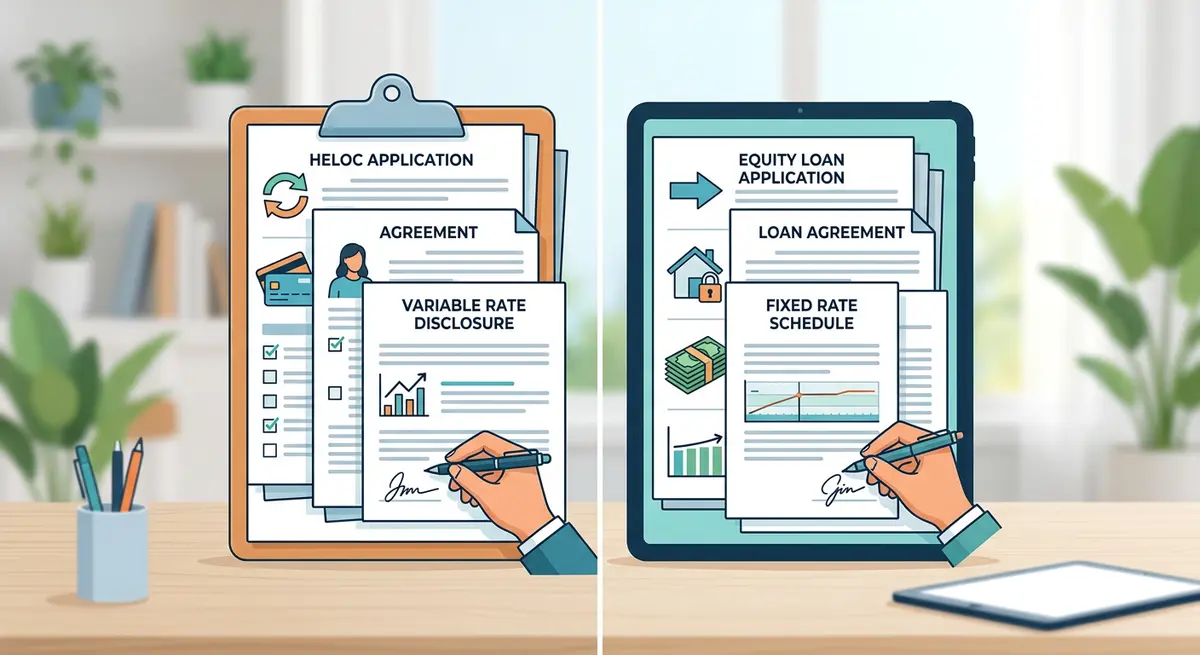
Homeowners typically choose between two primary structures: a Home Equity Line of Credit (HELOC) or a fixed-term lump-sum loan. While both leverage your property’s value, their specific paperwork requirements differ slightly due to how the funds are disbursed and managed.
| Requirement Category |
HELOC (Revolving Credit) |
Fixed-Term Equity Loan |
| Income Stability Proof |
Requires rigorous proof of ongoing, stable income due to fluctuating minimum payments. |
Focuses heavily on current debt-to-income ratios to support a fixed monthly payment. |
| Maximum Loan-to-Value (LTV) |
Capped at 65% of the home’s appraised value (up to 80% combined with primary mortgage). |
Can often reach up to 80% combined LTV with traditional lenders, or 95% with private lenders. |
| Appraisal Requirements |
Usually requires a full, interior professional appraisal. |
May sometimes accept automated valuation models (AVMs) or drive-by appraisals. |
| Ongoing Documentation |
Subject to annual financial reviews and potential credit re-pulls. |
No ongoing documentation required once the loan is funded and closed. |
Understanding these nuances helps you prepare the right file for the right product. If you are comparing these options against other financial strategies, it is wise to review how
leveraging equity compares to cash-out refinancing before finalizing your application.
Common Paperwork Pitfalls That Delay Funding
Even financially stable applicants can face frustrating delays if their paperwork is sloppy. Underwriters are trained to spot inconsistencies that indicate potential risk or fraud.
One of the most frequent errors is submitting incomplete bank statements. If your online banking portal generates a five-page PDF and the fifth page is blank, you must still submit all five pages. Omitted pages suggest to the underwriter that you might be hiding undisclosed debts or suspicious transactions.
Large, undocumented deposits are another major red flag. According to anti-money laundering regulations enforced by the
Financial Consumer Agency of Canada (FCAC), any sudden influx of cash into your accounts must be sourced. If you received a financial gift from a family member to help pay down debt, you must provide a signed gift letter confirming the funds do not require repayment.
Finally, self-employed individuals often fail to realize that
providing tax returns with low taxable income can severely limit their options with “A” lenders, pushing them toward alternative lenders who charge higher interest rates but focus primarily on the property’s equity rather than strict income metrics.
Frequently Asked Questions
What is the minimum credit score required for a second mortgage in Calgary?
Traditional banks typically require a minimum credit score of 680 to qualify for prime interest rates. However, alternative and private lenders in Calgary frequently approve applications with scores as low as 550, provided there is substantial equity in the property.
How recent must my pay stubs and bank statements be?
Lenders require your financial documents to be highly current. Pay stubs must be dated within the last 30 days, and bank statements must cover the most recent 90-day period leading up to your application date.
Do I need a new appraisal if I had one done last year?
Yes, almost certainly. Real estate markets fluctuate, and lenders require an accurate assessment of current risk. Most financial institutions will only accept property appraisals completed within the last 90 to 120 days by an approved, certified appraiser.
Can I use a municipal tax assessment instead of a professional appraisal?
While some lenders may accept a municipal tax assessment for very small equity lines, the vast majority require a full professional appraisal. Municipal assessments often lag behind actual market values and do not provide the detailed interior condition reports that lenders rely on.
What happens if I cannot find my Notice of Assessment (NOA)?
If you have misplaced your physical NOA documents, you can easily retrieve digital copies by logging into your CRA My Account online portal. Alternatively, your accountant can request them on your behalf through the Represent a Client system.
Will applying for this loan hurt my credit score?
When a lender pulls your credit report to underwrite the loan, it registers as a “hard inquiry,” which may temporarily lower your score by a few points. However, if you use the loan to consolidate revolving credit card debt, your score will likely improve significantly over the following months as your credit utilization ratio drops.
Conclusion
Securing additional financing against your home’s equity is a powerful wealth-building and debt-management tool. By understanding exactly what documents are needed for a second mortgage application in Calgary, you position yourself as a low-risk, highly organized borrower. Gathering your identification, income proofs, property valuations, and debt statements in advance not only expedites the approval process but also empowers you to negotiate the most competitive interest rates available in the 2026 market.
If you are ready to unlock your home’s potential but feel overwhelmed by the paperwork, you do not have to navigate the process alone. Our team of local experts specializes in structuring applications to highlight your financial strengths.
Get in touch with our team today to streamline your approval and access the capital you need.