To qualify for a second mortgage in Calgary in 2026, homeowners must typically possess at least 20% usable home equity, demonstrate a stable income with a debt-to-income (DTI) ratio below 40%, and maintain a credit score of 600 or higher. Lenders evaluate the Loan-to-Value (LTV) ratio, capping combined mortgages at 80% to 85% of the property’s appraised market value. Because a second mortgage acts as a subordinate lien behind your primary mortgage, lenders assume higher risk, making the available equity in your property the single most critical factor for approval.
Key Takeaways
- Equity is King: You need a minimum of 20% equity remaining in your home after accounting for your primary mortgage to qualify for secondary financing.
- LTV Limits: Most Calgary lenders cap your total combined borrowing (first plus second mortgage) at 80% to 85% of your home’s current appraised value.
- Credit Flexibility: While traditional banks prefer credit scores above 680, alternative and private lenders in Alberta often approve scores as low as 550 if sufficient equity exists.
- Income Verification: Borrowers must prove their ability to manage both mortgage payments, typically requiring a Total Debt Service (TDS) ratio below 40%.
- Faster Processing: Because your primary mortgage remains untouched, secondary financing often closes faster, sometimes within 5 to 10 business days.
Understanding Calgary’s Second Mortgage Landscape in 2026
Over 40% of Calgary homeowners do not realize their property holds untapped financial potential. A second mortgage allows you to borrow against built-up home equity without refinancing your primary loan or losing your current interest rate. This financial solution has become increasingly popular as property values continue to rise across Alberta’s energy capital.
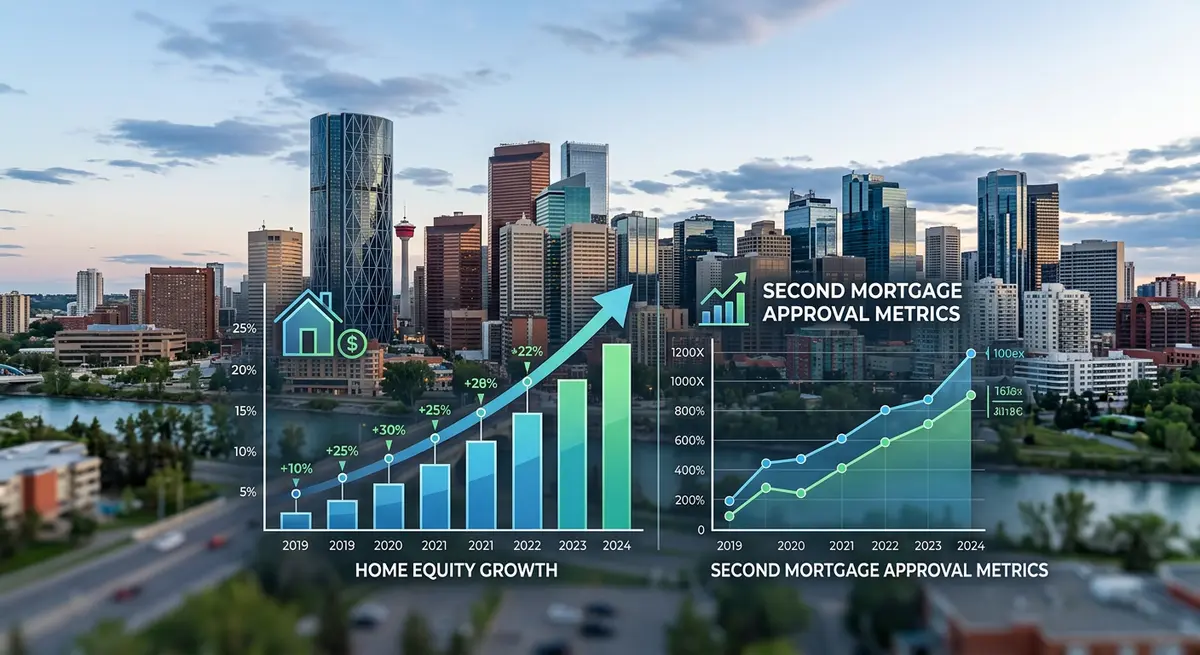
According to recent data from the Calgary Real Estate Board (CREB), average detached home prices in neighborhoods like the Beltline and Mount Royal saw an appreciation of 7% over the last year. This natural market growth automatically increases your home equity, expanding your borrowing power even if you have not made extra principal payments. However, accessing this capital requires navigating specific lender criteria designed to mitigate risk.
“In Calgary’s dynamic 2026 housing market, leveraging home equity requires a strategic approach to Loan-to-Value ratios,” explains Sarah Jenkins, Senior Underwriter at the Alberta Real Estate Finance Board. “Lenders are prioritizing robust equity cushions over pristine credit scores, especially as alternative lending spaces expand.”
The Three Core Requirements for Approval
Securing a subordinate lien against your property involves meeting strict criteria. Lenders evaluate three primary pillars: equity availability, repayment capacity, and credit reliability. Because the primary mortgage holder gets paid first in the event of a default, secondary lenders face higher exposure and adjust their requirements accordingly.
1. Sufficient Home Equity and LTV Limits
Your property’s equity position acts as the foundation for your borrowing power. Home equity represents your true ownership stake in the property, calculated by subtracting your remaining mortgage balance from the current market value. To determine your eligibility, lenders use the Loan-to-Value (LTV) ratio.
For example, if your Calgary home is appraised at $600,000 and you owe $350,000 on your first mortgage, your current LTV is 58.3%. Traditional lenders typically cap combined loans at 80% LTV. In this scenario, 80% of $600,000 is $480,000. Subtracting your existing $350,000 mortgage leaves you with a maximum second mortgage borrowing limit of $130,000.
Private lenders may stretch this limit to 85% or even 90% LTV for properties in highly desirable Calgary postal codes, though these extended limits come with higher interest rates to offset the risk.
2. Income Verification and Debt-to-Income (DTI) Ratios
While equity secures the loan, your income ensures you can make the monthly payments. Lenders calculate your Gross Debt Service (GDS) and Total Debt Service (TDS) ratios. The Canada Mortgage and Housing Corporation (CMHC) generally recommends a TDS ratio no higher than 44%, but conservative secondary lenders often look for a ratio below 40%.
Standard income verification requires recent pay stubs, T4s, and Notices of Assessment (NOAs). However, Calgary’s robust entrepreneurial sector means many applicants are self-employed. If you fall into this category, you may need to explore stated income options or understand the nuances of verifying self-employed income to satisfy underwriter requirements.
3. Credit Score Thresholds
Your credit history dictates both your approval odds and your interest rate. Prime lenders (A-lenders like major banks) typically require a credit score of 680 or higher. B-lenders (trust companies and credit unions) might accept scores down to 600. Private lenders focus almost entirely on equity and may approve scores in the 500s.
It is important to manage your credit inquiries before applying. Multiple hard pulls can temporarily depress your score. If you have been shopping around, knowing how to handle explaining recent credit inquiries to your mortgage broker can prevent an automatic decline.
Step-by-Step: How to Apply for a Second Mortgage in Alberta
Navigating the application process systematically ensures you secure the best possible terms while avoiding unnecessary delays. Follow these five steps to streamline your funding:
- Calculate Your Usable Equity: Use a conservative estimate of your home’s current value and subtract your exact mortgage payout balance. Ensure you have at least 20% equity remaining.
- Gather Required Documentation: Preparation is key. Compile your government ID, recent mortgage statements, property tax bills, and proof of income. Reviewing a comprehensive required mortgage documentation checklist beforehand saves weeks of back-and-forth.
- Order a Professional Appraisal: Lenders will not rely on municipal tax assessments. They require an independent, certified appraisal to confirm the property’s current fair market value.
- Compare Lender Offers: Do not settle for the first approval. Compare the Annual Percentage Rate (APR), which includes both the interest rate and lender fees. Also, pay attention to the impact of compounding frequency, as semi-annual versus monthly compounding significantly alters your total borrowing cost.
- Review Legal Terms and Close: Secondary financing involves legal fees and registration on your property title. Review the commitment letter carefully, noting any prepayment penalties or renewal fees.

Comparing Second Mortgages to Other Financing Options
Before committing to a second mortgage, it is crucial to understand how it stacks up against alternative financial products. Depending on your goal—whether it is debt consolidation, home renovation, or business investment—different structures offer distinct advantages.
| Feature | Second Mortgage (Term Loan) | HELOC (Line of Credit) | Unsecured Personal Loan |
|---|---|---|---|
| Interest Rates | Moderate (Higher than 1st mortgage, lower than unsecured) | Variable (Tied to Prime Rate) | High (Often 10% – 20%+) |
| Fund Disbursement | Single lump sum upfront | Revolving credit (draw as needed) | Single lump sum upfront |
| Approval Focus | Property Equity & LTV | Strong Credit & Income | Strictly Credit & Income |
| Best Used For | Large, one-time expenses (e.g., major renovations) | Ongoing projects with variable costs | Smaller emergencies (under $30,000) |
When weighing home equity versus unsecured credit, the secured nature of a second mortgage almost always yields a lower interest rate. However, if you are looking to restructure your entire debt load, you might also consider alternatives like cash-out refinancing. Refinancing breaks your current first mortgage, which can trigger massive prepayment penalties if you are locked into a fixed rate. A second mortgage avoids these penalties entirely.
How Local Market Conditions Impact Your Application
The macroeconomic environment heavily influences lender behavior. In 2026, the Bank of Canada‘s monetary policy continues to shape baseline interest rates. When the central bank adjusts the overnight rate, variable-rate secondary products (like HELOCs) react immediately, while fixed-rate second mortgages adjust based on bond yields.
Research from the Financial Consumer Agency of Canada indicates that regional economic stability plays a massive role in lending criteria. Calgary’s unique position as an energy and tech hub means local employment stability is viewed favorably by national lenders. If oil prices are strong, lenders often loosen LTV restrictions in Alberta, anticipating continued property appreciation and job security.
“Borrowers in Calgary have a distinct advantage in 2026,” notes David Chen, a regional mortgage economist. “The influx of interprovincial migration has stabilized property floors, making private lenders much more comfortable extending capital up to 85% LTV compared to markets in Ontario or British Columbia.”

Private vs. Institutional Lenders in Calgary
Not all second mortgages come from big banks. In fact, the majority of secondary financing in Alberta is facilitated through B-lenders, Mortgage Investment Corporations (MICs), and private individuals. Understanding the difference is vital for your application strategy.
Institutional Lenders (Banks & Credit Unions): These lenders offer the lowest interest rates but have the most stringent requirements. They demand pristine credit (680+), rigorous stress-testing of your income, and strict adherence to a 40% TDS ratio. The approval process can take 3 to 6 weeks.
Private Lenders: Private financing is equity-driven. If you have 25% to 30% equity in your home, private lenders are often willing to overlook poor credit, past bankruptcies, or non-traditional income sources. While their interest rates are higher (typically ranging from 8% to 12% in 2026) and they charge lender fees (1% to 3% of the loan amount), they offer unparalleled speed and flexibility. A private second mortgage can often be funded in under a week.
Frequently Asked Questions (FAQ)
What is the minimum equity required for a second mortgage in Calgary?
You generally need a minimum of 20% equity remaining in your home after accounting for your first mortgage. Most lenders cap total borrowing at 80% of your home’s appraised value, though some private lenders may go up to 85%.
Can I get a second mortgage with bad credit in Alberta?
Yes, it is entirely possible. While traditional banks require scores above 680, private lenders in Alberta focus primarily on your home’s equity rather than your credit score. If you have sufficient equity, scores as low as 550 can be approved.
Do I have to break my first mortgage to get a second one?
No. A second mortgage is a completely separate loan that sits behind your primary mortgage on the property title. Your first mortgage rate, terms, and amortization schedule remain completely untouched, saving you from prepayment penalties.
How long does it take to get approved for a second mortgage?
Approval timelines vary by lender. Traditional banks may take 3 to 6 weeks to process the extensive paperwork. Conversely, private lenders can often approve and fund a second mortgage within 5 to 10 business days, provided the appraisal is completed quickly.
What are the closing costs associated with a second mortgage?
Closing costs typically include appraisal fees ($300-$500), legal fees ($1,000-$1,500), and potentially broker or lender fees (1%-3% of the loan amount) if you use a private lender. These fees can often be deducted directly from the loan proceeds.
Can I use a second mortgage to pay off consumer debt?
Yes, debt consolidation is one of the most common uses for a second mortgage. By using home equity to pay off high-interest credit cards or unsecured loans, homeowners can significantly reduce their blended monthly interest payments and improve cash flow.
Conclusion
Securing a second mortgage in Calgary in 2026 offers a powerful way to leverage your home’s equity without disrupting the favorable terms of your primary loan. By understanding the core requirements—maintaining sufficient Loan-to-Value ratios, demonstrating repayment capacity, and knowing which lender tier fits your credit profile—you can unlock capital for renovations, debt consolidation, or business investments.
The local Alberta market provides unique opportunities, but navigating the nuances of appraisals, LTV limits, and private versus institutional lending requires expertise. If you are ready to explore your equity options and find a tailored financing solution, contact us today to speak with our Calgary mortgage specialists.