When securing a second mortgage in Calgary, financial institutions heavily favor suburban detached homes over inner-city condos due to the inherent stability of land value and the absence of restrictive strata fees. While suburban homeowners can typically access up to 85% of their equity, condo owners frequently face strict Loan-to-Value (LTV) caps of 65% to 75% because 50% of their monthly maintenance fees must be factored into their Total Debt Service (TDS) ratio. Understanding how underwriters evaluate your specific property type is the critical first step to maximizing your borrowing power in today’s economic climate.
Key Takeaways
- LTV Limits Vary by Property: Lenders typically cap second mortgages on inner-city condos at 65%-75% LTV, while suburban detached homes can reach 80%-85% LTV.
- The Condo Fee Penalty: Underwriting guidelines require 50% of monthly condo fees to be included in your debt ratios, significantly reducing your maximum loan amount.
- Land Value Equals Stability: Suburban homes offer more reliable collateral because the underlying physical land rarely depreciates, unlike condominium “air space.”
- The 2026 Secondary Suite Advantage: Federal regulations now allow refinancing up to 90% LTV for the creation of secondary suites, heavily favoring suburban homes with basements.
- Interest Rate Premiums: Due to the risks of special assessments and strata liabilities, private lenders often charge a 0.5% to 1.0% interest rate premium on condo second mortgages.
The Core Difference: Land Value vs. Strata Risk
When you apply for secondary financing, the lender’s primary concern is risk mitigation. If you default on the loan, the institution must be able to sell the property quickly to recover their capital. In Calgary’s robust 2026 real estate market, both the inner city and the suburbs have strong selling points, but they represent entirely different risk profiles to an underwriter.
Suburban properties in established communities like Evanston, Tuscany, or Seton are overwhelmingly viewed as stable collateral. When you own a detached or semi-detached home, you own the physical land. Land creates a solid, intrinsic floor for property value. Unlike a condominium, where you essentially own designated “air space” within a shared structure, a suburban lot has tangible value that rarely depreciates to zero, even during severe economic downturns.
“The fundamental divide in mortgage underwriting comes down to asset control,” explains Dr. Michael Henderson, Urban Economics Professor at the University of Calgary. “A suburban homeowner controls the entire asset. A condo owner is subject to the financial health of the entire building, which introduces third-party risk that lenders must price into their mortgage products.”
How Condo Fees Destroy Borrowing Power
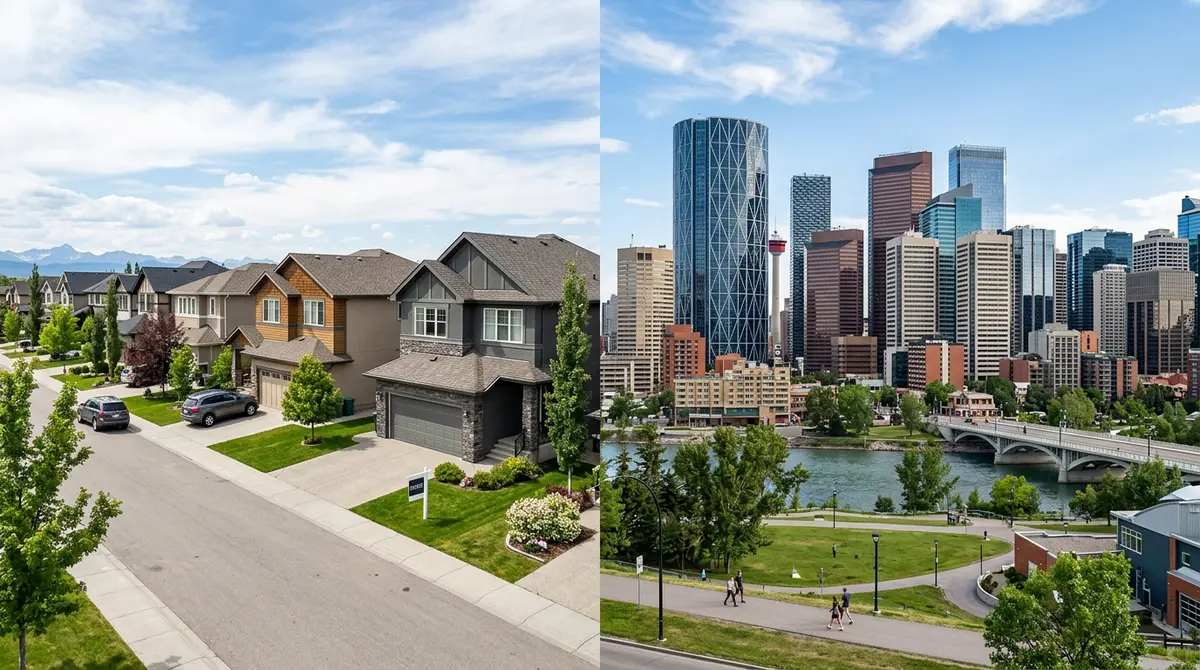
Calgary’s inner city is vibrant, attracting young professionals, downsizers, and investors to areas like the Beltline, Mission, and East Village. However, when you use an inner-city property as collateral for a second loan, you face specific underwriting challenges that suburban owners do not encounter. The most significant hurdle is the monthly condo fee.
When lenders calculate your debt service ratios, standard underwriting guidelines require them to include 50% of your condo fees as a monthly liability. In older buildings, these fees can be substantial, directly impacting your Total Debt Service (TDS) ratio.
As David Chen, Chief Risk Officer at Prairie Mortgage Solutions, explains: “Condo fees are the silent killer of borrowing power. A $600 monthly fee effectively wipes out roughly $60,000 in mortgage qualifying capacity under current 2026 stress test guidelines. Borrowers are often shocked to find their equity trapped by their strata obligations.”
Even if you have $200,000 in raw equity, a high condo fee can disqualify you from accessing it if your income cannot support this imputed debt. This is why exploring alternative equity extraction strategies is vital for condo owners.
Loan-to-Value (LTV) Limits: Condos vs. Detached Homes
Because of the differing risk profiles, lenders apply different Loan-to-Value (LTV) maximums based on property type. To clearly illustrate how lenders differentiate between these assets, review the comparison table below:
| Property Factor | Inner-City Condos | Suburban Detached Homes |
|---|---|---|
| Maximum LTV Limit | Typically 65% – 75% | Typically 80% – 85% (Up to 90% for suites) |
| Monthly Liabilities | High (50% of Condo Fees included in TDS) | Low (Only standard property taxes and heat) |
| Appraisal Volatility | High (Sensitive to new high-density developments) | Low (Stabilized by underlying land value) |
| Income Potential | Short-term rentals (High risk, variable income) | Long-term leases (Stable, predictable income) |
| Lender Premium | Often +0.5% to +1.0% on interest rates | Standard market rates apply |
The 2026 Secondary Suite Advantage for Suburban Homes
Suburban homes are prime candidates for secondary income suites, which significantly boosts their financing potential. According to recent guidelines from the Canada Mortgage and Housing Corporation (CMHC), federal mortgage insurance rules now allow refinancing up to 90% LTV specifically for the construction of secondary suites. This heavily favors suburban homeowners in 2026.
Basement suites in suburban homes are significantly easier to permit and build than retrofitting an inner-city apartment. If you can demonstrate the potential for a legal suite, lenders are highly motivated to approve financing, knowing the property’s overall value and income generation will increase. For homeowners weighing their options, understanding second mortgages vs. cash-out refinancing is essential when funding these large-scale renovations.

Underwriting Scrutiny for Inner-City Condos
When underwriting a condo, the lender is not just evaluating you; they are evaluating the condo corporation. This dual-layer scrutiny can complicate the approval process.
Special Assessments and Reserve Fund Risks
Owners of inner-city condos must navigate the risk of special assessments. If a building requires major structural repairs, such as a new roof, building envelope, or elevator modernization, the cost is passed directly to the owners. Lenders review status certificates and reserve fund studies meticulously. If they identify a building with a history of poor management or an underfunded reserve, they may deny a second mortgage application entirely, regardless of your personal credit score.
To prevent delays, condo owners must be highly organized. Having the right paperwork ready is crucial. Reviewing a comprehensive document checklist for secondary mortgages can help you gather the necessary strata documents before the underwriter requests them.
Short-Term Rental Income Limitations
Many inner-city condos are utilized as short-term rentals. While the gross income from platforms like Airbnb can be lucrative, lenders are inherently conservative. They rarely accept projected short-term rental income at 100% value when calculating your eligibility. They understand that municipal bylaws can change overnight and tourism fluctuates. Conversely, lenders heavily favor the stability of suburban rentals, often using 80% to 100% of the rental income from a signed, multi-year suburban lease agreement to offset your mortgage payments.
Interest Rate Premiums and Risk Pricing
Borrowers often mistakenly assume that interest rates are standardized across the city. In reality, the property type heavily influences the rate offered by private and alternative lenders. Due to the risks associated with strata fees, special assessments, and market saturation, private lenders typically charge a premium—often 0.5% to 1.0% higher—for a second mortgage on a condo compared to a detached home.
A standard suburban home is considered a “cleaner” asset. It is easier to appraise, easier to inspect, and faster to liquidate in the event of a default. This lower risk profile directly translates to more competitive interest rates and lower lender fees. Over time, even a half-percent difference can cost thousands, especially when considering how compounding frequency silently increases your debt.
“We price risk accordingly,” states Elena Rostova, Senior Underwriter at Alberta Equity Partners. “A detached home in Mahogany with a legal basement suite represents our ideal collateral profile in 2026. An aging high-rise condo in the Beltline with an upcoming special assessment requires a higher yield to justify the institutional exposure.”

Step-by-Step: How to Maximize Your Second Mortgage Approval in Calgary
Regardless of where you live, you must present your application strategically. Follow these steps to improve your eligibility and secure the best possible terms:
- Calculate Your True Debt Load: If you own a condo, manually add 50% of your strata fees to your monthly debt calculations before applying. This will give you a realistic view of your TDS ratio.
- Prepare Your Documentation: Success relies heavily on organization. Condo owners must provide up-to-date reserve fund studies and status certificates. Suburban owners should document all land improvements, particularly legal secondary suites or energy-efficient upgrades.
- Address Credit Anomalies Upfront: Be prepared to explain any negative marks on your bureau. Knowing how to explain credit inquiries to lenders can prevent an automatic decline from an underwriter.
- Verify Your Income Correctly: If you are a business owner, traditional banks may decline you due to strict stress tests. In these cases, understanding how lenders verify self-employed income is vital.
- Consult an Alternative Lender: If traditional financing fails, consult a specialized mortgage broker. They can guide you toward stated income second mortgages that focus more on property equity than traditional T4 income verification.
Market Volatility and Appraisal Challenges in 2026
Calgary’s real estate market remains sensitive to global energy prices, interprovincial migration trends, and interest rate policies set by the Bank of Canada. Historically, high-end inner-city properties experience sharper price corrections during economic downturns than mid-range suburban homes.
According to 2026 data from Statistics Canada, urban density projects can temporarily depress the resale values of older units as new inventory floods the market. Recent figures showed a localized 4.2% drop in high-density condo valuations in saturated neighborhoods, compared to a 3.1% rise in detached suburban lots during the same period.
“When evaluating second mortgage applications in 2026, we look closely at neighborhood absorption rates,” notes Sarah Jenkins, Senior Appraiser at the Real Estate Council of Alberta (RECA). “Suburban markets currently show a 12% faster absorption rate than downtown condos, making them far more attractive as collateral.”
If you apply for financing during a period of economic uncertainty, a lender will request a fresh appraisal. For inner-city properties, appraisers scrutinize recent comparables within the exact same building. If a single unit recently sold below market value due to distress, your property’s appraised value drops proportionally, instantly shrinking your accessible equity.
Frequently Asked Questions
Do condo fees affect how much I can borrow for a second mortgage?
Yes. Lenders are required to count 50% of your monthly condo fee as a strict debt obligation. This increases your Total Debt Service (TDS) ratio, which directly reduces the maximum loan amount you qualify for compared to a freehold suburban property.
Can I get a second mortgage on an inner-city investment condo?
You can, but the Loan-to-Value (LTV) limit will likely be lower. While primary residences can often secure up to 80% LTV, investment condos in saturated urban markets are typically capped at 65% or 75% by private lenders to mitigate risk.
Are suburban homes better for debt consolidation loans?
Generally, yes. Suburban detached homes are viewed as highly stable collateral with no monthly condo fees eating into your debt servicing capacity. This makes it significantly easier to qualify for a larger debt consolidation loan to pay off high-interest credit cards.
How does the new 2026 secondary suite rule help suburban homeowners?
The updated federal rules allow refinancing up to 90% LTV specifically for adding a secondary suite. Suburban homes with basements are much easier to convert than inner-city apartments, giving suburban owners a massive advantage in increasing property value and generating rental income.
Will a lender deny a second mortgage because of a special assessment?
It is highly possible. If a special assessment is pending or unpaid, a lender views the property as high-risk. They may require the loan proceeds to pay off the assessment first, or they may decline the financing entirely until the building’s structural or financial issues are resolved.
How do private lenders view transitional neighborhoods in Calgary?
Private lenders favor highly marketable areas with low days-on-market statistics. While both popular inner-city belts and established suburbs are excellent, transitional neighborhoods with higher crime rates or slower sales velocity might attract higher interest rates or lower LTV caps to offset the lender’s risk.
Conclusion
Your home’s location does far more than dictate your daily commute; it fundamentally shapes your financial flexibility. While inner-city living offers unmatched excitement and convenience, the associated condo fees, board restrictions, and market volatility introduce significant friction when applying for secondary financing. Suburban homes, fortified by land-based value and the potential for secondary suites, consistently offer a smoother path to approval and higher loan limits.
However, every property is unique. A meticulously managed condo in Bridgeland with a massive reserve fund can be a superior asset to a neglected detached house in the deep suburbs. Ultimately, for many Calgary homeowners, leveraging home equity vs. unsecured credit is the smartest financial move, provided you understand how lenders evaluate your specific address. The key to unlocking your wealth is working with a specialized lending team that understands the intricate nuances of the 2026 Calgary real estate market.
If you are ready to explore your equity options, contact us today to speak with a mortgage specialist who can help you navigate the approval process for your specific property type.