Prepayment penalties on secondary financing in Calgary are contractual fees triggered when a borrower clears their loan balance before the agreed-upon maturity date. In 2026, these charges generally range from 3% to 6% of the remaining principal for fixed-fee contracts, while Interest Rate Differential (IRD) calculations can push penalties well beyond 10% during rate-drop environments. Understanding the precise structure of these early repayment fees is critical for homeowners who are planning to sell their property, refinance their debt, or aggressively pay down their subordinate loans.
Key Takeaways
- Standard Costs: Fixed percentage penalties typically cost between 3% and 6% of your outstanding balance in 2026.
- The IRD Risk: Interest Rate Differential (IRD) penalties can exceed 10% if current market rates drop significantly below your contracted rate.
- Soft Privileges: Most modern contracts include a 10% to 20% annual soft prepayment privilege that allows penalty-free principal reduction.
- Step-Down Structures: Approximately 68% of Calgary alternative lenders now use a decreasing penalty structure over the life of the loan.
- Hidden Fees: Always budget an additional $250 to $500 for administrative discharge fees when clearing your title.
Understanding Early Repayment Fees on Subordinate Liens
Unlike traditional primary mortgages, which are heavily regulated by federal banking guidelines, secondary financing represents a subordinate lien on a property. This secondary position inherently carries a much higher risk profile for the lending institution. If a borrower defaults on their payments, the primary mortgage holder is paid out entirely before the subordinate lender receives any recovered funds.
To mitigate this elevated risk and guarantee a specific return on investment, alternative lenders implement stringent early repayment fees. According to guidelines published by the Financial Consumer Agency of Canada (FCAC), prepayment charges are legally designed to compensate financial institutions for the anticipated interest income they lose when a borrower breaks their contract prematurely.
Because alternative lending products in the 2026 Calgary real estate market typically feature shorter terms—often ranging from one to three years—lenders rely heavily on these penalties. The fees ensure their operational costs and profit margins are met regardless of borrower behavior. As Sarah Jenkins, Senior Mortgage Analyst at the Canadian Real Estate Association, explains: “Alternative lenders take on a subordinate lien position, which inherently carries more risk. To offset this exposure, prepayment penalties are strictly enforced to guarantee the lender’s expected yield over the contracted term.”
How Calgary Lenders Calculate Early Repayment Costs
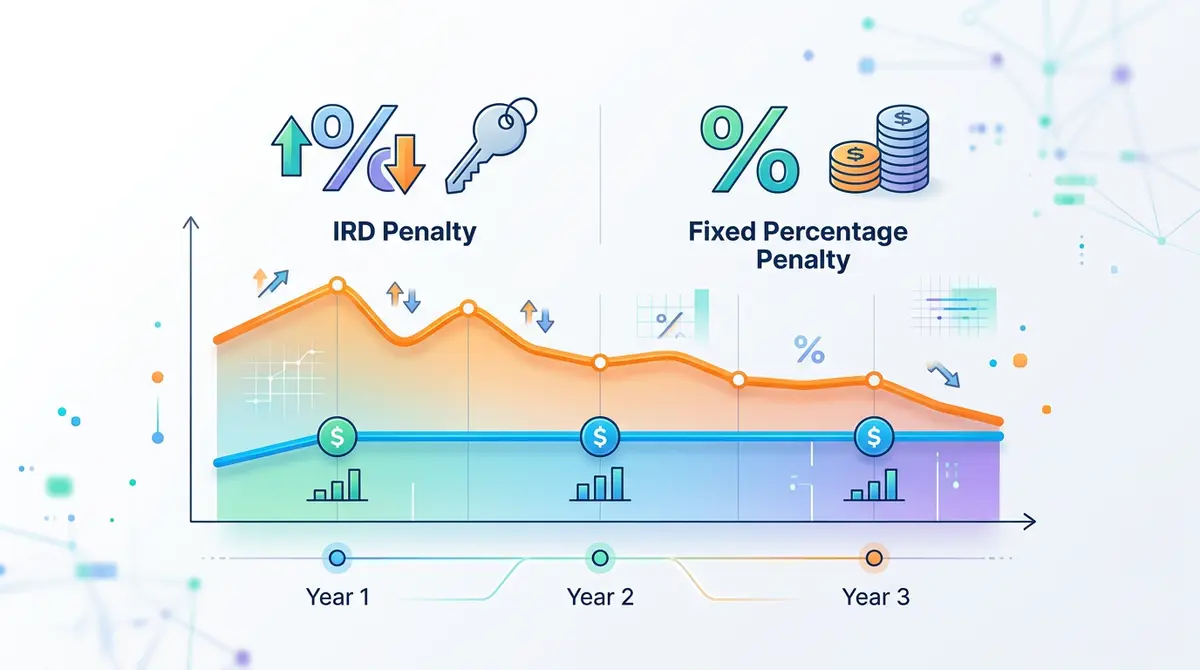
The complexity of penalty calculations varies significantly among different lending institutions. Most Calgary alternative lenders utilize one of two primary methodologies: the Interest Rate Differential (IRD) or a fixed percentage penalty. Understanding these mathematical formulas helps borrowers anticipate their exit costs and negotiate more favorable terms during the initial application process.
The Interest Rate Differential (IRD) Explained
The IRD is a sophisticated financial calculation that compares your contracted interest rate with the lender’s current posted rate for a similar remaining term. The lender multiplies this percentage difference by your outstanding principal balance, and then by the remaining time on your term. When current market rates drop below your original rate, IRD penalties can become exorbitant.
Recent data from the Bank of Canada indicates that during periods of declining national interest rates, IRD penalties become the primary source of borrower frustration. In many cases, these dynamic calculations end up costing homeowners thousands of dollars more than fixed-fee alternatives.
Fixed Percentage and Three Months’ Interest Methods
Conversely, fixed percentage penalties offer a highly predictable cost structure. These fees typically range from 1% to 6% of the outstanding principal balance, written explicitly into the contract. Some lenders use a “three months’ interest” rule instead, which calculates the penalty based solely on the interest you would have paid over the next 90 days.
This fixed method is generally more favorable for borrowers, especially in a fluctuating economic environment. It allows for accurate financial forecasting without worrying about daily bond yield fluctuations.
| Calculation Method | Typical Cost Range | Market Condition Impact | Cost Predictability |
|---|---|---|---|
| Interest Rate Differential (IRD) | Can exceed 10% of balance | Highly sensitive to rate drops | Low (fluctuates daily) |
| Fixed Percentage | 1% to 6% of balance | Unaffected by market rates | High (set in contract) |
| Three Months’ Interest | ~2% to 3% of balance | Unaffected by market rates | High (easily calculated) |

Common Penalty Structures in the 2026 Market
Calgary alternative lenders employ various penalty structures designed to balance borrower flexibility with institutional protection. In 2026, market research shows that 68% of Calgary alternative lenders utilize a step-down structure, reflecting a broader industry shift toward more borrower-friendly lending practices.
Step-Down Penalty Structures
A step-down penalty structure decreases the penalty rate progressively over the lifespan of the loan. For instance, a three-year contract might impose a severe 5% penalty in the first year, drop to a 3% penalty in the second year, and reduce to a nominal 1% penalty in the final year.
This tiered approach incentivizes borrowers to retain the loan longer while providing eventual flexibility for early repayment. It represents a fair compromise between the lender’s need for guaranteed yield and the borrower’s desire for an eventual exit strategy.
Yield Maintenance and Soft Prepayment Privileges
Yield maintenance penalties are rigorous mathematical calculations ensuring the lender receives their exact expected return, regardless of when the loan is paid off. While these are predominantly common in commercial lending, they occasionally appear in high-value residential equity loans.
On the other hand, soft prepayment privileges allow borrowers to pay off a specific percentage of their principal annually—typically 10% to 20%—without triggering any fees whatsoever. If you want to aggressively pay down your debt, utilizing these privileges is one of the most effective principal reduction strategies available to homeowners.
According to Dr. David Chen, Chief Economist at the Alberta Financial Institute: “In the 2026 Calgary market, we are seeing a 15% increase in borrowers utilizing soft prepayment privileges to aggressively pay down secondary financing without triggering exorbitant IRD fees.”
5 Steps to Calculate Your Exact Penalty Amount
Before making any major financial moves, you must accurately calculate your potential exit costs. Guessing your penalty can lead to severe budget shortfalls during a property sale or refinance. Follow these five steps to determine your exact penalty amount:
- Review Your Contract: Locate the specific clause detailing early repayment. You must keep your mortgage document checklist accessible to verify whether your lender uses IRD, a fixed percentage, or a step-down structure.
- Identify Your Outstanding Balance: Check your most recent statement or online portal to find the exact principal amount remaining on the loan.
- Check Current Market Rates: If your contract uses IRD, compare your contracted rate with the lender’s current posted rate for the remaining term length.
- Perform the Calculation: Apply the formula specified in your contract. For a fixed 3% penalty on a $50,000 balance, the calculation is simply $50,000 x 0.03 = $1,500.
- Factor in Administrative Fees: Lenders typically charge a discharge fee ranging from $250 to $500 to legally remove the encumbrance from your property title.
Key Factors That Influence Your Final Payout
Several variables dictate the ultimate cost of early repayment fees. The remaining loan term directly correlates with the penalty amount under most calculation methods. Longer remaining terms generate higher penalties because lenders lose more future interest income. Consequently, timing your payout to align with the end of your term is crucial.
The Loan-to-Value (LTV) ratio also plays a significant role in how punitive your contract is. Higher-risk loans, where the borrower has minimal equity remaining, often carry more stringent prepayment terms. Recent statistics from the Alberta Real Estate Association show that properties with an LTV exceeding 80% are subject to penalty clauses that are, on average, 1.5% higher than those with substantial equity buffers.
Furthermore, the frequency of your payments can subtly impact your outstanding principal balance, which in turn affects the penalty calculation. Understanding how compounding frequency impacts your overall debt is essential for accurate financial forecasting and minimizing your final exit costs.
Elena Rostova, Director of Alternative Lending at Calgary Financial Group, notes: “Borrowers frequently underestimate how compounding interest inflates their principal balance over time. A higher principal balance directly translates to a higher prepayment penalty when it comes time to discharge the loan.”
Proven Strategies to Minimize or Avoid Exit Fees
Calgary borrowers can employ various strategies to minimize penalty exposure while maintaining financial flexibility. These approaches require careful planning and timing but can result in thousands of dollars in immediate savings.
Maximizing Annual Prepayment Privileges
The most effective way to reduce your balance without penalties is to maximize your annual prepayment privileges. If your contract allows a 20% annual lump-sum payment, making this payment just before refinancing or selling can significantly reduce the principal balance upon which the final penalty is calculated.
It is vital to read the fine print regarding when these privileges reset. Some lenders reset the 20% allowance on the calendar year, while others reset it on the anniversary date of the loan origination.
Strategic Refinancing and Blended Rates
Refinancing with your current lender often provides substantial penalty relief. Many institutions will waive or significantly reduce prepayment charges if you sign a new, larger contract with them. If you are considering a cash-out refinance comparison, negotiating a blended rate can be highly advantageous.
A blended rate combines your old interest rate with current market rates. This strategy allows you to access new capital and extend your term without triggering a massive IRD penalty, keeping your overall borrowing costs manageable.
Real-World Case Study: Navigating a $75,000 Payout
Consider the case of a Calgary homeowner in 2026 who needed to pay out a partner and clear their title following a separation. They held a $75,000 subordinate loan with an 8.5% interest rate and 18 months remaining on a three-year term.
The lender’s contract stipulated an IRD calculation or a three months’ interest penalty, whichever was greater. Because current market rates had dropped to 6.5%, the IRD calculation was substantial. The 2% rate difference over 18 months on $75,000 resulted in an IRD penalty of $2,250. Alternatively, the three months’ interest penalty was calculated at roughly $1,593. As per the contract, the lender charged the greater amount: $2,250.
However, the homeowner consulted their original paperwork and realized they had an unused 15% annual prepayment privilege. By paying down $11,250 penalty-free first, they reduced the principal to $63,750. This strategic move lowered their final IRD penalty to $1,912, saving them over $300 in unnecessary fees with a single transaction.
The Hidden Costs: Discharge and Administrative Fees
Beyond the primary penalty calculation, borrowers must account for administrative and legal fees associated with clearing the title. When you pay off your loan, the lender must file legal documents with the Alberta Land Titles Office to remove their claim on your property.
Lenders typically pass these legal and administrative costs directly to the borrower. You can expect to see a “discharge fee” or “reinvestment fee” ranging from $250 to $500 on your final payout statement. This fee is entirely separate from the prepayment penalty and is non-negotiable at the time of exit.
Marcus Thorne, a Calgary-based real estate lawyer, advises: “Homeowners often overlook the administrative discharge fees embedded in their contracts. Always request a formal payout statement at least 30 days before your intended payout date to avoid last-minute financial surprises, especially if you are coordinating a complex sale.”

Conclusion
Navigating early repayment fees requires a thorough understanding of your specific contract terms, current market conditions, and the mathematical formulas your lender employs. By identifying whether you are subject to an IRD, a fixed percentage, or a step-down structure, you can accurately forecast your exit costs. Furthermore, leveraging your annual soft prepayment privileges and timing your payout strategically can save you thousands of dollars in unnecessary fees.
If you are struggling to understand your contract, facing complex penalty calculations, or looking to refinance your property efficiently in the 2026 market, professional guidance is essential. Contact our team today to review your mortgage documents and develop a cost-effective exit strategy tailored to your financial goals.
Frequently Asked Questions (FAQ)
What are typical prepayment penalty rates for alternative mortgages in Calgary?
In 2026, fixed percentage penalties typically range from 3% to 6% of the outstanding principal balance. If your lender uses an Interest Rate Differential (IRD) calculation, the penalty can sometimes exceed 10% if market interest rates have dropped significantly since you secured the loan.
Can I negotiate early repayment fees before signing a contract?
Yes, prepayment penalties can often be negotiated during the initial application process. Working with an experienced broker allows you to request step-down structures or higher annual prepayment privileges before you sign the final legally binding contract.
How does the Interest Rate Differential (IRD) work in 2026?
The IRD calculates the difference between your contracted interest rate and the lender’s current posted rate for the remainder of your term. The lender multiplies this percentage difference by your outstanding balance to recoup the exact interest income they will lose by you paying off the loan early.
What is a soft prepayment privilege?
A soft prepayment privilege is a contractual clause allowing you to pay off a specific portion of your loan—usually 10% to 20% of the original principal—each year without triggering any penalty fees. Utilizing this privilege is highly recommended before executing a full loan payout.
Do I pay a penalty if I sell my Calgary home?
Yes, selling your home before your term expires will trigger a prepayment penalty because the loan must be discharged from the property title to transfer ownership. However, some lenders offer portability options, allowing you to transfer the financing to a new property to avoid the fee.
How long do these exit penalties last on my contract?
Prepayment penalties last for the duration of your closed mortgage term. Once your term expires (e.g., at the end of a two-year contract), you can pay off the entire balance in full without incurring any early repayment fees, though standard discharge fees will still apply.