For homeowners seeking a private second mortgage in Calgary in 2026, the minimum required credit score typically falls between 550 and 600. However, unlike traditional Canadian banks that strictly mandate a 680+ Beacon score, alternative lenders prioritize your property’s equity over your credit history. If you maintain at least 20% to 25% usable equity in your home after the new loan is registered, many private lending institutions will approve your application regardless of past financial missteps, consumer proposals, or a poor credit rating.
Key Takeaways
- The Baseline Score: While 550 is the general minimum for alternative financing, exceptions are frequently made for properties with substantial equity.
- Equity is the Ultimate Decider: Borrowers must maintain a maximum combined Loan-to-Value (LTV) ratio of 75% to 80%.
- Risk-Based Pricing: Interest rates in 2026 range from 8% to 15%+, directly correlating to your Beacon score and available equity.
- Speed of Execution: Private financing bypasses federal stress tests, allowing for rapid approvals (48 hours) and funding (7-14 days).
- Strategic Utility: These 1-to-3-year loans are ideal for debt consolidation, business funding, or securing a down payment on an investment property.
The Shift in Alternative Lending for Alberta Homeowners
When considering secondary financing in Alberta, understanding the exact underwriting requirements is crucial for homeowners seeking additional capital. The alternative lending market has evolved significantly by 2026 to serve borrowers who face challenges obtaining financing through conventional channels. This demographic includes self-employed entrepreneurs, individuals recovering from recent financial hardships, or investors who need rapid access to liquidity for time-sensitive opportunities.
According to recent market data from the Canada Mortgage and Housing Corporation (CMHC), alternative lending volume has grown by over 15% across Western Canada. This surge is largely a response to the tightening of traditional banking regulations and the persistent federal stress test requirements. Private lenders evaluate risk through a fundamentally different lens than major financial institutions. While a Tier-1 bank views a credit profile of 580 as an automatic algorithmic decline, a private underwriter views it as an opportunity to assess the underlying collateral: your real estate.
As Dr. James Aris, a Real Estate Economist at the University of Calgary, explains: “The private mortgage sector has become the vital shock absorber of the Canadian housing market. By focusing on asset liquidity rather than just the borrower’s Beacon score, these institutions provide a critical bridge for homeowners transitioning through temporary financial turbulence.”
Credit Score Tiers and Expected Interest Rates in 2026
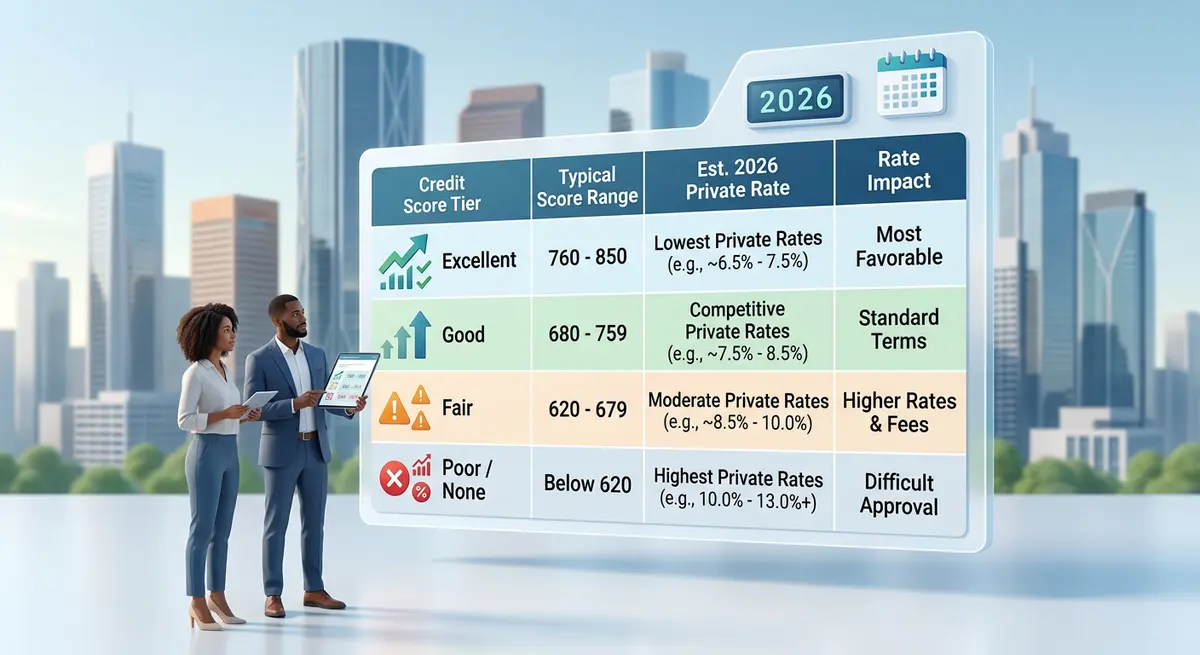
Understanding how different credit brackets affect your approval likelihood and borrowing costs helps set realistic financial expectations. Private lenders categorize applicants into distinct risk tiers, each associated with specific pricing structures and LTV limits. While data from Equifax Canada indicates that the average Albertan holds a credit score of roughly 670, alternative lenders frequently and successfully work with borrowers well below this median.
| Credit Score Range | Typical Interest Rate (2026) | Maximum LTV Ratio | Approval Odds |
|---|---|---|---|
| 650 – 750+ (Good to Excellent) | 8% – 10% | 80% | Excellent |
| 600 – 649 (Fair) | 10% – 12% | 75% | Very Good |
| 550 – 599 (Poor) | 12% – 15% | 65% – 70% | Good (Equity Dependent) |
| Below 550 (Bad) | 15% – 18%+ | 50% – 60% | Fair (Case-by-Case) |
Excellent to Good Credit (650+)
Borrowers presenting scores above 650 generally secure the most favorable terms available in the alternative market. Annual interest rates typically hover between 8% and 10%, closely tracking the baseline rates set by the Bank of Canada plus a standard risk premium. These applicants often qualify for maximum loan-to-value ratios (up to 80%) and experience a highly streamlined underwriting process focused primarily on basic property valuation.
Fair to Poor Credit (550-649)
Scores in the 550 to 649 range represent the core demographic for private lending. Interest rates naturally scale upward to account for statistical default risks, generally landing between 10% and 15%. Borrowers in this bracket face slightly more stringent equity requirements, with lenders typically capping the LTV at 70% to 75%. Approval remains highly probable, provided the property is marketable and the borrower can demonstrate a logical plan for managing the new monthly obligations.
Four Crucial Factors That Outweigh Your Beacon Score
While your credit rating provides underwriters with a historical baseline, private institutions evaluate a matrix of compensating factors. These elements can heavily influence the final decision, frequently allowing individuals with sub-550 scores to secure necessary funding.
1. Loan-to-Value (LTV) Ratio and Usable Equity
Property equity is the undisputed king of alternative lending. Underwriters calculate the combined LTV ratio of your existing primary mortgage plus the requested secondary loan. For instance, if your property is appraised at $600,000 and your primary mortgage balance is $350,000, you possess $250,000 in raw equity. A lender willing to extend up to 75% LTV would authorize a maximum combined debt load of $450,000. This means you could access up to $100,000 in secondary financing, completely independent of a low credit score, because the lender’s capital is fully protected by the physical asset.
2. Income Stability and Alternative Verification
Cash flow matters. While traditional banks rely on rigid debt-to-income (DTI) ratios and standard T4 tax slips, private lenders focus on the practical reality of your monthly cash flow. In 2026, there is a pronounced shift toward stated income products. If you are a contractor or small business owner, alternative lenders have flexible methods for verifying self-employed mortgage income, such as reviewing 6 to 12 months of business bank statements rather than relying solely on your Notice of Assessment (NOA).
3. Clear Exit Strategies
Alternative mortgages are inherently short-term financial instruments, typically structured for 12 to 36 months. Lenders require a definitive “exit strategy”—a realistic roadmap detailing how you intend to retire the principal at the end of the term. Acceptable exit strategies include rehabilitating your credit to refinance back with an “A” lender, selling the property, or utilizing anticipated funds from a business sale or inheritance. A strong exit strategy significantly mitigates the risk of a low credit score.
4. Property Location and Marketability
The local real estate micro-market plays a pivotal role. Homes situated in highly liquid, desirable neighborhoods (such as Altadore, Hillhurst, or Evanston) are viewed far more favorably than specialized rural properties or acreages. A highly marketable asset ensures that, in the worst-case scenario of default, the lender can quickly recover their capital. This liquidity premium directly compensates for borrower credit deficiencies.
Step-by-Step Application Process for Alberta Homeowners
The alternative financing process is engineered for efficiency. Standard applications receive formal commitments within 48 to 72 hours, with capital deployment occurring within one to two weeks. To maximize your approval odds, follow this structured approach:
- Calculate Your Usable Equity: Determine your home’s current conservative market value and subtract your existing mortgage balance. Ensure you retain at least 25% equity to present a strong case.
- Gather Alternative Documentation: While the paperwork burden is lighter than a bank’s, you must provide proof of income, current property tax statements, and your latest primary mortgage statement. Reviewing a comprehensive second mortgage document checklist prevents processing delays.
- Draft a Letter of Explanation: If your credit score sits below 600, take control of the narrative. Whether the drop was caused by a medical emergency, divorce, or business downturn, providing a well-crafted Letter of Explanation builds vital trust with the underwriter.
- Order a Property Appraisal: Lenders require a current, objective market valuation from an approved, licensed appraiser to finalize the exact loan amount.
- Legal Review and Funding: Upon approval, you must retain independent legal counsel to review the commitment letter, explain the terms, and register the new charge against your property title.

Real-World Case Study: Securing Funds with a 540 Credit Score
To illustrate how these underwriting principles function in the real world, consider the case of “David,” an independent electrical contractor. Like many construction industry workers in Calgary, David experienced seasonal income fluctuations. A protracted dispute with a telecom provider, combined with high credit card utilization during the winter months, had severely damaged his credit profile, dropping his Beacon score to a challenging 540.
David required $50,000 to consolidate his high-interest revolving debt and purchase new equipment. His home in deep south Calgary appraised at $550,000, and his primary mortgage sat at $300,000. This gave him an initial LTV of just 54%. Because his equity position was exceptionally strong—leaving him at a combined LTV of 63% even after adding the new $50,000 loan—a private lending syndicate approved his application at a 13% interest rate.
By using the funds to eliminate his credit card balances, David’s credit utilization ratio plummeted. Within 14 months, his credit score rebounded to 685, allowing him to break his private term early and refinance his entire debt load back into a traditional, low-rate bank mortgage.
Common Pitfalls When Borrowing with Bad Credit
When navigating the alternative lending space with a compromised credit history, urgency can sometimes lead to costly oversights. The Financial Consumer Agency of Canada (FCAC) consistently warns borrowers to meticulously review all associated terms, fees, and legal obligations before signing commitment letters.
Ignoring the Compounding Frequency
Borrowers frequently fixate solely on the advertised nominal interest rate while ignoring the compounding schedule. A 12% rate compounded monthly is mathematically more expensive than a 12% rate compounded semi-annually. Understanding how compounding frequency silently increases your debt is vital for protecting your long-term financial health and accurately calculating your true cost of borrowing.
Misunderstanding Guarantor Responsibilities
If an applicant’s credit score is exceptionally low (e.g., below 500) or their income is entirely unverifiable, an underwriter might request a co-signer. Many borrowers and their family members fail to realize that a guarantor assumes joint and several liability for the entire debt. It is absolutely critical to fully comprehend second mortgage guarantor responsibilities before asking a relative to risk their own financial standing to secure your loan.
“Borrowers must look beyond the headline interest rate and understand the total cost of capital,” notes Elena Rostova, a prominent Financial Consumer Advocate. “Always calculate the Annual Percentage Rate (APR), which accurately bakes in lender fees, broker commissions, and the mathematical effects of compounding.”

Frequently Asked Questions (FAQ)
What is the absolute minimum credit score for alternative lenders?
While most private institutions prefer a baseline score of 550, there is no strict legal minimum. If you possess substantial usable equity (resulting in an LTV below 60%), specialized equity-based lenders will frequently approve your application regardless of your exact credit rating.
Will secondary financing improve my credit score?
Yes, if utilized strategically. If you deploy the borrowed funds to pay off high-utilization revolving debt, such as maxed-out credit cards, your credit utilization ratio will drop immediately. Combined with consistent, on-time mortgage payments, your score can improve significantly within 6 to 12 months.
Do private lenders report my payments to Equifax or TransUnion?
The vast majority of private lenders do not report monthly payment history to the major Canadian credit bureaus. However, the act of paying off the external consumer debts that were suppressing your score will naturally and effectively rehabilitate your credit profile.
How much are the standard fees for alternative financing?
In addition to the annual interest rate, borrowers should expect a lender fee ranging from 1% to 3% of the total loan amount. You must also budget for broker origination fees, property appraisal costs ($350 to $500), and independent legal fees ($1,000 to $1,500).
Can I secure funding if I am currently in a consumer proposal?
Yes, it is entirely possible. Alternative lenders focus on the physical asset rather than the proposal. In fact, many homeowners utilize secondary financing specifically to pay off their consumer proposal in a single lump sum, thereby accelerating their path to financial rehabilitation.
How long does the entire approval and funding process take?
The alternative lending process is designed for speed. Most borrowers receive a formal commitment letter within 48 to 72 hours of submitting their application and appraisal. Full legal funding and capital disbursement typically conclude within 7 to 14 days.
Conclusion
Securing secondary financing in 2026 does not require a flawless financial history. While traditional banks maintain rigid barriers to entry, the alternative lending market offers a pragmatic, equity-focused solution for homeowners. By understanding that your property’s Loan-to-Value ratio carries far more weight than a three-digit Beacon score, you can confidently leverage your real estate to consolidate debt, fund business operations, or navigate temporary financial hurdles.
If you have equity in your home but are concerned about your credit history, professional guidance can help you navigate the alternative lending landscape safely and efficiently. Contact us today to discuss your unique situation and explore the financing options available to you.