Porting a secondary loan in Calgary means transferring your existing interest rate, loan balance, and remaining amortization schedule to a new property without breaking your current contract. This financial maneuver utilizes collateral substitution to bypass costly prepayment penalties while preserving favorable lending terms. To execute this transfer successfully in 2026, homeowners must purchase their new property within a strict 30 to 120-day window, pass updated federal stress test requirements, and ensure the new home meets stringent appraisal standards.
Key Takeaways for Calgary Homeowners
- Strict Timelines: Lenders enforce a rigid 30 to 120-day window between the sale of your current home and the purchase of your new property.
- Mandatory Re-qualification: Borrowers must pass the 2026 federal stress test, proving financial stability at a qualifying rate of approximately 7.25%.
- Penalty Avoidance: Successful porting eliminates the Interest Rate Differential (IRD), saving homeowners an average of $5,000 to $15,000 in prepayment penalties.
- Appraisal Requirements: The new property must undergo a fresh appraisal to ensure it meets the lender’s acceptable Loan-to-Value (LTV) ratio.
- Blended Rates: If your new home requires additional funds, lenders will blend your existing favorable rate with current 2026 market rates.
- Bridge Financing: Misaligned closing dates often require short-term bridge loans, typically priced at Prime + 2%, to prevent the porting agreement from collapsing.
The Mechanics of Mortgage Porting in Alberta
Transferring a home equity loan or secondary financing arrangement is a contractual privilege, not an automatic legal right. In Calgary’s dynamic 2026 real estate market, this option provides unparalleled financial flexibility for homeowners who secured low interest rates in previous years and wish to preserve them while upgrading or downsizing their living situation.
The fundamental principle behind this process is collateral substitution. When you sell your current home, the lender agrees to release their legal lien on that property and simultaneously register a new lien on your future home. This symbiotic arrangement benefits both parties. Borrowers avoid exorbitant prepayment penalties—which routinely average 3% to 4% of the principal balance—while lenders retain a performing asset and bypass the administrative costs of originating an entirely new loan.
According to early 2026 data from the Calgary Real Estate Board (CREB), the average detached home price in the city has stabilized at $615,400. As property values fluctuate across diverse neighborhoods—from the high-density Beltline district to suburban communities like Tuscany—lenders rigorously evaluate the risk profile of the new collateral. They must ensure the new asset provides adequate security for the outstanding debt in the event of a default.

2026 Eligibility and Qualification Standards
Assuming that existing home equity guarantees a seamless transfer is a critical error. Qualifying to move your financing involves satisfying both your original contractual terms and the stringent lending standards established for 2026.
Property Valuation and Equity Requirements
The property qualification phase is the most common stumbling block for applicants. Your new Calgary residence must appraise for a value that maintains the lender’s maximum Loan-to-Value (LTV) thresholds. The property type, zoning, location, and physical condition heavily influence the underwriter’s final decision. For example, transitioning from a detached single-family home in Kensington to a high-rise condominium in the East Village triggers additional scrutiny regarding condo board financial health and special assessment risks.
As Marcus Thorne, Chief Economist at the Calgary Real Estate Board, explains: “The biggest mistake Calgary homeowners make is assuming their existing equity guarantees a seamless port. Lenders evaluate the new property’s risk profile just as strictly as the borrower’s income, especially in transitioning neighborhoods where valuation models are highly sensitive.”
Income Verification and the Federal Stress Test
Income verification during a transfer frequently catches borrowers off guard. Calgary financial institutions must comply with federal guidelines enforced by the Office of the Superintendent of Financial Institutions (OSFI). This includes subjecting all applicants to the mortgage stress test, regardless of their flawless payment history.
In 2026, the qualifying stress test rate hovers around 7.25%. This mechanism ensures your household finances remain resilient even if macroeconomic conditions force interest rates higher. If your household income has decreased since your original approval, or if you have transitioned to freelance work, you must provide comprehensive updated documentation. Understanding the intricacies of verifying self-employed income is absolutely critical for entrepreneurs attempting to preserve their current lending terms.
“Porting is a privilege that demands rigorous re-qualification under 2026 federal stress test guidelines. A spotless payment history does not exempt you from proving current income stability,” notes Sarah Jenkins, Senior Underwriter at Alberta Financial Group.
Step-by-Step Process for Transferring Your Mortgage
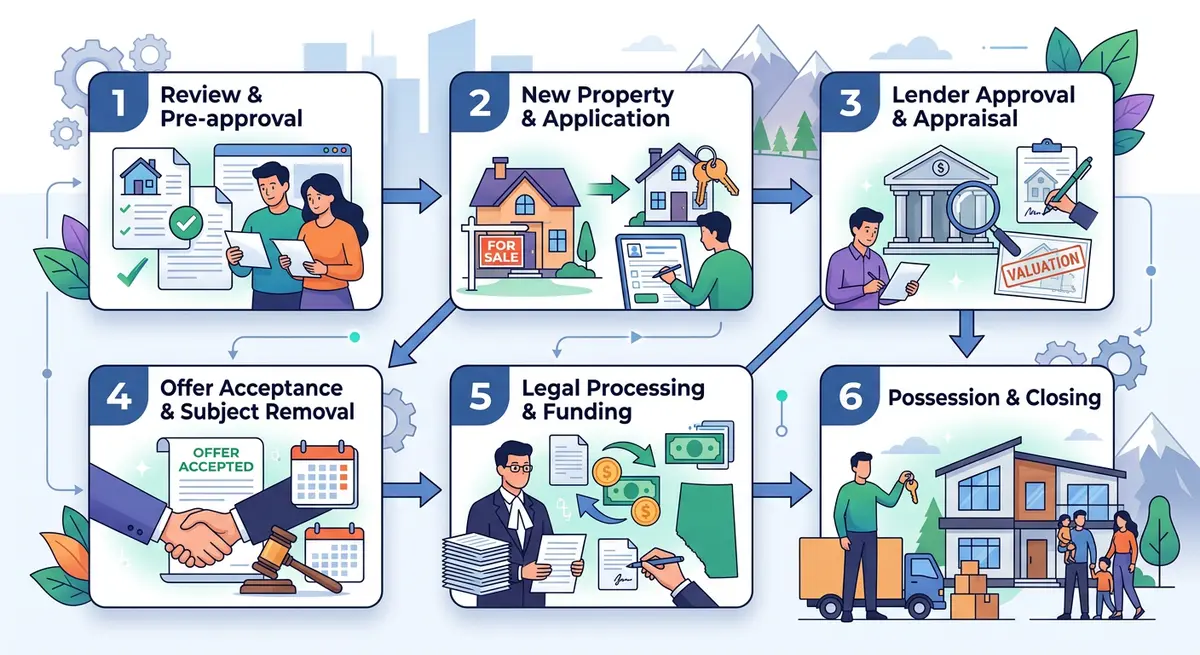
Executing a flawless transfer requires meticulous logistical planning. Industry research indicates that 78% of Calgary homeowners successfully port their financing when they initiate the administrative process at least 90 days prior to their intended moving date. Follow this standardized sequence to prevent underwriting delays:
- Review Your Current Contract: Before listing your property, verify your specific porting window (typically 30 to 120 days) and check for geographic limitations. Many regional credit unions restrict transfers exclusively to properties within Alberta.
- Gather Financial Documentation: Compile your recent pay stubs, T4s, Notice of Assessments (NOAs), and updated credit reports. Utilizing a comprehensive checklist for organizing your second mortgage paperwork will streamline the underwriter’s review.
- Request a Porting Package: Formally notify your lender of your intent to relocate. They will issue a standardized application package and disclosure statements detailing your legal rights and financial obligations.
- Coordinate Closing Dates: Work closely with your real estate agent to align the sale of your current home with the possession date of your new property. Misaligned dates are the primary catalyst for transaction failures.
- Order the New Appraisal: Immediately upon securing an accepted offer on your new home, commission a professional appraisal. In the fast-paced 2026 Calgary market, appraisal turnarounds require 7 to 14 business days.
- Finalize the Legal Transfer: Retain a qualified real estate lawyer to manage the discharge of the lien from your old property title and the subsequent registration on your new property title.
Financial Analysis: Porting vs. Breaking Your Mortgage
Evaluating the financial viability of a transfer requires a granular analysis of immediate out-of-pocket costs versus long-term interest savings. While porting successfully eliminates the dreaded Interest Rate Differential (IRD) penalty, the transaction still incurs unavoidable administrative and legal fees.
Cost Comparison Table (2026 Calgary Market)
| Expense Category | Porting Your Mortgage | Breaking Your Mortgage |
|---|---|---|
| Prepayment Penalty | $0 (Waived completely) | $5,000 – $15,000+ (IRD or 3 Months Interest) |
| Appraisal Fee | $450 – $650 | $450 – $650 |
| Legal Fees | $1,200 – $2,500 (Discharge & Registration) | $1,500 – $3,000 (Full new origination) |
| Interest Rate | Maintained at original favorable rate | Subject to current 2026 market rates |
| Administrative Fees | $200 – $400 | $300 – $500 |
Blended Rates and Additional Borrowing
If your new Calgary residence costs more than your current outstanding balance, you will require additional capital. Lenders facilitate this through a “blended rate” structure. This mechanism mathematically combines your existing low interest rate with the current market rate applied only to the newly borrowed funds.
For instance, if you possess a $100,000 balance at 5% and require an additional $50,000 at the current 2026 market rate of 8%, your blended rate will settle at approximately 6%. While this grants access to necessary liquidity, borrowers must also calculate how compounding frequency impacts their total cost of borrowing over the term. In some scenarios, executing a full cash-out refinance might yield superior long-term savings despite the upfront penalty.
Overcoming Common Porting Challenges
Even with impeccable preparation, homeowners frequently encounter structural hurdles during the transition. Anticipating these friction points allows you to deploy effective countermeasures before they jeopardize your real estate transaction.
Timing Misalignments and Bridge Financing
The most pervasive challenge involves the timing misalignment between property closings. The compressed timeframe mandated by financial institutions often conflicts with the unpredictable nature of property negotiations.
“Timing is the silent killer of mortgage ports. A delay of just 48 hours between closing dates can trigger massive prepayment penalties if bridge financing isn’t secured proactively,” warns David Chen, Principal Broker at West Coast Mortgages.
Bridge financing serves as a short-term liquidity bridge designed to cover the capital gap between selling your existing property and taking possession of the new one. In 2026, Calgary bridge loans typically carry interest rates of Prime + 2%. The Bank of Canada sets the overarching monetary policy that dictates these prime rates, making bridge loans a costly but indispensable safety net.
Property Value Discrepancies
Calgary’s distinct quadrants exhibit substantial price volatility. Borrowers occasionally discover that their desired new home appraises lower than the purchase price, creating an immediate equity shortfall. If you are downsizing and your new required loan amount is less than your current balance, the lender will force a partial prepayment. This action triggers a proportional IRD penalty based exclusively on the prepaid amount.
Conversely, if you are upsizing and the blended rate offered by your primary lender is uncompetitive, you might explore using a second mortgage for your down payment to bridge the valuation gap while keeping your primary loan intact.

Legal Framework and Documentation in Alberta
The legal architecture governing property financing in Alberta provides specific consumer protections that Calgary residents must leverage. Provincial regulations, strictly overseen by the Real Estate Council of Alberta (RECA), mandate comprehensive disclosure requirements and establish minimum response timeframes for financial institutions processing transfer requests.
Because this procedure involves formally discharging a legal encumbrance from one municipal title and registering it on another, independent legal representation is non-negotiable. Your real estate lawyer ensures that the chain of title remains unclouded and that funds are held in trust appropriately during the transition period. Furthermore, homeowners must understand how long to keep second mortgage documents after the transaction closes to protect against future title disputes or audit requests from the Canada Revenue Agency.
If your household structure is changing during the move, such as adding a spouse to your application, this must be disclosed immediately, as it fundamentally alters the legal liability and requires a complete re-underwriting of the file under the Dower Act.
Frequently Asked Questions (FAQ)
Can I port my second mortgage to another province?
Generally, no. Most regionally focused lenders, particularly Alberta credit unions, restrict transfers exclusively to properties within the same province. If you are relocating from Calgary to Vancouver, you will likely need to break your contract, absorb the prepayment penalty, and originate an entirely new loan in British Columbia.
What happens if my new home requires a smaller mortgage?
If you are downsizing and require a smaller principal balance, you must pay down the difference between your current debt and the new required amount. This mandatory partial prepayment will trigger a proportional penalty based on the specific amount being paid off early.
Do I need a new appraisal to port my mortgage?
Yes, a fresh appraisal is universally mandatory. The financial institution must empirically verify that the new property provides sufficient collateral to secure the existing debt under current 2026 market conditions and LTV guidelines.
Can I increase my mortgage amount when porting?
Yes, you can increase your total borrowing through a process known as a “port and increase.” The lender will issue a blended interest rate, which mathematically combines your existing favorable rate with the current market rate applied to the newly requested funds.
What is the maximum time allowed between selling and buying?
Most Calgary financial institutions enforce a strict window of 30 to 120 days between the closing date of your current property and the possession date of your new home. Exceeding this exact timeframe causes the privilege to expire, resulting in standard prepayment penalties.
Will my credit score be checked again when porting?
Absolutely. Transferring a loan requires comprehensive re-qualification. Underwriters will pull a fresh Equifax or TransUnion credit report to verify your score has not deteriorated and to recalculate your current Total Debt Service (TDS) ratios.
Conclusion
Successfully transferring your financing to a new property in Calgary is a highly effective strategy to preserve low interest rates and avoid devastating prepayment penalties. However, navigating the 2026 federal stress tests, managing strict 120-day timelines, and coordinating bridge financing requires expert precision. By understanding the mechanics of collateral substitution and preparing your documentation well in advance, you can ensure a seamless transition to your new home. If you are planning a move and need professional guidance to evaluate your porting eligibility, contact our team today for a comprehensive portfolio review.