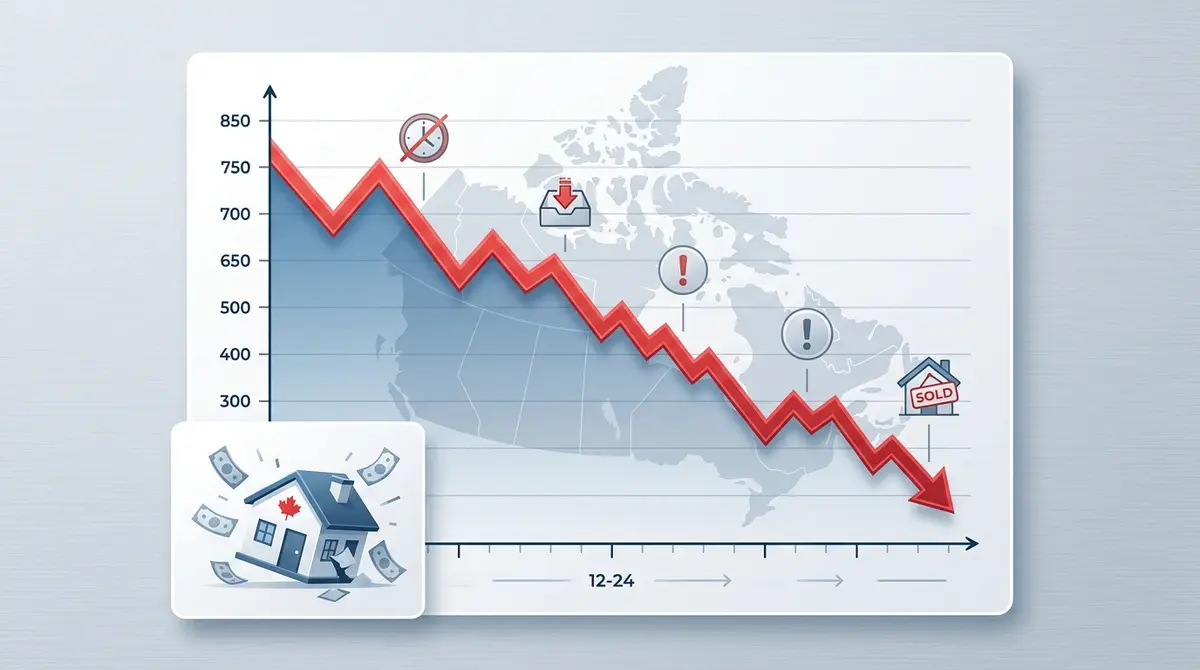
Foreclosure severely damages your credit score, typically causing an immediate drop of 100 to 160 points, and remains on your Canadian credit report for six to seven years. However, the most significant algorithmic penalty occurs within the first 24 to 36 months, after which strategic credit rebuilding—such as utilizing secured credit cards and maintaining flawless payment histories—can restore your borrowing power and qualify you for alternative mortgage financing in as little as two years.
Key Takeaways
- Immediate Score Drop: A foreclosure typically plunges a healthy credit score by 100 to 160 points instantly.
- Reporting Duration: The derogatory mark remains on your Equifax report for 6 years and TransUnion for up to 7 years.
- Compounding Damage: The missed payments leading up to the foreclosure damage your score before the legal process even concludes.
- Recovery Timeline: While the record stays for years, the actual impact on your beacon score diminishes significantly after 24 months of positive credit behavior.
- Future Borrowing: Conventional lenders require a 5 to 7-year waiting period post-foreclosure, while alternative lenders may approve new mortgages in 2 to 3 years.
- Proactive Measures: Communicating with lenders early can open doors to forbearance or alternative financing, potentially saving your credit profile.
The Algorithmic Impact: How Foreclosure Devastates Your Credit Score
In the Canadian financial system, your credit score is a numerical representation of your risk as a borrower, ranging from 300 to 900. When a lender repossesses a property due to defaulted mortgage obligations, it triggers one of the most severe derogatory marks possible within credit scoring algorithms. Understanding the mechanics of this drop is essential for homeowners navigating financial distress in 2026.
The Anatomy of a Credit Score Drop
Payment history accounts for approximately 35% of your total credit score calculation. Long before the final legal gavel falls, the preliminary missed payments begin eroding your score. A single 30-day late payment can deduct 30 to 50 points. By the time a homeowner reaches 90 days of delinquency, the cumulative damage is already catastrophic.
According to data published by the Financial Consumer Agency of Canada (FCAC), severe derogatory events penalize borrowers with high starting scores more heavily than those with already poor credit. A borrower with an excellent score of 800 might see a plummet of up to 160 points, whereas a borrower starting at 600 might only lose 80 to 100 points. This algorithmic leveling ensures that the foreclosure accurately reflects the sudden increase in default risk.
“A foreclosure is a catastrophic credit event, but its half-life is shorter than most Canadians realize. By year three, the algorithmic impact on your beacon score diminishes significantly if offset by new, positive credit lines,” explains Dr. Sarah Jenkins, Senior Financial Analyst at the Canadian Credit Institute.
Canadian Credit Bureau Reporting Timelines in 2026
Understanding exactly how long this financial blemish will haunt your credit file is crucial for long-term planning. In Canada, the two major credit bureaus—Equifax and TransUnion—have slightly different protocols for handling public records and severe defaults.
The clock generally starts ticking from the Date of First Delinquency (DOFD). This is the date of the first missed mortgage payment that ultimately led to the property seizure, not the date the bank took possession.
| Credit Bureau | Reporting Duration | Starting Point | Provincial Exceptions |
|---|---|---|---|
| Equifax Canada | 6 Years | Date of First Delinquency | Standard across all provinces |
| TransUnion Canada | 7 Years | Date of First Delinquency | Up to 10 years in PEI |
It is important to note that if your lender pursues legal action through the courts, the resulting judgments may have their own reporting timelines. Familiarizing yourself with the final order of foreclosure timeline can help you anticipate when these public records will hit your file.
The Domino Effect: Additional Financial Consequences
The repercussions of losing a home extend far beyond a three-digit number on a credit report. The financial shockwaves impact your ability to secure housing, employment, and affordable insurance rates.
Deficiency Judgments and Unsecured Debt
In many jurisdictions, if the forced sale of the property does not cover the outstanding mortgage balance, the lender can sue the borrower for the difference. This is known as a deficiency judgment. Navigating deficiency judgment calculations is critical, as this unsecured debt will appear as a separate, highly damaging trade line on your credit report.
“The deficiency judgment is the hidden sting of foreclosure. It not only liquidates your primary asset but leaves a lingering unsecured debt that continues to suppress your credit utilization metrics long after the house is gone,” warns David Chen, Real Estate Legal Counsel at Chen & Associates.
Tax Implications and CRA Audits
Furthermore, if a lender forgives a portion of the debt rather than pursuing a judgment, the Canada Revenue Agency (CRA) may classify that forgiven debt as taxable income. This unexpected tax liability can lead to further financial distress, potentially resulting in tax liens or wage garnishment after foreclosure if left unpaid.
Additionally, landlords routinely run credit checks on prospective tenants. A recent foreclosure makes securing a rental property exceptionally difficult, often requiring larger security deposits or co-signers. Insurance companies also utilize credit-based insurance scores, meaning your auto and tenant insurance premiums are likely to surge.

The Foreclosure Timeline: Warning Signs and Lender Actions
Foreclosure is rarely a surprise; it is the culmination of months of financial distress and escalating legal warnings. Recognizing these stages allows homeowners to intervene before the damage becomes irreversible.
30 to 90 Days Delinquent
The process typically begins after the first missed payment. At 30 days late, lenders send initial warning letters and report the delinquency to Equifax and TransUnion Canada. By the 60-day mark, the communication shifts from customer service inquiries to formal demands from the lender’s collections department.
Once a borrower hits 90 days of delinquency, the lender usually accelerates the loan, demanding the full balance immediately. This is followed by a formal legal notice. Knowing the intricacies of responding to a foreclosure Statement of Claim is your last line of defense before the courts take over the process entirely.
“Homeowners often freeze when the Statement of Claim arrives. Proactive communication with your lender during the first 90 days of delinquency is the single most effective way to preserve your credit rating,” says Marcus Thorne, Director of Mortgage Recovery at Alberta Financial Advocates.
Strategic Alternatives to Prevent Foreclosure
If you are facing imminent default in 2026, several strategic interventions can halt the legal proceedings and protect your credit profile. Lenders generally prefer to avoid the costly and time-consuming process of property repossession.
Forbearance and Loan Modifications
The first step is always direct negotiation. Many financial institutions offer forbearance programs that temporarily pause or reduce payments while you navigate a short-term financial hardship. Alternatively, a loan modification permanently alters the terms of your mortgage—such as extending the amortization period or lowering the interest rate—to make the monthly payments sustainable.
Leveraging Alternative Equity
If traditional banks refuse to negotiate, homeowners with sufficient equity might explore alternative financing. Securing stated income second mortgages can provide the capital needed to bring the primary mortgage current. While these alternative loans carry higher interest rates, they act as a vital bridge to save the home and prevent a catastrophic credit collapse. Borrowers should also weigh these options against cash-out refinancing alternatives to determine the most cost-effective survival strategy.
Step-by-Step Guide: Rebuilding Your Credit Post-Foreclosure
If the loss of your home was unavoidable, your focus must immediately shift to financial rehabilitation. Rebuilding a credit score from the 500s back to the 700s requires discipline, patience, and a strategic methodology.
- Audit Your Credit Reports: Obtain free copies of your credit files from both major bureaus. Verify that the foreclosure is reporting accurately and that the balance shows as zero (unless there is a deficiency judgment). Dispute any duplicate entries or incorrect dates immediately.
- Establish New Credit Lines: You cannot rebuild credit without active trade lines. Apply for a secured credit card, which requires a cash deposit equal to your credit limit. This eliminates the risk for the issuer while allowing you to demonstrate responsible repayment behavior.
- Maintain Micro-Balances: Credit utilization—the ratio of your credit card balances to your limits—accounts for 30% of your score. Keep your utilization strictly below 10%. If your secured card has a $1,000 limit, never let the statement balance exceed $100.
- Utilize Credit Builder Loans: These specialized financial products hold the loan amount in a locked savings account while you make monthly payments. Once the term is complete, the funds are released to you. The primary purpose is to generate a flawless 12-to-24-month payment history.
- Automate All Payments: A single late payment during your recovery phase will reset your progress entirely. Set up automatic withdrawals for all utilities, cell phones, and credit accounts to ensure you never miss a due date.

The Path Back to Homeownership: Securing a Mortgage After Foreclosure
A foreclosure does not mean you will rent forever. However, the timeline for re-entering the housing market depends heavily on the type of lender you approach and the economic climate dictated by the Bank of Canada.
Conventional Lenders vs. Alternative Lenders
Prime lenders (A-lenders) and government-backed insurers like the Canada Mortgage and Housing Corporation (CMHC) maintain strict underwriting guidelines. Typically, you must wait a minimum of 5 to 7 years from the date the foreclosure was finalized before they will consider a new mortgage application. During this waiting period, you must re-establish at least two active credit lines with perfect two-year histories.
Conversely, the alternative lending market (B-lenders and private lenders) offers a faster route back to homeownership. If you have successfully navigated the Alberta foreclosure redemption periods and stabilized your income, alternative lenders may approve a new mortgage in as little as 24 to 36 months.
“Alternative lending has evolved in 2026. We now see borrowers securing equity loans just 24 months post-foreclosure, provided they can demonstrate a flawless 24-month payment history on newly established trade lines and bring a minimum 20% down payment,” notes Elena Rostova, Chief Underwriter at Calgary Alternative Finance.
Conclusion
The impact of a foreclosure on your credit score is undeniably severe, stripping away up to 160 points and lingering on your public record for up to seven years. However, the algorithmic damage is front-loaded. By understanding the reporting timelines, mitigating additional financial fallout like deficiency judgments, and aggressively implementing credit-rebuilding strategies, you can restore your financial health much faster than anticipated. If you are currently facing mortgage distress or need guidance on rebuilding your financial profile, do not wait until the courts intervene. Contact us today to explore your options and protect your financial future.
Frequently Asked Questions
How long does a foreclosure stay on your credit report in Canada?
A foreclosure remains on your Equifax Canada credit report for 6 years from the date of your first missed payment. TransUnion Canada typically reports it for 7 years, though it can remain for up to 10 years in certain provinces like Prince Edward Island.
Will a foreclosure permanently ruin my chances of getting a credit card?
No, the damage is not permanent. While traditional unsecured credit cards will be difficult to obtain immediately, you can easily qualify for a secured credit card. Using a secured card responsibly is the fastest way to begin rebuilding your credit profile.
Can I avoid foreclosure by negotiating a short sale with my lender?
Yes, lenders are often open to short sales or loan modifications because the legal process of repossession is expensive and time-consuming. Proactive communication with your bank’s loss mitigation department is essential to exploring these alternatives.
How does a foreclosure affect my credit utilization ratio?
The foreclosure itself does not directly alter your credit utilization ratio. However, the financial hardship leading up to the event usually causes borrowers to max out their existing credit cards, which severely inflates their utilization and further damages their score.
How soon can I get a new mortgage after losing my home?
Conventional banks typically require a strict 5 to 7-year waiting period. However, alternative and private lenders may approve you for a new mortgage in as little as 2 to 3 years, provided you have a 20% down payment and a perfectly rebuilt payment history since the event.
What should I look for when reviewing my credit report post-foreclosure?
Ensure that the foreclosure is listed accurately with the correct Date of First Delinquency. Verify that the mortgage account balance shows as zero (unless a deficiency judgment was filed) and dispute any duplicate derogatory marks related to the same mortgage.