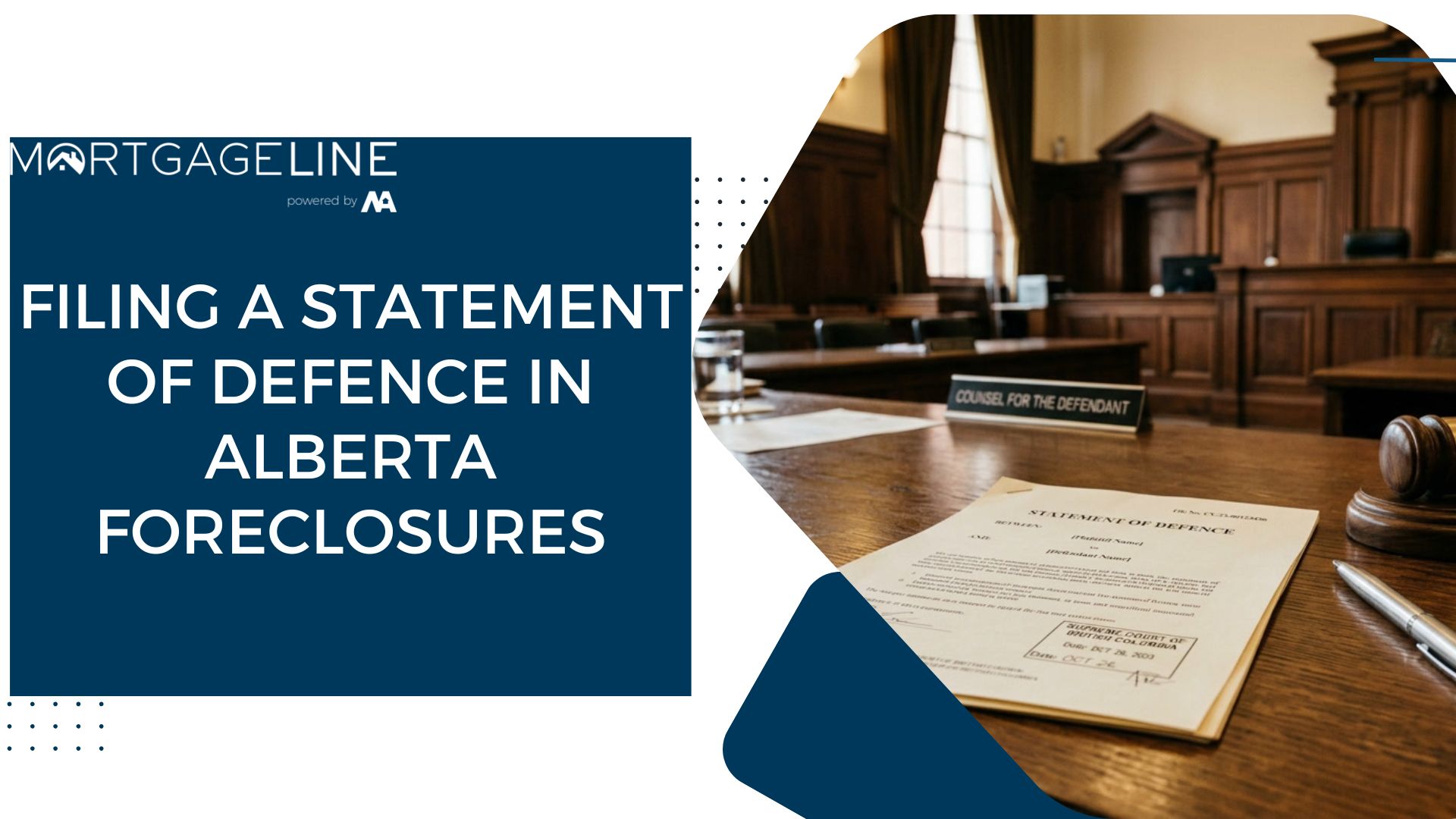
Filing a Statement of Defence in Alberta requires formally responding to a lender’s Statement of Claim within 20 days if you reside within the province. This legally binding document disputes the plaintiff’s allegations—such as incorrect arrears calculations, invalid mortgage terms, or procedural errors—thereby preventing the court from issuing an immediate default judgment against the homeowner. By submitting this document to the Alberta Court of King’s Bench, a homeowner forces the lender to prove their claims in court, buying crucial time to negotiate or seek alternative financing.
Key Takeaways
- Strict Deadlines: Homeowners in Alberta have exactly 20 days to file a defence after being served with a Statement of Claim.
- Valid Grounds Required: A defence must be based on factual or legal disputes, such as mathematical errors in the lender’s payout statement, not simply an inability to pay.
- Court Jurisdiction: All foreclosure litigation, including the filing of your defence, takes place through the Alberta Court of King’s Bench.
- Risk of Penalties: Filing a frivolous or baseless defence can result in the Master in Chambers awarding substantial legal costs to the lender, adding to your debt.
- Alternative Options: If you have no legal dispute, filing a Demand for Notice is often a safer route to stay informed of the proceedings without incurring litigation penalties.
Understanding the 2026 Alberta Foreclosure Landscape
Navigating property litigation requires a clear understanding of provincial court procedures. According to recent economic insights from the Bank of Canada, fluctuating interest rates have triggered a 12% rise in early-stage mortgage arrears across Western Canada. When homeowners fall behind, lenders initiate a formal legal recovery process by issuing a Statement of Claim. This document outlines the debt owed and the lender’s intent to repossess the property.
Once served, the clock begins ticking. Understanding the exact nature of responding to a foreclosure statement of claim is the most critical juncture in the entire legal proceeding. You are presented with three primary options: do nothing (which leads to default judgment), file a Demand for Notice, or draft a Statement of Defence. Making the correct choice depends entirely on the facts surrounding your specific mortgage agreement.
What Constitutes a Valid Statement of Defence?
A Statement of Defence is a comprehensive legal pleading that contradicts the assertions made by the lender. It is not a platform to ask for sympathy or extra time; rather, it is a strict legal mechanism to challenge the legitimacy of the lawsuit.
As Michael Ross, Senior Foreclosure Counsel at Alberta Legal Advocates, explains: “A Statement of Defence is not a tool for delaying the inevitable. It must be rooted in substantive factual or legal disputes, such as mathematical errors in the lender’s payout statement or a breach of contract by the financial institution itself.”
Valid grounds for filing might include:
- Accounting Errors: The lender has miscalculated the principal, interest, or accumulated penalties.
- Payment Disputes: You have proof of payments that the lender failed to credit to your account.
- Contractual Breaches: The lender violated the terms of the mortgage agreement or the Law of Property Act.
- Statute of Limitations: The lender failed to act within the legally prescribed time limits to recover the debt.

Statement of Defence vs. Demand for Notice
Many homeowners confuse these two vital legal documents. While both are filed at the courthouse, their purposes and consequences are vastly different. If you have no legitimate legal dispute regarding the debt, filing a Demand for Notice is often recommended by legal professionals.
| Feature | Statement of Defence | Demand for Notice |
|---|---|---|
| Primary Purpose | To legally dispute the lender’s claims and force a trial or summary judgment hearing. | To admit the debt but request copies of all future court applications and proceedings. |
| When to Use | When there are factual errors, invalid terms, or miscalculated balances. | When you agree you owe the money but want to monitor the process and redemption period. |
| Court Risk | High. Frivolous filings can result in heavy cost awards against the homeowner. | Low. It is a standard procedural right with minimal risk of cost penalties. |
| Filing Deadline | 20 Days (in Alberta) | Typically 10-20 Days, but can be filed later before final orders are granted. |
Step-by-Step Guide to Filing in 2026
If you and your legal counsel determine that disputing the claim is the correct path, you must adhere strictly to the rules set by the Alberta Courts. Here is the step-by-step process:
- Review the Statement of Claim: Carefully read all allegations. Identify exactly which paragraphs you admit, which you deny, and which you have no knowledge of.
- Draft the Document: Use the standardized Form 10 (Statement of Defence) mandated by the Alberta Rules of Court. Ensure all legal arguments are formatted correctly. It is highly advised to seek obtaining independent legal advice during this drafting phase.
- File at the Court of King’s Bench: Take the original and several copies to the courthouse where the action was commenced. In 2026, standard filing fees typically range between $250 and $300, depending on specific court disbursements.
- Serve the Plaintiff: Once the court clerk stamps your documents, you must serve a copy to the lender’s lawyer at their stated address for service.
- Prepare for the Application for Summary Judgment: Lenders rarely back down. They will likely file an application to strike your defence, moving the matter before a Master in Chambers.

Crucial Deadlines and Legal Timelines
Time is of the essence in real estate litigation. The Rules of Court establish rigid timelines based on geographical location. “Missing the 20-day window is the most common and fatal mistake homeowners make,” notes Elena Rostova, a financial restructuring expert based in Western Canada. “Once default judgment is entered, unwinding the legal damage is exponentially more difficult and expensive.”
- Within Alberta: You have exactly 20 days from the date you were served to file.
- Outside Alberta (but within Canada): The deadline extends to 1 month.
- Outside Canada: You are granted 2 months to respond.
If you fail to act within these parameters, the lender can proceed to the next stage unchecked, rapidly pushing toward the timeline for the final order of foreclosure.
Financial Repercussions of Baseless Defences
It is a common misconception that filing any document will buy months of free time. The legal system actively discourages delay tactics. If a Master in Chambers determines that your submission has no merit, they will strike it out.
David Thorne, a senior financial analyst, warns: “Homeowners who submit templated, sovereign-citizen style defenses or legally baseless arguments usually face severe financial penalties. The court frequently awards the lender ‘costs on a solicitor-client scale’.”
Statistical data from provincial legal associations, including insights from the Canadian Bar Association, indicate that approximately 85% of baseless defenses are struck down on the first application. When this happens, legal fees ranging from $3,000 to $5,000 are immediately added to the homeowner’s outstanding mortgage balance, further eroding any remaining property equity.
Strategic Alternatives to Litigation
If you lack a valid legal dispute, fighting in court is counterproductive. Instead, homeowners should focus on actionable financial solutions during the redemption period—a phase typically lasting 6 months where you still hold the right to pay off the arrears or the entire mortgage.
1. Refinancing or Alternative Equity Solutions
If traditional banks have turned you away, you might explore alternative equity financing. Leveraging the remaining equity in your property can provide the necessary capital to pay out the demanding lender, effectively halting legal proceedings in their tracks. This strategy requires sufficient equity and an ability to manage the new debt terms.
2. Negotiating a Forbearance Agreement
Sometimes, direct negotiation is the best path. If your financial hardship is temporary (e.g., a resolved medical issue or a new job), lenders may agree to a forbearance. This agreement pauses litigation in exchange for a strict repayment plan. Whether you are managing bank foreclosure actions from a major institution or a private lender, communication is crucial.
3. Selling the Property
If retaining the home is mathematically impossible, listing the property for sale during the redemption period allows you to control the transaction. Selling privately almost always yields a higher return than a court-ordered sale, preserving your remaining equity and protecting your credit score from the devastating impact of a finalized judgment.

Frequently Asked Questions
Can I draft a Statement of Defence myself?
Yes, you can act as a self-represented litigant. However, property law is highly complex, and formatting errors or improper legal arguments can result in your documents being rejected or struck down by the courts. Consulting a lawyer is strongly recommended.
How much time does filing a defence actually buy?
If your defense is valid, it forces the matter to trial, which can take several months or more to schedule. If it is invalid, the lender will likely apply for summary judgment within 30 to 60 days, quickly nullifying your filing.
Will filing a defence stop the redemption period?
No, the redemption period is a separate statutory right that begins after a Master in Chambers grants a Redemption Order. Disputing the initial claim simply delays the granting of that specific order.
What happens if I miss the 20-day deadline?
If you miss the deadline, the lender can note you in default. This means they can proceed with their applications without notifying you of the specific hearing dates, vastly accelerating the loss of your property.
Can the lender’s lawyer refuse to accept my filed documents?
If your documents are properly stamped by the court clerk and served correctly according to the Rules of Court, the opposing counsel must accept them. However, they will aggressively scrutinize the contents for legal weaknesses.
Is a Demand for Notice cheaper than filing a defence?
Yes, generally speaking. Because a Demand for Notice simply requests updates without disputing the debt, it does not trigger a costly legal battle. It is an affordable way to stay informed without risking heavy cost penalties.
Conclusion
Filing a Statement of Defence in Alberta Foreclosures is a powerful legal maneuver, but it must be executed with precision and legitimate justification. Understanding the difference between a valid legal dispute and a simple inability to pay is the cornerstone of a successful strategy in 2026. Misusing the court system will only accelerate your financial losses, while the correct legal and financial interventions can save your home.
If you are facing legal action from a lender and are unsure of your next steps, time is your most valuable asset. Contact our team today to explore your equity financing options and discover viable pathways to protect your home and financial future.