A consumer proposal is a legally binding debt settlement negotiated through a Licensed Insolvency Trustee that allows Calgary homeowners to reduce unsecured debt by up to 70% while retaining ownership of their property. In contrast, foreclosure is a court-administered legal process where a lender permanently seizes and sells a property to recover unpaid mortgage debts, resulting in the total loss of the home and severe, long-term credit damage. For homeowners facing insurmountable financial pressure, understanding the distinct legal and financial trajectories of these two paths is the critical first step toward economic recovery.
Key Takeaways
- Asset Retention: Consumer proposals allow you to keep your home and vehicle as long as you maintain your secured loan payments, whereas foreclosure results in permanent property loss.
- Debt Reduction: A successful proposal can eliminate 40% to 70% of unsecured debts (like credit cards and personal loans), freeing up cash flow to save your mortgage.
- Legal Protection: Filing a proposal enacts an immediate “Stay of Proceedings,” legally halting all creditor harassment, wage garnishments, and collection lawsuits.
- Credit Impact: A consumer proposal results in an R3 credit rating lasting three years after completion, while a foreclosure triggers a devastating R9 rating that scars your credit for up to seven years.
- Alberta-Specific Laws: Foreclosure in Alberta is a judicial process requiring court oversight, meaning homeowners have specific legal windows, such as the redemption period, to halt the seizure.
The 2026 Financial Landscape for Calgary Homeowners
Calgary’s economic environment in 2026 presents a complex web of challenges for property owners. With the Bank of Canada maintaining stringent monetary policies to combat lingering inflation, household budgets are stretched to their absolute limits. Recent data from Statistics Canada indicates that 23% of Alberta households are currently spending more than 45% of their gross income on housing costs alone. This financial strain frequently forces families into impossible choices between paying essential utility bills, servicing high-interest credit cards, or making their monthly mortgage payments.
When homeowners rely heavily on credit to bridge the gap between income and living expenses, the compounding interest frequency of unsecured debt can quickly spiral out of control. According to the Financial Consumer Agency of Canada, the average non-mortgage debt for Calgarians has surpassed $28,000 in 2026. As these unsecured debts mount, mortgage arrears inevitably follow. In fact, local mortgage default rates have risen by 18% year-over-year, triggering a wave of aggressive lender actions. Understanding how to navigate this precarious landscape requires a deep dive into the formal debt relief mechanisms available under Canadian law.
What is a Consumer Proposal?
A consumer proposal is a formal, legally binding process administered under the federal Bankruptcy and Insolvency Act (BIA). It is designed specifically for individuals who owe less than $250,000 (excluding their primary residence mortgage) and possess a steady income but cannot manage their current debt load. The process must be facilitated by a Licensed Insolvency Trustee (LIT), who acts as an impartial officer of the court to negotiate a settlement between the debtor and their creditors.
Instead of paying back 100% of what is owed with exorbitant interest, the homeowner proposes to pay a fraction of the total debt over a maximum period of five years. Once accepted by the majority of creditors, the agreement becomes legally binding on all unsecured creditors. Interest charges are immediately frozen, and the debtor makes a single, manageable monthly payment to the LIT. Most importantly for Calgary homeowners, a consumer proposal deals exclusively with unsecured debts. As long as the homeowner continues to make their regular mortgage payments, the lender cannot foreclose on the property simply because a proposal was filed.

The Alberta Foreclosure Process Explained
Unlike provinces that utilize a rapid “Power of Sale” process, Alberta operates under a strict judicial foreclosure system. This means that lenders cannot simply evict a homeowner and sell the property; they must petition the Court of King’s Bench to obtain legal authorization. While this judicial oversight extends the timeline, it also provides homeowners with critical windows of opportunity to intervene.
The foreclosure process typically begins after three to six months of missed mortgage payments. The lender’s legal counsel will draft and serve a formal legal document, officially initiating the lawsuit. Understanding the difference between receiving a Statement of Claim versus a simple warning letter is vital for your legal defense. Once served, the homeowner has a limited time to file a Statement of Defence or Demand for Notice.
If the arrears are not cleared, the court will typically grant a Redemption Order. This order establishes a specific timeframe—usually six months, though it can be shortened to one day if the property has zero equity—during which the homeowner can pay the arrears and legal costs to reinstate the mortgage. Accurately calculating your redemption period is essential, as failing to redeem the mortgage results in the court issuing an Order for Sale, allowing the lender to list the property on the open market. If the property sells for less than the outstanding mortgage balance, the homeowner may still face the severe risk of a deficiency judgment, leaving them without a home but still burdened with debt.
Consumer Proposal vs. Foreclosure: A Direct Comparison
To make an informed decision, homeowners must evaluate how these two scenarios contrast across several critical financial metrics. The table below outlines the fundamental differences between restructuring debt through a proposal versus losing property to a lender.
| Feature | Consumer Proposal | Foreclosure (Alberta) |
|---|---|---|
| Primary Objective | Restructure and reduce unsecured debt to regain financial stability. | Lender recovers capital by seizing and liquidating the collateral property. |
| Asset Retention | Homeowner keeps the property (provided mortgage payments are maintained). | Total loss of property ownership and accumulated equity. |
| Credit Bureau Impact | R3 rating (remains for 3 years after the proposal is fully paid off). | R9 rating (remains for 6 to 7 years from the date of default). |
| Legal Control | Debtor initiates the process and proposes the repayment terms. | Lender dictates the process through court orders and judicial timelines. |
| Financial Outcome | Eliminates 40-70% of unsecured debt with zero added interest. | Homeowner may still owe money if the sale doesn’t cover the mortgage balance. |
How a Consumer Proposal Can Stop Foreclosure in Calgary
One of the most powerful legal mechanisms within the Bankruptcy and Insolvency Act is the “Stay of Proceedings.” When a Licensed Insolvency Trustee files your consumer proposal with the Office of the Superintendent of Bankruptcy, this stay goes into effect immediately. It acts as a legal shield, forcing all unsecured creditors to cease collection calls, halt wage garnishments, and stop any pending lawsuits.
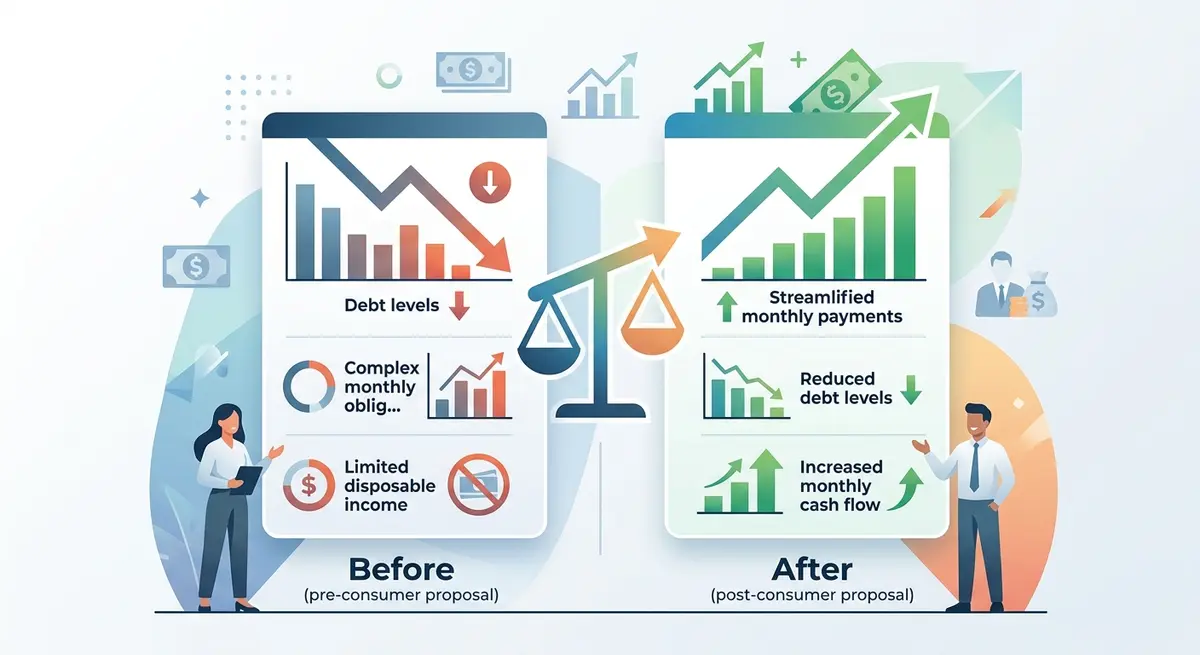
While a consumer proposal does not directly include your secured mortgage debt, it indirectly saves homes by drastically improving cash flow. Consider a Calgary family earning $6,000 net per month, paying $3,000 toward their mortgage and $2,500 toward minimum payments on $60,000 of credit card debt. This leaves a mere $500 for groceries, utilities, and property taxes—a mathematically unsustainable situation that inevitably leads to missed mortgage payments.
By filing a proposal, that $60,000 in unsecured debt might be reduced to $24,000, payable over 60 months at $400 per month with zero interest. The family’s monthly debt servicing drops from $2,500 to $400, instantly freeing up $2,100. This newly available capital allows them to comfortably afford their mortgage, pay property taxes, and avoid foreclosure entirely. As financial analyst Marcus Thorne of the Alberta Economic Institute notes: “Strategic insolvency is rarely about avoiding responsibility; it is about restructuring obligations to protect the foundational asset of the family home.”
Step-by-Step Guide: Filing a Consumer Proposal to Save Your Home
Taking proactive steps before a lender initiates legal action preserves your options. If you are struggling to maintain your mortgage due to overwhelming unsecured debt, follow this structured process:
- Assess Your Total Financial Picture: Begin by organizing your financial documentation. Gather all recent mortgage statements, property tax assessments, credit card bills, vehicle loan details, and recent pay stubs. You must know exactly what you owe and to whom.
- Consult a Licensed Insolvency Trustee (LIT): Schedule a free, confidential consultation with an LIT in Calgary. They will review your assets, income, and liabilities to determine if a proposal is mathematically viable and legally appropriate.
- Draft the Proposal Terms: Work with the LIT to determine a fair repayment amount. This figure must be more than what creditors would receive in a bankruptcy scenario, but low enough that you can comfortably afford it alongside your mortgage.
- File the Documents: The LIT files the proposal with the federal government, triggering the immediate Stay of Proceedings. All collection harassment stops instantly.
- Creditor Voting Period: Creditors have 45 days to review and vote on the proposal. In Alberta, over 85% of consumer proposals are accepted by creditors because it guarantees them a better return than bankruptcy.
- Complete the Payments: Once accepted, you make your agreed-upon monthly payments to the LIT. You must also attend two mandatory financial counseling sessions to build better money management habits.
Credit Score Impacts and Long-Term Financial Recovery
A primary concern for Calgary homeowners is how debt relief impacts their ability to borrow in the future. Both foreclosure and consumer proposals damage your credit, but the severity and recovery timelines differ drastically.
When a property is foreclosed upon, Equifax Canada and TransUnion register an R9 rating—the worst possible credit score designation. This catastrophic mark remains on your credit file for six to seven years from the date of first default. During this decade-long shadow, securing any form of traditional financing is nearly impossible, and if approved by subprime lenders, interest rates will be punitively high.
Conversely, a consumer proposal results in an R3 rating. While this signifies that you are paying back debt on modified terms, it is significantly less damaging than an R9. The R3 rating remains on your credit report for three years after you make your final proposal payment. Because proposals free up cash flow immediately, proactive homeowners can begin rebuilding their credit right away by obtaining a secured credit card, keeping utilization below 30%, and ensuring all ongoing bills (especially the mortgage) are paid flawlessly.
Alternative Solutions: Leveraging Home Equity Before Default
Before committing to a formal insolvency process, homeowners with substantial property equity should explore alternative financing. If your credit score is still intact but cash flow is tight, restructuring debt through your property might be the optimal solution.
One highly effective strategy is exploring cash-out refinancing options. By breaking your current mortgage and securing a new one at a higher principal amount, you can use the extracted equity to pay off all high-interest credit cards and personal loans. This consolidates multiple expensive payments into one lower-interest mortgage payment.
If breaking your first mortgage triggers massive prepayment penalties, a second mortgage might be preferable. Private lenders in Calgary focus heavily on the equity in the home rather than strict income verification, making this a viable path for self-employed individuals who struggle with traditional bank approvals. However, this strategy requires careful calculation; shifting unsecured debt into secured debt puts your home directly at risk if you default on the new loan.

Common Mistakes Calgary Homeowners Make When Facing Default
Financial distress often induces paralysis, leading homeowners to make critical errors that accelerate property loss. Avoiding these common pitfalls is essential for preserving your wealth.
The most frequent mistake is ignoring communication from lenders. Tossing warning letters into a drawer does not stop the legal clock; it simply ensures you miss your window to file a Statement of Defence. Lenders interpret silence as surrender, expediting their application for an Order for Sale.
Another devastating error is prematurely borrowing against retirement savings to pay unsecured creditors. RRSPs are legally protected from creditors in Canada (except for contributions made in the 12 months prior to insolvency). Draining a protected asset to pay off credit cards, only to lose the house to foreclosure six months later anyway, leaves families entirely destitute. Always consult a financial professional before liquidating protected retirement funds to service unmanageable debt.
Frequently Asked Questions (FAQ)
Can a consumer proposal include my mortgage?
No, a consumer proposal only includes unsecured debts like credit cards, personal loans, and tax debts. Secured debts, such as your mortgage and auto loans, remain separate, and you must continue making regular payments to keep those assets.
Will I lose my home if I file a consumer proposal in Calgary?
Filing a consumer proposal does not cause you to lose your home. In fact, by drastically reducing your unsecured debt payments, a proposal often frees up the necessary cash flow to help you maintain your mortgage payments and avoid foreclosure.
How long does a foreclosure stay on my credit report in Alberta?
A foreclosure results in an R9 credit rating, which typically remains on your Equifax and TransUnion credit reports for six to seven years from the date of your first missed payment, severely limiting your future borrowing capacity.
Can my lender refuse my consumer proposal?
Your mortgage lender does not vote on your consumer proposal because it only affects unsecured creditors. Unsecured creditors do vote, but if creditors representing the majority of your debt accept the terms, it becomes legally binding on all of them.
What happens if my house sells for less than I owe in a foreclosure?
In Alberta, if your mortgage is CMHC-insured or if it is not a traditional conventional mortgage, the lender may pursue a deficiency judgment against you. This means you could lose your home and still be legally required to pay the remaining shortfall.
Can I renew my mortgage while in a consumer proposal?
Yes, most major banks will allow you to renew your existing mortgage while in an active consumer proposal, provided you have a flawless payment history with them. However, switching to a new lender during this time is highly unlikely due to the R3 credit rating.
Conclusion
Navigating the turbulent waters of financial distress requires clear-headed strategy and expert guidance. For Calgary homeowners in 2026, the choice between a consumer proposal and foreclosure is ultimately a choice between proactive restructuring and reactive asset loss. While foreclosure strips you of your property, equity, and long-term credit health, a consumer proposal offers a dignified, legally protected pathway to eliminate unmanageable debt while keeping your family in their home. Time is your most valuable asset when dealing with aggressive creditors and judicial timelines. If you are falling behind on payments and fear for the safety of your home, immediate action is required. Contact our team today to explore your options, protect your equity, and build a sustainable financial future.