When Calgary homeowners fall behind on their condominium contributions or homeowners association (HOA) dues, the property is immediately at risk of a forced sale. Under Alberta law, specifically the Condominium Property Act, a condo board or HOA has the legal authority to register a caveat against the property’s title for unpaid common expenses. This caveat acts as an encumbrance with immense legal weight, effectively granting the association the same powers as a traditional lender to pursue the forced sale of the home to recover the debt. To halt this severe legal action, property owners must act swiftly to negotiate a formal repayment plan, dispute invalid charges through mediation, or secure secondary financing to clear the arrears before the board advances from a simple demand letter to a formal Statement of Claim.
Key Takeaways
- Legal Authority: Condo boards in Alberta possess sweeping powers to force a property sale for unpaid dues, often acting faster than primary mortgage lenders.
- The Caveat Threat: A registered caveat severely restricts a homeowner’s ability to sell or refinance through traditional banking channels.
- Compounding Costs: Unpaid fees rapidly balloon due to late penalties, administrative fees, and the board’s legal costs, which are legally charged back to the homeowner.
- Alternative Financing: Equity-based lending is often the most viable mechanism to clear caveats when traditional banks decline restructuring.
- Immediate Action Required: Delaying communication with the board accelerates the legal timeline, drastically reducing your available resolution windows.
The Legal Reality of Association Dues in Alberta
Many property owners mistakenly assume that missing a monthly condo fee or annual HOA levy is a minor infraction, similar to paying a utility bill late. However, in 2026, the legal framework governing shared residential communities in Alberta remains fiercely protective of condominium corporations. The financial health of a condo building relies entirely on the collective contributions of its owners. When one owner defaults, the burden shifts to the rest, which is why the provincial government grants boards aggressive collection powers.
According to research from the Canadian Real Estate Association, the average monthly condo fee in major Alberta metropolitan areas has steadily risen, reaching an average of $545 in 2026 due to increased insurance premiums and inflation. As a result, even a few months of missed payments can quickly escalate into a substantial debt. Once an account falls into arrears, the board’s property management company will typically issue a demand for payment. If ignored, the board’s legal counsel will file a caveat against the property title.
As Marcus Thorne, a Senior Condominium Manager in Alberta, explains: “A condo corporation in Alberta operates under a strict fiduciary duty to collect all common expenses. When we file a caveat, it is not merely a warning—it is the first definitive step toward forcing the sale of the unit to recover what the community is owed.”
The Escalation Timeline: From Missed Payment to Court Order
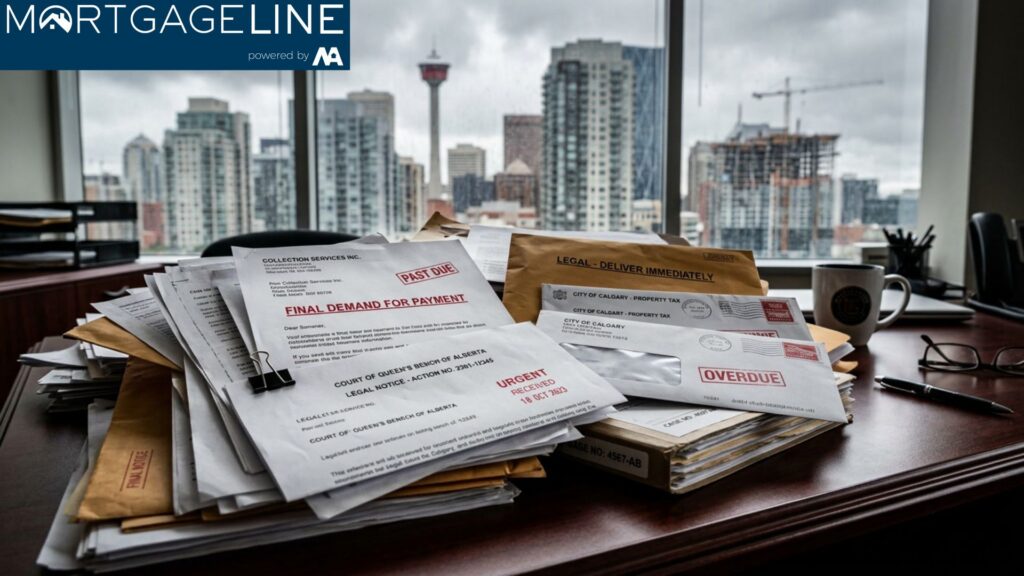
Understanding the exact legal timeline is crucial for homeowners trying to protect their equity. Unlike traditional mortgage lenders, who may wait three to six months before taking severe legal action, condo boards often operate on a much more compressed schedule.
- Days 1 to 30 (The Arrears Phase): The payment is missed. The property management company typically sends a friendly reminder, followed by a formal late notice. Administrative fees and interest are applied to the account balance.
- Days 31 to 60 (The Demand Letter): The account is turned over to the board’s collection lawyer. A formal demand letter is drafted and sent to the owner via registered mail. This letter provides a strict deadline (often 10 to 14 days) to pay the balance in full, plus the lawyer’s fees.
- Days 61 to 90 (Caveat Registration): If the demand is unmet, the lawyer registers a caveat against the property title at the Alberta Land Titles Office. At this stage, traditional refinancing becomes nearly impossible without discharging the caveat first.
- Day 90+ (Statement of Claim): The board authorizes legal action. A Statement of Claim is filed in the Court of King’s Bench. This is the formal initiation of the property seizure process. Homeowners must understand the intricacies of responding to a foreclosure Statement of Claim to avoid a default judgment.
- Order Nisi and Final Sale: If no defense or payment plan is presented, the court will grant an Order Nisi, setting a redemption period. If the debt remains unpaid after this period, the property is listed for sale. Familiarizing yourself with the order of foreclosure timeline can help you gauge exactly how much time remains to save your home.
Lender Initiated vs. HOA Initiated Legal Action
While the end result—losing your home—is the same, the mechanics between a bank and an association pursuing your property differ significantly. In many cases, an association’s caveat will trigger a cross-default clause in your primary mortgage. This means your bank could also begin legal proceedings simply because you owe the HOA money.
| Feature | Primary Mortgage Lender | Condo Board / HOA |
|---|---|---|
| Trigger Amount | Typically 3+ months of missed high-value payments. | Often initiated for debts as low as $1,000 to $2,500. |
| Speed of Action | Moderate. Lenders prefer forbearance and restructuring. | Aggressive. Boards must secure debts swiftly to protect the corporation. |
| Legal Costs | Added to the mortgage balance at the end of the process. | Added immediately to the ledger, often doubling the initial debt rapidly. |
| Priority on Title | First position (usually). | Second position, but statutory rights allow them to force a sale regardless. |
Strategic Financial Solutions to Clear Arrears
When staring down a registered caveat, the primary objective is raising the necessary capital to clear the arrears, including all accumulated legal fees. Because traditional banks typically freeze lines of credit and refuse to refinance properties with active encumbrances, homeowners must look toward alternative financial vehicles.
Leveraging Home Equity
For individuals who have built up equity in their property, accessing that capital is the most straightforward resolution. Equity-based lenders focus on the total value of the home rather than strict credit scores or recent financial hiccups. By utilizing specialized financing, homeowners can pay off the aggressive board and its lawyers in one lump sum.
This strategy is highly versatile. Whether a homeowner needs to secure a second mortgage on a bare land condominium or navigate the complexities of a traditional high-rise, equity loans can be customized to the property type. It is essential to thoroughly weigh the pros and cons of second mortgages, as these alternative loans carry higher interest rates but provide the critical speed required to halt legal proceedings.
A common question during crises is how long second mortgage approval takes. In pressing legal situations, private equity lenders can often approve and fund a file within 5 to 10 business days, effectively beating the court’s deadlines.
Managing Large Special Assessments
Sometimes, arrears are not caused by standard monthly dues but by massive, unexpected levies. When a building requires a new roof, updated exterior siding, or major foundation repairs, boards will issue a special assessment. These can range from $5,000 to over $50,000 per unit. If an owner cannot pay their share by the deadline, the exact same collection mechanics apply. Homeowners facing this scenario should immediately look into options for funding condo special assessments before the board’s lawyers step in.
Negotiating with the Condo Board
If alternative financing is not immediately available, proactive communication is your strongest defense. While property managers act as the enforcers, the actual condo board consists of your fellow neighbors. Presenting a logical, documented forbearance plan directly to the board can sometimes yield positive results.
Steps for a successful negotiation:
- Acknowledge the Debt: Never ignore the letters. Contact the property manager in writing to acknowledge receipt of the notices.
- Provide Context, Not Excuses: Briefly explain the temporary financial hardship (e.g., medical emergency, temporary job loss). According to data from Service Alberta, boards are increasingly open to mediation if the owner communicates transparently.
- Propose a Realistic Payment Plan: Offer to pay your ongoing monthly fee plus a specific extra amount each month to aggressively pay down the arrears. Ensure the proposed timeline does not exceed six to twelve months.
- Request a Fee Freeze: Ask the board to temporarily pause the addition of further administrative late penalties while you adhere to the payment plan. They will likely refuse to waive legal fees already incurred, but halting future penalties can save thousands.
Sarah Jenkins, a Real Estate Legal Analyst, advises: “Many property owners mistakenly believe their bank holds the ultimate power over their property. In reality, a well-organized condo board can dismantle a homeowner’s equity in a matter of months if the owner buries their head in the sand. Always negotiate in writing and never assume a verbal agreement is legally binding.”

Protecting Yourself Against Predatory Practices
The stress of an impending property loss makes individuals highly vulnerable to exploitation. As the legal deadlines approach, desperate property owners might be targeted by unregulated lenders offering “guaranteed rescue” loans with exorbitant upfront fees or complex legal traps designed to strip the home’s equity entirely.
To safeguard your financial future, it is critical to work only with licensed mortgage brokerages and vetted legal professionals. Take the time to educate yourself on how to identify unregulated lending scams. Legitimate equity lenders will clearly disclose all fees, interest rates, and term lengths on formal commitment letters, and they will require you to receive Independent Legal Advice (ILA) before signing.
FAQs
Can a condo board really force the sale of my home in Alberta?
Yes. Under the Condominium Property Act of Alberta, a condo corporation has the legal authority to register a caveat for unpaid contributions and pursue a forced sale to recover those funds, similar to a bank enforcing a mortgage.
How much does it cost to clear a caveat placed by a homeowners association?
To discharge a caveat, you must pay the original arrears, any late penalties, and all legal fees incurred by the board to register the encumbrance. Legal fees frequently double the total amount owed, meaning a $1,500 debt can quickly escalate past $3,000.
Will my primary mortgage lender find out about my unpaid HOA fees?
Yes. Once a caveat is registered on your property title, your primary mortgage lender will be notified. Most standard mortgage contracts include a clause stating that falling into arrears with your property taxes or condo fees constitutes a default on your mortgage itself.
Can I dispute the HOA fees if I believe they were charged incorrectly?
You can dispute charges, but withholding payment is a dangerous strategy. Legal experts strongly recommend paying the disputed fees “under protest” to avoid caveat registration, and then pursuing resolution through the board, mediation, or the court system afterward.
What happens if I ignore the Statement of Claim from the condo board’s lawyer?
If you ignore a formal Statement of Claim, the court will assume you have no defense. The judge will grant a default judgment and issue an Order Nisi, which sets a final countdown (often just a few months) before the property is forcibly listed for sale.
Conclusion
Facing the potential loss of your property due to unpaid condominium contributions or HOA fees in Calgary is an incredibly stressful experience, but it is a highly solvable problem if addressed promptly. The 2026 legal landscape heavily favors the association’s right to collect, meaning that passive avoidance will only result in rapidly compounding legal costs and eventual property seizure. By understanding the legal timeline, opening negotiations with the board, and aggressively exploring alternative equity-based financing to clear the caveats, you can secure your home and protect your financial future. If you are currently dealing with a demand letter, an active caveat, or a Statement of Claim, do not wait until the court makes a final ruling. Contact our team today to explore your immediate financing options and halt the legal process.