Facing a mortgage default can be an incredibly stressful experience, but homeowners in Cochrane, Alberta have several legal and financial pathways to halt the process before losing their property. By understanding the provincial legal timeline, acting decisively during the redemption period, and leveraging available home equity, you can successfully protect your home and stabilize your financial future. The key to resolving a default lies in early intervention, open communication with your lender, and securing the right specialized financing or legal representation.
Key Takeaways
- Act Immediately: The foreclosure process in Alberta formally begins with a Demand Letter, giving you a short window to resolve arrears before legal fees accumulate.
- Know Your Timeline: The standard redemption period in Alberta is typically six months, providing a crucial window to refinance, sell, or reinstate the mortgage.
- Leverage Home Equity: If you have 20% or more equity in your Cochrane home, private second mortgages or refinancing can provide the capital needed to stop legal proceedings.
- Understand Court Options: You must respond to a Statement of Claim to ensure your voice is heard in the Court of King’s Bench.
- Avoid Common Scams: Be wary of unregulated lenders offering “quick fixes” without proper legal documentation and independent advice.
The Alberta Foreclosure Legal Framework in 2026
In Alberta, foreclosure is a judicial process governed by the Court of King’s Bench. Unlike some jurisdictions where lenders can seize property through a power of sale without court supervision, Alberta law requires lenders to obtain court approval at multiple stages. According to the Government of Alberta, this judicial oversight is designed to protect the rights of both borrowers and lenders, ensuring that homeowners have a fair opportunity to remedy their defaults.
The process begins when a homeowner misses one or more mortgage payments. Under standard mortgage contracts, a lender can declare the loan in default after a single missed payment, though most financial institutions wait until the borrower is 60 to 90 days in arrears before initiating formal legal action. Once the file is transferred to the lender’s legal counsel, the costs rise rapidly, as all legal fees incurred by the lender are ultimately added to the homeowner’s outstanding debt.
According to data from the Bank of Canada, mortgage delinquency rates in Alberta have remained relatively low but stable at approximately 0.15% in early 2026. However, localized economic shifts and interest rate adjustments continue to put pressure on suburban communities like Cochrane, where residential property values have experienced rapid growth over the last decade.

The Critical First Step: Responding to a Statement of Claim
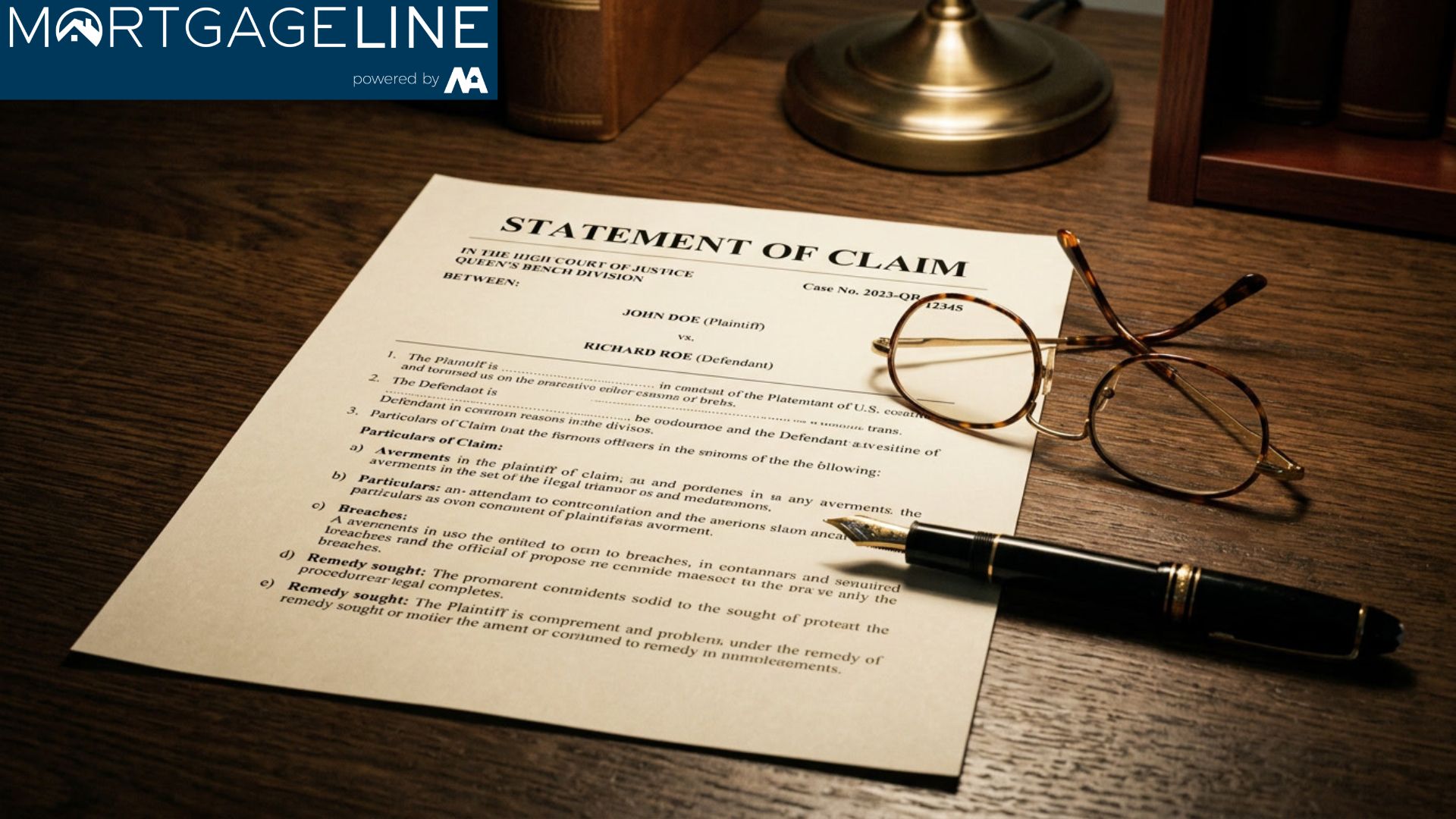
If you are unable to resolve your arrears during the initial default phase, the lender will file and serve a Statement of Claim for Foreclosure. This is a formal legal document that marks the official start of the lawsuit. Receiving this document can be intimidating, but ignoring it is the most critical mistake a homeowner can make. If you fail to respond, the lender can obtain a default judgment, allowing them to bypass the standard redemption period and accelerate the sale of your home.
To protect your rights, you must file a response within 20 days of being served (or 1 month if you are served outside of Alberta). Your response typically takes the form of a Demand for Notice or a Statement of Defence. Filing a Demand for Notice ensures that you are kept informed of every court date and application, giving you the opportunity to appear before the master or judge to request more time. For a comprehensive breakdown of this step, refer to our detailed guide on responding to a Statement of Claim.
As Sarah Jenkins, Senior Foreclosure Counsel at Alberta Legal Aid, explains: “The moment you receive a demand letter or a Statement of Claim, the clock is ticking. Homeowners in Cochrane often wait too long, hoping their financial situation will magically resolve, which only increases legal costs and reduces their available options.”
Financial Strategies to Stop the Foreclosure Process
When looking to halt legal action, homeowners generally have three primary financial pathways: reinstating the mortgage, refinancing the entire debt, or securing subordinate financing. The right choice depends heavily on your current income, credit score, and the amount of equity built up in your Cochrane property.
1. Reinstating the Mortgage
Reinstatement is the simplest way to stop a foreclosure. It involves paying the lender the entire amount of the arrears, plus any late fees and legal costs incurred up to that date. Once paid, the mortgage is restored to good standing, and the legal action is discontinued. While this is the most cost-effective solution, it requires immediate access to a lump sum of cash, which many homeowners in default do not have.
2. Refinancing with a New Lender
If your current lender is unwilling to work with you—which is common once legal proceedings have commenced—you may need to pay off the entire mortgage by refinancing with a new financial institution. If you are dealing with a major bank, you should understand their specific default policies. For instance, you can read about managing a BMO foreclosure or explore your options for stopping an RBC foreclosure to see how different institutional policies affect your refinancing timeline.
3. Securing a Second Mortgage
If you cannot qualify for a traditional refinance due to credit damage from missed payments, a second mortgage can be an excellent alternative. By borrowing against the equity in your home, you can secure a lump sum of cash to pay off your primary lender’s arrears and legal fees, effectively halting the foreclosure. This buys you valuable time to rebuild your credit or prepare the property for an orderly sale. Before proceeding, it is vital to weigh the pros and cons of second mortgages to ensure this strategy aligns with your long-term financial goals.
The Role of Home Equity in Cochrane Real Estate
Cochrane’s real estate market has shown remarkable resilience. According to the Calgary Real Estate Board (CREB), the benchmark price for a single-family home in Cochrane reached approximately $585,000 in early 2026. This sustained property value is excellent news for homeowners facing financial distress, as it means many local residents have accumulated significant home equity.
Equity is your greatest shield in a foreclosure action. If your home is worth $600,000 and your outstanding mortgage is $400,000, you have $200,000 in equity. Private lenders are highly active in the Cochrane area and are often willing to lend up to 75% or 80% of a property’s appraised value, regardless of your credit score or employment status. They focus primarily on the security of the real estate asset rather than traditional debt-to-income ratios.
“Private equity and second mortgages are highly effective tools for stopping an active foreclosure, provided the homeowner has at least twenty to twenty-five percent equity in their property,” explains Marcus Vance, Principal Broker at Western Capital Mortgages. “This equity allows private lenders to mitigate their risk while providing the homeowner with the necessary capital to stop court proceedings immediately.”
The Legal Timeline: From Default to Final Order
Understanding the judicial timeline is critical for planning your exit strategy. Foreclosure in Alberta is not instantaneous; it typically takes several months from the first missed payment to the loss of property ownership. Below is a breakdown of the standard timeline for Alberta homeowners in 2026.
- Demand Letter
Month 3Pay arrears or seek alternative financing options.
| Stage of Process | Typical Timeline | Homeowner’s Action Required |
|---|---|---|
| Missed Payments | Month 1 to 3 | Contact the lender immediately to arrange a payment plan. |
| Statement of Claim | Month 4 | File a Demand for Notice within 20 days of service. |
| Order Nisi (Redemption Period) | Month 5 to 11 | Standard 6-month period to pay off debt, refinance, or sell. |
| Order for Judicial Sale / Foreclosure | Month 11+ | Property is listed for sale by court or transferred to lender. |
The most critical phase of this timeline is the redemption period, which is established by the court during the Order Nisi application. The standard redemption period is six months, during which the lender cannot take further action to sell your home or evict you. However, if the lender can prove that the property has little to no equity, or is abandoned, the court may shorten this redemption period to a matter of weeks or even a single day. For a detailed analysis of this phase, consult our guide on the final order of foreclosure timeline.
Step-by-Step Guide to Stopping a Foreclosure in Cochrane
If you have been served with legal documents or are falling behind on your payments, follow these structured steps to regain control of your situation:
- Do Not Ignore the Mail: Open every letter from your lender or their lawyers. Keep a detailed log of all communications, dates, and names of representatives you speak with.
- Request an Up-to-Date Payout Statement: Ask your lender’s lawyer for a formal payout statement that details the exact breakdown of principal, interest arrears, late fees, and legal costs.
- Assess Your Home Equity: Obtain a professional appraisal or a comparative market analysis from a local Cochrane real estate agent to determine your home’s current market value.
- File Your Legal Response: Work with a lawyer to file a Demand for Notice or Statement of Defence in response to the Statement of Claim.
- Explore Private Financing: If traditional banks reject your applications, contact a specialized mortgage broker to explore private second mortgages or equity-based refinancing.
- Consider a Voluntary Sale: If keeping the home is financially unfeasible in the long term, listing the property for sale voluntarily allows you to preserve your equity and protect your credit rating far better than a court-ordered sale.
Common Pitfalls and the Importance of Independent Legal Advice
When facing foreclosure, emotions run high, making homeowners vulnerable to predatory lending practices and common legal mistakes. One of the most frequent errors is signing agreements with unregulated “foreclosure rescue” companies that promise to save your home but instead strip your equity through hidden fees or lease-back schemes. Always ensure that any lender you work with is fully licensed and transparent.
Furthermore, the Court of King’s Bench heavily scrutinizes transactions involving distressed properties. To protect yourself, you must obtain independent legal advice in Alberta before signing any new mortgage documents or property transfer agreements. A qualified real estate lawyer will ensure that your interests are protected and that you fully understand the terms of any rescue financing.
As Justice Elizabeth Carter, a retired Alberta Court of King’s Bench judge, notes: “Courts in Alberta prefer to see homeowners keep their properties. If you can present a realistic plan to catch up on arrears, judges are often willing to grant reasonable extensions during the redemption period. However, you must present credible, documented evidence of your refinancing or sale efforts.”
Frequently Asked Questions
Can I stop a foreclosure at the last minute in Alberta?
Yes, you can stop a foreclosure at any point before the court grants a Final Order of Foreclosure or confirms a judicial sale. However, stopping the process at the last minute requires paying off the entire outstanding debt and legal fees, which usually necessitates secured private financing.
How many missed payments trigger a foreclosure in Cochrane?
Technically, a lender can initiate legal action after a single missed payment. In practice, most institutional lenders in Alberta wait until a borrower is 90 days (three missed payments) in arrears before issuing a formal Demand Letter and starting court proceedings.
Will a foreclosure ruin my credit score permanently?
A foreclosure will severely impact your credit score and remain on your credit report for up to six years in Alberta. However, voluntarily selling the home or resolving the default through a second mortgage before a final court order is granted will significantly reduce the long-term damage to your credit profile.
Can the lender evict me immediately after serving a Statement of Claim?
No. The lender cannot evict you without a court order. You have the right to remain in your home throughout the redemption period, which is typically six months. Eviction can only occur after the court grants an Order for Possession or a Final Order of Foreclosure.
What is the difference between foreclosure and power of sale?
In a power of sale (common in provinces like Ontario), the lender sells the property without taking ownership of it, and court involvement is minimal. In Alberta’s foreclosure process, the entire transfer of ownership or judicial sale is managed and approved by the Court of King’s Bench.
Conclusion
Navigating a mortgage default in Cochrane, Alberta, requires quick action, clear financial planning, and an understanding of provincial real estate laws. Whether you choose to reinstate your mortgage, secure private equity financing, or pursue a voluntary sale, acting during the early stages of the legal process is the best way to protect your hard-earned home equity and avoid displacement. If you are facing legal action from your lender, do not wait until the redemption period expires. Contact us today to explore your financing options and find a solution tailored to your situation.
References
- Government of Alberta: https://www.alberta.ca
- Bank of Canada: https://www.bankofcanada.ca
- Calgary Real Estate Board (CREB): https://www.creb.com
- Statistics Canada: https://www.statcan.gc.ca
- Wikipedia – Foreclosure: https://www.wikipedia.org