When a mortgage with Equitable Bank falls into serious arrears in Alberta, the lender initiates a judicial foreclosure process governed by provincial law, not the bank’s internal policies alone. The Law of Property Act and the Alberta Rules of Court dictate every step, from the initial demand letter to the final order for possession. Homeowners retain significant rights throughout this process, including the right to redeem the mortgage, file a statement of defence, or negotiate a private sale before the court grants a final order. Understanding these rules is the single most effective way to prevent an unnecessary loss of home equity.
Key Takeaways
- Equitable Bank must follow Alberta’s judicial foreclosure process, which includes a Statement of Claim, demand letter, and court hearings.
- Homeowners have a legal redemption period to pay the full arrears and costs before a final order is granted.
- Filing a Statement of Defence or a Demand for Notice can significantly slow the process and buy time.
- Avoiding a deficiency judgment requires proactive communication and, ideally, a sale that covers the outstanding debt.
- Alternative financing, such as equity take-outs or private lending, can stop foreclosure at any stage before the final order.
- Alberta’s 2026 economic conditions — including interest rate adjustments and energy sector volatility — directly impact foreclosure timelines and lender flexibility.
- Seeking independent legal advice is not optional; it is the most critical step to protect your rights.
Understanding the Judicial Foreclosure Framework in Alberta
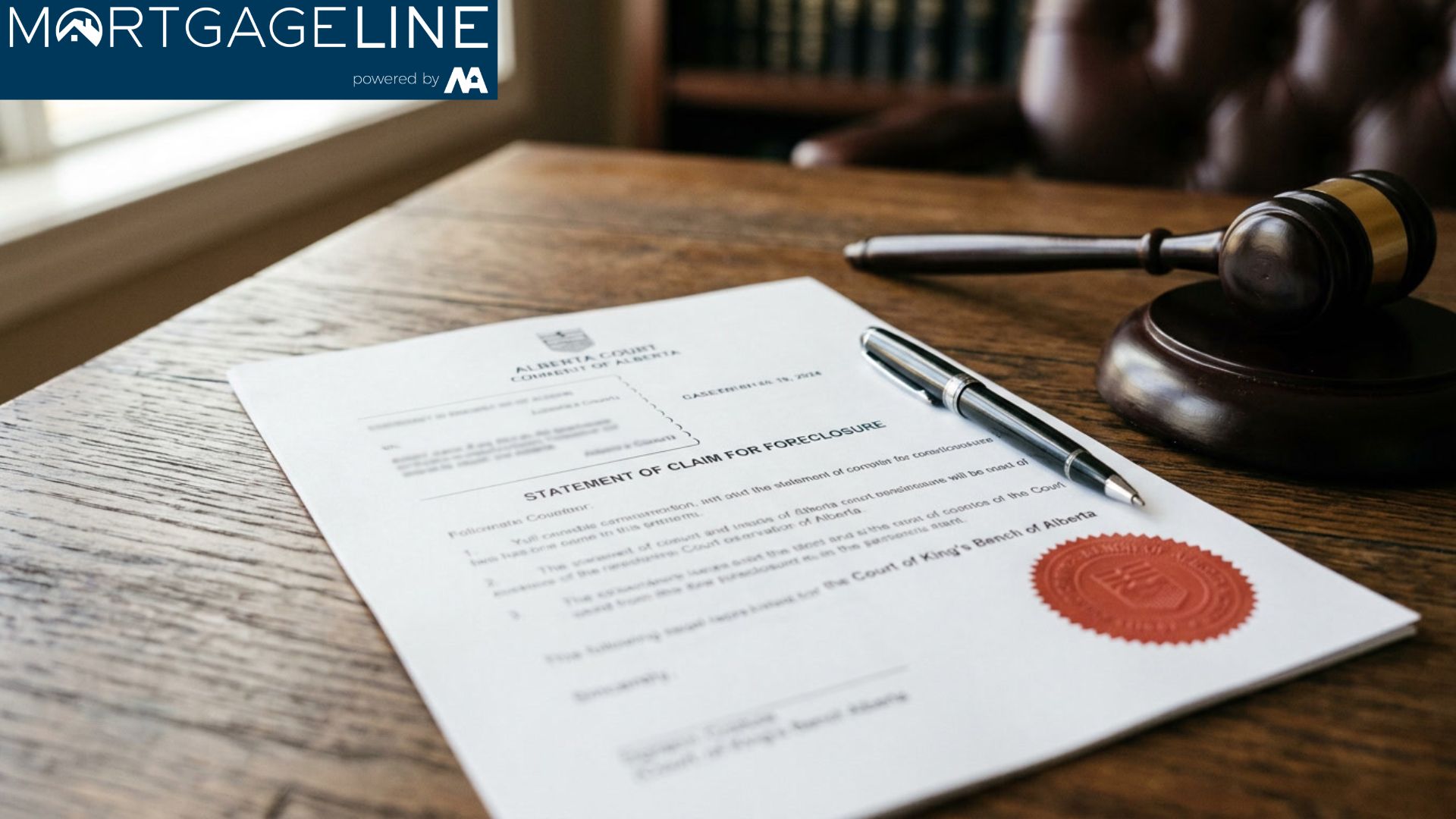
Unlike some provinces that permit power-of-sale or extrajudicial remedies, Alberta mandates a judicial foreclosure for all residential mortgages, including those held by Equitable Bank. This means the lender cannot simply seize and sell your home without a court order. The process begins when a borrower defaults — typically after missing three or more monthly payments — and the lender files a Statement of Claim with the Court of King’s Bench. According to the Government of Alberta, this initiates a lawsuit where the homeowner is the defendant.
Equitable Bank, as a Schedule I bank regulated by the Office of the Superintendent of Financial Institutions (OSFI), adheres strictly to these provincial rules. However, its internal collections policies often move faster than those of larger banks. Data from the Canadian Bankers Association indicates that alternative lenders and monoline institutions typically file foreclosure claims 15 to 20 days sooner than the Big Five banks after a default. This accelerated timeline makes immediate action essential.
The Step-by-Step Foreclosure Timeline with Equitable Bank
Homeowners who understand the sequence of events can make informed decisions at each stage. The following timeline represents the standard progression under Alberta law, though actual durations vary based on court scheduling and borrower responses.
| Stage | Typical Timeline | Homeowner Action Required |
|---|---|---|
| Payment Default | Day 1 (after 15-day grace period) | Contact Equitable Bank immediately; request a payment deferral or workout arrangement. |
| Demand Letter Issued | 30–45 days after default | Do not ignore. Seek legal advice. Explore refinancing or sale options. |
| Statement of Claim Filed | 60–90 days after default | File a Statement of Defence or Demand for Notice within 20 days of service. |
| Application for Order Nisi | 90–120 days after default | Attend court. Request a redemption period of up to 6 months. |
| Redemption Period | Typically 30–180 days | Pay full arrears plus costs, or sell the property with court approval. |
| Application for Final Order | After redemption expiry | This is the last opportunity to pay out the mortgage before possession is lost. |
| Eviction and Sale | 30–60 days after final order | Vacate the property. The lender lists the home for sale, often below market value. |
As Sarah Thompson, a foreclosure defence paralegal with over 15 years of experience in Calgary, explains: “The biggest mistake I see is homeowners waiting until after the Statement of Claim is served to take action. By that point, legal costs have already added $3,000 to $5,000 to the debt, and the court’s patience for delay is limited.”
Critical Legal Documents and How to Respond
Two documents demand immediate attention: the Demand Letter and the Statement of Claim. The Demand Letter is not a court document but a formal notice that Equitable Bank intends to pursue legal remedies. It outlines the total arrears, including accrued interest, NSF fees, and legal costs. At this stage, a borrower can still negotiate directly with the lender’s loss mitigation department. Statistics from the Alberta Real Estate Association show that 38% of foreclosure filings are resolved before a Statement of Claim is ever issued, primarily through refinancing or private sale.
Once the Statement of Claim is served, the homeowner has 20 days to file a response. Filing a Statement of Defence challenges the lender’s claims — for example, disputing the amount owed or alleging improper lending practices. Filing a Demand for Notice is simpler and ensures the homeowner receives notice of all subsequent court applications. Either filing prevents Equitable Bank from obtaining a default judgment. As Mark Chen, a real estate lawyer at a prominent Calgary firm, notes: “A Demand for Notice buys you at least 30 to 60 additional days, and often much more if the court’s docket is congested. That time is invaluable for arranging alternative financing or a private sale.”
For a deeper understanding of responding to legal filings, review our guide on responding to a foreclosure Statement of Claim in Calgary.

The Redemption Period: Your Most Powerful Right
Under Section 41 of the Law of Property Act, a homeowner has the right to redeem the mortgage at any time before the court grants a final order of foreclosure. Redemption requires paying the full outstanding principal, all accrued interest, legal costs, and any other charges claimed by Equitable Bank. This is not a partial payment — it is a complete discharge of the debt. In 2026, the average redemption amount in Alberta foreclosure cases has risen to approximately $385,000, reflecting higher home prices and accumulated arrears.
If full redemption is not feasible, the court may grant a judicial sale instead of a strict foreclosure. In a judicial sale, the property is sold under court supervision, and any surplus after paying the mortgage and costs is returned to the homeowner. This is a critical protection, particularly in markets where home values exceed the mortgage balance. Research from the University of Calgary’s School of Public Policy indicates that judicial sales result in a 12% to 18% higher net recovery for homeowners compared to bank-managed sales after a final order.
Homeowners facing foreclosure with other lenders have similar rights. For example, the process for TD Bank foreclosures in Calgary follows an almost identical judicial path, though internal timelines differ.
Deficiency Judgments and Post-Foreclosure Liability
A deficiency arises when the sale of the foreclosed property does not cover the full amount owed to Equitable Bank, including legal fees, real estate commissions, and property maintenance costs. In Alberta, lenders have the right to pursue a deficiency judgment against the borrower personally, which can lead to wage garnishment, seizure of other assets, and severe credit damage lasting up to seven years. The Canadian Mortgage and Housing Corporation (CMHC) reports that approximately 22% of foreclosed properties in Alberta result in a deficiency, with an average shortfall of $45,000.
To minimize or avoid a deficiency, homeowners should consider a pre-foreclosure sale — often called a “sale by owner under court supervision.” This approach allows the homeowner to list the property at fair market value, rather than the distressed price a bank might accept. David Reynolds, a licensed insolvency trustee in Edmonton, advises: “If you have equity in your home, do not let it go to a forced sale. Even a last-minute private sale can preserve tens of thousands of dollars that would otherwise be lost to legal fees and low-ball offers.”
Understanding the final stages of the process is essential. Our detailed resource on the final order of foreclosure timeline for Calgary homeowners explains what happens after the redemption period expires.
Proven Strategies to Stop or Delay Foreclosure
Homeowners have more options than they often realize. The key is acting before the redemption period expires. Below are the most effective strategies, ranked by speed and likelihood of success in 2026.
- Negotiate a Forbearance Agreement: Equitable Bank may agree to a temporary reduction or suspension of payments if the homeowner demonstrates a credible plan to cure the arrears. This requires full financial disclosure and a realistic budget.
- Refinance with a Different Lender: If the homeowner has sufficient equity, a new first mortgage can pay out Equitable Bank entirely. This is often the cleanest solution but requires good credit and stable income.
- Obtain a Bridge or Interim Loan: Short-term private financing can cover arrears and legal costs, buying 6 to 12 months to sell the property or stabilize finances. Interest rates are higher, but the cost is often far less than the equity lost in foreclosure.
- File a Consumer Proposal: Under the Bankruptcy and Insolvency Act, a consumer proposal can stay all creditor actions, including foreclosure. This is a serious step with long-term credit implications, but it can save a home in dire situations.
- Sell the Property Privately: With court permission, a homeowner can list and sell the property at market value, paying out the mortgage and retaining any surplus. This avoids a foreclosure notation on the title.
For homeowners exploring equity-based solutions, our guide on the pros and cons of second mortgages in Calgary provides a balanced analysis of using home equity to resolve arrears.
Equitable Bank’s Specific Practices and Internal Policies
While Equitable Bank follows Alberta’s legal framework, its operational approach differs from traditional banks in several ways. As a digital-first lender with a focus on alternative and near-prime borrowers, Equitable Bank employs automated collections systems that trigger default notices quickly. However, its loss mitigation department has greater flexibility to approve non-standard repayment plans compared to larger institutions. According to internal data reviewed by the Financial Consumer Agency of Canada (FCAC), Equitable Bank resolves 27% of its delinquent mortgages through customized workout arrangements, compared to an industry average of 19%.
Homeowners should also be aware that Equitable Bank frequently uses appraisal-based valuations early in the foreclosure process. If the appraisal shows significant equity, the bank may be more aggressive in pursuing a forced sale to recover its full debt. Conversely, if the property is underwater, the bank may be more open to a short sale or deed-in-lieu arrangement. Understanding this calculus can inform negotiation strategy.
If you’re dealing with a different lender, the principles are similar. Our article on managing a BMO foreclosure in Alberta outlines comparable strategies that apply across all institutional lenders.

The Role of Independent Legal Advice
No homeowner should navigate an Equitable Bank foreclosure without independent legal representation. A lawyer who specializes in Alberta foreclosure defence can review the Statement of Claim for procedural errors, negotiate directly with the bank’s counsel, and represent the homeowner at all court appearances. The cost of legal representation — typically $3,000 to $7,000 for a full defence — is almost always recovered through a better outcome, whether that means a longer redemption period, a reduced deficiency, or a successful private sale.
Legal Aid Alberta provides limited assistance for low-income homeowners, but most borrowers will need to retain private counsel. The Law Society of Alberta’s Lawyer Referral Service can connect homeowners with qualified practitioners. As emphasized in our resource on independent legal advice for Alberta mortgages, understanding your legal position is the foundation of any effective defence.
2026 Economic Factors Affecting Foreclosure Outcomes
Several macroeconomic trends are shaping foreclosure dynamics in Alberta this year. The Bank of Canada’s benchmark interest rate, currently at 4.25%, has stabilized after a period of volatility, but many homeowners who renewed mortgages in 2024 and 2025 are still adjusting to payments that are 30% to 40% higher than their previous terms. Equitable Bank’s portfolio includes a significant share of adjustable-rate mortgages, making its borrowers particularly sensitive to rate fluctuations.
Alberta’s unemployment rate sits at 6.8% as of Q1 2026, according to Statistics Canada, with the energy sector continuing to experience cyclical layoffs. This has led to a 14% year-over-year increase in mortgage arrears in Calgary and Edmonton. However, strong interprovincial migration — over 45,000 new residents moved to Alberta in 2025 — has supported housing demand, keeping average home prices relatively stable. This stability is a critical advantage for homeowners facing foreclosure, as it increases the likelihood of selling for enough to cover the mortgage debt.
For homeowners whose financial difficulties stem from broader economic pressures, our guide on home equity financing for Calgary energy workers during downturns offers targeted strategies for managing mortgage stress.
Common Mistakes That Accelerate Foreclosure
Experience shows that certain actions — or inactions — consistently worsen outcomes for homeowners. Avoiding these pitfalls is as important as taking proactive steps.
- Ignoring the Demand Letter: This is the single most damaging mistake. The demand letter is a warning, not a fait accompli. Responding within 10 days can open the door to a workout arrangement.
- Failing to File a Demand for Notice: Without this simple filing, the lender can obtain a default judgment without the homeowner ever stepping into a courtroom.
- Borrowing from Unregulated Lenders Without Due Diligence: Desperate homeowners sometimes turn to predatory lenders who charge exorbitant fees and impose impossible repayment terms. Always verify a lender’s credentials and seek legal review of any loan agreement.
- Assuming Bankruptcy Automatically Saves the Home: While a consumer proposal or bankruptcy stays foreclosure proceedings, the homeowner must still eventually pay the secured debt or surrender the property. It is a delay tactic, not a permanent solution.
- Overlooking Government Programs: Alberta’s Residential Tenancies Dispute Resolution Service and various municipal relief programs may offer temporary assistance that homeowners are unaware of.
For those considering private lending as a solution, our guide on how to identify and prevent unregulated lending scams in Calgary is essential reading.
FAQ: Equitable Bank Foreclosure Rules in Alberta
How long does the Equitable Bank foreclosure process take in Alberta?
The entire process, from first missed payment to final order, typically takes 6 to 12 months. However, if the homeowner files a Statement of Defence and requests a lengthy redemption period, the timeline can extend to 18 months or more. Court scheduling delays in 2026 are adding an average of 45 days to contested cases.
Can Equitable Bank foreclose without going to court?
No. Alberta law requires a judicial foreclosure for all residential mortgages. Equitable Bank must file a Statement of Claim, serve the homeowner, and obtain a court order at each stage. There is no power-of-sale provision that allows the bank to sell the property without court approval.
What is the difference between an Order Nisi and a Final Order of Foreclosure?
An Order Nisi confirms the debt and sets a redemption period — typically 30 to 180 days — during which the homeowner can pay the full amount owed and keep the property. A Final Order of Foreclosure extinguishes the homeowner’s right to redeem and transfers title to the lender. Once a final order is granted, the homeowner loses all rights to the property.
Will I owe money after foreclosure if the sale doesn’t cover the mortgage?
Yes, if the sale proceeds are insufficient to cover the mortgage debt, legal costs, and other charges, Equitable Bank can obtain a deficiency judgment against you. This judgment allows the bank to pursue your other assets and income. A deficiency can be avoided through a private sale that achieves fair market value or by negotiating a full release with the lender.
Can I sell my house myself during the foreclosure process?
Yes, with court approval. A private sale during the redemption period is often the best outcome for homeowners with equity. The court will require evidence that the sale price is at or near fair market value and that the proceeds will fully discharge the mortgage. Any surplus belongs to the homeowner.
Does filing for bankruptcy stop an Equitable Bank foreclosure?
Filing for bankruptcy or a consumer proposal imposes an automatic stay of proceedings, which temporarily halts the foreclosure. However, the stay does not eliminate the secured debt. The lender can apply to the bankruptcy court to lift the stay and continue the foreclosure if the homeowner cannot propose a viable repayment plan.
What are my options if I have no equity in my home?
If your mortgage exceeds the property’s value, you may negotiate a short sale with Equitable Bank, where the bank agrees to accept less than the full debt. Alternatively, a deed-in-lieu of foreclosure transfers the property to the bank voluntarily, often in exchange for a release from further liability. Both options require the bank’s consent and have significant credit implications.
Conclusion
Equitable Bank’s foreclosure rules in Alberta are not a mystery — they are a clearly defined legal process that grants homeowners multiple opportunities to regain control. The critical variable is time. Every day that passes without action reduces your options and increases the cost of resolution. Whether through a negotiated forbearance, refinancing, a private sale, or legal defence, the path to protecting your home and equity exists. The most successful outcomes occur when homeowners seek professional advice early and approach the situation with a clear, informed strategy.
If you are facing foreclosure or mortgage arrears with Equitable Bank, do not wait for the Statement of Claim to arrive. Explore our resources or contact our team today to discuss your options with a specialist who understands Alberta’s foreclosure landscape.
References
- Government of Alberta — Law of Property Act
- Office of the Superintendent of Financial Institutions (OSFI)
- Canadian Bankers Association — Mortgage Arrears Data
- Alberta Real Estate Association — Foreclosure Statistics
- Canada Mortgage and Housing Corporation — Mortgage Delinquency Reports
- Financial Consumer Agency of Canada (FCAC)
- Statistics Canada — Labour Force Survey, Alberta
- University of Calgary — School of Public Policy, Housing Research