When you borrow against your home’s equity in Alberta, the tax implications depend entirely on how you use the borrowed funds, not the property securing the loan. If you use the capital to generate taxable income—such as purchasing a rental property or investing in a business—the interest is generally tax-deductible. Conversely, using the funds for personal expenses, such as a family vacation or primary home renovations, yields no tax deductions and must be paid with after-tax dollars.
Key Takeaways
- The Tracing Principle: The Canada Revenue Agency (CRA) determines interest deductibility based on the destination of the funds, not the collateral used to secure them.
- Capital Gains Updates: As of recent legislative changes leading into 2026, the capital gains inclusion rate is 66.67% for annual gains exceeding $250,000 for individuals.
- Primary Residence Exemption: Your main home remains largely exempt from capital gains taxes, but converting it to a rental property triggers complex change-of-use rules.
- Adjusted Cost Base (ACB): Funding major renovations through equity increases your property’s ACB, which lowers your future tax liability upon sale.
- Record Keeping: Commingling personal and investment funds can instantly void your ability to claim interest deductions.
The Core Principle: Tracing the Use of Borrowed Funds
Many homeowners mistakenly believe that because a loan is secured by their primary residence, the interest automatically qualifies for special tax treatment. In Canada, the fiscal reality is governed by the “use of funds” rule. According to Canada Revenue Agency (CRA) guidelines on interest deductibility, you can only deduct interest expenses if the borrowed money is used directly for the purpose of earning income from a business or property.
For example, if you leverage $100,000 of your home’s equity and inject it into a dividend-paying stock portfolio or use it for commercial property upgrades, the interest paid on that $100,000 is tax-deductible. However, if you use $50,000 of that same loan to buy a personal vehicle, only the interest on the remaining $50,000 investment portion remains deductible.
As Dr. Elena Rostova, Chief Economist at the Canadian Real Estate Research Institute, explains: “The tracing of funds is the single most critical factor in determining interest deductibility. The CRA looks at the destination of the capital, not its origin. Homeowners who fail to maintain distinct paper trails often lose their deductions during audits.”

Property Classifications and Their Fiscal Impact
When you acquire an additional property using leveraged equity, the tax treatment of that new asset depends heavily on its classification. The CRA distinguishes between owner-occupied living spaces, pure income generators, and hybrid vacation properties. Each category carries distinct rules for down payments, income reporting, and eventual capital gains.
| Property Classification | Typical Minimum Down Payment | Interest Deductibility (If Financed) | Capital Gains Tax Status |
|---|---|---|---|
| Primary Residence | 5% | Not Deductible | Fully Exempt (PRE applies) |
| Pure Rental Property | 20% | Fully Deductible | Taxable (Based on inclusion rates) |
| Vacation Home (Mixed Use) | 10% – 20% | Prorated based on rental days | Prorated based on personal vs. rental use |
Data from Statistics Canada indicates that nearly 15% of homeowners in major Alberta markets own multiple properties. For these individuals, understanding the nuances between a primary residence and an investment asset is paramount. If you move out of your primary home and convert it into a rental, the CRA considers this a “deemed disposition.” You are treated as having sold the property to yourself at fair market value, which resets the cost basis and changes its tax-exempt status moving forward.
Navigating Capital Gains Taxes in 2026
Borrowing against your home to purchase an investment property eventually leads to the question of capital gains. When you sell an asset for more than you paid for it, the profit is subject to taxation. Following recent legislative updates from the Department of Finance Canada, the landscape for capital gains has shifted significantly for the 2026 tax year.
Currently, the capital gains inclusion rate is 50% for the first $250,000 of capital gains realized by an individual in a year. However, for any gains exceeding the $250,000 threshold, the inclusion rate jumps to 66.67% (two-thirds). This means high-net-worth individuals liquidating major real estate assets face substantially higher tax burdens if they do not strategize properly.
Sarah Jenkins, Director of Wealth Management at Calgary Fiscal Partners, notes: “With the 2026 adjustments to capital gains inclusion rates, staggering the sale of investment properties over multiple tax years is no longer just a good idea—it is a financial necessity to avoid the 66.67% inclusion bracket.”

Step-by-Step Guide: Calculating Your Adjusted Cost Base (ACB)
If you use borrowed equity to fund major renovations on an investment property, those expenditures do not just improve the property’s value—they also increase your Adjusted Cost Base (ACB). A higher ACB reduces your total capital gain when you eventually sell, directly lowering your tax bill. Here is how to accurately calculate your ACB:
- Determine the Original Purchase Price: Start with the exact amount you paid for the property.
- Add Acquisition Costs: Include legal fees, land transfer taxes, and property inspection costs incurred during the purchase.
- Identify Capital Improvements: Add the cost of major upgrades funded by your equity loan (e.g., a new $20,000 roof or a $45,000 basement suite addition). Do not include routine maintenance like painting or minor plumbing fixes.
- Subtract Partial Dispositions: If you sold a portion of the land, subtract that value from the total.
- Final Calculation: The resulting figure is your ACB. Subtract this from your final sale price to determine your gross capital gain.
According to Marcus Thorne, Senior Tax Strategist at Alberta Financial Advisory: “Homeowners frequently miscalculate their adjusted cost base by failing to separate routine maintenance from true capital improvements, leading to inflated tax liabilities upon sale. Proper organizing of your financial paperwork is essential.”
Capital Cost Allowance (CCA) and Recapture Rules
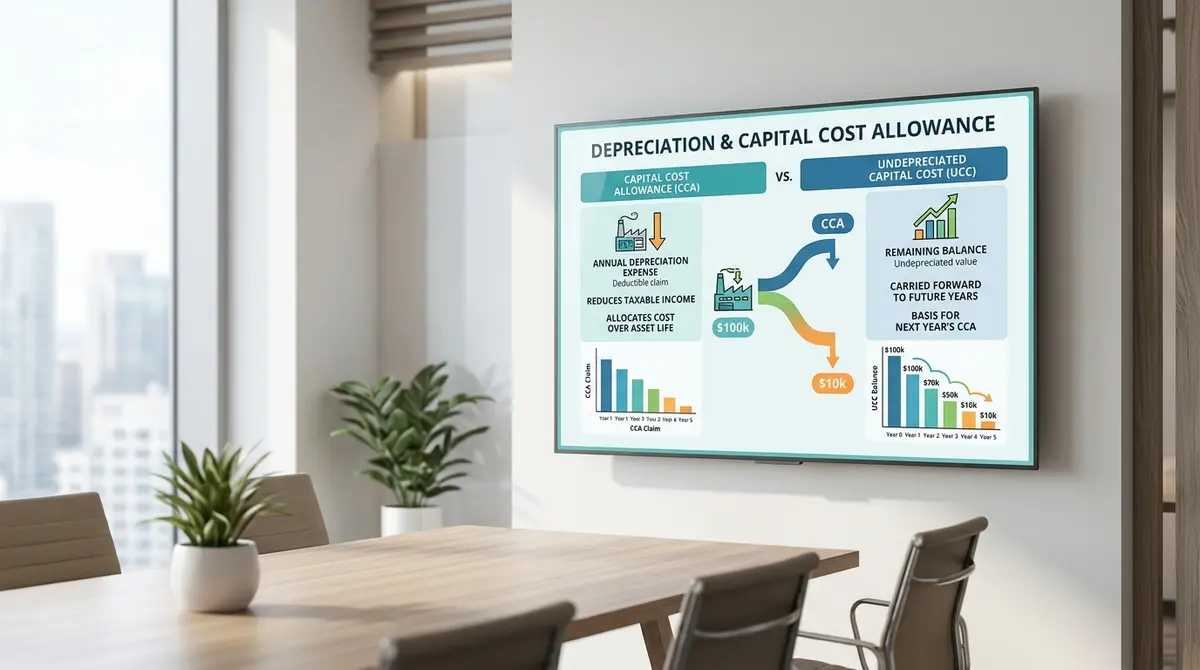
When managing an income-producing property, you have the option to claim Capital Cost Allowance (CCA), which is essentially depreciation for tax purposes. Claiming CCA allows you to deduct a percentage of the building’s value from your rental income each year, reducing your immediate tax burden.
However, this strategy carries a significant caveat known as “recapture.” When you claim CCA, you lower your property’s Undepreciated Capital Cost (UCC). If you eventually sell the property for more than its UCC, the CRA requires you to add all previously claimed CCA back into your taxable income for the year of the sale. This recapture is taxed at your full marginal tax rate, not the favorable capital gains rate.
Because of the recapture rules, many financial advisors recommend against claiming CCA on residential real estate that is expected to appreciate in value. Instead, investors often focus on paying down your principal balance and relying on natural market appreciation.
Advanced Wealth Strategies: The Smith Manoeuvre
For financially savvy homeowners, leveraging equity isn’t just about accessing cash; it’s about optimizing tax efficiency. One popular Canadian strategy is the Smith Manoeuvre. This involves converting the non-deductible interest of a primary residential mortgage into deductible investment interest.
Here is how it works in practice: As you pay down the principal on your primary mortgage, you simultaneously borrow that exact amount back through a readvanceable line of credit. You then invest those borrowed funds into income-producing assets (like dividend stocks or a rental property). Because the newly borrowed funds are used for investment purposes, the interest becomes tax-deductible. Over time, this strategy effectively makes your entire mortgage interest tax-deductible, accelerating wealth creation.
However, this strategy requires strict discipline and an understanding of interest compounding effects. If the investments perform poorly, you are still liable for the debt, and the Bank of Canada‘s fluctuating interest rates can drastically alter the math behind this maneuver.
Leveraging Equity for Entrepreneurial Ventures
Alberta has a robust entrepreneurial spirit, and many business owners use residential equity to fund commercial operations. Whether you are exploring alternative documentation financing to bypass strict bank requirements or seeking business equity leverage for a logistics company, the tax rules remain consistent: if the funds are used for business operations, the interest is deductible.
For example, if a homeowner borrows $75,000 against their house to purchase inventory for a retail business, the interest on that $75,000 is written off as a business expense. This is often much more cost-effective than taking out high-interest unsecured business loans. Similarly, professionals can use equity for funding professional development, provided the education directly increases their earning capacity in a taxable business.
Common Compliance Traps to Avoid
The most common mistake homeowners make when leveraging equity is commingling funds. If you take out a $100,000 equity loan, deposit it into your personal checking account, buy $50,000 worth of stocks, and use the rest for groceries and a vacation, the CRA may disallow the entire interest deduction due to the inability to clearly trace the funds.
To maintain compliance, always use dedicated accounts. If you borrow for an investment, transfer the funds directly from the loan account to the investment or business account. Never mix these funds with your daily operating cash. Furthermore, when comparing refinancing alternatives, ensure that any new loan structure maintains the clear separation of deductible and non-deductible debt.
Conclusion
Understanding the tax implications of borrowing against your residential assets in Alberta is essential for preserving your wealth. From navigating the 2026 capital gains inclusion rates to mastering the tracing principle for interest deductibility, strategic planning can save you tens of thousands of dollars. Whether you are funding a new rental property, expanding a business, or simply restructuring your debt, maintaining pristine records and consulting with tax professionals will ensure you remain compliant with CRA regulations while maximizing your financial leverage.
If you are ready to explore your equity options and need guidance tailored to your specific financial situation, get in touch with our team today for a comprehensive strategy session.
Frequently Asked Questions (FAQ)
Can I deduct the interest on a loan secured by my primary residence?
You can only deduct the interest if the borrowed funds are used to generate taxable income, such as investing in a business or buying a rental property. If the funds are used for personal expenses, the interest is not deductible, regardless of the collateral used.
How do the 2026 capital gains rules affect real estate investors?
For individuals, the first $250,000 of capital gains in a year is taxed at a 50% inclusion rate. Any capital gains exceeding $250,000 are subject to a higher 66.67% inclusion rate, making it crucial to stagger property sales when possible.
What happens if I rent out a portion of my primary home?
If you rent out a portion of your home, you can still claim the Principal Residence Exemption on the entire property provided the rental use is ancillary, you make no structural changes to accommodate the rental, and you do not claim Capital Cost Allowance (CCA) on the property.
Does renovating a rental property lower my future taxes?
Yes, major capital improvements (like adding a new roof or an extension) increase your property’s Adjusted Cost Base (ACB). A higher ACB reduces the total taxable capital gain when you eventually sell the property.
What is the Smith Manoeuvre?
The Smith Manoeuvre is a legal tax strategy in Canada where a homeowner uses a readvanceable mortgage to convert non-deductible personal mortgage debt into tax-deductible investment debt by continuously borrowing against paid-down equity to invest.
Why is commingling funds a problem for the CRA?
The CRA requires a clear paper trail to prove that borrowed money was used for income-producing purposes. If you mix investment loan funds with personal cash in the same bank account, it becomes impossible to trace the exact use of funds, often resulting in denied tax deductions.