Recent arrivals to Alberta can successfully access secondary financing by leveraging the accumulated equity in their properties, even if they possess a limited domestic credit history. Rather than relying exclusively on traditional credit scores, alternative lenders focus primarily on the Loan-to-Value (LTV) ratio, typically requiring homeowners to maintain at least 20% to 25% equity in their property to qualify for a subordinate loan.
Key Takeaways
- Equity is King: Alternative lenders prioritize property value over credit history, requiring a maximum LTV of 75% to 80%.
- Alternative Documentation: Newcomers can use foreign income verification, global asset statements, and stated income programs to qualify.
- Credit Flexibility: A “thin” Canadian credit file is not an automatic disqualifier; lenders look at overall financial behavior and global assets.
- Speed of Funding: Private and alternative lending solutions can often be processed and funded within 7 to 14 days.
- Strategic Use: Funds are commonly used by new arrivals for business investments, family sponsorship costs, or debt consolidation.
The 2026 Landscape of Home Equity for Recent Arrivals in Alberta
Calgary’s demographic and economic landscape has evolved significantly. According to 2026 projections from Statistics Canada, the Calgary metropolitan area continues to welcome tens of thousands of new permanent residents annually. These newcomers account for nearly 32% of all new household formations in the province. Many of these individuals arrive with substantial global wealth and quickly purchase real estate, yet they find themselves marginalized by traditional banking institutions when attempting to access their property’s equity.
Traditional banks operate on rigid underwriting algorithms that heavily weight domestic credit history. Research from the Canada Mortgage and Housing Corporation (CMHC) indicates that “A” lenders reject approximately 68% of secondary financing applications from individuals with less than two years of established Canadian credit. This creates a frustrating paradox: a homeowner might possess $200,000 in accessible property equity but cannot borrow against it through conventional channels.
“Newcomers often possess substantial global wealth but lack the localized credit footprint traditional institutions demand. Alternative equity financing bridges this critical gap,” says Dr. Elena Rostova, Senior Economist at the Alberta Real Estate Institute. This shift has led to a robust alternative lending market tailored specifically to the needs of recent immigrants.

Overcoming the “Thin Credit” Hurdle
In the Canadian financial system, a “thin credit” file refers to a credit report with fewer than three active trade lines or a history spanning less than 24 months. The Financial Consumer Agency of Canada (FCAC) notes that building a robust credit profile takes time, regardless of an individual’s actual net worth or income level.
When applying for a subordinate lien, traditional lenders view a thin file as high risk. However, alternative and private lenders assess risk differently. They utilize equity-based lending models. If a borrower defaults, the lender’s security is the physical property itself. Therefore, the appraisal and the mathematical calculation of the Loan-to-Value (LTV) ratio take precedence over the Equifax or TransUnion score.
Furthermore, alternative lenders are more forgiving of recent credit checks. If you have been shopping around for a car loan or a primary mortgage, you might have multiple hard inquiries on your report. Understanding the nuances of explaining credit inquiries to lenders is a crucial step in presenting a strong application, as private lenders will listen to the context behind the data.
Key Requirements for Secondary Financing
While credit scores are less critical, securing a subordinate loan still requires meeting specific criteria. Lenders need to ensure the investment is secure and that the borrower has a realistic exit strategy.
- Sufficient Property Equity: This is the non-negotiable foundation. In 2026, most alternative lenders cap their maximum LTV at 75% to 80%. For example, if your Calgary home is appraised at $600,000, the total of all mortgages against the property cannot exceed $480,000 (80% LTV).
- Professional Property Appraisal: Because the property is the primary security, lenders require an independent, current appraisal. Appraisal costs in the Calgary metro area currently average between $350 and $500.
- Demonstrable Income: Even in equity-based lending, you must prove you can service the monthly interest payments. This is where alternative documentation for secondary financing becomes vital. Lenders may accept bank statements showing consistent deposits rather than standard T4 tax slips.
- Clear Title: The property must not have outstanding property tax arrears or unexpected builder’s liens, as these take precedence over mortgage registrations.
Traditional Banks vs. Alternative Lenders
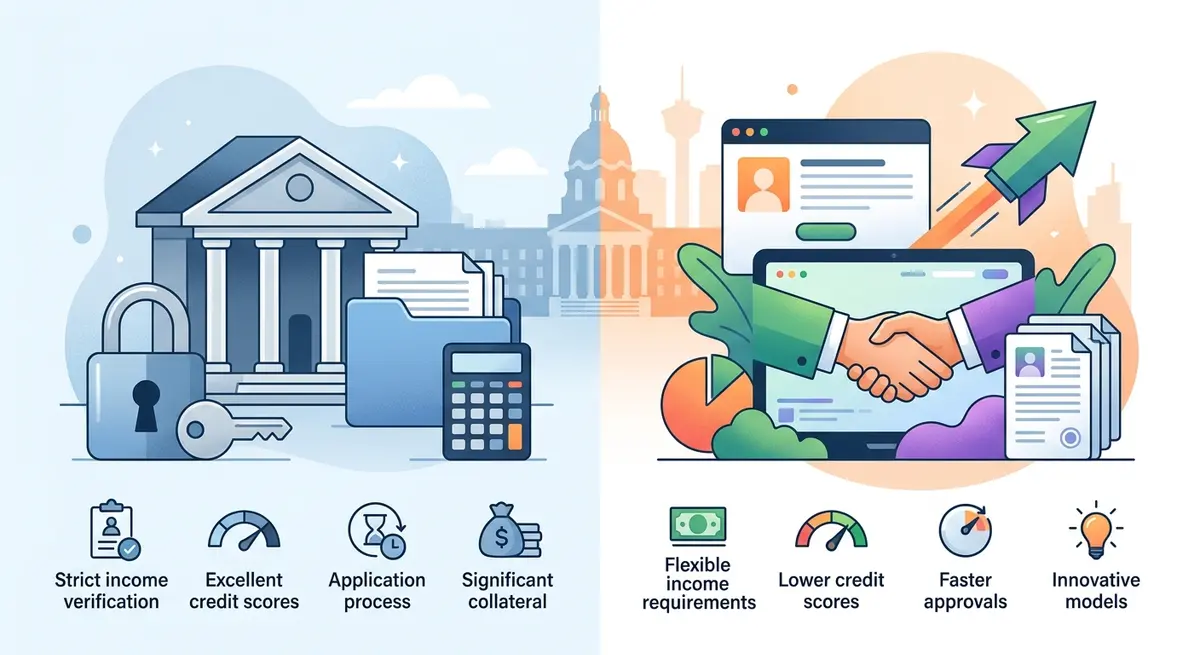
Understanding the difference between lending tiers is essential for new arrivals navigating the Canadian financial ecosystem. Below is a comparison of how different institutions handle secondary financing requests from recent immigrants.
| Feature | Traditional Banks (A-Lenders) | Alternative/Private Lenders |
|---|---|---|
| Credit Score Requirement | Strict (Typically 680+) | Flexible (Often no minimum if equity is high) |
| Canadian Credit History | Minimum 2 years required | Not strictly required |
| Income Verification | Standard T4s, Notice of Assessment | Bank statements, foreign income, stated income |
| Processing Time | 3 to 6 weeks | 7 to 14 days |
| Interest Rates (2026 Average) | Prime + 1% to 3% | 8.5% to 12.9% |
Documenting Your Income and Assets
One of the largest hurdles for recent immigrants is proving income, especially for those who are self-employed or continuing to manage businesses in their home countries. Traditional lenders rely heavily on the Canada Revenue Agency’s Notice of Assessment (NOA). If you have only filed taxes in Canada for one year, your NOA will not reflect your true earning capacity.
“The 2026 lending environment requires a nuanced approach to risk assessment. We look at the asset’s value and the borrower’s global financial behavior, not just a three-digit Canadian score,” explains Marcus Thorne, Director of Underwriting at Prairie Alternative Capital.
To navigate this, borrowers must focus on organizing your mortgage paperwork meticulously. Alternative lenders will often accept 6 to 12 months of business bank statements to demonstrate cash flow. This is particularly useful when verifying self-employed income. Additionally, providing statements of foreign investment accounts, overseas property deeds, or international pension incomes can significantly strengthen an application by proving global net worth.
Leveraging Equity for Financial Growth
Why do new arrivals seek out subordinate financing despite the higher interest rates associated with alternative lenders? The answer lies in opportunity cost and strategic financial planning. According to recent economic data, immigrants invest 40% more in small businesses within their first five years compared to native-born citizens.
Many newcomers utilize these funds for entrepreneurial ventures. For instance, securing retail inventory financing via home equity is often much cheaper and more accessible than applying for an unsecured commercial loan as a new business owner.
Other common uses include debt consolidation. Moving expenses, settlement costs, and initial living expenses often result in high-interest credit card debt. Consolidating this debt into a single, lower-interest mortgage payment can drastically improve monthly cash flow. Finally, many use these funds to cover the substantial legal and administrative costs associated with sponsoring family members for Canadian immigration.
Common Pitfalls to Avoid
While accessing home equity can be a powerful financial tool, it carries inherent risks that must be managed carefully. The most significant risk is the cost of borrowing. Alternative lending rates are higher than prime mortgage rates, reflecting the increased risk the lender assumes by taking a subordinate position on the property title.
Borrowers must pay close attention to the terms of the contract. “Leveraging property equity allows recent immigrants to bypass the punitive unsecured lending rates that often trap new arrivals in cycles of debt, but only if they understand the math behind the loan,” notes Sarah Jenkins, Financial Literacy Advocate for the New Canadian Financial Alliance.
It is crucial to understand how compounding frequency increases debt. A loan that compounds monthly will cost significantly more over its term than one that compounds semi-annually, even if the advertised interest rate is identical. Furthermore, borrowers should be wary of excessive broker fees, hidden renewal fees, and harsh prepayment penalties. Always have a qualified real estate lawyer review the commitment letter before signing.
The Role of Guarantors and Co-Signers
If a newcomer’s income or equity falls slightly short of a lender’s requirements, bringing in a co-signer or guarantor can bridge the gap. A guarantor is someone who guarantees the loan will be paid but does not necessarily have an ownership stake in the property.
For younger immigrants or those who have family already established in Canada, using a parent as a guarantor is a highly effective strategy. The established family member’s robust Canadian credit history and income can secure a lower interest rate and better terms for the primary borrower. However, all parties must understand that the guarantor is legally liable for the debt if the primary borrower defaults.
Step-by-Step Application Process
Navigating the application process efficiently requires a systematic approach. Here is the recommended step-by-step process for 2026:
- Calculate Available Equity: Estimate your home’s current market value and subtract your primary mortgage balance. Multiply the home’s value by 0.80 (80% LTV) to find the maximum total debt lenders will allow.
- Compile Alternative Documentation: Gather 12 months of bank statements, proof of foreign assets, employment letters, and any documentation proving consistent cash flow.
- Engage a Specialized Broker: Work with a mortgage broker who specializes in alternative lending and newcomer programs. They have direct access to private lending pools that do not advertise to the public.
- Order the Appraisal: Once a lender shows preliminary interest, they will order an appraisal through an approved third-party appraiser to confirm the property’s value.
- Legal Review and Funding: Upon approval, the lender will issue a commitment letter. You must take this to your real estate lawyer for independent legal advice. Once signed, the lawyer registers the subordinate lien on the property title, and funds are disbursed.
Frequently Asked Questions (FAQ)
Can I get a subordinate loan if I have only been in Canada for six months?
Yes, provided you own property in Alberta with sufficient equity (typically 20% or more). Alternative lenders focus on the asset’s value rather than the length of your Canadian residency or credit history.
Will my foreign credit score help me qualify in Calgary?
Canadian lenders generally cannot directly use foreign credit scores (like a US FICO score or UK Experian report) for automated underwriting. However, private lenders may review them manually as character references to support your application.
What is the maximum amount I can borrow against my home?
In 2026, most alternative lenders will allow you to borrow up to a combined Loan-to-Value (LTV) of 80%. This means your primary mortgage plus the new loan cannot exceed 80% of the home’s appraised value.
Do I need a permanent resident (PR) card to qualify?
While PR status makes the process easier and opens up more lending options, many private lenders will extend financing to individuals on work visas, provided the property equity is substantial and the legal title is clear.
How long does the approval process take for alternative financing?
Unlike traditional banks that can take over a month, private and alternative lenders can often appraise the property, approve the loan, and disburse funds within 7 to 14 business days.
Can I use the funds to start a business in Alberta?
Absolutely. Lenders place very few restrictions on how you use the equity. Funding business startups, purchasing inventory, or investing in commercial ventures are among the most common uses for these funds.
Conclusion
Securing secondary financing as a new Canadian or recent immigrant in Calgary requires navigating a financial system that inherently favors long-term domestic credit history. However, by understanding the power of your property’s equity, utilizing alternative documentation, and partnering with lenders who look beyond the traditional credit score, you can successfully access the capital you need. Whether you are looking to consolidate settlement debt, fund a new business venture, or support family members, your home’s equity is a powerful tool for establishing your financial foundation in Alberta.
If you are a recent arrival struggling to access your property’s equity due to a thin credit file, you do not have to navigate this complex landscape alone. Contact us today to speak with our alternative lending specialists and discover the financing options available to you.