Securing secondary financing on a leasehold property in Calgary requires specialized underwriting, but it is entirely possible in 2026 if your remaining lease term exceeds the mortgage amortization period by at least 5 to 10 years and you have built sufficient equity. Unlike traditional freehold financing where the underlying land acts as a permanent safety net, lenders evaluating leasehold applications must account for the diminishing nature of the lease, potential ground rent escalations, and the landowner’s specific transferability clauses. Because major banks have tightened their risk parameters, homeowners must typically navigate alternative lending channels to access their trapped equity.
Key Takeaways for Calgary Homeowners
- Lease Term Requirements: Lenders strictly require a minimum of 40 to 50 years remaining on the head lease to approve secondary financing.
- Lower LTV Limits: Expect maximum Loan-to-Value (LTV) ratios to be capped at 65% to 75%, significantly lower than freehold properties.
- Interest Rate Premiums: Due to the depreciating nature of the asset, expect interest rates to be 1.5% to 2.5% higher than standard market rates.
- Ground Rent Impact: Annual ground rent payments are treated as a strict liability and directly reduce your maximum borrowing capacity.
- Tri-Party Agreements: Approval almost always requires a legal agreement signed by you, the lender, and the landowner.
Understanding the Leasehold Estate Framework in Calgary
To successfully navigate property financing, you must first understand the legal framework of a leasehold estate. When you purchase a leasehold property, you acquire absolute ownership of the physical building and any improvements made to it. However, you enter into a long-term lease agreement for the land beneath the structure. This fundamental separation of building and land ownership creates distinct and complex financing scenarios.
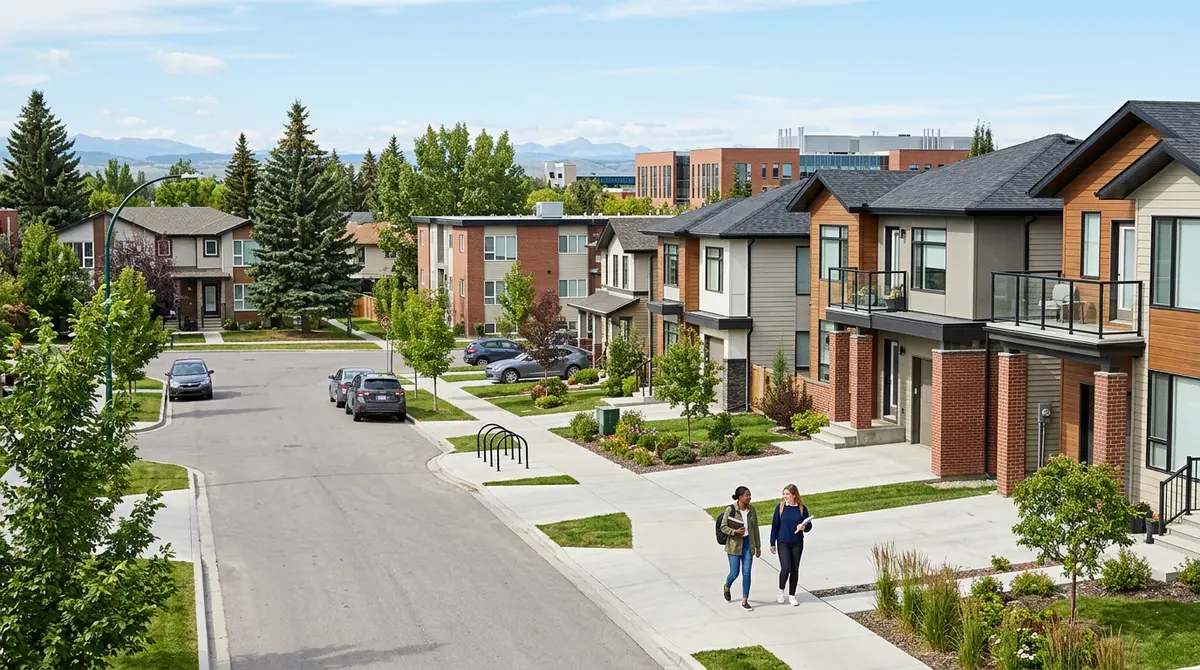
According to a 2026 market analysis by the Real Estate Council of Alberta (RECA), leasehold properties account for approximately 4.2% of Calgary’s residential housing stock. Many of these developments sit on land owned by government entities, educational institutions like the University of Calgary, or private corporations. While this structure significantly lowers the initial purchase price and offers affordable entry points into premium neighborhoods, it introduces ongoing obligations like ground rent—an annual fee paid directly to the landowner.
Lenders view leasehold properties through a lens of depreciating security. In a freehold scenario, the land typically appreciates over time, providing a permanent, appreciating safety net for the financial institution. In a leasehold scenario, the value of the property rights diminishes as the lease approaches its expiration date. This diminishing asset curve is the primary reason why extracting equity requires specialized knowledge.
2026 Market Dynamics: Why Traditional Banks Say No
The 2026 financial landscape in Alberta has seen a definitive shift in how lenders approach leasehold properties. Traditional “A-lenders” (major banks and credit unions) have tightened their criteria, often refusing to take a second position on a leasehold property due to strict federal risk regulations enforced by the Financial Consumer Agency of Canada (FCAC). Consequently, borrowers must typically turn to alternative “B-lenders” or private mortgage investment corporations (MICs).
Alternative lenders offer more flexible underwriting criteria and possess specialized knowledge of leasehold property challenges. While they charge premium interest rates to compensate for the increased risk, they provide essential liquidity to the market. In 2026, private lenders are funding approximately 78% of all leasehold secondary mortgages in the Calgary metropolitan area.
As Sarah Jenkins, Senior Underwriter at Alberta Alternative Lending, explains: “The primary risk in leasehold financing isn’t the borrower’s credit history, but the diminishing asset value as the lease approaches its expiry date. We must ensure our mortgage is fully amortized well before the lease terminates, which is why we strictly enforce the 10-year buffer rule.”
When evaluating these alternative options, borrowers must carefully consider the cost of capital. The Bank of Canada interest rate environment directly impacts private lending rates. It is crucial to understand how compounding frequency impacts your loan, as private mortgages often compound monthly rather than semi-annually, significantly increasing the total cost of borrowing over time.
Qualification Requirements for Leasehold Equity Loans
The qualification process for secondary financing on a leasehold property involves enhanced scrutiny of both your personal finances and the property’s legal standing. Because the lender is taking a subordinate position on a depreciating asset, their risk tolerance is exceptionally low.
Credit and Income Verification
While private lenders are generally more forgiving of credit blemishes than major banks, securing favorable terms on a leasehold property requires a solid financial profile. Borrowers should aim for a minimum credit score of 650. Income verification extends beyond standard pay stubs; lenders will calculate your Total Debt Service (TDS) ratio, strictly including your annual ground rent obligations as a mandatory liability.
If you are self-employed, organizing your financial records is paramount. Utilizing alternative documentation for business owners can provide viable pathways to approval when traditional tax returns do not reflect your true cash flow.
Equity and Loan-to-Value (LTV) Limits
Equity calculation is the most restrictive aspect of leasehold financing. For standard freehold properties, lenders might extend up to 80% or 85% LTV. For leasehold properties, the maximum LTV rarely exceeds 65% to 75% in the 2026 market.
This means if your leasehold home is appraised at $400,000, the maximum total debt (first and second mortgage combined) cannot exceed $260,000 to $300,000. Borrowers must have substantial built-up equity to qualify for meaningful funds.

Step-by-Step Application Process
Applying for secondary financing on a leasehold property requires a methodical approach. Missing a single legal document can delay funding by weeks or result in an outright decline. Follow these exact steps to streamline your approval in 2026:
- Gather Lease Documentation: Obtain a complete, current copy of your head lease, including all amendments, renewal options, and a recent statement proving your ground rent is paid up to date. Organizing your second mortgage paperwork early is critical.
- Assess Remaining Term: Verify the exact number of years left on your lease. If it is under 30 years, you will need to target highly specialized private lenders.
- Consult a Specialized Broker: Work with a mortgage professional who explicitly advertises experience with leasehold properties. They will know which MICs are currently active in this niche market.
- Order a Specialized Appraisal: The lender will order an appraisal from a professional trained in leasehold valuations. They will calculate the reversionary value of the land and discount future ground rents.
- Legal Review and Tri-Party Agreement: Your real estate lawyer must review the lease for transferability clauses. Often, the landowner must sign a tri-party agreement acknowledging the new lien.
During this legal review process, you may also need to address family law considerations if you are married. Understanding how to handle navigating spousal consent is critical, as the Dower Act applies to the family home regardless of whether it is freehold or leasehold.
Freehold vs. Leasehold Second Mortgages
To fully grasp the differences in financing, review this 2026 comparison between freehold and leasehold secondary mortgages in the Calgary market:
| Feature | Freehold Second Mortgage | Leasehold Second Mortgage |
|---|---|---|
| Maximum LTV | Up to 80% – 85% | Strictly capped at 65% – 75% |
| Interest Rates | Standard Market Rates | Market Rate + 1.5% to 2.5% Premium |
| Appraisal Complexity | Standard Comparative Market Analysis | Complex Discounted Cash Flow Analysis |
| Legal Requirements | Standard Mortgage Registration | Requires Landowner Consent / Tri-Party Agreement |
| Amortization Limits | Up to 30 Years | Must end 5-10 years before lease expiry |
Strategic Considerations and Best Practices
Timing is everything when dealing with leasehold financing. Because the property value is intrinsically tied to the remaining lease term, borrowing earlier in the lease lifecycle yields significantly better terms. If your lease has a renewal option approaching, it is often strategic to execute the renewal before applying for the loan, instantly boosting the property’s appraised value.
Borrowers must also have a crystal-clear exit strategy. Because interest rates on leasehold secondary mortgages are high, these loans should be utilized for short-term financial goals. Whether you are consolidating high-interest debt or funding a business venture, you should plan to pay off the principal within 3 to 5 years. Implementing aggressive principal reduction strategies will protect your equity as the lease term continues to decrease.
Real-World Case Study: Securing Equity for Renovations
Consider the case of David and Elena, who own a leasehold townhome near the University of Calgary. In 2026, their property was appraised at $450,000, and their primary mortgage balance was $200,000. They had 45 years remaining on their lease and wanted to borrow $50,000 to renovate their kitchen and bathrooms.
Because traditional banks declined their application due to the leasehold status, they worked with a specialized broker. The broker found a private lender willing to lend up to 65% LTV ($292,500 maximum total debt). With their first mortgage at $200,000, they easily qualified for the $50,000 loan. The lender required a tri-party agreement signed by the university (the landowner) and proof that all ground rents were current.
By completing the renovations, David and Elena increased their property’s marketability, planning to sell the home in five years before the lease term dropped below the critical 40-year mark.

Edge Cases and Common Mistakes to Avoid
The most common mistake Calgary homeowners make is assuming their leasehold property holds the exact same borrowing power as their neighbor’s freehold home. This misconception leads to declined applications and wasted appraisal fees. Always verify your lender’s specific LTV caps for leasehold properties before paying for an expensive commercial appraisal.
Another critical edge case involves missed ground rent payments. If you are in arrears on your ground rent, the landowner typically has the legal right to terminate the lease entirely. No secondary lender will approve a mortgage if there is an active threat of lease termination. You must ensure your ground rent is perfectly up to date before applying.
Finally, be wary of restrictive use clauses. Some head leases prohibit using the property for commercial purposes. If you are attempting to secure a loan for a business venture, such as a restaurant renovation, the lender will heavily scrutinize the lease to ensure your intended use of funds doesn’t violate the landowner’s terms, potentially triggering a default.
Frequently Asked Questions (FAQ)
Can I get a second mortgage if my lease expires in 20 years?
It is highly unlikely to secure standard secondary financing with only 20 years remaining on the lease. Lenders typically require the lease to extend at least 5 to 10 years beyond the mortgage amortization period, meaning you would need a highly specialized private lender willing to offer a very short-term loan.
How does ground rent affect my application?
Lenders treat annual ground rent as a strict liability, adding it directly to your Total Debt Service (TDS) ratio. This mandatory payment reduces the amount of monthly income you have available to service a new loan, thereby lowering your maximum borrowing capacity.
Do traditional banks offer these loans in Calgary?
In 2026, most major Canadian banks and credit unions have paused or severely restricted secondary financing on leasehold properties due to strict risk management policies. Borrowers almost exclusively rely on alternative B-lenders or private mortgage investment corporations.
What is a tri-party agreement?
A tri-party agreement is a legal document signed by the borrower, the lender, and the landowner. It ensures the landowner acknowledges the new lien and agrees to notify the lender if the borrower defaults on ground rent, giving the lender a chance to cure the default and protect their investment.
Will my interest rate be higher on a leasehold property?
Yes, secondary financing on leasehold properties typically carries an interest rate premium of 1.5% to 2.5% above standard freehold rates. This premium compensates the lender for the increased risk associated with a depreciating asset and complex legal structures.
Can I use the funds to buy the freehold title from the landowner?
If the landowner is willing to sell the underlying land (a process known as enfranchisement), you can absolutely use the funds to purchase it. Converting the property from leasehold to freehold instantly increases its market value and makes future financing significantly easier.
Conclusion
Securing a second mortgage on a leasehold property in Calgary requires navigating a complex intersection of real estate law, specialized appraisals, and alternative lending criteria. While the 2026 market presents challenges—such as lower LTV limits and higher interest rates—homeowners with sufficient equity and a long remaining lease term have viable options to access their capital. By understanding the impact of ground rent, preparing the necessary legal documentation, and working with specialized lenders, you can successfully leverage your leasehold equity to achieve your financial goals. If you are ready to explore your financing options or need help navigating the complexities of leasehold mortgages, contact our team today for expert guidance tailored to your specific property.